Pratibhuti: Collateral and Security Principles
When Dharma Protected Both Borrower and Lender
How ancient India created sophisticated collateral systems that balanced creditor protection with debtor dignity, limiting interest rates, prohibiting seizure of essential tools, and embedding ethics into the debt relationship in ways modern finance is still learning.
The Weaver's Dilemma
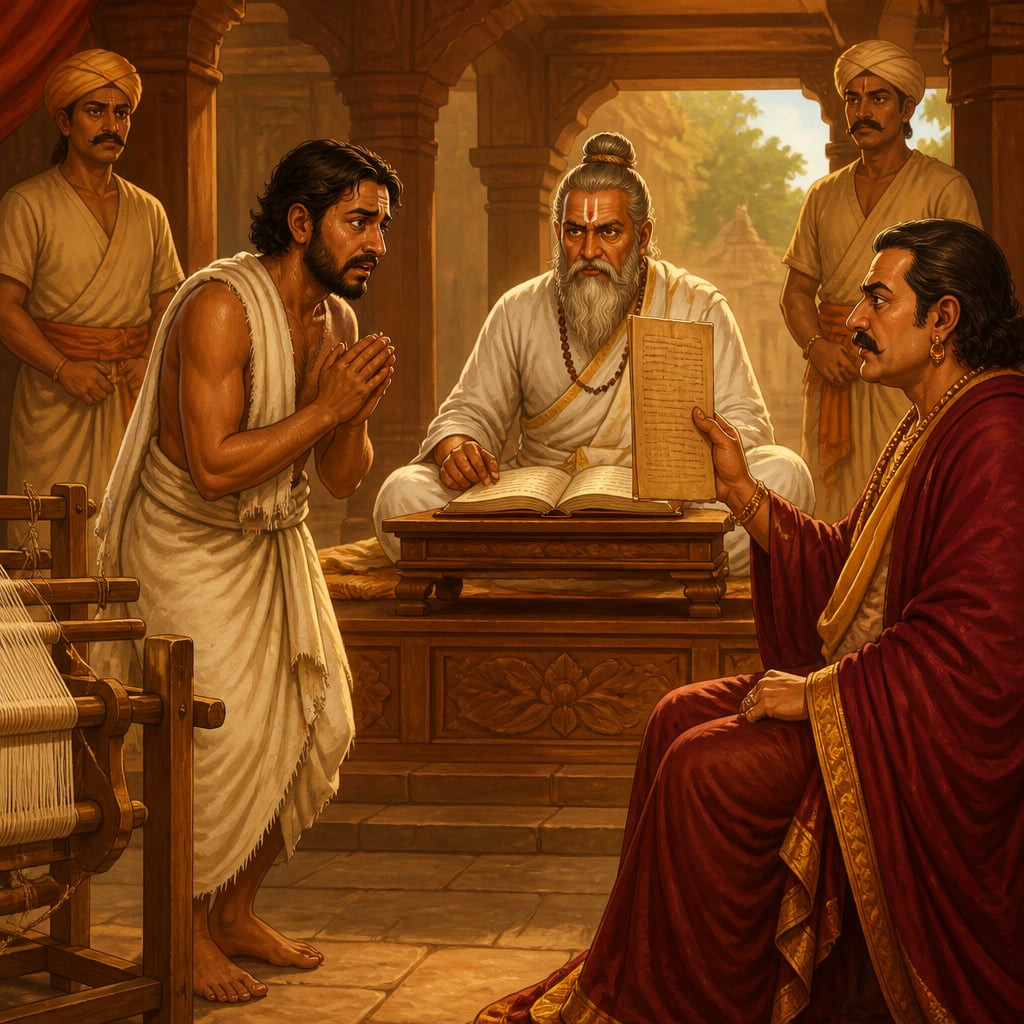
The weaver Vishvakarman stood before the sabha (assembly) in Ujjain, his hands trembling. For three generations, his family had produced the finest cotton cloth in the city, fabric that traveled to distant Rome and fetched prices that made merchants wealthy. But this year, the monsoon had failed. His cotton supply had tripled in price. His customers, facing their own difficulties, had delayed payments. And now the moneylender Dhanadhipa was demanding his due.
"He pledged his loom," Dhanadhipa argued, holding up the loan document. "Three months have passed. The debt is unpaid. The loom is mine by right."
The presiding judge, trained in the Katyayana Smriti, studied the document carefully. Then he asked a question that would change everything:
"Dhanadhipa, what interest rate did you charge?"
"Fifteen panas per hundred per month," the moneylender replied, fifteen percent monthly, or 180% annually.
The judge's expression hardened. He reached for the Smriti text.
"Dvikam trikam caturbhāgam pañcakam ṣaṭkam eva ca | māsavṛddhir yathāvarṇaṃ na cātaḥ param ādiśet ||" "Interest of two, three, four, five, or six percent per month according to varna, nothing beyond this should be prescribed."
The judge turned to Dhanadhipa. "You charged more than twice the lawful limit. But there is a greater problem."
He looked at Vishvakarman. "A weaver's loom is his jīvikā-upakāraṇa, his instrument of livelihood. The Smriti forbids its seizure. A creditor may take land, may take savings, may take luxuries. But he may not take the tools by which a debtor feeds his family."
The judgment followed ancient principle: the debt was reduced by the excess interest already paid. The loom remained with the weaver. And Dhanadhipa learned that in a dharmic economy, profit had limits.
The Architecture of Ancient Collateral Law
The Dharmashastra texts devoted remarkable attention to pratibhūti (security/collateral) and ṛṇa (debt), recognizing that credit is essential for commerce but dangerous when unregulated. Their framework balanced three concerns:
1. Protecting the Creditor's Legitimate Interest
Lenders deserved security for their capital. The Katyayana Smriti (c. 400-600 CE) recognized multiple forms of collateral:
- Immovable property (sthāvara): Land, buildings, wells, the most secure form
- Movable property (jaṅgama): Goods, jewelry, livestock
- Personal surety (pratibhū): A third party guaranteeing repayment
- Document (lekhya): Written acknowledgment creating legal obligation
Creditors could choose their security level. Higher-risk loans (unsecured, or secured only by document) justified higher interest. Lower-risk loans (secured by land or personal surety from a respected person) commanded lower rates.
2. Protecting the Debtor's Dignity and Livelihood
This is where ancient Indian law distinguished itself. While creditors had rights, debtors had protections that modern bankruptcy law is only beginning to recognize:
Essential tools were exempt from seizure:
"Jīvikopakāraṇāni ca na haret" "The instruments of livelihood should not be seized."

A farmer's plough, a craftsman's tools, a musician's instruments, a scholar's books, these could never be taken as collateral or seized for debt. The logic was clear: if you destroy someone's ability to earn, you destroy their ability to repay. Seizing livelihood tools was economically stupid and dharmic violation.
Certain categories received special protection:
- Women's strīdhana (personal property) could not be seized for a husband's debts
- Minors' inheritance was protected from parental creditors
- Religious endowments and charitable trusts were exempt
- Essential household items (cooking vessels, beds) were unseizable
3. Limiting Exploitation Through Interest Caps
The Smritis prescribed maximum interest rates that varied by:
| Borrower Category | Monthly Limit | Annual Equivalent |
|---|---|---|
| Brahmin | 2% | 24% |
| Kshatriya | 3% | 36% |
| Vaishya | 4% | 48% |
| Shudra | 5% | 60% |
| Secured loans | Lower rates | Varies by security |
These weren't arbitrary, they reflected risk assessment. Brahmins, with temple connections and community standing, were lower credit risks. The variation also reflected earning capacity and alternative options.
More remarkably, the Smritis established the principle of damdupat, that accumulated interest could never exceed the principal:
"Na kālanetā vṛddhiḥ pūrayedadhikaṃ dhanāt | mūlyam eva gṛhṇīyāt dviṃ vā triṃ vā yathāvidhi ||" "Interest accumulating over time should not exceed the principal. One may take double or triple at most, according to rule."
This prevented debt spirals where compound interest grew beyond any possibility of repayment, a problem that still plagues modern microfinance.
Global Perspectives on Usury and Collateral
Jeremy Bentham (1748-1832), the English philosopher and legal reformer, wrote "Defence of Usury" (1787), a landmark argument against interest rate caps. Bentham contended that usury laws harmed the very people they intended to protect: by limiting legal interest rates, they pushed high-risk borrowers toward illegal lenders charging even higher rates. Let the market determine interest, Bentham argued, and rates will find their efficient level.
Katyayana would have disagreed, but with nuance. The Smriti system recognized that different borrowers warranted different rates (a form of risk-based pricing Bentham would approve). But it insisted on absolute limits because markets, left unchecked, would produce predatory outcomes. The debtor in desperate need cannot bargain freely; the moneylender with monopoly power will extract maximum rent. Some limits are necessary to prevent exploitation.
Adam Smith (1723-1790), often cited as the apostle of free markets, actually supported modest usury laws. In "The Wealth of Nations" (1776), Smith argued that without interest limits, capital would flow to "prodigals and projectors", risky borrowers willing to pay any rate, rather than productive enterprise. A ceiling slightly above market rates would channel capital toward legitimate commerce.
Smith's position aligns surprisingly well with Katyayana's. Both recognized that completely free credit markets could produce dysfunctional outcomes. The question was where to set limits, not whether limits should exist.
The Islamic tradition (developing 200+ years after the Smritis) prohibited riba (usury/interest) entirely, developing alternative structures, mudarabah (profit-sharing), murabaha (cost-plus sale), that achieved similar economic functions without explicit interest. Indian and Islamic merchants traded extensively, and their credit practices showed mutual influence.
| Thinker | Period | Position on Interest | Katyayana Comparison |
|---|---|---|---|
| Jeremy Bentham | 1787 | Against all limits | Disagrees, limits prevent exploitation |
| Adam Smith | 1776 | Modest limits useful | Similar, limits channel capital productively |
| Islamic Jurisprudence | 700s+ | Prohibition with alternatives | Different mechanism, shared concern about exploitation |
The Ethics of Collateral Types
Return to Vishvakarman's case. Why did ancient law distinguish between pledging land versus pledging a loom?
The distinction reveals sophisticated economic reasoning:
Land can be lost without destroying earning capacity. A farmer who loses one field can work another, or become a laborer on the land he once owned. The loss is painful but not existentially threatening.
Tools cannot be lost without destroying earning capacity. A weaver without a loom cannot weave. A blacksmith without a forge cannot smith. Seizing these tools doesn't just transfer wealth, it destroys it. The creditor gains an object of limited value (what use is a specialized loom to a moneylender?), while the debtor loses everything.
Modern bankruptcy law has gradually recognized similar distinctions:
- Chapter 7 exemptions protect essential household items, tools of trade, and primary residence (up to limits)
- Wage garnishment limits prevent taking so much income that debtors cannot survive
- Student loans, which purchase human capital, receive special (and controversial) treatment
But ancient Indian law went further. It embedded these protections not in bankruptcy proceedings (after disaster) but in collateral formation (before lending). The loom was never valid collateral because it was never legitimately seizable. This prevented the predatory practice of lending against essential tools with the intention of seizure.
Modern Resonance: When the State Became the Lender

In 2015, the Government of India launched Pradhan Mantri Mudra Yojana (PMMY), commonly called "Mudra loans", to provide collateral-free credit to small entrepreneurs. The program explicitly addressed the ancient problem: creditworthy borrowers excluded from formal finance because they lacked acceptable collateral.
The Mudra framework created three categories:
| Category | Loan Limit | Target Borrower |
|---|---|---|
| Shishu | Up to ₹50,000 | Startup/nascent enterprises |
| Kishore | ₹50,000 - ₹5 lakh | Growing enterprises |
| Tarun | ₹5 lakh - ₹10 lakh | Established but scaling enterprises |
By 2024, Mudra had disbursed over ₹27 lakh crore (approximately $325 billion) across 47+ crore loan accounts. The average loan size, approximately ₹57,000, indicates genuine reach to small borrowers.
From a Dharmashastra perspective, Mudra represents the state assuming the pratibhū (guarantor) role that ancient guilds once played:
Collateral-free lending: Like the Smriti prohibition on seizing livelihood tools, Mudra recognizes that demanding traditional collateral excludes precisely those who most need credit. The enterprise itself, the borrower's skills, business plan, and character, serves as security.
Interest rate limits: Mudra loans carry capped interest rates (typically 10-12% annually), far below informal moneylender rates (often 36-120%). This echoes the Smriti's rate ceilings.
State as backstop: When borrowers default (approximately 3-5% NPAs in Mudra portfolio), losses are absorbed by public institutions rather than destroying individual borrowers. This is śreṇi-pratibhūti (guild guarantee) at national scale.
Critics note that Mudra loans show higher NPAs than traditional bank lending. Supporters respond that this is precisely the point, Mudra serves borrowers whom traditional banks reject. Some default is the price of inclusion. Katyayana would recognize the trade-off: protecting borrowers from exploitation versus protecting lenders from loss. The dharmic balance lies somewhere between.
The Debt Spiral Problem
The damdupat principle, that interest cannot exceed principal, addressed a problem that still devastates borrowers: compound interest growing beyond any possibility of repayment.
Consider a modern example: A borrower takes ₹10,000 at 3% monthly interest (36% annually, within informal lending range). If unable to pay:
| Year | Principal | Interest | Total Owed |
|---|---|---|---|
| 0 | ₹10,000 | - | ₹10,000 |
| 1 | ₹10,000 | ₹3,600 | ₹13,600 |
| 3 | ₹10,000 | ₹10,800 | ₹20,800 |
| 5 | ₹10,000 | ₹18,000 | ₹28,000 |
| 10 | ₹10,000 | ₹36,000 | ₹46,000 |
Without damdupat, debt becomes unpayable. Generational debt bondage, children working to pay parents' loans, was common where such limits didn't exist.
The Smriti solution was elegant: at most, you can owe double (or by some interpretations, triple) your original borrowing. This provides lender incentive to collect promptly rather than letting interest accumulate. It prevents the debt-slavery that unregulated lending produces.
Modern Indian law partially incorporates this principle. The Usurious Loans Act, 1918 (still in effect) allows courts to reopen "substantially unfair" loan transactions. The Insolvency and Bankruptcy Code, 2016 provides fresh-start mechanisms. But these operate after disaster; the Smriti approach prevented disaster by limiting how large debts could grow.
Your Turn: Debt as Dharmic Relationship
The Dharmashastra framers understood something that modern finance often forgets: debt is a relationship, not just a transaction. The creditor and debtor are bound by mutual obligations extending beyond the contract terms.
The creditor's dharma:
- Charge fair rates appropriate to risk and borrower capacity
- Respect essential exemptions, don't take what would destroy livelihood
- Pursue repayment with dignity, not humiliation
- Accept reasonable restructuring when circumstances change
The debtor's dharma:
- Borrow only what you can reasonably repay
- Use borrowed funds for stated purposes
- Prioritize repayment, ṛṇa-mukti (freedom from debt) is a life goal
- Communicate honestly when difficulties arise
When you next encounter credit, as borrower or lender, consider these dharmic dimensions:
- Is the interest rate fair for the risk involved, or exploitative?
- Is the collateral requirement reasonable, or designed to strip essential assets?
- Does the loan enable productive activity, or fund consumption that can't be repaid?
- Is there a relationship of mutual respect, or merely extraction?
The moneylenders of Ujjain faced a court that held them accountable. Modern borrowers often lack such protection. But understanding the ancient principles helps us recognize when debt relationships have become adharmic, and what dharmic alternatives might look like.
In our next lesson, we explore Sakshi-Dharma, the ethics of witnessing and documentation that made all these contractual relationships enforceable.
Gary Becker's Human Capital Theory (Nobel Prize 1992) established that skills and productive capacity are economic assets. Destroying human capital through excessive debt collection is economically inefficient, you destroy more value than you recover. Modern bankruptcy exemptions partially reflect this logic.
The Smriti approach was more radical: the exemption operated at collateral formation, not bankruptcy. You couldn't pledge your essential tools in the first place. This prevented predatory lending designed to seize livelihood assets. Modern 'ability to repay' regulations are moving toward similar preemptive protection.
RBI's 2022 digital lending guidelines require lenders to verify borrower income and existing obligations before lending, a modern expression of the ancient principle that loans shouldn't destroy earning capacity.
Hyman Minsky's Financial Instability Hypothesis identified how debt accumulation leads to crisis. Thomas Piketty's 'r > g' (return on capital exceeds growth) shows how debt compounds faster than ability to repay. Both support Katyayana's intuition that unchecked debt accumulation produces unsustainable outcomes.
Damdupat solved the problem with elegant simplicity: hard cap on total obligation. Modern alternatives (bankruptcy discharge, debt restructuring, forgiveness programs) operate after crisis. Damdupat prevented crisis by limiting how bad things could get. The lender knew from day one the maximum they could ever collect.
The microfinance crisis in Andhra Pradesh (2010) saw borrowers paying 50+ different lenders with aggregate interest exceeding 100% of original borrowing. Damdupat-style limits could have prevented the suicides and defaults that followed.
Key terms
- Pratibhūti
- Security, collateral, or surety; something pledged to guarantee repayment of a debt, or a person who guarantees another's obligation
- Damdupat
- The principle that accumulated interest cannot exceed the original principal; literally 'double the principal' as the maximum recoverable amount
- Jīvikopakāraṇa
- Instruments of livelihood; the tools, equipment, and essential items by which a person earns their living
- Ṛṇa-mukti
- Freedom from debt; the state of having discharged all financial obligations, considered a significant life achievement
Verses
द्विकं त्रिकं चतुर्भागं पञ्चकं षट्कमेव च | मासवृद्धिर्यथावर्णं न चातः परमादिशेत् ||
dvikam trikam caturbhāgam pañcakam ṣaṭkam eva ca | māsavṛddhir yathāvarṇaṃ na cātaḥ param ādiśet ||
Two, three, four, five, or six, let interest hold these bounds; beyond this ceiling, dharma frowns.
The graduated rate structure represents sophisticated risk-based pricing. Higher rates for higher-risk borrowers isn't discrimination, it's actuarial logic. But the absolute ceiling (maximum 6% monthly / 72% annually) prevents the spiral into predatory rates that informal lending often reaches. Modern consumer protection law is still debating these same trade-offs.
Katyayana Smriti, Vyavahara section, Ṛṇādāna (Based on P.V. Kane's History of Dharmashastra)
जीविकोपकरणानि च न हरेत्
jīvikopakāraṇāni ca na haret
The tools that feed the family's need shall never feed the creditor's greed.
This principle reflects both ethical and economic logic. Ethically, destroying livelihood to collect debt is disproportionate punishment. Economically, it's stupid, a debtor without earning capacity can never repay. The seized tool has limited value to the creditor but infinite value to the debtor. Modern bankruptcy exemptions follow similar reasoning.
Narada Smriti, Ṛṇādāna section (Based on Julius Jolly translation)
न कालनेता वृद्धिः पूरयेदधिकं धनात् | मूल्यमेव गृह्णीयात् द्विं वा त्रिं वा यथाविधि ||
na kālanetā vṛddhiḥ pūrayed adhikaṃ dhanāt | mūlyam eva gṛhṇīyāt dviṃ vā triṃ vā yathāvidhi ||
Let not the interest, grown through time, exceed the debt's original prime; at most take double, maybe three, beyond lies avarice, not equity.
Damdupat solves the compound interest trap. Without such limits, small debts become unpayable obligations that enslave families for generations. By capping total obligation at 2-3x principal, the law incentivizes creditors to collect promptly and prevents the debt slavery that unregulated lending produces. Modern 'ability to repay' regulations pursue similar goals less elegantly.
Manu Smriti / Yajnavalkya Smriti, Ṛṇādāna sections (Based on Ganganath Jha translation)
Key figures
Katyayana
c. 400-600 CE (composition period of Katyayana Smriti)
Uday Kotak
1959-present
Jeremy Bentham
1748-1832
Case studies
Mudra: When the State Becomes the Guarantor
In April 2015, Prime Minister Narendra Modi launched the Pradhan Mantri Mudra Yojana (PMMY), a government scheme to provide collateral-free loans to micro and small enterprises. The program addressed a core Dharmashastra concern: creditworthy borrowers excluded from formal finance because they lacked property collateral. Mudra operates through three categories, Shishu (up to ₹50,000), Kishore (₹50,000-5 lakh), and Tarun (₹5-10 lakh), targeting different stages of enterprise development. Banks, NBFCs, and microfinance institutions disburse loans; the government provides refinancing and credit guarantees. By December 2024, Mudra had disbursed over ₹27.75 lakh crore across 47+ crore loan accounts since inception. The average loan size of approximately ₹57,000 indicates genuine reach to small borrowers. Women entrepreneurs received over 68% of Mudra loans, a deliberate policy choice reflecting the Smriti protection of women's independent economic activity.
From a Katyayana perspective, Mudra represents the state assuming the *pratibhū* (guarantor) function that ancient guilds once provided: **Collateral-free lending echoes the livelihood tools exemption.** Traditional bank lending requires property collateral, often the borrower's home or business assets. Mudra recognized that demanding such collateral excludes precisely those who most need credit: first-generation entrepreneurs, women without property in their names, small traders without fixed assets. The enterprise itself, the borrower's skills and business plan, serves as security. **Interest rate limits follow Smriti principles.** Mudra loans carry capped rates (typically 10-12% annually), far below informal moneylender rates (often 36-120%). While higher than large corporate borrowing, these rates reflect actual risk while preventing exploitation. **The state as backstop follows śreṇi-pratibhūti logic.** When borrowers default (3-5% NPAs), losses are absorbed by credit guarantee funds rather than destroying individual borrowers. This is guild guarantee at national scale, the collective backing individual risk. **However, Katyayana would note concerns:** NPAs in Mudra portfolios are higher than traditional bank lending (approximately 3-5% vs. 2% for secured lending). Some borrowers may be taking loans they cannot repay. The ancient balance between access and sustainability requires constant recalibration.
Mudra has achieved genuine scale: over ₹27 lakh crore disbursed across 47+ crore accounts represents one of the world's largest microenterprise lending programs. Impact assessments show: - Significant formalization of previously informal enterprises - First-time access to formal credit for millions of borrowers - Women's entrepreneurship expansion, particularly in retail and services - Some concerns about NPAs and whether all borrowers can genuinely repay The program continues to evolve, with increasing emphasis on digital disbursement, better borrower assessment, and coordination with skill development programs. The Katyayana balance, access without exploitation, inclusion without unsustainable debt, remains the goal.
Mudra demonstrates that the ancient guild guarantee function can operate at national scale through state-backed mechanisms. When traditional collateral requirements exclude productive borrowers, alternative security structures, credit guarantees, character-based lending, enterprise viability assessment, can fill the gap. The challenge remains balancing inclusion with sustainability.
Fintech lenders in India and globally are learning what Mudra demonstrated at scale: small borrowers with limited collateral can be creditworthy when loan products match their repayment capacity. Buy-now-pay-later platforms, micro-lending apps, and embedded finance all operate on this principle. The challenge remains the same as ancient guild lending: how to extend trust without creating moral hazard.
Mudra loans have a 97%+ on-time repayment rate for Shishu category (smallest loans), suggesting that small borrowers with limited collateral can be creditworthy when loans match their capacity. NPAs increase with loan size, indicating that the ancient wisdom about matching loan terms to borrower capacity remains relevant.
Historical context
Classical Smriti Period (200 BCE - 600 CE)
Credit in ancient India operated through multiple channels: temple treasuries lent to farmers; merchant guilds provided trade finance; shroffs offered money-changing and loans. All operated within Dharmashastra constraints. The interest rate limits and collateral exemptions weren't just theoretical, inscriptions and commercial documents show they were enforced.
Roman law distinguished between mutuum (consumption loan) and commodatum (loan for use), but had less developed debtor protection. Islamic law prohibited interest entirely, developing alternative structures. Medieval European usury law drew on Church prohibition of interest, gradually relaxing after the Reformation. Only in the 20th century did Western bankruptcy law develop exemptions comparable to ancient Indian livelihood protection.
The Arthashastra records state-run banks that lent to farmers at 15% annually, significantly below the Smriti-permitted maximum, suggesting government provision of affordable credit as public policy.
Understanding ancient Indian collateral and interest regulation corrects the myth that consumer protection is a modern invention. India had sophisticated debtor protection 2,000 years before Western bankruptcy law developed comparable safeguards.
Living traditions
Modern Indian financial regulation incorporates ancient principles in multiple ways: the SARFAESI Act (2002) restricts seizure of agricultural land (echoing livelihood exemptions); RBI's 'Fair Practices Code' mandates transparent interest disclosure; the Insolvency and Bankruptcy Code (2016) provides fresh-start mechanisms that echo debt forgiveness principles. The tension between Bentham-style free markets and Katyayana-style protection continues in every regulatory debate.
- Self-Help Group Lending: SHG-bank linkage programs use group guarantee (modern pratibhū) instead of physical collateral, multiple members guaranteeing each other's loans, echoing ancient surety arrangements.
- Gold Loan Industry: India's gold loan NBFCs (Muthoot, Manappuram) provide credit against gold jewelry, movable collateral that the Smritis recognized. LTV limits and fair auction procedures reflect ancient principles.
- Agricultural Debt Waivers: Periodic farm loan waivers by state governments reflect the Smriti principle that debts shouldn't destroy livelihood. Controversy over these waivers echoes the eternal tension between creditor rights and debtor protection.
- Reserve Bank of India Museum, Mumbai: Documents the evolution of Indian banking and credit regulation, including traditional lending practices that preceded British banking institutions
- Chettiar Heritage Museum, Karaikudi: Preserves the history of Nattukottai Chettiars, traditional bankers whose lending practices incorporated many Dharmashastra principles across Southeast Asia
- Sri Ranganathaswamy Temple: One of India's wealthiest temples that historically functioned as a banking institution, accepting deposits and providing loans to merchants and farmers. Temple inscriptions document dharmic lending practices with interest rate limits.
- Tirupati Balaji Temple (Tirumala): India's richest temple with historical role in merchant finance. Merchant families have long associated temple donations with business prosperity and ethical commercial conduct.
Reflection
- The Smritis established that livelihood tools could never be seized as collateral, a weaver's loom, a farmer's plough, a scholar's books. In the modern economy, what constitutes 'livelihood tools'? Is a professional's laptop protected? A gig worker's vehicle? A content creator's camera? How might we update the jīvikopakāraṇa principle for the digital age?
- Calculate your personal debt situation. What is your total outstanding debt? What is the total interest you will pay over all loan tenures? Does the total obligation (principal + all interest) exceed 2-3x your original borrowing? If you're on the lending side, do your products enable sustainable repayment or create debt traps?