Samaya: Contract Law in Narada Smriti

When Ancient India Invented the Binding Agreement

How Narada Smriti codified contract law 1,500 years before European legal systems, defining valid agreements, breach remedies, and the sacred nature of commercial promises that still echo in modern Indian jurisprudence.

The Broken Promise of Pataliputra
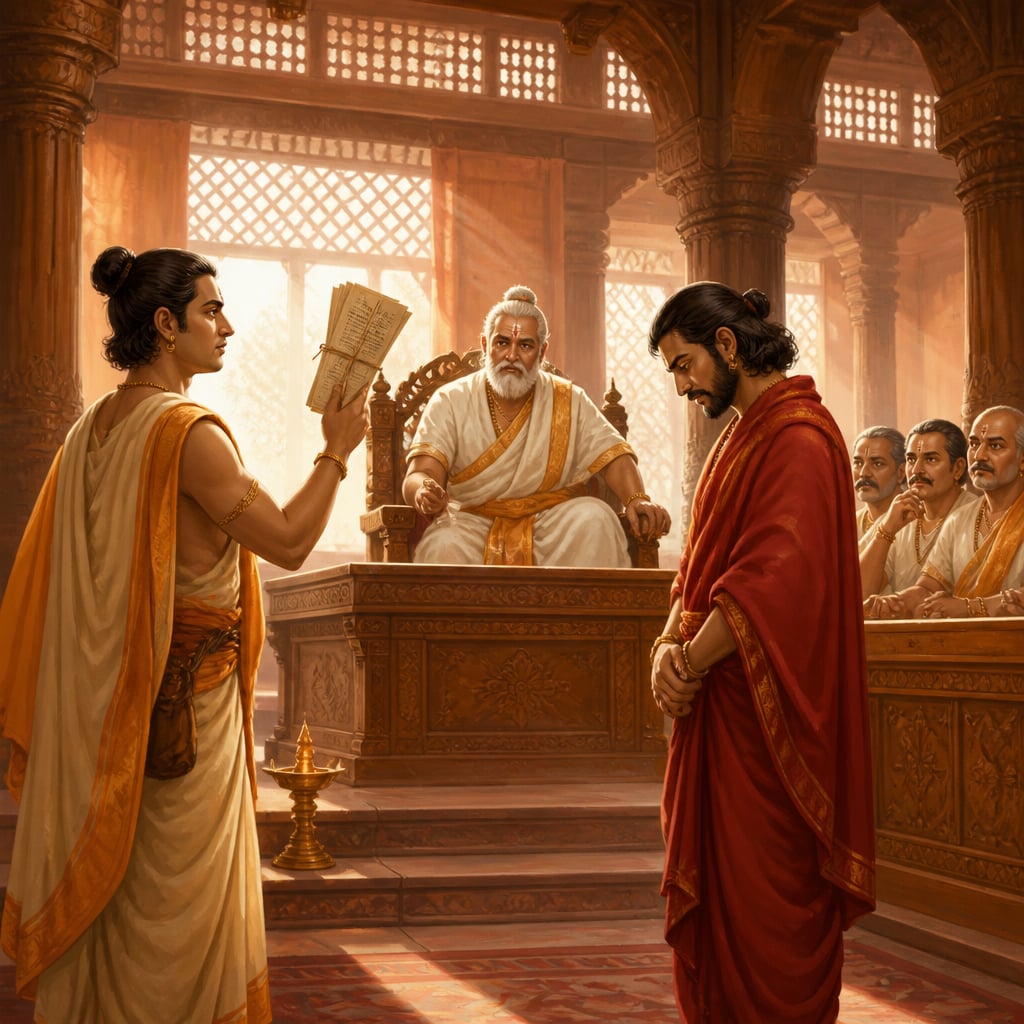
Merchant Vasubandhu confronting Dhanapala before a Pataliputra judge

The Sabha fell silent as the merchant Vasubandhu rose to speak. It was the third month of the rainy season in Pataliputra, circa 400 CE, and the dispute had dragged on for weeks. Vasubandhu had contracted with the grain trader Dhanapala for 500 dronas of rice, to be delivered before the monsoon floods closed the river routes. The price was fixed: 200 panas per hundred dronas. A witness, the guild master Vishvamitra, had watched them clasp hands.

But Dhanapala never delivered. When rice prices tripled after the floods, he claimed the agreement was invalid. "There was no written document," he argued. "No stamp, no seal. How can you call this a samaya?"

The presiding judge, a learned Brahmin trained in Narada's texts, leaned forward. "Tell me, Dhanapala," he asked, "did you accept the artha, the earnest money?"

Dhanapala's face betrayed him. He had accepted 50 panas as advance.

"Samayakṛtaṃ nāśayati yaḥ sa daṇḍyaḥ" "He who destroys what was agreed upon shall be punished."

The judge was quoting the Narada Smriti, the most sophisticated legal text of ancient India. And in that courtroom, Dhanapala learned what merchants across the subcontinent already knew: in India, a promise was not merely words. It was dharma itself.

The Architecture of Ancient Contract Law

The Narada Smriti, composed between 100-400 CE, dedicated eighteen chapters (vyavahāra-padas) to legal procedures. Among these, the sections on samaya (contract), ṛṇādāna (debt), and kraya-vikraya (sale-purchase) created a contract law framework of remarkable sophistication.

What made a contract valid? Narada specified five essential elements:

  1. Competent parties (adhikārin), Both parties must have legal capacity. Minors, the insane, and those under duress could not contract.

  2. Lawful object (dharma-yukta), The contract's purpose must not violate dharma. Agreements for gambling, prostitution, or harm were void.

  3. Free consent (svecchā), Coerced agreements were invalid. Narada explicitly lists threats, fraud, and misrepresentation as vitiating factors.

  4. Consideration (mūlya or artha), Something of value must pass between parties. This could be goods, services, or earnest money (arha).

  5. Clear terms (niyama), The subject matter, quantity, quality, price, and time of performance must be determinable.

Compare this to the modern Indian Contract Act of 1872, drafted by British jurists: offer, acceptance, consideration, capacity, free consent, lawful object. The Narada Smriti anticipated every element by 1,500 years.

The Remedy Revolution

What truly distinguished Indian contract law was its approach to breach. While many ancient legal systems focused on punishment, Narada developed remedy-based thinking, the idea that law should make the wronged party whole.

The Narada Smriti classified remedies into three categories:

1. Specific Performance (karma-pūrti): The defaulting party must complete the promised action. If Dhanapala agreed to deliver rice, he must deliver rice, not merely pay compensation.

"Pratijñātaṃ yathā karma tat kuryāt eva dharmataḥ" "What action was promised, that indeed must be performed according to dharma."

2. Compensation (hāni-pūraṇa): When specific performance is impossible, the breaching party must compensate for actual loss plus consequential damages.

3. Penalty (daṇḍa): Beyond compensation, wrongful breach attracted a fine payable to the king, recognizing that broken contracts harm not just individuals but the entire commercial ecosystem.

This three-layered approach mirrors modern contract remedies: specific performance, damages, and punitive elements. English courts wouldn't develop comparable sophistication until the 18th century.

Global Perspectives on Contract Formation

How does Narada's framework compare to other ancient and early-modern legal traditions?

Hugo Grotius drafting his treatise in a Delft study

Hugo Grotius (1583-1645), the Dutch jurist considered the father of international law, established in De Jure Belli ac Pacis (1625) that contracts derive binding force from natural law, the inherent human capacity to make and keep promises. This "pacta sunt servanda" (agreements must be kept) principle became foundational to Western contract law. Yet Narada had articulated the same principle twelve centuries earlier: samaya (agreement) creates bandha (binding obligation) because humans possess dharma-buddhi (moral reasoning capacity).

Thomas Hobbes (1588-1679) argued in Leviathan (1651) that contracts are meaningless without state enforcement, "covenants without the sword are but words." Narada disagreed. While state enforcement existed (rāja-daṇḍa), the Smriti emphasized that contracts bound parties through dharmic obligation first. A merchant who broke his word suffered not just legal penalty but apakīrti (loss of reputation) and adharma (moral failing).

Samuel Pufendorf (1632-1694), building on Grotius, argued that consideration, value exchanged, was essential to distinguish binding contracts from mere gifts. The Narada Smriti's requirement of artha (earnest money or value) anticipated this by 1,200 years.

Thinker Period Key Insight Narada Parallel
Hugo Grotius 1625 CE Contracts bind through natural law Samaya binds through dharma
Thomas Hobbes 1651 CE State enforcement essential Dharmic + state enforcement combined
Samuel Pufendorf 1672 CE Consideration required Artha (earnest money) requirement

Modern Resonance: When Contracts Fail in 2025

The principles Narada articulated aren't museum pieces, they illuminate today's most contentious commercial disputes.

Tense modern boardroom meeting over a broken investor covenant

Consider Byju's, India's edtech giant that became a cautionary tale. In 2021-22, Byju's raised over $2.5 billion from global investors including Prosus, Tiger Global, and Blackstone. These investment agreements contained standard provisions: financial reporting requirements, governance commitments, and anti-dilution clauses.

By 2023, investors alleged systematic breach. Financial statements were delayed or absent. Board governance was bypassed. Founders made decisions that allegedly harmed investor interests. In Narada's framework, this represented failure of niyama (clear terms observance) and violation of svecchā (the trust implicit in consent).

The consequences followed ancient logic. Investors sought karma-pūrti (specific performance, proper governance) and hāni-pūraṇa (compensation for value destruction). Byju's valuation crashed from $22 billion to under $1 billion by 2024. The market imposed apakīrti, reputational destruction that no court needed to mandate.

Similarly, the Vodafone-Idea merger (2018) demonstrated sophisticated contract architecture that Narada would recognize. When Vodafone India and Idea Cellular merged, they created binding agreements covering spectrum sharing, debt allocation, management control, and government liability. The samaya was clear: each party's obligations were specified across hundreds of pages.

Yet disputes emerged around AGR (Adjusted Gross Revenue) dues. Who was responsible for pre-merger government liabilities? The contract drafters had anticipated this, niyama included specific indemnity clauses. When the Supreme Court ruled against telecom companies in 2019, the merger agreement's terms determined how the ₹58,000 crore liability was shared. Ancient principles, modern application.

Your Turn: The Eternal Contract

The Narada Smriti teaches that every samaya contains three invisible parties: the two contractors and dharma itself. When you sign your next employment contract, lease agreement, or business deal, consider:

Narada's merchants traded across continents, from Rome to Southeast Asia, on the strength of their word. Their legal system didn't just punish breach, it made keeping promises a matter of identity. Fifteen centuries later, that insight remains radical.

In our next lesson, we explore Sambhuya Samutthana, how ancient India structured partnerships, divided profits, and managed the eternal tension between individual ambition and collective enterprise.

George Akerlof's 'Market for Lemons' (1970) showed how information asymmetry can destroy markets. If sellers can deceive buyers without consequence, buyers withdraw and markets collapse. Modern contract law's fraud provisions address exactly this problem.

Narada went further by including 'moha' (delusion/confusion) as a vitiating factor, not just active fraud but passive confusion. This anticipates modern consumer protection law's requirement that contracts be clear and comprehensible. The standard isn't just 'no lies' but 'genuine understanding.'

India's Consumer Protection Act 2019 received 600,000+ complaints in its first two years, with 'unfair contract terms' among the top categories, demonstrating continued relevance of Narada's consent principles.

The 'efficient breach' theory (Posner, 1973) argues that breaching contracts should be permitted when the breacher can compensate the victim and still profit, economic efficiency over promise-keeping. Most common law jurisdictions prefer monetary damages over specific performance.

Narada's preference for specific performance recognizes what economists call 'subjective value', the promised goods may be worth more to the promisee than market price suggests. It also maintains trust in the commercial system. If breach-and-pay becomes normalized, commercial relationships become purely transactional, destroying the relational fabric that sustains long-term business.

The Indian Specific Relief Act, 1963 (amended 2018) now makes specific performance the default remedy for contract breach, a return to Narada's principle after 150 years of British-influenced 'damages preference.'

Key terms

Samaya
A formal agreement or contract; a binding understanding between two or more parties that creates legal obligations
Arha
Earnest money; an advance payment given to confirm a contract and demonstrate commitment to the agreement
Vyavahāra
Legal procedure; the conduct of lawsuits; commercial dealings and their adjudication; the eighteen titles of law in Dharmashastra
Sākṣin
A witness; one who has direct knowledge of a transaction or event and can testify to its occurrence in legal proceedings

Verses

समयकृतं नाशयति यः स दण्ड्यः पराभवेत्

samayakṛtaṃ nāśayati yaḥ sa daṇḍyaḥ parābhavet

He who breaks the bond once made shall face both judgment and decay.

This principle creates the foundation for all commercial activity, the confidence that agreements will be honored. Without enforceable contracts, trade beyond immediate barter becomes impossible. Narada understood that economic prosperity requires legal infrastructure.

Narada Smriti, Vyavahara-pada 1.42-43 (Based on Julius Jolly translation (Sacred Books of the East))

प्रतिज्ञातं यथा कर्म तत् कुर्यात् एव धर्मतः

pratijñātaṃ yathā karma tat kuryāt eva dharmataḥ

What your word has pledged, your hand must complete, such is the way of dharma.

Specific performance is crucial for contracts involving unique goods, specialized services, or time-sensitive delivery. Modern courts still debate when specific performance should be ordered versus monetary damages, a debate Narada resolved by making performance the default expectation.

Narada Smriti, Vyavahara-pada 4.5-7 (Based on Richard Lariviere translation)

बलात् कृतश्च यो भावः मोहात् वा साहसेन वा। अधर्मेण कृतो यश्च स समयो निष्फलो भवेत्॥

balāt kṛtaśca yo bhāvaḥ mohāt vā sāhasena vā | adharmeṇa kṛto yaśca sa samayo niṣphalo bhavet ||

Forced by threat, born of deceit, or stained by violence, such agreements bear no fruit.

Free consent is the moral foundation of market economies. If contracts could be enforced despite coercion or fraud, the powerful would simply extract agreements from the weak. Narada's principle protects market integrity by ensuring only genuinely voluntary transactions receive legal backing.

Narada Smriti, Vyavahara-pada 1.28-30 (Based on Julius Jolly translation)

Key figures

Narada

c. 100-400 CE (composition period of Narada Smriti)

N.R. Madhava Menon

1935-2019

Hugo Grotius

1583-1645

Case studies

Byju's and the Broken Investor Covenant

Between 2020-2022, Byju's, India's most valuable startup, raised over $2.5 billion from global investors including Prosus, Tiger Global, General Atlantic, and Blackstone. The investment agreements contained standard covenants: quarterly financial reporting, board representation, governance procedures, and restrictions on related-party transactions. These weren't mere formalities; they were samaya, binding promises that formed the basis for investor trust and capital deployment. By late 2022, investors alleged systematic breach. Audited financial statements for FY2022 were delayed by 18 months. Board meetings were allegedly bypassed for major decisions. Acquisitions worth hundreds of millions were made without proper disclosure. The Deloitte and BDO auditor resignations in 2023 signaled deeper governance failures. Investors who had deployed capital based on specific contractual commitments found those commitments dishonored.

Narada's framework illuminates what went wrong. First, the *niyama* (clear terms) existed, investor agreements specified reporting timelines and governance requirements. Second, *arha* (consideration) had passed, $2.5 billion in capital. Third, the samaya was unambiguously formed. The breach occurred in *karma-pūrti* (performance): promised actions weren't completed. From a dharmic perspective, the founders may have calculated that investors were too dispersed and the company too important to face consequences, a variation of 'too big to fail.' But Narada teaches that breach has consequences beyond legal penalty: *apakīrti* (reputational destruction) follows *adharma* (unethical conduct). The market's reaction proved Narada right, Byju's couldn't raise new capital at any valuation, precisely because its word was no longer trusted.

By 2024, Byju's valuation collapsed from $22 billion to estimates below $1 billion, a destruction of over $20 billion in perceived value. Multiple investors marked their holdings to zero. The company faced insolvency proceedings, NCLT involvement, and potential personal liability for founders. More significantly, the entire Indian edtech sector suffered; investors became wary of all companies in the space. The breach of samaya didn't just harm direct parties, it damaged the entire commercial ecosystem, exactly as Narada warned when he mandated state penalties (*danda*) beyond individual compensation.

Narada's three-tier remedy system (performance, compensation, penalty) reflects understanding that contract breach has radiating consequences. Byju's founders may have believed investor agreements were merely legal formalities. The market's verdict demonstrated that contracts are the trust infrastructure of capitalism, break enough of them, and the infrastructure collapses.

The Byju's collapse triggered a reckoning across India's startup ecosystem, with investors now demanding monthly financial reporting, independent board seats, and governance audits before writing checks. The lesson echoes globally: WeWork, FTX, and Wirecard all showed that ignoring contractual covenants destroys not just the offending company but investor confidence in entire sectors.

Indian startup funding dropped 75% from 2021 to 2023 ($42 billion to $10 billion). While multiple factors contributed, investor surveys cited 'governance concerns' as a primary reason for caution, the Byju's effect on ecosystem trust.

Vodafone-Idea Merger: When Contracts Meet Sovereignty

In 2018, Vodafone India and Idea Cellular merged to create Vi (Vodafone Idea Limited), India's largest telecom operator by subscribers. The merger agreement was extraordinarily complex: spectrum sharing arrangements, debt allocation, management control provisions, brand usage rights, and crucially, allocation of pre-merger government liabilities. Both parties' legal teams spent months drafting precise *niyama* (terms) covering every contingency they could imagine. Then came the Supreme Court's AGR (Adjusted Gross Revenue) judgment in October 2019. The court ruled that telecom companies owed the government massive back-dues calculated on a broader revenue definition than companies had used. For Vi, this meant approximately ₹58,000 crore in unexpected liability, and the merger agreement's indemnity clauses would determine how this burden was shared between the pre-merger entities.

This case illustrates Narada's wisdom about *niyama* (clear terms) under uncertainty. No contract can anticipate every future event, the AGR judgment was unforeseeable. Yet the merger agreement's drafters had included general indemnity provisions addressing pre-merger liabilities, even without knowing their exact nature. Narada's approach would focus on *svecchā* (the intent behind consent). What did each party understand when agreeing to indemnity clauses? The spirit of the agreement, each entity responsible for its historical obligations, guided interpretation even when specific liabilities weren't named. This contrasts with purely literal interpretation that might seek technical escape from obligations.

The merger agreement's terms held. Liability was allocated based on pre-merger revenue shares, with Vodafone's share approximately 56% and Idea's 44%. While both parties sought government relief (eventually granted through a four-year moratorium in 2021), the contractual allocation between themselves was never seriously disputed. The samaya, properly drafted, survived even a ₹58,000 crore shock. Vi continues to struggle, as of 2024, the company holds massive debt and faces market share erosion. But the lesson for contract law is clear: sophisticated parties with clear terms can navigate even unprecedented challenges without litigation between themselves.

Narada emphasized that samaya should be drafted with *viveka* (discernment), anticipating not specific contingencies but categories of risk. The Vodafone-Idea drafters couldn't predict AGR, but they could create frameworks for 'unknown pre-merger liabilities.' This principled approach to contract drafting, focus on underlying responsibilities rather than exhaustive listing, reflects dharmic understanding of uncertainty in commercial life.

Geopolitical risk in commercial contracts is now a board-level concern after the Russia-Ukraine war disrupted supply chains, the US-China tech decoupling forced restructuring of joint ventures, and India's China app bans unwound partnerships overnight. Modern contract drafters increasingly include 'geopolitical force majeure' clauses, acknowledging that sovereignty can override commercial agreements at any time.

The Vodafone-Idea merger documentation exceeded 2,000 pages across multiple agreements. Yet the provisions governing the ₹58,000 crore AGR allocation occupied just a few paragraphs of indemnity clauses, demonstrating that contract quality matters more than quantity.

Historical context

Classical Smriti Period (100-600 CE)

India during the Narada Smriti's composition was the world's largest economy (estimated 25-32% of global GDP). Trade extended from Rome to Southeast Asia to China. Merchants, guilds, and banking networks required robust contract enforcement that the Smriti provided.

Roman law (Corpus Juris Civilis compiled 529-534 CE) was contemporaneous but differently focused. Roman contract law emphasized formal categories (stipulatio, emptio venditio) while Narada emphasized underlying principles applicable across contract types. Islamic contract law (fiqh al-mu'amalat) wouldn't develop for another 200 years. European commercial law wouldn't achieve similar sophistication until the lex mercatoria of medieval trade fairs (1100s CE).

Archaeological evidence from Arikamedu, Muziris, and other ancient ports shows standardized weights, measures, and sealing practices consistent with the Narada Smriti's requirements for valid commercial transactions.

Understanding Narada Smriti's historical context corrects the misperception that Indian commercial law 'began' with the British. The 1872 Contract Act codified principles already practiced for 1,500 years, often with less sophistication than the original sources.

Living traditions

The Indian Contract Act, 1872, still the primary contract legislation, incorporates every essential element from Narada Smriti: offer and acceptance (samaya formation), consideration (arha/mūlya), free consent (svecchā), competent parties (adhikārin), and lawful object (dharma-yukta). The Specific Relief Act, 2018 amendment making specific performance the default remedy marked a return to Narada's priority of karma-pūrti over mere damages. E-commerce contracts and digital agreements are now interpreted through these ancient-origin principles.

Reflection

More in Ancient Contracts, Partnerships & Risk

All lessons in Ancient Contracts, Partnerships & Risk · Vaishya Dharma: The Art of Ethical Commerce course