Sambhuya Samutthana: Ancient Partnership Structures
When Merchants Joined Forces and Fortunes
How ancient India invented sophisticated partnership structures, from profit-sharing formulas to liability allocation to dissolution procedures, creating frameworks that modern LLPs and joint ventures still echo.
The Varanasi Reckoning
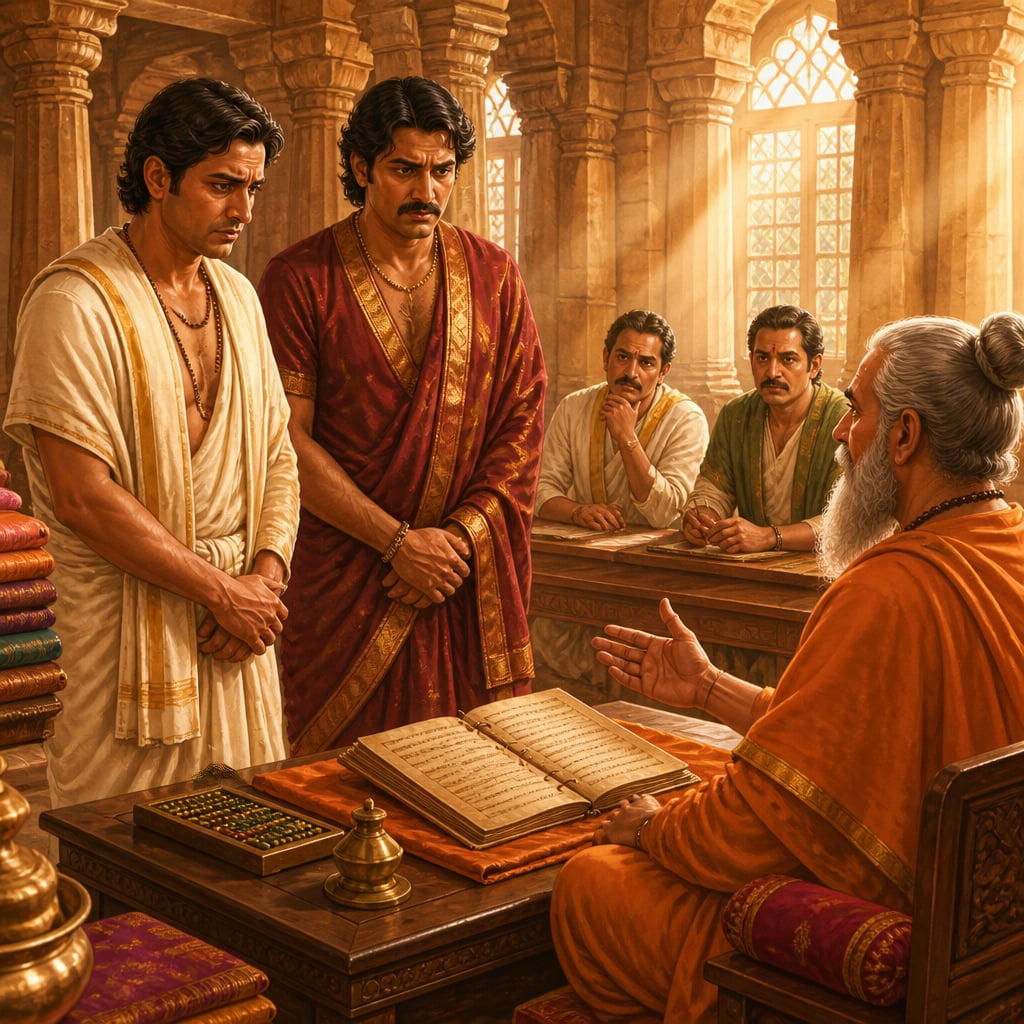
The silk merchant Devadatta and his partner Mitra had not spoken in three months. Their joint venture, a trading house on the ghats of Varanasi, had prospered for seven years, sending fine Banarasi textiles to merchants in Tamralipti, Bharuch, and even distant Muziri for the Roman trade. But now, in the assembly hall of the Vanik Shreni (merchants' guild), they stood on opposite sides.
The dispute was simple in statement, complex in resolution: Mitra had contributed twice the capital but worked half the hours. Devadatta had managed the daily operations, negotiated with weavers, and twice saved shipments from bandits on the Deccan route. Now that they wished to dissolve the partnership, how should seven years of accumulated profits, and one year of accumulated losses, be divided?
"I put in 2,000 panas," Mitra argued. "He put in 1,000. The profits should follow the capital."
"I put in my life," Devadatta countered. "For seven years, I lived in our warehouse while he lived in comfort. Should sweat count for nothing?"
The guild master, a veteran of forty years in trade, reached for his copy of the Brihaspati Smriti. The answer, he knew, lay not in choosing between capital and labor, but in understanding how the sambhuya samutthana, the joint enterprise, had been structured from the beginning.
The Architecture of Ancient Partnership
The term sambhuya samutthana appears throughout the Dharmashastra literature, but receives its most detailed treatment in the Brihaspati Smriti (c. 300-500 CE). The compound is precise: sambhuya (coming together, joining) + sam (together) + utthana (rising up, enterprise). A partnership is literally a "rising up together", an enterprise that neither party could achieve alone.
Brihaspati identified three fundamental types of partnership:
1. Capital-Only Partnership (Prayoga Sambhoga)
Here, partners contribute only capital, with management delegated to hired agents or one designated partner. Profits and losses follow capital ratios exactly.
"Yathā-nyāsaṃ vibhajet lābhaṃ hāniṃ ca tathā bhajet" "As the deposit, so divide the gain; as the deposit, so share the loss."
This is the ancient equivalent of a silent partnership or limited partner arrangement, capital at risk, but no operational involvement.
2. Labor-Capital Partnership (Karma-Prayoga Sambhoga)
The more complex arrangement, where some partners contribute capital and others contribute labor (or some contribute both). Brihaspati prescribed that such partnerships must explicitly agree on three things:
- The valuation of labor contribution (śrama-mūlya)
- How profits divide between capital and labor shares
- Whether labor partners bear losses or only capital partners
Devadatta and Mitra's dispute arose precisely because they had never formalized these terms. The guild master would have to reconstruct their implied agreement from seven years of conduct.
3. Skill-Based Partnership (Vidyā Sambhoga)
A specialized form where one partner contributes expertise, navigation knowledge for sea voyages, metallurgical skill for mining ventures, or textile quality assessment. Brihaspati recognized that rare skills could command partnership shares disproportionate to either capital or time.
The Profit Distribution Problem
How should partnerships divide profits? Brihaspati devoted considerable attention to this eternal question, anticipating debates that would occupy economists for millennia.
The default rule was straightforward:

"Samāna-bhāgau bhāgena labhete tāvubhau samau" "Equal shares from equal contribution, both receive the same when both give the same."
But what constitutes "equal"? Brihaspati's innovation was recognizing multiple dimensions of contribution:
| Contribution Type | Sanskrit Term | Modern Equivalent |
|---|---|---|
| Capital invested | Mūla-dhana | Equity stake |
| Labor/time given | Śrama-dāna | Sweat equity |
| Expertise provided | Vidyā-yoga | Intellectual capital |
| Risk undertaken | Sankaṭa-vāhana | Risk premium |
| Reputation leveraged | Kīrti-yoga | Brand/goodwill |
A sophisticated partnership agreement might allocate, say, 40% of profits to capital, 40% to labor, and 20% to the partner whose reputation enabled key relationships. This multi-factor approach anticipates modern startup equity allocation discussions with remarkable precision.
Global Perspectives on Partnership Economics
John Stuart Mill (1806-1873), the British philosopher-economist, devoted significant attention to partnerships in his Principles of Political Economy (1848). Mill distinguished between "sleeping partners" (capital-only) and "active partners" (capital plus management), arguing that the sleeping partner arrangement encouraged capital formation while the active partnership created better-aligned incentives.
Mill would have recognized Brihaspati's framework instantly. The Prayoga Sambhoga (capital-only) and Karma-Prayoga Sambhoga (labor-capital) distinction maps precisely to Mill's sleeping/active classification. Yet Brihaspati wrote 1,400 years earlier and went further, his Vidyā Sambhoga (skill-based) partnership recognized that human capital could be valued independently of either time or money.
Adam Smith (1723-1790) was famously skeptical of partnerships beyond small scale. In The Wealth of Nations (1776), he argued that joint-stock companies (the precursor to modern corporations) suffered from the "negligence and profusion" of managers spending other people's money. Smith preferred partnerships where each partner's own capital was at risk.
Brihaspati anticipated this concern. The Smriti explicitly addresses the problem of pramāda (negligence) in partnership:
"Pramādena kṣayo jāto yena tasya sa eva syāt" "Loss arising from negligence falls upon the negligent one alone."
This personal liability for negligent acts, even within a partnership, created accountability that joint-stock companies would struggle to replicate.
Max Weber (1864-1920), the German sociologist, studied Indian commercial structures and noted their sophistication. Weber observed that Indian merchant communities had developed "rationalized" business structures comparable to early modern Europe, but embedded within caste and kinship networks that provided trust mechanisms unavailable to Western partnerships.
| Thinker | Period | Key Insight | Brihaspati Parallel |
|---|---|---|---|
| J.S. Mill | 1848 | Sleeping vs. active partner distinction | Prayoga vs. Karma-Prayoga types |
| Adam Smith | 1776 | Partnership accountability superior to corporations | Personal liability for pramāda |
| Max Weber | 1905 | Indian commercial rationality within community networks | Shreni (guild) as partnership guarantor |
The Dissolution Question
All partnerships end. Brihaspati's genius was recognizing that the rules for ending must be established at the beginning.
The Smriti identifies five legitimate grounds for dissolution:
- Mutual consent (anyonya-sammati), Both parties agree to end
- Completion of purpose (kārya-samāpti), The venture's objective is achieved
- Expiration of term (kāla-samāpti), The agreed duration ends
- Material breach (dharma-hāni), One party violates the partnership dharma
- Changed circumstances (sthiti-bheda), Conditions make continuation impossible
For Devadatta and Mitra in Varanasi, the dissolution was by mutual consent, but the absence of original terms meant the guild master had to determine retrospectively what fair allocation would have been.
His ruling, following Brihaspati's principles: Since Mitra contributed 2:1 capital but Devadatta contributed approximately 2:1 labor over seven years, their effective contributions were equal. Profits would be divided equally, losses would fall on capital (since labor partners had already "lost" their time), and accumulated inventory would be auctioned with proceeds split 50-50.
Neither party was fully satisfied, the mark of a fair judgment.
Modern Resonance: Partnerships Built and Broken in 2025
Brihaspati's principles illuminate contemporary partnership stories with uncomfortable clarity.

Consider Infosys, founded in 1981 by seven partners with a combined capital of ₹10,000 (approximately $1,250 at the time). N.R. Narayana Murthy contributed the largest single share, but all seven brought different assets: Murthy's vision and connections, Nandan Nilekaki's client relationships, Kris Gopalakrishnan's technical expertise, and so on.
The founding partnership agreement, drafted on a kitchen table, established principles Brihaspati would recognize: equity allocated based on multiple factors (capital, commitment, expertise), explicit understanding that early contributors were taking risk, and clear mechanisms for bringing in new partners or buying out departing ones.
The result? Infosys created over 4,000 dollar-millionaires through its employee stock programs, became India's second-largest IT company, and maintained partnership harmony across four decades. When disputes arose (as they inevitably do), the foundational clarity enabled resolution. Murthy himself stepped back, returned, and stepped back again, each transition managed through established processes.
Contrast this with the Paytm-Alibaba partnership. When Alibaba invested $680 million in Paytm between 2015-2017, the partnership terms seemed clear: Alibaba would provide capital and technology (Alipay's expertise), while Paytm founder Vijay Shekhar Sharma would provide local execution and regulatory navigation.
But the niyama (clear terms) were incomplete. What happened when Chinese investment faced Indian regulatory scrutiny? Who controlled data? What were the exit terms? By 2022, Alibaba was selling its Paytm stake at massive losses while the relationship had soured publicly.
Brihaspati would diagnose the failure: The partnership was structured for success but not for stress. The sthiti-bheda (changed circumstances) provision, how to handle geopolitical shifts, was never articulated. A 7th-century Smriti anticipated that partners must agree not just on how to win together, but how to part when winning becomes impossible.
Your Turn: Partnership as Dharma
The Brihaspati Smriti teaches that partnership is not merely a business arrangement but a dharmic relationship, creating mutual obligations that transcend the written terms.
When you enter your next partnership, whether a startup with a co-founder, a project with a colleague, or a joint investment with a friend, consider Brihaspati's questions:
- Have you explicitly valued each partner's contribution across all dimensions (capital, labor, skill, risk, reputation)?
- Have you agreed how profits will divide AND how losses will be allocated?
- Have you specified the grounds and process for dissolution?
- Most importantly: have you chosen a partner whose dharma-buddhi (moral reasoning) you trust when the agreement is silent?
The merchants of ancient Varanasi knew what modern startup founders often forget: the partnership agreement you write when excited and aligned is for the day when you're frustrated and divergent. That's when dharma matters most.
In our next lesson, we venture to the seas, exploring how ancient Indian merchants managed the ultimate risk: ships that might never return, cargoes that might sink, and the proto-insurance mechanisms they invented to share maritime peril.
Gary Becker's Human Capital Theory (1964) established that skills and knowledge are economic assets comparable to physical capital. Modern startup equity negotiations struggle to price these non-monetary contributions, often using vesting schedules and cliff periods as imperfect proxies.
Brihaspati's five-factor framework provides a more holistic approach than binary 'cash vs. sweat equity' thinking. By explicitly recognizing reputation and risk-bearing as separate contribution types, Indian partnership law enabled fairer allocation among partners with genuinely different strengths.
A 2023 Harvard Business Review study found that 65% of startup co-founder disputes involve equity allocation disagreements, with 'unequal effort perception' as the leading cause, exactly the problem Brihaspati's multi-factor approach was designed to solve.
Oliver Hart's Incomplete Contract Theory (Nobel Prize 2016) established that no contract can specify all future contingencies. The question becomes: who has decision rights when the contract is silent? Modern partnerships often leave exit terms vague, creating hostage situations.
Brihaspati's five grounds for dissolution create a framework for interpreting exit rights even when specific situations weren't anticipated. 'Changed circumstances' (sthiti-bheda) as a legitimate exit ground acknowledges the world's uncertainty, you can leave when conditions make the original purpose impossible, not just when the other party breaches.
According to a 2022 KPMG study, 70% of joint ventures and partnerships fail to achieve their objectives, with 'inability to exit cleanly' identified as a key factor in value destruction. Clear dissolution terms dramatically improve outcomes.
Key terms
- Sambhūya Samutthāna
- A joint enterprise or partnership; a business venture where multiple parties combine resources (capital, labor, or expertise) to achieve a common commercial purpose
- Śrama-Mūlya
- The value or price of labor; the monetary equivalent assigned to a partner's work contribution as distinct from capital contribution
- Vibhājana
- Division or distribution; the process of allocating partnership profits, losses, or assets among partners according to agreed terms
- Pramāda
- Negligence, carelessness, or inattention; failure to exercise the care that a reasonable partner would exercise in managing partnership affairs
Verses
यथान्यासं विभजेत् लाभं हानिं च तथा भजेत्
yathā-nyāsaṃ vibhajet lābhaṃ hāniṃ ca tathā bhajet
As the stake, so the gain; as the risk, so the pain.
This principle creates proper incentives for capital formation. Partners invest knowing their return is proportional to risk undertaken. Modern venture capital term sheets, with their preferred returns and pro-rata rights, are sophisticated expressions of this ancient principle.
Brihaspati Smriti, Vyavahara-kanda, Sambhuya Samutthana section (Based on Julius Jolly translation (Sacred Books of the East))
समानभागौ भागेन लभेते तावुभौ समौ
samāna-bhāgau bhāgena labhete tāvubhau samau
When both give equally, both gain equally, such is the partnership's sacred balance.
The principle seems obvious but its implementation is profound. 'Equality' must account for timing (early capital vs. late capital), type (money vs. effort vs. expertise), and risk (guaranteed salary vs. uncertain equity). Brihaspati's framework for multi-dimensional equality remains relevant for modern equity negotiations.
Brihaspati Smriti, Vyavahara-kanda, Sambhuya Samutthana section (Based on Ganganath Jha translation)
प्रमादेन क्षयो जातो येन तस्य स एव स्यात्
pramādena kṣayo jāto yena tasya sa eva syāt
The careless hand that caused the loss shall bear that burden alone.
This principle solves the 'moral hazard' problem in partnerships. Without it, a negligent partner could damage the enterprise knowing losses would be shared. By isolating negligence-caused losses, Brihaspati created accountability that modern corporate governance struggles to replicate (see: executives destroying shareholder value with golden parachute exits).
Brihaspati Smriti, Vyavahara-kanda, Sambhuya Samutthana section (Based on Julius Jolly translation)
Key figures
Brihaspati
c. 300-500 CE (composition period of Brihaspati Smriti)
N.R. Narayana Murthy
1946-present
John Stuart Mill
1806-1873
Case studies
Seven Partners, Ten Thousand Rupees: The Infosys Founding Partnership
In July 1981, seven engineers founded Infosys with a combined capital of ₹10,000, approximately $1,250 at the time. The seven founders, N.R. Narayana Murthy, Nandan Nilekaki, Kris Gopalakrishnan, S.D. Shibulal, K. Dinesh, Ashok Arora, and N.S. Raghavan, each brought different assets. Murthy contributed the largest capital share and provided the founding vision; Nilekaki had client relationships from his Patni Computer Systems days; Gopalakrishnan brought deep technical expertise; others contributed execution capability, industry connections, and willingness to forgo immediate salary. The founding partnership faced immediate challenges: no significant capital, no established brand, and a regulatory environment (License Raj India) hostile to new ventures. The partners had to structure their arrangement to survive years of minimal income while building toward long-term success.
Brihaspati would recognize the Infosys founding as a classic *Karma-Prayoga Sambhoga*, a partnership combining capital and labor, with explicit understanding that early sacrifice would be rewarded with later gains. The founders' decision to take minimal salaries while building equity embodied *sankaṭa-vāhana* (risk-bearing) as a contribution type. Crucially, the founding agreement established what Brihaspati called *niyama* (clear terms): equity was allocated based on multiple factors (capital contribution, expertise value, time commitment), with mechanisms for vesting and for adjusting shares as circumstances changed. The partnership also specified governance procedures, monthly reviews, collective decision-making for major moves, that created the accountability Brihaspati required. When Ashok Arora left within a year and N.S. Raghavan departed later, the established dissolution procedures (*sthiti-bheda* terms) enabled clean exits without value destruction or litigation. The partners who remained knew exactly what they owned and what they owed each other.
Infosys went public in 1993 and created extraordinary wealth: by 2024, the company's market capitalization exceeded $75 billion. More remarkably, the founding partnership's structure, with its emphasis on transparency, shared ownership, and fair governance, extended to employees through India's first major ESOP program. Over 4,000 employees became dollar-millionaires. The six remaining founders maintained remarkably harmonious relationships across four decades. When transitions occurred, Murthy stepping back as CEO, returning as Executive Chairman, stepping back again, established processes managed each change. The partnership that began in a Pune apartment became a model for Indian entrepreneurship.
Brihaspati's insight was that partnership structure determines partnership destiny. The Infosys founders succeeded not despite taking time to structure their partnership carefully, but because of it. The ₹10,000 initial capital was trivial; the founding agreement's multi-dimensional equity allocation, clear governance, and dissolution procedures were priceless.
Startup co-founder disputes are now the leading cause of early-stage company failure, ahead of product-market fit and funding gaps. Y Combinator and other accelerators now require co-founder agreements before investing. The Infosys founding partnership, with its clarity on roles, equity, and exit terms from day one, remains the gold standard that every startup accelerator curriculum references.
Of the original seven Infosys founders, five maintained leadership roles for over 30 years, an extraordinary retention rate that reflects the partnership structure's strength. In contrast, 70% of startup co-founder relationships fail within five years.
When Geopolitics Broke the Partnership: Paytm and Alibaba
Between 2015 and 2017, Alibaba Group and its affiliate Ant Financial invested approximately $680 million in Paytm, India's leading digital payments company founded by Vijay Shekhar Sharma. The partnership seemed ideal: Alibaba brought massive capital, proven payment technology (Alipay's architecture), and global scale; Paytm brought local market expertise, regulatory relationships, and a rapidly growing user base. The partnership terms reflected the apparent complementarity: Alibaba received significant equity (approximately 30% at peak), board seats, and technology transfer arrangements; Paytm retained operational control and Indian management. Both parties anticipated riding India's digital payments revolution together. Then came the geopolitical shift. Following the 2020 India-China border clashes, India implemented restrictions on Chinese investments and apps. TikTok was banned; Chinese FDI faced scrutiny; Alibaba and Ant Financial found themselves holding large stakes in an Indian company they could no longer easily support, or exit.
Brihaspati's concept of *sthiti-bheda* (changed circumstances) was designed precisely for situations like this. No partnership agreement can anticipate geopolitical ruptures, but a dharmic agreement should specify how partners respond when external circumstances make the original arrangement untenable. The Paytm-Alibaba partnership appears to have lacked robust *sthiti-bheda* provisions. Questions that Brihaspati would have required clarity on were apparently unaddressed: What happens if one partner's home country restricts investment? How is 'fair value' determined when public markets are influenced by political sentiment? Can a partner exit when they cannot participate in governance? From Brihaspati's perspective, the partnership committed a classic error: it was structured for upside alignment but not for stress scenarios. The *kīrti-yoga* (reputation contribution) that Alibaba once provided through its brand association became a liability when Chinese investment faced public backlash. Neither party had a framework for managing this reversal.
By 2022-2023, Alibaba and Ant Financial sold most of their Paytm stakes at significant losses, reportedly below $1 billion for holdings that had cost nearly $680 million, and far below peak valuations. The divestment occurred at an awkward moment: Paytm's stock had crashed following RBI regulatory concerns, and Chinese sellers faced discounted pricing. The partnership that began as a strategic triumph ended as a cautionary tale. Vijay Shekhar Sharma retained control of Paytm but lost a major capital source. Alibaba recovered partial capital but forfeited India market access. Both parties might have fared better with clearer exit terms negotiated when relationships were strong.
Brihaspati's insistence on dissolution planning wasn't pessimism, it was realism. The Paytm-Alibaba partnership succeeded commercially for years but failed structurally when tested by unforeseen circumstances. Modern cross-border partnerships should learn the ancient lesson: design your partnership for the worst scenario, not just the best one.
Cross-border technology partnerships face increasing regulatory scrutiny worldwide. The EU's foreign subsidy regulation, the US CFIUS review process, and India's FDI restrictions on Chinese investment all reflect the same reality: commercial partnerships between geopolitical rivals carry structural dissolution risk that no contract clause can fully mitigate. Founders must plan for geopolitical unwinding as a baseline scenario.
Chinese investment in Indian startups dropped from $4.1 billion in 2020 to less than $200 million in 2022, a 95% decline. Existing partnerships across the ecosystem faced similar restructuring challenges, most without adequate sthiti-bheda provisions.
Historical context
Classical Smriti Period (300-600 CE)
India during the Brihaspati Smriti's composition was characterized by complex commercial networks. The shreni (guild) system managed most economic production, operating as partnerships within regulatory frameworks. Maritime trade extended to Southeast Asia, East Africa, and the Mediterranean. This commercial sophistication required, and produced, sophisticated partnership law.
Roman law (societas) provided partnership frameworks contemporaneously, but with less nuanced treatment of different contribution types. Islamic partnership law (shirkah, mudarabah) would develop similar sophistication 200 years later, possibly influenced by Indian models via trade contact. Medieval European commenda partnerships (10th-12th century) show structural similarities suggesting knowledge transfer along trade routes.
Inscriptions from the Gupta period document merchant guilds (shreni) operating across multiple generations, maintaining continuous identity despite changing membership, evidence that Brihaspati's partnership structures enabled institutional continuity.
Understanding ancient Indian partnership structures reveals that sophisticated business organization isn't a Western import. When Indian startups structure co-founder agreements today, they're participating in a tradition millennia old, whether they know it or not.
Living traditions
The Indian Partnership Act, 1932 and the Limited Liability Partnership Act, 2008 incorporate principles traceable to Dharmashastra texts. The emphasis on partnership deed (explicit terms), fiduciary duties (accountability for negligence), and dissolution procedures directly echoes Brihaspati's framework. Modern venture capital term sheets, with their treatment of founders, investors, and employees as different partner classes, represent sophisticated applications of ancient multi-dimensional partnership thinking.
- Marwari Partnership Networks: Traditional Marwari merchant families still use partnership structures combining different contribution types, one family provides capital, another provides market access, another provides management expertise, following patterns Brihaspati would recognize.
- Startup Co-founder Agreements: India's startup ecosystem increasingly uses 'founders agreements' that allocate equity based on multiple factors (cash contribution, technical expertise, business development capability, full-time commitment), a modern expression of Brihaspati's multi-dimensional framework.
- Film Production Partnerships: Bollywood and regional cinema often use partnership structures where producers contribute capital, directors contribute creative vision, stars contribute box office drawing power, each receiving shares reflecting their contribution type.
- SEBI Office, Mumbai: India's securities regulator, where partnership regulations and corporate governance norms are shaped, continuing the tradition of state oversight of commercial arrangements that Brihaspati described
- Infosys Campus, Bangalore: The physical manifestation of India's most successful founding partnership, where the seven-founder model continues to influence Indian entrepreneurship
- Shri Mahalaxmi Temple: One of the most important Lakshmi temples in India, visited by merchant families before launching new business partnerships. The temple's Shakti Pitha status connects commercial prosperity to dharmic duty.
- Sanwaliya Seth Temple: Known as the temple of the 'merchant Krishna,' this shrine is especially venerated by Marwari business communities who seek blessings for partnerships and joint ventures.
Reflection
- Brihaspati held that partners who contribute different things (capital, labor, expertise, reputation) can be equal partners if the valuation is fair. In modern startups, technical co-founders often receive less equity than business co-founders, despite contributing comparable value in a different form. How might applying Brihaspati's multi-dimensional framework change how we structure founding teams?
- Think of a partnership or collaboration you're currently part of (work team, business venture, creative project). Apply Brihaspati's dissolution test: Have you agreed on grounds for ending? Have you specified how value would be divided? Do you know what 'changed circumstances' would justify exit? If not, what conversation do you need to have?