Sakshi-Dharma: Witness and Documentation Ethics
How Ancient India Proved What Was Promised
How ancient Indian law developed sophisticated rules for witnesses, documents, and evidence, knowing that commerce depends not just on making agreements but on proving them when memories fade and interests diverge.
The Disputed Sale of Kashi
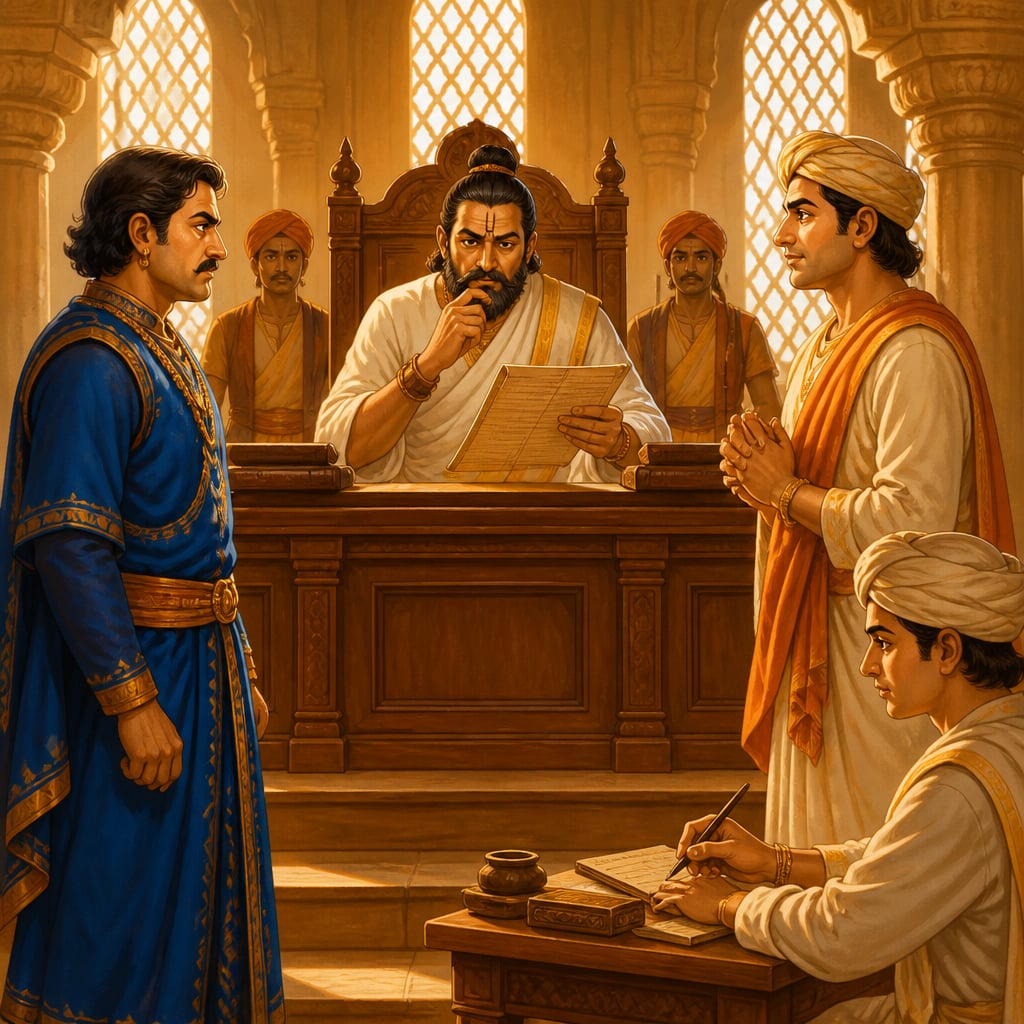
The merchant Haridatta and the landowner Somadeva stood before the royal court in Varanasi, each claiming righteous cause. Five years earlier, Somadeva had sold a warehouse near the ghats to Haridatta. Or had he?
"I sold him only the building," Somadeva insisted. "The land beneath remained mine. Now he refuses to pay rent for the ground his warehouse stands upon."
"He sold me building and land together," Haridatta countered. "The price of 5,000 panas was for both. Everyone knows land and building cannot be separated."
The presiding judge, trained in Yajnavalkya Smriti, faced the eternal problem of commerce: two honest people remembering the same transaction differently. Five years of unstated assumptions had calcified into genuine belief.
"Produce your witnesses," the judge ordered.
Somadeva called his brother, who remembered the sale as land-excluded. Haridatta called his partner, who remembered it as land-included. The judge dismissed both: the Smriti barred testimony from those with sāpekṣa (interest in the outcome).
"Produce your documents."
Haridatta presented a sale deed, but the judge noticed irregularities. The ink color varied between clauses. The writing style shifted midway. The seal impression was crisp in some places, smudged in others.

He called the royal scribe who maintained the lekhya-śālā (document archive). Comparison with the original registration copy revealed the truth: someone had added "including the land" to a deed that originally specified only the building.
The forgery was subtle. But ancient Indian courts had developed forensic techniques precisely because they understood human capacity for self-serving memory and document manipulation.
The Architecture of Ancient Evidence Law
The Dharmashastra texts devoted extensive attention to sākṣya (evidence) and pramāṇa (proof), recognizing that justice depends on determining truth when parties disagree. Yajnavalkya Smriti classified evidence into three categories:
1. Documentary Evidence (Lekhya)
Written documents held the highest evidentiary weight. The Smriti specified requirements for valid documents:
"Deśa-kāla-dhanāni ca likhitavyāni yatnataḥ | sākṣiṇaś ca tathā nāma vāhya-madhyānta-saṃsthitāḥ ||" "Place, time, and amount must be written carefully; witnesses' names should be recorded at the margins, middle, and end."
This created redundancy, multiple witness signatures distributed throughout the document, making selective forgery difficult. Ancient Indian contracts often had witnesses sign at the beginning, middle, and end of the text.
Document authentication techniques included:
- Seal verification (mudrā-parīkṣā): Comparing seals against known authentic impressions
- Writing analysis (lipi-parīkṣā): Examining handwriting consistency, ink characteristics
- Registration cross-check: Comparing private documents against official archives
- Paper/material examination: Different eras and regions used different materials
2. Witness Testimony (Sākṣya)
When documents were absent or disputed, witnesses provided crucial evidence. But the Smritis understood that witnesses could lie, misremember, or be biased. They developed sophisticated rules:
Competent witnesses must be:
- Disinterested (nirāpekṣa), no stake in the outcome
- Trustworthy (āpta), known for honesty in the community
- Knowledgeable (jñātā), actually present at the transaction
- Consistent (avirudha), not contradicting themselves
Categories of incompetent witnesses:
| Category | Sanskrit Term | Rationale |
|---|---|---|
| Interested parties | Sāpekṣa | Self-interest corrupts testimony |
| Close relatives | Bandhu | Loyalty may override truth |
| Enemies | Śatru | Malice may produce false testimony |
| Those with criminal record | Prāpta-doṣa | Prior dishonesty suggests unreliability |
| Dependents | Āśrita | Economic pressure may distort truth |
| Those promised reward | Vetana-labdha | Payment creates bias |
The Smriti also addressed the eternal challenge: what if witnesses contradict each other?
"Bahūnām ekavākyatvāt ekasyāpi ca sādhutāt | grāhyaṃ vacanam āptasya bahavo'py anṛtā matāḥ ||" "When many speak as one, their word is taken; but even one truthful witness outweighs many liars."
Quality over quantity. A single credible witness could defeat multiple compromised ones.
3. Circumstantial Evidence (Yukti)
When both documents and witnesses failed, courts turned to logical inference, anumāna based on circumstances:
- Possession (bhoga): Who has been using the property? Long possession suggests ownership.
- Conduct (ācāra): Did the parties act consistent with their claimed agreement?
- Probability (sambhāvana): Which version makes more sense given normal commercial practice?
In Haridatta's case, the judge noted that he had paid rent for the first two years, conduct inconsistent with believing he owned the land. This circumstantial evidence supported Somadeva's version even before the forgery was detected.
The Ethics of Witnessing
Ancient India treated witnessing as a dharmic duty, not merely legal testimony but sacred obligation. The witness oath invoked cosmic consequences:
"Ye ye pāpās tava dehastā ye ca pāpāḥ purātanāḥ | sarve te mūrdhni tiṣṭhantu sākṣye'nṛtam vadatas tava ||" "Whatever sins are in your body, and whatever ancient sins, all shall rest upon your head if you speak falsely as a witness."
But the Smritis recognized ethical complexity. What if truth-telling would cause great harm? Yajnavalkya addressed this directly:
"Arthasya rakṣaṇārthāya prāṇānām api vā punaḥ | anṛtaṃ na vadel leśam api dharmārtha-sādhakam ||" "Even for protection of wealth or life itself, one should not speak even the slightest falsehood that undermines dharma and justice."
This is absolute: no commercial interest justifies false testimony. But what about personal loyalty versus truth?
The Smritis distinguished between māhātmya-vacana (praising someone's good qualities) and sākṣya-vacana (formal testimony). In social contexts, kind silence about a friend's faults was acceptable. In legal testimony, only truth was permitted, regardless of relationship.
Global Perspectives on Evidence and Proof
John Henry Wigmore (1863-1943) was an American legal scholar whose multi-volume "Treatise on Evidence" (1904-1905) systematized evidence law and influenced courts worldwide. Wigmore developed a "rational" approach to evidence: testimony should be evaluated based on factors affecting reliability (opportunity to observe, memory capacity, veracity history), not on categorical rules about who may or may not testify.
Yajnavalkya would have partially agreed. The Smriti's exclusion categories (interested parties, relatives, enemies) reflect the same reliability concerns Wigmore analyzed. But Yajnavalkya went further: the ancient system also incorporated ethical dimensions that pure rationalism might miss. A witness who would profit from lying isn't just unreliable, they're in a position where truth-telling requires unusual virtue.
Jeremy Bentham (1748-1832) criticized traditional evidence rules as irrational exclusions that kept relevant information from courts. Why exclude a family member's testimony entirely rather than letting the jury weigh their bias? Bentham's "free proof" theory argued for maximum admissibility with minimum categorical exclusions.
The Smriti system represented a middle ground: categorical exclusions for the most obvious bias categories (self-interested parties, paid witnesses), but flexibility for others. A relative's testimony wasn't absolutely excluded, it was subject to heightened scrutiny and corroboration requirements.
The Roman-Canon tradition developed elaborate rules about testimony quantity ("two witnesses" requirements) that Wigmore later criticized as arbitrary. Yajnavalkya's "quality over quantity" principle anticipated Wigmore's reform: one credible witness could defeat many compromised ones.
| Thinker | Period | Key Insight | Yajnavalkya Comparison |
|---|---|---|---|
| John Henry Wigmore | 1904 | Evaluate witness reliability by factors | Similar factor analysis, plus ethical dimension |
| Jeremy Bentham | 1820s | Maximum admissibility, minimum exclusion | Partial agreement, some exclusions necessary |
| Roman-Canon Law | Medieval | Numerical rules (two witnesses required) | Disagrees, quality over quantity |
Modern Resonance: When Documents Deceive
The ancient challenge, proving what was promised when memories differ and documents may be forged, has only intensified in the digital age.

Forensic accounting emerged as a profession precisely because modern commerce produces vast documentary trails that can be manipulated. When Satyam Computer Services collapsed in 2009 after its founder confessed to fabricating accounts, forensic accountants faced exactly the challenge ancient courts addressed: distinguishing authentic records from manufactured ones.
The Satyam fraud involved:
- Fictitious bank statements showing ₹5,040 crore that didn't exist
- Forged board resolutions authorizing transactions
- Fabricated customer contracts with inflated revenues
- Manipulated invoices creating fake receivables
Forensic investigators used techniques Yajnavalkya would recognize:
Document analysis: Examining metadata, creation dates, modification histories, the digital equivalent of ink analysis and seal verification.
Cross-reference verification: Comparing internal records against external sources (bank confirmations, customer statements), the digital equivalent of checking against the lekhya-śālā archive.
Pattern analysis: Identifying anomalies in transaction timing, amounts, or approval patterns, circumstantial evidence (yukti) suggesting manipulation.
Witness interviewing: Speaking with employees who might have observed irregularities, applying the same competence and credibility analysis the Smritis prescribed.
The Satyam investigation eventually produced evidence sufficient to convict the perpetrators. But the fraud had persisted for years because auditors, modern witnesses whose profession is verification, had failed their dharmic duty. When PricewaterhouseCoopers was later penalized for audit failures, it echoed the ancient principle: witnesses who fail to speak truth, or fail to investigate adequately, share responsibility.
Digital evidence and e-signatures present the contemporary frontier of authentication. India's Information Technology Act, 2000 (amended 2008) grants legal validity to electronic records and digital signatures, but verification challenges remain.
Consider the requirements for valid digital signatures:
| Requirement | IT Act Provision | Smriti Parallel |
|---|---|---|
| Identity verification | Certificate Authority validates signer | Witness confirms party's identity |
| Integrity assurance | Hash function detects tampering | Distributed signatures detect alteration |
| Non-repudiation | Private key uniquely controlled | Seal uniquely possessed |
| Time-stamping | Electronic timestamp proves timing | Date recorded and verified |
The principles are identical, only the technology differs. Ancient courts worried about forged seals; modern courts worry about compromised private keys. Ancient judges examined ink consistency; modern judges examine metadata timestamps. The underlying challenge, proving that a document accurately represents what parties agreed, remains constant.
The Witness's Dilemma
Return to the Varanasi court. After the forgery was exposed, the judge faced a secondary question: who had altered the document?
Haridatta claimed ignorance, perhaps a servant had added the clause without his knowledge. But circumstantial evidence suggested otherwise: he had immediately started treating the land as his own, he had stopped paying rent, and he had produced the altered document when challenged.
The judge applied Yajnavalkya's principle of ācāra (conduct as evidence). Haridatta's behavior was consistent with knowing the document was altered. An innocent party would have continued paying rent while disputing the original terms.
The judgment: Haridatta must return the land, pay back-rent for five years, and forfeit a penalty for document forgery. But the judge added a reflection for the community:
"Every merchant who witnesses a transaction carries sākṣi-dharma, the witness's duty. Had proper witnesses attested the original sale with clarity, this dispute would never have arisen. The cost of careful documentation at the beginning is always less than the cost of litigation at the end."
Your Turn: Evidence as Dharmic Practice
The Dharmashastra framers understood that commerce depends on trust, but trust requires verification. Every contract creates potential for future dispute. Every verbal agreement may be remembered differently.
Consider your own documentation practices:
When making agreements:
- Are the terms specific enough that future dispute is unlikely?
- Have you included the "place, time, and amount" that Yajnavalkya required?
- Are witnesses truly disinterested, or compromised by relationship or interest?
- Is there a written record that could survive your own memory's deterioration?
When serving as witness:
- Do you actually understand what you're attesting to?
- Would you be comfortable testifying about this years later?
- Is your relationship to the parties something you would disclose in court?
- Are you witnessing freely, or under pressure?
When evaluating evidence:
- Is the documentary trail consistent internally and with external sources?
- Do witness statements reflect genuine knowledge or coached repetition?
- Does the circumstantial evidence, how parties behaved, match their claimed understanding?
The merchants of ancient Varanasi knew that commercial reputation depended not just on fulfilling promises but on being able to prove what was promised. Two thousand years later, in an age of digital documents and blockchain verification, the dharmic challenge remains: speak truth, document carefully, and verify thoroughly.
In our next lesson, we explore the Brihaspati Smriti in full, the comprehensive commercial code that synthesized contracts, partnerships, evidence, and remedies into a unified framework.
Oliver Williamson's Transaction Cost Economics (Nobel Prize 2009) analyzed how incomplete contracts create disputes and enforcement costs. Complete contracts, specifying all terms clearly, reduce these costs but require upfront investment in documentation.
Yajnavalkya understood the trade-off intuitively: documentation investment at contract formation reduces dispute costs later. The specification of 'place, time, and amount' addresses the most common sources of commercial disagreement. The distributed signature requirement adds verification infrastructure that pays dividends if disputes arise.
A 2023 FICCI-EY study found that Indian businesses spend approximately 1.5% of revenue on contract-related disputes and litigation. Companies with standardized documentation practices showed 40% lower dispute costs, validation of Yajnavalkya's insight that careful writing prevents litigation.
Douglass North's Institutional Economics analyzed how societies enforce agreements. External enforcement (courts, police) is expensive and imperfect. Internal enforcement (conscience, reputation, religious belief) is cheaper and often more reliable. Societies that develop strong internal enforcement mechanisms show lower transaction costs.
The karmic framework created internal enforcement at industrial scale. A witness who believed false testimony would follow them across lifetimes had powerful reason to tell truth even when detection was unlikely. This reduced the need for external verification, witnesses could be trusted more because they trusted the cosmic system.
Cross-cultural studies show that societies with stronger belief in cosmic/divine justice show higher baseline trust and lower transaction costs. India's traditional commercial networks (Marwaris, Chettiars) operated across vast distances on trust, enabled partly by shared belief systems that made oath-breaking cosmically costly.
Key terms
- Sākṣī
- A witness; one who has direct knowledge of facts and provides testimony in legal proceedings; more broadly, one who 'sees' truth and can attest to it
- Lekhya
- A written document; any written record that serves as evidence of a transaction, agreement, or fact
- Pramāṇa
- Proof or evidence; more broadly, the means of valid knowledge, how we know what we know with certainty
- Yukti
- Logical inference or reasoning; circumstantial evidence derived from logical analysis of facts and behavior rather than direct observation
Verses
देशकालधनानि च लिखितव्यानि यत्नतः | साक्षिणश्च तथा नाम वाह्यमध्यान्तसंस्थिताः ||
deśa-kāla-dhanāni ca likhitavyāni yatnataḥ | sākṣiṇaś ca tathā nāma vāhya-madhyānta-saṃsthitāḥ ||
Write the where, the when, the what with care; let witness names be everywhere, at margin, middle, and end they stand, guarding truth with signing hand.
The distributed signature requirement is an ancient anti-forgery technology. If a forger adds a clause, they must also forge corresponding witness signatures, but forging in one place while maintaining consistency elsewhere is technically difficult. Modern document security (digital signatures, blockchain timestamping) pursues similar goals with different technology.
Yajnavalkya Smriti, Vyavahara Adhyaya 2.22 (Based on Ganganath Jha translation)
बहूनामेकवाक्यत्वात् एकस्यापि च साधुतात् | ग्राह्यं वचनमाप्तस्य बहवोऽप्यनृता मताः ||
bahūnām ekavākyatvāt ekasyāpi ca sādhutāt | grāhyaṃ vacanam āptasya bahavo'py anṛtā matāḥ ||
When many speak as one, believe their voice; but one true witness still has greater choice, for crowds may lie while truth stands alone; a single honest word outweighs untruth's throne.
This principle protects against coordinated false testimony. A wealthy or powerful party could potentially assemble many witnesses willing to lie; the Smriti's quality standard prevents numerical advantage from overriding actual truth. Modern courts similarly evaluate witness credibility rather than merely counting heads.
Yajnavalkya Smriti, Vyavahara Adhyaya 2.68-69 (Based on Ganganath Jha translation)
ये ये पापास्तव देहस्था ये च पापाः पुरातनाः | सर्वे ते मूर्ध्नि तिष्ठन्तु साक्ष्येऽनृतं वदतस्तव ||
ye ye pāpās tava dehastā ye ca pāpāḥ purātanāḥ | sarve te mūrdhni tiṣṭhantu sākṣye'nṛtaṃ vadatas tava ||
Your sins of present, sins of past, upon your head they all shall mast, if in the witness seat you sit and false testimony permit.
The cosmic framing serves a practical purpose: it raises the psychological stakes of perjury beyond legal penalty. A witness who fears only court punishment might lie if confident of escaping detection; a witness who believes in karmic consequences faces deterrence even when undetected. This internalized enforcement mechanism strengthens the reliability of the entire evidence system.
Yajnavalkya Smriti, Vyavahara Adhyaya 2.73 (Based on Ganganath Jha translation)
Key figures
Yajnavalkya
c. 200-500 CE (composition period of Yajnavalkya Smriti)
Nani Ardeshir Palkhivala
1920-2002
John Henry Wigmore
1863-1943
Case studies
Forensic Accounting: Modern Sākṣya in Corporate Fraud Detection
When corporate fraud is suspected, forensic accountants serve as modern sākṣī (witnesses), but witnesses to documentary truth rather than live events. Their job is to examine financial records, apply Yajnavalkya's scrutiny standards, and determine what the documents actually prove. Consider the elements of a typical forensic accounting investigation: **Document authentication:** Examining financial statements for internal consistency, comparing against external sources (bank confirmations, vendor statements), checking metadata for manipulation, the digital equivalent of ancient lekhya-parīkṣā (document examination). **Pattern analysis:** Identifying anomalies in transaction timing, approval patterns, round-number bias, or unusual journal entries, applying yukti (logical inference) to detect manipulation. **Interview and testimony:** Speaking with employees who may have observed irregularities, assessing their credibility using factors the Smritis would recognize (interest, knowledge, consistency). **Cross-reference verification:** Comparing internal records against independent sources, the modern equivalent of checking against the lekhya-śālā archive.
Forensic accounting embodies Yajnavalkya's evidence principles in corporate context: **The quality-over-quantity principle:** Forensic investigators don't count documents, they assess reliability. A single authentic bank confirmation outweighs volumes of internally-generated invoices. The Smriti's skepticism about interested-party testimony translates to skepticism about company-generated records without external verification. **The anti-forgery standards:** Just as Yajnavalkya required distributed signatures to prevent selective alteration, forensic accountants look for audit trails, approval chains, and system-generated timestamps that make manipulation detectable. **The circumstantial evidence principle:** When documents conflict, forensic accountants apply yukti, does the company's behavior match its claimed understanding? If management says cash exists but doesn't pay dividends, doesn't invest, and borrows at high rates, the conduct contradicts the documents. **The witness duty:** Forensic accountants serve as expert witnesses, bound by professional ethics that echo the cosmic oath. A forensic accountant who provides misleading testimony faces not just legal liability but professional destruction, the modern equivalent of sins resting on one's head.
Major corporate frauds, Satyam (2009), IL&FS (2018), DHFL (2019), were ultimately exposed through forensic accounting techniques applying ancient evidence principles: - Document analysis revealed inconsistencies between internal records and external confirmations - Pattern analysis identified statistically improbable transaction clusters - Interview techniques extracted testimony from employees with knowledge - Cross-reference verification caught fabricated customer relationships The Institute of Chartered Accountants of India now requires forensic accounting modules, recognizing that the ancient sākṣī function requires specialized training in the modern documentary environment.
Yajnavalkya's evidence framework, document scrutiny, witness assessment, circumstantial inference, translates directly into modern forensic practice. The technology changes; the principles endure. Careful examination of documentary evidence, healthy skepticism about interested testimony, and logical inference from conduct remain the foundations of truth-finding in commercial disputes.
AI-powered forensic accounting tools now analyze millions of transactions in hours, detecting patterns invisible to human auditors. Yet the fundamental framework remains unchanged: examine documents, assess witness credibility, draw logical inferences. Companies deploying AI for fraud detection are essentially automating the same evidence hierarchy that ancient legal thinkers prescribed.
The Global Economic Crime Survey 2022 found that 46% of Indian organizations experienced fraud in the prior 24 months. Organizations with strong forensic accounting capabilities detected fraud 60% faster than those without, evidence that Yajnavalkya's investment in verification infrastructure continues to pay dividends.
Digital Evidence and E-Signatures: Lekhya in the Electronic Age
India's Information Technology Act, 2000 (amended 2008) grants legal validity to electronic records and digital signatures, creating a new category of lekhya (written evidence) that Yajnavalkya never anticipated but whose verification challenges he would recognize. Digital documents create unique authentication problems: **Identity verification:** How do we know who actually signed? Yajnavalkya required witnesses to confirm party identity at signing. Digital certificates attempt the same function, a Certificate Authority verifies identity before issuing signing capability. **Integrity assurance:** How do we know the document wasn't altered? Yajnavalkya's distributed signatures made alteration detectable. Digital signatures use hash functions, any change to the document changes the hash, revealing tampering. **Time-stamping:** When was the signature made? Yajnavalkya required date recording. Digital timestamps from trusted sources serve the same function. **Non-repudiation:** Can the signer deny signing? Physical seals were uniquely possessed; digital private keys similarly should be uniquely controlled, but key compromise remains possible.
The IT Act's provisions map remarkably well to Smriti requirements: | Yajnavalkya Requirement | IT Act Equivalent | |-------------------------|-------------------| | Place-time-amount specificity | Metadata and timestamps | | Witness signatures | Certificate Authority validation | | Distributed signatures | Hash integrity verification | | Seal verification | Private key authentication | | Archive registration | Electronic repository records | **The authentication challenge is structural, not technological.** Yajnavalkya worried about forged seals; we worry about compromised private keys. He worried about altered documents; we worry about metadata manipulation. The specific vulnerabilities change; the verification imperative remains. **The witness function persists.** Digital certificates require human attestation, someone must verify identity before the certificate issues. The Certificate Authority serves the sākṣī function, attesting to the signer's identity. When Aadhaar-based e-KYC enables digital signing, the biometric verification serves as the modern witness confirming 'this person is who they claim.'
Digital evidence is now routine in Indian courts: - E-contracts are enforceable under the IT Act - Digital signatures carry presumption of validity (Section 85A, Evidence Act) - Electronic records are admissible as documentary evidence (Section 65B, Evidence Act) - Aadhaar-based e-signatures enable paperless transactions However, challenges remain: - Court infrastructure for digital evidence examination is uneven - Many judges lack technical training in digital authentication - Metadata manipulation detection requires forensic expertise not universally available - The Shakuntala Devi case (2005) and subsequent rulings established that electronic evidence requires certification under Section 65B, a procedural hurdle that often trips up litigants The ancient principle applies: technology doesn't eliminate the authentication challenge; it merely changes its form.
Digital evidence requires the same verification rigor that Yajnavalkya prescribed for physical documents. The distributed-signature principle becomes hash verification; the seal-comparison principle becomes digital certificate validation; the archive-comparison principle becomes blockchain timestamping. Technology changes; the dharmic imperative, ensuring documents prove what they claim, remains constant.
India's Digital Personal Data Protection Act (2023) and the growing use of blockchain-based evidence in court proceedings are pushing digital evidence standards further. Smart contracts on blockchain create self-executing agreements that generate tamper-proof audit trails. The ancient insistence on verifiable, witnessed documentation finds its most complete modern expression in distributed ledger technology.
India registered over 1.2 billion Aadhaar-authenticated e-signatures in FY2023-24, indicating massive adoption of digital documentation. E-court filings exceeded 4 crore cases using electronic evidence. The scale requires robust authentication infrastructure, Yajnavalkya's verification imperative applied at civilizational scale.
Historical context
Classical Smriti Period (200-600 CE)
India during this period had sophisticated administrative systems requiring documentary evidence. Royal grants were recorded and archived; commercial transactions were witnessed and registered; disputes were resolved through systematic evidence evaluation. The Smriti provisions reflect not theoretical ideals but functioning legal practices evidenced in inscriptions and legal documents.
Roman law had developed elaborate evidence rules (witness requirements, document formalities) contemporaneously, but with less emphasis on reliability-based assessment. Medieval European law inherited Roman numerical requirements (two witnesses to prove a fact) that Wigmore would later criticize as irrational. Islamic evidence law (developing 7th century onwards) showed structural parallels, witness competence rules, document authentication requirements, possibly reflecting shared Indo-Persian legal heritage.
Inscriptions from the Gupta period frequently reference archival registration of land grants and commercial agreements, confirming that the lekhya-śālā (document archive) system described in Smritis actually operated. Several inscriptions explicitly cite earlier registered documents as evidence of title, documentary evidence applied in real disputes.
Understanding ancient Indian evidence law corrects the misperception that systematic legal procedure is a colonial import. India had sophisticated evidence rules, document authentication, and witness assessment 1,500 years before the Indian Evidence Act, 1872. When that Act was drafted, it drew on both English common law and (often unacknowledged) indigenous practice that the Dharmashastra had codified.
Living traditions
The Indian Evidence Act, 1872 incorporates Smriti principles: Section 3 defines 'document' consistently with lekhya; Sections 59-65 on documentary evidence echo Yajnavalkya's primacy of written records; Sections 118-134 on witness competence reflect Smriti reliability concerns; Section 9 on facts as evidence enables yukti-style circumstantial inference. The Act's framework, though drafted by British jurists, drew on functioning Indian legal practice that Dharmashastra had shaped for centuries.
- Stamp Paper and Registration: India's stamp duty and registration requirements for property transactions continue the lekhya-śālā function, official archives that enable cross-verification and prevent fraudulent claims.
- Notarization and Attestation: Modern notaries and attestation requirements echo the Smriti witness function, third-party verification that documents were signed by claimed parties.
- Aadhaar-Based Verification: Biometric authentication through Aadhaar serves the ancient identity-verification function, confirming that the signing party is who they claim to be.
- High Court Archives: Major High Courts maintain archives of historical documents and judgments, some dating to the 19th century, demonstrating the continuity of documentary evidence practices
- National Archives of India, New Delhi: Houses historical documents including ancient inscriptions, colonial-era legal records, and administrative papers that demonstrate evolving documentation standards
- Shri Kashi Vishwanath Temple: Historically served as a center for oath-taking and dispute resolution. The temple precinct was where the witness oath invoking cosmic consequences was administered in commercial disputes.
- Guruvayur Temple: Major pilgrimage center where merchant communities traditionally recorded important agreements and sought divine witness to commercial commitments. Temple records documented significant transactions.
Reflection
- Yajnavalkya prioritized quality over quantity in witness assessment, one truthful witness could defeat many compromised ones. In an age of social media where thousands can simultaneously 'witness' and comment on events, how should courts evaluate mass testimony? When does quantity of witnesses indicate truth versus coordinated false narrative?
- Review a significant agreement you're party to (employment contract, lease, business arrangement). Apply Yajnavalkya's documentation test: Are place, time, and amounts specified clearly? Are there witnesses who could testify if needed? If a dispute arose in five years, would this document clearly prove what was agreed?