Brihaspati Smriti: Commercial Law Codified

When Ancient India Wrote the Comprehensive Commercial Code

How the Brihaspati Smriti synthesized centuries of commercial legal development into a comprehensive framework, and how its principles quietly shaped modern Indian commercial law, from the Contract Act to the Insolvency Code.

The Judge's Discovery
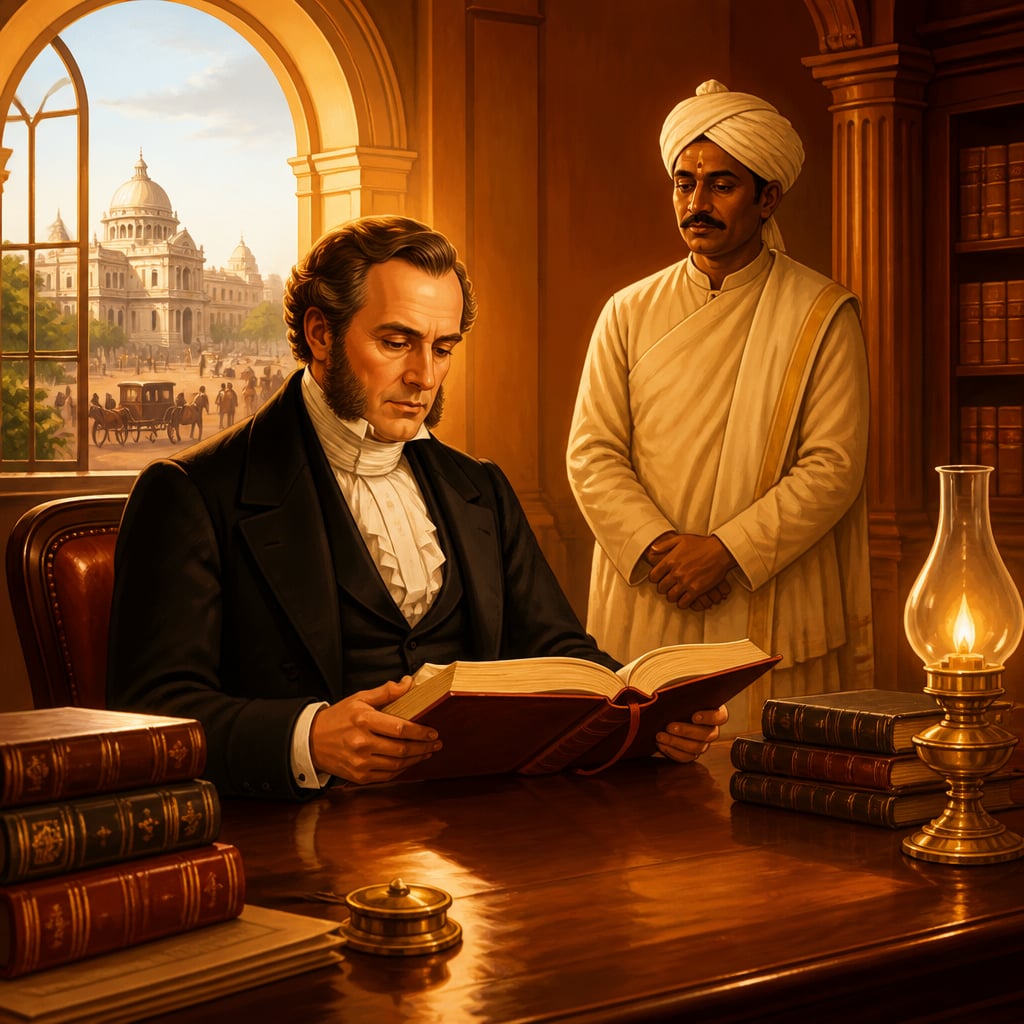
Sir Henry Maine encountering the Brihaspati Smriti in Calcutta 1865

It was 1865, and Sir Henry Maine sat in his chambers at the Calcutta High Court, wrestling with a commercial dispute between Hindu merchants. The case involved a partnership dissolution, contested collateral, and conflicting witness testimony, the kind of complexity that would challenge any legal system.

Maine had arrived in India expecting to find primitive customary law requiring British enlightenment. Instead, he found something that would reshape his understanding of legal history.

His clerk had placed on his desk a translation of the Brihaspati Smriti, prepared by pandits attached to the court. Maine began reading, and found himself increasingly unsettled.

The text before him contained:

"This is not primitive custom," Maine later wrote to a colleague. "This is a commercial code of remarkable sophistication. We are not bringing law to India, we are encountering a legal tradition as developed as our own, merely different in its philosophical foundations."

Maine's realization would inform his masterwork, Ancient Law (1861), and begin a slow recognition that Indian commercial law was not a blank slate awaiting British inscription, but a sophisticated system requiring respectful engagement.

The Architecture of the Brihaspati Smriti

An open Brihaspati Smriti palm-leaf manuscript on a scholar's desk

The Brihaspati Smriti (c. 300-500 CE) represents the most comprehensive treatment of commercial law in the Dharmashastra corpus. While Manu provided broad principles and Narada focused on procedure, Brihaspati synthesized centuries of commercial legal development into systematic framework.

The text is organized around the eighteen titles of law (aṣṭādaśa-vyavahāra-pada), the complete scope of legal disputes:

Title Sanskrit Commercial Relevance
1. Debt recovery Ṛṇādāna Core commercial obligation
2. Deposits Nikṣepa Bailment and custody
3. Sale without ownership Asvāmivikraya Title and possession
4. Partnership Sambhūya-samutthāna Joint ventures
5. Non-delivery of gift Dattāpradānika Promise enforcement
6. Non-payment of wages Vetanādāna Employment contracts
7. Breach of contract Samayasyānapākarma Contract remedies
8. Sale rescission Vikrīyāsaṃpradāna Consumer protection
9. Disputes between owner and herdsman Svāmipālayorvivāda Agency and bailment
10. Boundary disputes Sīmāvivāda Property rights
11. Assault Daṇḍapāruṣya Tort liability
12. Defamation Vākpāruṣya Reputation protection
13. Theft Steya Property crimes
14. Violence Sāhasa Criminal liability
15. Sexual offenses Strīsaṃgrahaṇa Family law
16. Husband-wife duties Strīpuṃdharma Domestic relations
17. Inheritance Dāyabhāga Succession
18. Gambling Dyūta Regulated activities

At least half these titles concern directly commercial matters; most others have commercial implications. The Brihaspati Smriti treats each systematically, with principles, exceptions, procedures, and remedies.

The Synthesis Achievement

What distinguished Brihaspati from earlier texts was systematic integration. Where Narada excelled at contract formation and Yajnavalkya at evidence, Brihaspati connected these into a unified framework.

1. Contract-to-Remedy Continuity

Brihaspati traced commercial obligations from formation through breach to remedy:

Formation: The five elements of valid contract (adhikārin, dharma-yukta, svecchā, mūlya, niyama)

Performance: Duties of each party during the contract term

Breach: Classification of breach types (non-performance, defective performance, anticipatory breach)

Remedy: Graduated responses (specific performance → compensation → penalty)

"Samayakṛtaṃ pālayitavyaṃ sarvaḥ samayaḥ svadharmeṇa | vyabhicāre tu samayāt daṇḍaḥ syāt samayānurūpaḥ ||" "Every contract must be observed according to its own dharma. But upon deviation from the agreement, penalty shall follow proportionate to the agreement."

This principle, that remedy should match the breach severity and contract type, anticipates modern contract law's distinction between material and minor breaches.

2. Evidence-to-Judgment Integration

Brihaspati connected evidence gathering to judgment formation:

Documentary primacy: Written evidence prevails unless proven forged

Witness hierarchy: Disinterested witnesses over interested; quality over quantity

Circumstantial inference: When direct evidence fails, conduct reveals truth

Burden allocation: Plaintiff must prove claim; defendant proves exceptions

"Lekhyaṃ sākṣiṇam ādhāya bhogaṃ cāpi tataḥ param | pūrvaṃ pūrvaṃ balīyaḥ syāt tatra tatra vyavasthitiḥ ||" "Document, witness, and possession, each earlier is stronger than the later. The determination follows this hierarchy."

3. Commercial-Criminal Integration

Brihaspati recognized that commercial misconduct could shade into criminal behavior:

This integration, treating commercial and criminal as connected rather than separate spheres, influenced Indian law's continued tendency to criminalize commercial misconduct (see: bounced checks, corporate fraud provisions).

Global Perspectives on Legal Codification

Frederick William Maitland (1850-1906) was the greatest English legal historian, whose works on medieval English law revealed how common law evolved from feudal custom to sophisticated commercial system. Maitland demonstrated that legal development follows economic development, as commerce grows complex, so must law.

Maitland never studied Indian law directly, but his methodology illuminates Brihaspati's achievement. Maitland showed that English commercial law emerged from merchants' practice, was recognized by courts, and eventually codified in statutes. The Brihaspati Smriti represents similar evolution: merchant guild practice → judicial recognition → systematic codification. Different societies, parallel developmental paths.

Justinian's Corpus Juris Civilis (529-534 CE) provides the direct comparison. The Roman Emperor Justinian commissioned a comprehensive codification of Roman law almost exactly contemporaneous with Brihaspati Smriti's composition. Both texts:

The Corpus Juris shaped European civil law tradition; the Dharmashastra shaped Indian legal tradition. Neither was "ahead" or "behind", both represented sophisticated responses to commercial complexity.

Max Weber (1864-1920), the German sociologist, analyzed Indian law in his comparative studies and concluded that Hindu commercial law showed "formal rationality" comparable to Western systems, logical consistency, predictable rules, systematic organization. Weber challenged the Orientalist assumption that Indian law was arbitrary or mystical; Brihaspati Smriti exemplified the rational systematization Weber identified.

Legal System Period Key Text Commercial Focus
Indian (Hindu) 300-500 CE Brihaspati Smriti 18 titles, integrated framework
Roman 529-534 CE Corpus Juris Civilis Comprehensive codification
English 1200s-1800s Common law precedents Case-by-case development
Continental European 1804+ Code Napoleon, BGB Statutory codification

The Commentator's Synthesis: Vijnaneshwara

Vijnaneshwara (c. 1070-1120 CE) composed the Mitākṣarā, a commentary on Yajnavalkya Smriti that became the dominant legal authority across most of India. While nominally a commentary on Yajnavalkya, Vijnaneshwara synthesized all major Smritis, including Brihaspati, into a unified interpretive framework.

Vijnaneshwara's achievement was harmonization. Where Smritis appeared to conflict, he showed how different texts addressed different contexts. Where principles seemed unclear, he provided practical interpretation. The Mitākṣarā became the working law of Hindu India not because it invented new principles, but because it made existing principles practically applicable.

For commercial law specifically, Vijnaneshwara:

When British courts sought "Hindu law" on commercial matters, they typically consulted Mitākṣarā, and through it, encountered Brihaspati's systematization.

Modern Resonance: Ancient Principles in Contemporary Codes

The influence of Brihaspati and related Smritis on modern Indian commercial law is both direct and pervasive, though often unacknowledged.

The Indian Contract Act, 1872

Sir Henry Maine's encounter with Dharmashastra influenced British India's legislative approach. When the Indian Contract Act was drafted, its architects faced a choice: impose purely English contract law, or synthesize English and Indian principles.

The result was synthesis, though often unconscious. Consider the parallels:

Contract Act Provision Brihaspati/Smriti Parallel
Section 10: Valid contract requires free consent, lawful consideration, competent parties, lawful object Five elements: svecchā, mūlya, adhikārin, dharma-yukta, niyama
Section 14-22: Consent vitiated by coercion, fraud, misrepresentation, mistake Balāt (force), moha (delusion), sāhasa (violence) void agreements
Section 73-74: Compensation for breach proportionate to loss Remedy proportionate to breach severity
Section 124-147: Indemnity and guarantee Pratibhūti (surety) provisions
Section 148-181: Bailment Nikṣepa (deposit) rules

The Contract Act's drafters drew on English common law, but the underlying commercial reality they were codifying had been shaped by Smriti principles for millennia. Hindu merchants already understood contract formation, breach, and remedy in Dharmashastra terms; the Act provided English-language codification of practices that Brihaspati had systematized centuries earlier.

The Insolvency and Bankruptcy Code, 2016

Modern NCLT insolvency tribunal hearing in session

India's modern insolvency framework, the IBC and its tribunals (NCLT/NCLAT), represents the most significant commercial law reform in decades. Yet its principles echo ancient concerns:

Debtor protection with creditor rights: The IBC balances giving debtors a "fresh start" against ensuring creditors recover fairly, exactly the Smriti balance between ṛṇa-mukti (debt freedom) and creditor security.

Resolution over liquidation: The IBC prefers reorganization (keeping businesses alive) over liquidation (dismemberment). Brihaspati similarly preferred karma-pūrti (specific performance, completing obligations) over mere compensation.

Specialized tribunals: The NCLT provides dedicated commercial adjudication, echoing the Dharmashastra's sabhā system where commercial disputes went to merchant assemblies with specialized knowledge.

Time-bound resolution: The IBC mandates resolution within 180-330 days, preventing the endless litigation that destroys commercial value. Smriti provisions similarly emphasized timely disposition, justice delayed was adharma.

IBC Provision Smriti Echo
Moratorium protecting debtor Protection of jīvikopakāraṇa (livelihood tools)
Committee of Creditors Śreṇi (guild) collective decision-making
Resolution plan over liquidation Karma-pūrti (performance) preference
Fraudulent transaction clawback Penalty for adharmic commercial conduct
Fresh start for individuals Ṛṇa-mukti as legitimate aspiration

The Comparative Method: Ancient and Modern Side by Side

P.V. Kane, the legendary scholar whose five-volume History of Dharmashastra remains definitive, developed a comparative method: reading ancient texts alongside modern statutes to reveal continuities and divergences.

Consider how Kane might compare Brihaspati with contemporary law on a specific issue, say, partnership dissolution:

Brihaspati Smriti:

"When partners wish to dissolve the joint enterprise, let the accumulated property be divided according to original contribution ratios, unless labor contribution was separately valued, in which case labor's share shall be calculated first."

Indian Partnership Act, 1932, Section 48:

"In settling the accounts of a firm after dissolution, the losses... shall be paid first out of profits, next out of capital, and lastly, if necessary, by the partners individually in the proportions in which they were entitled to share profits."

The modern statute is more detailed, but the underlying logic, divide according to contribution, with special treatment for different contribution types, echoes Brihaspati. The Partnership Act didn't invent these principles; it codified what merchants had practiced for centuries under Smriti guidance.

Kane's method reveals that modern Indian commercial law isn't simply British import or purely indigenous, it's synthesis, with ancient principles persisting beneath modern statutory language.

Your Turn: The Living Code

The Brihaspati Smriti teaches that commercial law isn't arbitrary rules imposed by authority, it's the systematization of practices that enable commerce to flourish. Every provision addresses a real problem merchants faced; every remedy reflects accumulated wisdom about what actually works.

When you encounter modern commercial law, ask Brihaspati's questions:

On contracts: Are the formation requirements ensuring genuine agreement, or creating technicalities that defeat reasonable expectations?

On evidence: Are the proof requirements finding truth, or excluding relevant information on arbitrary grounds?

On remedies: Is the response proportionate to the breach, or is one-size-fits-all creating injustice?

On procedure: Is the dispute resolution system delivering timely justice, or enriching lawyers while parties wait?

Brihaspati understood that good commercial law serves commerce, facilitating transactions, enforcing obligations, resolving disputes efficiently. Law that makes commerce harder, rather than easier, has failed its dharmic purpose.

Two thousand years later, as India develops new commercial frameworks, digital contracts, cryptocurrency regulation, AI liability, Brihaspati's method remains relevant: observe what commerce requires, systematize solutions that work, and embed ethical principles in practical rules.

In our final lesson for this chapter, we bring all these threads together, examining how ancient Indian commercial law principles apply to the challenges of 2026 and beyond.

Douglas North's Institutional Economics (Nobel Prize 1993) established that economic development depends on institutional infrastructure, including predictable, enforceable commercial law. Countries with reliable legal systems attract more investment and enable more complex transactions.

The Brihaspati system provided this infrastructure for ancient Indian commerce. Merchants trading across the subcontinent, and beyond to Rome, Persia, Southeast Asia, could rely on consistent legal principles governing their transactions. This legal certainty enabled the commercial networks that made ancient India wealthy.

The World Bank's Ease of Doing Business index shows strong correlation between contract enforcement predictability and economic growth. India's improvement from rank 142 (2014) to 63 (2019) accompanied GDP growth acceleration, validation of Brihaspati's insight that commercial law quality affects commercial outcomes.

Gary Becker's economic analysis of law (Nobel Prize 1992) showed that penalties should be calibrated to deter efficiently, too low and violations continue; too high and over-deterrence chills legitimate activity. The optimal penalty equals the harm caused times the probability of escaping detection.

Brihaspati anticipated this analysis intuitively. The principle of 'samayānurūpaḥ' (proportionate to the agreement) means remedies calibrated to contract type and breach severity. A minor delay in delivery warrants different treatment than fundamental non-performance; commercial contracts warrant different remedies than personal agreements.

Studies of the IBC (Insolvency Code) show that proportionate resolution, restructuring rather than liquidation where possible, preserves significantly more value than rigid creditor-takes-all approaches. Brihaspati's proportionality principle, applied in modern insolvency, shows measurable economic benefit.

Key terms

Aṣṭādaśa-vyavahāra-pada
The eighteen titles of law; the comprehensive classification of legal disputes recognized in Dharmashastra, covering the complete scope of matters requiring legal resolution
Mitākṣarā
Literally 'measured words'; the famous commentary on Yajnavalkya Smriti by Vijnaneshwara that became the dominant legal authority across most of India
Dharmaśāstra
The science or treatise of dharma; the genre of Sanskrit texts dealing with law, ethics, and proper conduct, including the Smritis that codified commercial law
Saṃhitā
A compilation or codification; a systematic collection of rules or texts on a particular subject arranged in organized form

Verses

समयकृतं पालयितव्यं सर्वः समयः स्वधर्मेण | व्यभिचारे तु समयात् दण्डः स्यात् समयानुरूपः ||

samayakṛtaṃ pālayitavyaṃ sarvaḥ samayaḥ svadharmeṇa | vyabhicāre tu samayāt daṇḍaḥ syāt samayānurūpaḥ ||

Every pact must be kept according to its own true nature; but when one strays from what was pledged, let penalty match the departure's measure.

The proportionality principle prevents both under-deterrence (penalties too small to matter) and over-deterrence (penalties so severe they discourage contracting). Modern contract law's distinction between material and minor breaches, with different remedy consequences, follows this ancient logic.

Brihaspati Smriti, Vyavahara-kanda, General Principles (Based on Julius Jolly translation)

लेख्यं साक्षिणमाधाय भोगं चापि ततः परम् | पूर्वं पूर्वं बलीयः स्यात् तत्र तत्र व्यवस्थितिः ||

lekhyaṃ sākṣiṇam ādhāya bhogaṃ cāpi tataḥ param | pūrvaṃ pūrvaṃ balīyaḥ syāt tatra tatra vyavasthitiḥ ||

Document, then witness, then possession held, each earlier form of proof more weight does wield.

The documentary primacy principle encourages written contracts, reducing dispute costs. When parties know documents will prevail over testimonial recollection, they invest in clear documentation at formation, preventing disputes rather than merely resolving them.

Brihaspati Smriti, Vyavahara-kanda, Evidence Section (Based on P.V. Kane translation)

समुत्थानं यथोक्तेन विधिना यो न पालयेत् | स स्वभागाद् विहीनः स्यात् धर्मशास्त्रविधानतः ||

samutthānaṃ yathoktena vidhinā yo na pālayet | sa svabhāgād vihīnaḥ syāt dharmaśāstra-vidhānataḥ ||

Who fails to honor the partnership's rule shall lose his portion, dharma's verdict, firm and full.

Forfeiture creates powerful incentives for partnership fidelity. A partner who knows misconduct will cost them their share has strong reason to act properly. This is more effective than mere damage claims, which might not fully compensate faithful partners for breach harm.

Brihaspati Smriti, Vyavahara-kanda, Partnership Section (Based on Julius Jolly translation)

Key figures

Vijnaneshwara

c. 1070-1120 CE

Pandurang Vaman Kane

1880-1972

Frederick William Maitland

1850-1906

Case studies

From Brihaspati to the Contract Act: Ancient Principles in Modern Statutory Form

The Indian Contract Act, 1872 is one of India's oldest statutes still in force, governing contract formation, performance, breach, and remedies for over 150 years. The Act was drafted during British colonial rule, ostensibly importing English common law contract principles. Yet a closer examination reveals remarkable parallels with Dharmashastra provisions that governed Indian commerce for centuries prior. Consider the Act's fundamental framework: **Section 10 (Valid Contract):** 'All agreements are contracts if they are made by the free consent of parties competent to contract, for a lawful consideration and with a lawful object, and are not hereby expressly declared to be void.' **Compare Brihaspati:** Valid contracts require: (1) competent parties (*adhikārin*), (2) free consent (*svecchā*), (3) lawful object (*dharma-yukta*), (4) consideration (*mūlya*), (5) clear terms (*niyama*). The mapping is nearly perfect, five elements in each system, covering the same conceptual ground.

The Contract Act's apparent adoption of English principles masked substantial continuity with Dharmashastra: **Consent vitiation (Sections 14-22):** The Act treats coercion, undue influence, fraud, and misrepresentation as factors that make consent not 'free.' Brihaspati's provision that agreements made by *balāt* (force), *moha* (delusion), or *sāhasa* (violence) are void addresses the same concern, only genuine meeting of minds creates binding obligation. **Consideration requirement (Section 2(d)):** English law requires 'consideration' for valid contracts; Indian law adopted this requirement. But consideration parallels the Dharmashastra requirement of *mūlya* or *arha* (something of value exchanged). The form differs; the substance, that gratuitous promises are treated differently than bargained exchanges, is identical. **Remedy framework (Sections 73-75):** The Act provides for damages 'naturally arising' from breach plus 'special damages' for foreseeable consequences. Brihaspati's proportionate remedy principle (*samayānurūpaḥ*) similarly calibrates response to breach type and severity. The colonial drafters may not have consciously imported Dharmashastra, but they were codifying commercial practices that Dharmashastra had shaped. Indian merchants already understood these principles; the Contract Act gave them English-language statutory form.

The Indian Contract Act has proven remarkably durable, still governing Indian commerce 150+ years after enactment. Courts have interpreted its provisions consistently with both English precedent and Indian commercial practice. Notably, Indian courts have sometimes interpreted Contract Act provisions more expansively than English courts, reflecting underlying Dharmashastra influences: - Greater willingness to find 'undue influence' protecting weaker parties (echoing Dharmashastra's concern for consent quality) - More flexible approach to consideration (allowing past consideration in some contexts) - Greater emphasis on good faith performance (reflecting dharmic obligations beyond contract letter) The Act's longevity suggests that its principles, whether traced to English common law or Dharmashastra, reflect genuine requirements of commercial practice that transcend particular legal traditions.

Legal systems that govern similar commercial activities tend to develop similar solutions, not because one copies another, but because commercial reality imposes constraints. Brihaspati and the Contract Act drafters, separated by 1,500 years, arrived at similar frameworks because contracts everywhere require consent, capacity, consideration, and clarity. The lesson isn't about legal genealogy; it's about understanding why certain principles persist across traditions.

India's new data protection law, the Digital India Act (in progress), and updates to commercial arbitration rules all face the same design challenge: how to govern 21st-century transactions using principles that remain stable. The convergence between ancient Indian commercial law and modern statute suggests that foundational principles of consent, performance, and remedy are universal, even as their expression changes with technology.

A 2019 study of Contract Act jurisprudence found that Indian courts cite English precedents in approximately 60% of contract cases, but depart from English interpretation in approximately 25% of cases, often in directions consistent with Dharmashastra principles (broader consent protection, greater emphasis on good faith, more flexible remedies).

The IBC Revolution: Ancient Principles in Modern Insolvency Framework

The Insolvency and Bankruptcy Code, 2016 (IBC) represents India's most significant commercial law reform in decades. The Code created a unified framework for insolvency resolution, replacing a patchwork of laws that had made debt recovery painfully slow, often taking decades, with recovery rates among the world's lowest. The IBC introduced: - **Time-bound resolution:** Maximum 330 days from initiation to resolution - **Creditor-in-possession initially, resolution professional management:** Replacing debtor control during proceedings - **Committee of Creditors decision-making:** Collective creditor governance - **Resolution over liquidation preference:** Preserving going-concern value where possible - **Fresh start provisions for individuals:** Debt relief enabling economic re-engagement The transformation has been dramatic: recovery rates improved from approximately 26% (pre-IBC) to approximately 43% (post-IBC); resolution time dropped from 4+ years to under 2 years for resolved cases.

The IBC, though designed by modern technocrats drawing on global best practices, echoes Dharmashastra principles: **Resolution over liquidation** parallels Brihaspati's preference for *karma-pūrti* (specific performance) over mere compensation. Where the ancient text preferred that obligations be fulfilled rather than merely compensated, the IBC prefers that businesses continue operating (with new ownership/management if necessary) rather than being dismembered. **Time-bound resolution** reflects the Dharmashastra insistence that justice delayed is *adharma*. The Smritis prescribed expeditious dispute resolution; the IBC's strict timelines operationalize this principle with specific deadlines. **Committee of Creditors** echoes the *śreṇi* (guild) model of collective decision-making. Just as merchant guilds made collective determinations affecting member interests, the CoC represents creditor collectivity deciding resolution outcomes. **Fresh start for individuals** reflects *ṛṇa-mukti* (debt freedom) as legitimate aspiration. The Dharmashastra recognized that perpetual debt bondage served no one; the IBC's personal insolvency provisions enable genuine fresh starts. **Protection of essential assets** in personal insolvency echoes *jīvikopakāraṇa* (livelihood tools) exemptions, certain property remains with the debtor regardless of debt size. The IBC's designers may not have consciously drawn on Dharmashastra, but they were solving problems that Indian commercial law had addressed for millennia.

The IBC has transformed Indian commercial law: - Over 5,000 cases resolved in NCLT since 2016 - Recovery rates for financial creditors improved significantly - 'Ease of Doing Business' ranking improvement partly attributed to insolvency reform - Behavioral change in debtor-creditor relationships (debtors more willing to engage constructively knowing resolution will be timely) Challenges remain: - Infrastructure strain (NCLT benches overloaded) - Litigation delays despite statutory timelines - Real estate sector complications - Pre-packaged insolvency processes still developing But the directional change, from endless litigation to time-bound resolution, from liquidation preference to reorganization preference, represents alignment with both global best practices and ancient dharmic principles.

The IBC demonstrates that modern commercial law reform can align with ancient principles while adopting contemporary mechanisms. Time-bound resolution, collective creditor governance, and fresh-start provisions aren't just global best practices borrowed from the US or UK, they echo Dharmashastra values that Indian commerce has honored for centuries. The best reforms often rediscover ancient wisdom in modern form.

The IBC's success has inspired similar reforms across emerging economies. Pre-packaged insolvency for MSMEs (introduced 2021) extends the framework to small businesses, while cross-border insolvency provisions are being developed for multinational cases. The speed of resolution has attracted global investors who previously avoided Indian distressed assets, proving that legal infrastructure directly impacts capital flows.

World Bank Resolving Insolvency rankings: India improved from 136 (2017, pre-IBC implementation) to 52 (2020). The 84-rank improvement was among the largest for any country globally, demonstrating that systematic commercial law reform produces measurable results.

Historical context

Classical Smriti Period (300-600 CE) and Commentary Period (1000-1200 CE)

The period saw India as a major node in global trade networks, connected to Rome, Persia, Central Asia, Southeast Asia, and China. Complex commerce required complex law; the Dharmashastra corpus developed correspondingly. The later commentary period (Mitākṣarā, etc.) represented systematization for practical court application as political authority fragmented but commercial networks persisted.

The Dharmashastra-to-Mitākṣarā development parallels European legal development: Roman law codification → medieval glossators and commentators → early modern systematizers. Both traditions moved from authoritative text through interpretive commentary to practical application. The timing differed (Indian development earlier), but the pattern, text, commentary, synthesis, appears universal for complex legal systems.

Archaeological evidence from Gupta-period commercial centers (Tamralipti, Bharuch, Arikamedu) shows standardized weights, sealing practices, and documentation consistent with Brihaspati Smriti's commercial law provisions, evidence that the texts reflected actual commercial practice.

Understanding Dharmashastra as sophisticated legal codification corrects the colonial narrative that India lacked developed law before British arrival. The reality: India had comprehensive commercial codes while England still relied on local custom. British codification (Contract Act, etc.) engaged with an existing legal tradition, not a blank slate.

Living traditions

Modern Indian commercial law reflects Dharmashastra influence at multiple levels: the Contract Act's formation requirements parallel Smriti provisions; the IBC's resolution principles echo ancient debt-recovery frameworks; evidence law maintains documentary primacy from Yajnavalkya; partnership provisions follow Brihaspati's profit-sharing logic. Courts regularly cite Dharmashastra texts when interpreting statutory ambiguities in Hindu law matters, and legal education increasingly recognizes indigenous legal tradition alongside imported British principles.

Reflection

More in Ancient Contracts, Partnerships & Risk

All lessons in Ancient Contracts, Partnerships & Risk · Vaishya Dharma: The Art of Ethical Commerce course