The Vaada Vriksha: The Decision Tree
Step 0: Adhikari Bheda. Then the Tree.
The Vaada Vriksha is the capstone framework of this course. Step 0 comes before the tree: Adhikari Bheda, the Mahabharata's teaching that not every opponent deserves engagement. Then the three branches. Vaada, engage fully. Jalpa, control the frame. Vitanda, exit cleanly. Your job is not to win every argument. It is to pick the right branch for the person and the platform in front of you.
The Question Before the Tree
Hastinapura, sometime in the years leading up to the Kurukshetra war. A blind king sits in his chamber. His younger brother, born of a palace maid and raised as the moral conscience of the court, stands before him. The brother is Vidura. The king is Dhritarashtra.
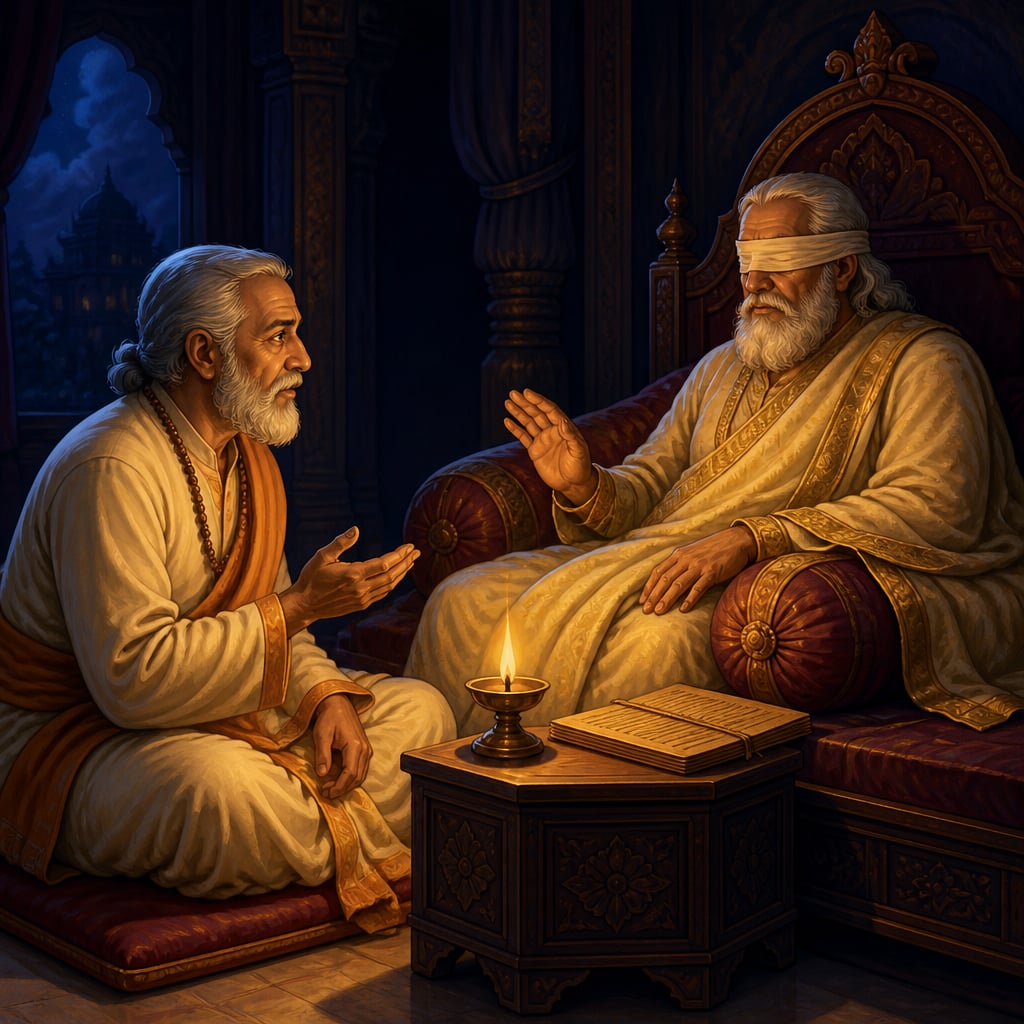
Vidura has been giving dharmic counsel to this king for decades. He has warned him about Duryodhana. He has warned him about the game of dice. He has warned him about the insult to Draupadi. Every warning was correct. Every warning was heard. None of them were acted on.
In the Udyoga Parva, on the eve of war, Vidura sits up through the night delivering what the tradition now calls the Vidura Niti, one of the longest passages of ethical counsel in the Mahabharata. Dhritarashtra listens. At dawn, Dhritarashtra still intends to back his son.
Vidura does one thing most readers of the epic miss on the first reading. He stays. He keeps giving counsel. But he has already, quietly, made a different choice about what kind of counsel this is. He is no longer speaking to convince. He is speaking for the record, so that history, the gods, and later readers would know where dharma stood.
This is the question that opens this lesson, and it is the question the Dharmic tradition insists you answer before you answer anything else. Who is the person in front of you, and what kind of engagement do they deserve?
The Mahabharata's name for this distinction is Adhikari Bheda, the distinction of the qualified. An Adhikari is someone whose mind can change when shown evidence. A non-Adhikari cannot. Not because they are stupid. Because something else, ego, fear, loyalty, power, money, is holding their position in place. Evidence does not reach what is not being held by evidence.
You cannot tell these two apart by their opening sentence. You can only tell by watching what happens after the first two or three rounds of honest exchange. An Adhikari updates. A non-Adhikari restates, louder.
Step 0 of the Vaada Vriksha is this: before you engage, ask who the person in front of you actually is. Then pick the branch that fits.
The Tree
The Vaada Vriksha has exactly three branches. Every opponent, every platform, every moment, fits on one of them. The tree is the whole lesson.
Branch 1: Vaada. Engage Fully.
Use this branch when the person in front of you is an Adhikari, the platform gives you space to talk properly, and your own inner state is steady. The goal is truth. Both of you may update. You run the full Shat-Khandana System. You do Purva Paksha. You build. You question. You close the loop.
This is the highest and rarest branch. Most public arguments do not qualify. Be generous in offering it. Be honest when the other person is not ready for it.

Branch 2: Jalpa. Control the Frame.
Use this branch when the opponent is a non-Adhikari but the audience matters. You will not change the opponent's mind. You may change the audience's mind. The goal is not to win with the opponent. It is to make sure dharma's position is visible, clear, and on the record for everyone else in the room.
Jalpa has two sub-branches worth naming.
- Delay. If you are not prepared, the room is not the right room, or your inner state is not steady, buy time. 'That is a serious question. Let me come back to it next week with the full picture.' Delay is not cowardice. It is battlefield awareness.
- Redirect. If the frame the opponent has set up is rigged, reframe once, clearly, and move the conversation to the honest version of the question. 'The real question here is not X, it is Y. Let me explain why.' One reframe, cleanly done.
Branch 3: Vitanda. Exit.
Use this branch when the person is a non-Adhikari, the audience will not be reached, and continuing would only drain your Shakti without creating any dharmic return. The goal is not to walk away in silence. It is to exit in a way that does not leave the field to lies.
Vitanda also has two sub-branches.
- Document. Before exiting, write down what was said, what was not answered, and where. A short post, a clean email, a two-line note in a group. The audience who was not in the room, and the future reader, can still be reached by the record. Vidura stayed and spoke for the record even when he knew Dhritarashtra would not change.
- Escalate. If the non-Adhikari is causing harm beyond the debate, platform abuse, misinformation at scale, coordinated attack, escalate to the right forum. Moderators. Regulators. Press. Courts. Not as revenge. As the right use of the right tool.
That is the whole tree. Three branches. Two sub-branches each under Jalpa and Vitanda. Six paths in total, plus full engagement under Vaada.
Three Walked Scenarios
Reading a tree is not the same as using a tree. Here are three scenarios the tree handles. Walk them slowly.
Scenario 1: The Twitter Troll
A stranger replies to your post with a sneer, a strawman, and a demand that you defend yourself. You have forty-seven notifications. You have a day job. The stranger has an anime avatar and a three-month-old account. The thread has eleven likes.
Step 0. Is this person an Adhikari? The account is new. The opening move is contempt. The history shows the same pattern on twenty other threads. Non-Adhikari.
The tree. Vaada is wrong. Jalpa is wrong because the audience is tiny and the platform shatters long arguments. Vitanda. Sub-branch: document or escalate? The troll is not causing harm at scale. Document is overkill. Do not engage. Do not quote-tweet. Do not screenshot-and-clap. Scroll past. Save your Shakti for real opponents.
Scenario 2: The Family Argument at Dinner

Your uncle, home for a wedding, makes a confident sweeping claim about a contested political topic. The table goes quiet. Your aunt looks tense. Your cousin is watching you.
Step 0. Is your uncle an Adhikari? Unlikely tonight, on this topic, in front of the whole family, after two glasses of wine. But he is not a bad-faith opponent. He is family. The audience is real. Your cousin, your aunt, and the younger kids at the table are the people who matter here.
The tree. Jalpa. Control the frame. Sub-branch: Redirect once. 'I see it differently. The real question here is X, not what you said. Let me give one example.' One clean reframe, one clear example, then let the conversation move on. You are not here to destroy your uncle. You are here to make sure your cousin, who is sixteen and paying attention, sees that there is another honest position.
Scenario 3: The News Panel
You have been invited onto a prime-time news channel with thirty-eight minutes on the clock, four guests, and one anchor whose framing questions are not neutral. The other guests include a researcher you respect, a columnist you have argued with before, and one person whose presence on the panel is, itself, an insult to the topic.
Step 0 is two questions, not one. Is the anchor an Adhikari in the full sense? Almost certainly not; a good anchor manages the show, not the truth. Is the researcher across the table one? Yes. Is the columnist? No, but their followers are.
The tree. Jalpa with the columnist and anchor. Vaada with the researcher. You can run both on the same panel if you stay steady. With the researcher, engage seriously, update openly, disagree honestly; the audience will see that both of you are there for truth. With the columnist and anchor, control the frame, name tactics cleanly (Expose the Pattern from Lesson 8.1), and redirect once when the frame is rigged. Do not pretend to be debating truth with someone who is debating ratings.
Sidebars
Two of the earlier lessons quietly support the tree. They do not need to be re-taught here.
If you want to go deeper on which level of a debate you are on, the data level, the logic level, the frame level, the value level, or the meta level, recall Pancha-Tala from Lesson 2.7. Pick the level where the honest conversation can actually happen, and meet the opponent there.
Before engaging on any branch, check your own inner state from Lesson 10.1. If you are not in Sthitaprajna, pause. A Vaada run from ego becomes Jalpa. A Jalpa run from fear becomes Vitanda without the exit. The tree works only when the person using it is steady.
These sidebars are reminders, not re-teachings. Go back to 2.7 and 10.1 when you need them.
Why This Tree Changes Everything
Most debaters, Dharmic or otherwise, run one branch by default. Some try to run Vaada on every opponent, and burn out within a year. Some run Vitanda on everyone, and lose every argument by default. Some run Jalpa on everyone, and become indistinguishable from the people they are fighting.
The Vaada Vriksha teaches the opposite discipline. The right branch depends on the person and the platform, not on your mood or your habit. A great debater picks the branch that fits, and picks it quickly.
This is what the Mahabharata means when it says dharma is sukshma, subtle. It is not a rulebook. It is a tree with choice-points, and the choice-points depend on who is in front of you. Vidura stayed. Krishna went as envoy. Arjuna fought. Each of them picked a different branch on the same civilizational question, and each of them acted rightly within their branch.
The Discipline of Saving Shakti
There is a quiet line in the Vidura Niti that the tree rests on. Shakti kshayaya na kartavya. Your strength should not be spent needlessly. Every Vaada, every Jalpa, every Vitanda costs something. Attention, clarity, emotional energy, and in public life, reputation. You have a finite supply. The tree is, in the end, a resource-management framework dressed as a debate framework. Saving your Shakti for battles that matter is not selfishness. It is the dharma of a fighter who wants to still be fighting in ten years.
Modern Echoes
The Harvard negotiation scholar William Ury, co-author of Getting to Yes (1981), eventually wrote a companion book called The Power of a Positive No (2007). His core argument in the later book: negotiators burn out not because they fight too little, but because they fight everything indiscriminately. His prescription, which he presents as a modern insight, maps almost exactly onto Adhikari Bheda. Know who you are negotiating with. Pick the mode that fits. Say no cleanly when no is the right answer. Two and a half thousand years after Vidura, a Harvard program on negotiation reached the same conclusion by a different road.
The writer Naval Ravikant has compressed the same teaching into a modern aphorism widely shared in Indian tech circles: 'You cannot reason someone out of a position they did not reason themselves into.' That is Adhikari Bheda in one line. The tree is what you do after you have accepted that line.
Back in Hastinapura, Vidura finishes his night of counsel. Dhritarashtra thanks him. Nothing has changed in the king's intentions. But on some later page of the epic, long after Vidura has walked out of the palace and into the forest, a listener is still reading what Vidura said that night. The record reached someone. The tree had worked, just not on the branch Vidura would have chosen if he had had a choice.
Case studies
Vidura and Dhritarashtra: Step 0 Walked to Its Honest End
Across the long arc of the Mahabharata, Vidura gives his half-brother Dhritarashtra correct counsel on every major decision. Do not send Duryodhana and Shakuni to the dice game. Do not permit the disrobing of Draupadi. Do not let the exile end in betrayal. Do not reject the Pandavas' offer of five villages. Each warning is dharmic, precise, and delivered with respect. Each warning is heard. None is acted on. By the eve of the Kurukshetra war, Vidura has been counselling Dhritarashtra for roughly forty years with the same outcome. The night before the war, he still sits up and delivers the Vidura Niti in full, one of the longest passages of ethical counsel in the entire epic. Then, later, he quietly leaves the palace and walks into the forest, never to return.
Vidura's career is the canonical Step 0 case of the Vaada Vriksha. He correctly identifies Dhritarashtra as a non-Adhikari very early. A non-Adhikari is not an enemy; Dhritarashtra loves Vidura. But the king's position is held in place by vatsalya (attachment to his son) and not by evidence. No amount of counsel will reach what is not being held by evidence. Vidura does not run Vaada. He runs Vitanda with Document, the subtlest sub-branch of the tree. He stays in the court and speaks for the record, so that the later reader, which includes us, two and a half millennia after the fact, can see where dharma stood. When even the record stops reaching anyone, he exits. Every branch of the Vaada Vriksha, done at the right moment, in the right order.
The war happens. Dhritarashtra loses his hundred sons. The Vidura Niti, which Dhritarashtra heard and ignored, is read today as a foundational Indian ethics text. Vidura's choice to stay and document rather than exit early or engage pointlessly gave the tradition one of its clearest maps of dharmic counsel under tyranny.
If the person you are arguing with is a non-Adhikari but the larger audience (family, court, readers, future) is real, stay. But stay as a Document keeper, not as a debater. The record, written honestly, reaches people the live debate never will.
The Vidura Niti spans roughly 7,000 verses across the Udyoga and Shanti Parvas, making it one of the longest single ethical-counsel passages in any ancient text in any language.
Krishna's Peace Mission: Jalpa for the Record
In the Udyoga Parva, after thirteen years of Pandava exile, Krishna is sent to Hastinapura as peace envoy. The Pandavas' demand has been whittled down to a final minimum: return of five villages. Krishna knows before he enters the court that Duryodhana will refuse. Duryodhana's position is held in place by ego, jealousy of the Pandavas' wealth in Indraprastha, and decades of accumulated resentment. None of this is evidence-based. Krishna still goes. He enters the Kuru sabha before the full assembly of elders, warriors, allies, and family. He delivers a long, precise, publicly recorded argument for peace. He names the dharmic costs of war. He quotes tradition. He offers, with full dignity, the minimum terms. Duryodhana rejects the offer and attempts to arrest Krishna himself. Krishna reveals his Vishvarupa briefly, and walks out.
This is the Jalpa branch run with full awareness and full dignity. Krishna's Adhikari Bheda judgment is correct; Duryodhana is a non-Adhikari on this topic. But the Kuru sabha is the largest possible audience for a foundational dharma claim. Bhishma is present. Drona is present. Vidura is present. Every neutral and wavering ally in the court is present. The Jalpa is not for Duryodhana. It is for the sabha, and through the sabha, for history. Krishna controls the frame perfectly. He refuses the rigged framing of the Pandavas as rebellious claimants. He reframes, once, cleanly: the question is not whether the Pandavas deserve the kingdom; it is whether a king is a king at all who breaks his word. Then he lets the record stand.
War becomes inevitable, but the Pandavas enter it with the full moral record that they had offered peace down to a minimum of five villages and been refused. Later critics, within the Mahabharata and outside it, who attempt to argue that the Pandavas started the war are undercut by this scene. The Jalpa worked. Not with Duryodhana; with everyone else who ever read the text.
When you are going into a debate with a non-Adhikari in front of a large audience, do not sulk, walk out, or shout. Run Jalpa with full seriousness. Make dharma's position visible. Let the record do the work on the rest of the audience and on the later reader. Your victory is not measured by whether the opponent conceded.
The Udyoga Parva, which centers on Krishna's peace mission, is the longest book of dedicated dharmic diplomacy in the Mahabharata, over 6,000 verses across roughly 197 chapters, far longer than the entire Bhagavad Gita.
The Poona Pact: Full Vaada Under Real Pressure
In September 1932, Mahatma Gandhi began a fast unto death in Yerwada Jail, Pune, against the British Communal Award's grant of separate electorates to the Depressed Classes. On the other side of the negotiation was Dr. B. R. Ambedkar, the Columbia and LSE trained jurist and scholar whose community had won the separate electorates in the first place. Ambedkar was under enormous pressure: Gandhi's death during the fast would have been pinned on him publicly, and communal violence against his community would have been catastrophic. Across six days, with the clock of Gandhi's fast ticking in the background, Ambedkar met Gandhi's representatives, then Gandhi himself, in the Yerwada compound. They argued openly about representation, reservation, the nature of democracy, and the future of the Depressed Classes in independent India. At the end, they produced the Poona Pact: a replacement of separate electorates with reserved seats in joint electorates, with a substantially larger number of seats for the Depressed Classes than the Communal Award had given.
This is the Vaada branch of the Vaada Vriksha run at civilizational stakes. Ambedkar's Adhikari Bheda judgment of Gandhi is the striking part. Under pressure that would have justified Vitanda (exit, or refuse to talk under duress), Ambedkar recognized that Gandhi, whatever their real disagreements, was an Adhikari on this specific topic. Gandhi could and would update on evidence; the fast was not a negotiating trick but a moral act Gandhi took seriously. So Ambedkar engaged in full Vaada. He stated his position with full rigor. He steelmanned Gandhi's position. He forced reciprocal concessions. Both sides walked out with a document neither had started with. The Shakti was not spent on posturing. It was spent on producing a workable settlement.
The Poona Pact was signed on 24 September 1932 and became the basis for reserved seat provisions that were later incorporated into the Constitution of India, where Ambedkar himself served as chair of the drafting committee. The number of reserved seats for the Depressed Classes rose from 71 in the original award to 148 in the Pact. Ambedkar and Gandhi continued to disagree, publicly and sharply, on many other issues for the rest of Gandhi's life. On this one, full Vaada produced a result that survived.
When the person across the table is a genuine Adhikari, engage fully even under extreme pressure. Steelman them. Force them to steelman you. Let the argument actually reach the shape of a negotiated truth. Full Vaada is rare, expensive, and sometimes decisive.
The Poona Pact increased reserved seats for the Depressed Classes in provincial legislatures from 71 to 148, more than doubling representation compared to the original Communal Award, a shift negotiated in under a week of intense talks.
The WhatsApp Family Group: Vitanda with Document, the Modern Everyday Case
A thirty-three-year-old professional in Pune is the youngest active member of a forty-person extended-family WhatsApp group. Every morning the group receives five to ten forwarded videos, memes, and audio clips. Some are benign. Most are low-quality political or communal outrage material, shared by older uncles in good faith. For six months, she does the full Shat-Khandana on each serious forward. She names tactics (Expose the Pattern). She fact-checks sources (Anchor the Frame). She asks for primary evidence (Redirect the Burden). She finds the one counter-example (Isolate the Weakness). She defuses the emotion (Dissolve the Emotion). She closes the loop (Close the Loop). She does this respectfully, with context, in long messages. At the end of six months, the volume of forwards has not dropped. Two uncles have privately thanked her. Four have stopped speaking to her. The group's overall tone is the same.
This is where Vitanda lives in modern life. She began with generous Adhikari Bheda assumptions, and she tested them over six months of real engagement. The Vaada Vriksha's update is clear. The majority of the group is not an Adhikari audience on this topic; the two uncles who thanked her privately are. Continuing full engagement in the group drains her Shakti without creating Dharmic return. But pure silent exit is wrong too; it leaves the field. The tree's answer is Vitanda with Document. She posts one final message: a short, clean, dated summary of the specific categories of misinformation that have recurred, the three most common sources, and a simple request that the group agree to source-check before forwarding. She thanks the people who engaged with her. She stays in the group but mutes it. She writes the same message, tightened, as a one-page PDF and shares it with the two uncles privately. Her Shakti is now reserved for one-on-one Vaada with the Adhikaris she has identified.
Over the following year, forward volume in the group does not meaningfully change. But the two uncles who engaged start source-checking their own forwards before sending them. One of them becomes, within his own smaller circle, a source-checker for the next generation of cousins. The Vitanda-with-Document exit did not fix the group. It concentrated her Shakti on the actual Adhikaris and gave the tradition a pocket of honest discourse where there had been none. This is the realistic Vaada Vriksha outcome for 90 percent of modern family and social media arguments.
Most of your debates are in family WhatsApp groups, office chains, comment sections, and dinner tables, not in courtrooms or on TV. Run Step 0 honestly. If six months of real engagement changes nothing, you have your answer. Vitanda with Document, followed by private Vaada with the Adhikaris you found along the way, is the most common correct branch of the Vaada Vriksha in ordinary life.
Researchers at IIT Bombay (2020) studying misinformation in Indian WhatsApp groups found that roughly 5 to 10 percent of members in any large family group were genuinely open to source-checking, while the remaining 90 to 95 percent were held by loyalty patterns no single-forward correction could reach. The study's finding quantifies what Adhikari Bheda names qualitatively.
Reflection
- Think of an argument from the last month where you invested far more energy than the situation warranted. Looking back, were you running the wrong branch of the Vaada Vriksha for the person in front of you? Which branch would you run now?
- Why does the Mahabharata give so much weight to Vidura's counsel even though Dhritarashtra never acted on it?
- If dharma is situational, as Vidura says, how is it different from relativism?