Building a Civilizational Debate Culture
From Individual Skill to Collective Capability
An individual dharmic debater is a single voice. A civilizational debate culture is a system of voices that trains, tests, and sustains itself across generations. India had this system for over a thousand years at Nalanda, Vikramashila, Mithila, and Sringeri. The system was destroyed in 1193 and is being slowly rebuilt today through podcasts, fellowships, and self-organized study circles. This lesson teaches what made the original culture work, what Hindus lost when it ended, and what the modern dharmic debater must do to participate in rebuilding it.
The Burning Library
In the winter of 1193, on a cold morning in northern Bihar, a Turkic cavalry commander named Bakhtiyar Khilji rode up to the gates of Nalanda Mahavihara at the head of a few hundred horsemen. Nalanda was eight hundred years old. It had been founded under the Gupta emperor Kumaragupta the First in the early fifth century. It had survived the Hunas, the rise and fall of three imperial dynasties, and twelve generations of intellectual reformation. Inside its walls, on the morning Khilji arrived, ten thousand monks lived in residential quarters, two thousand teachers held classes in stone-floored halls, and a library of nine million manuscripts was housed in three buildings the monks called Ratnasagara, Ratnodadhi, and Ratnaranjaka. The Three Oceans of Jewels.
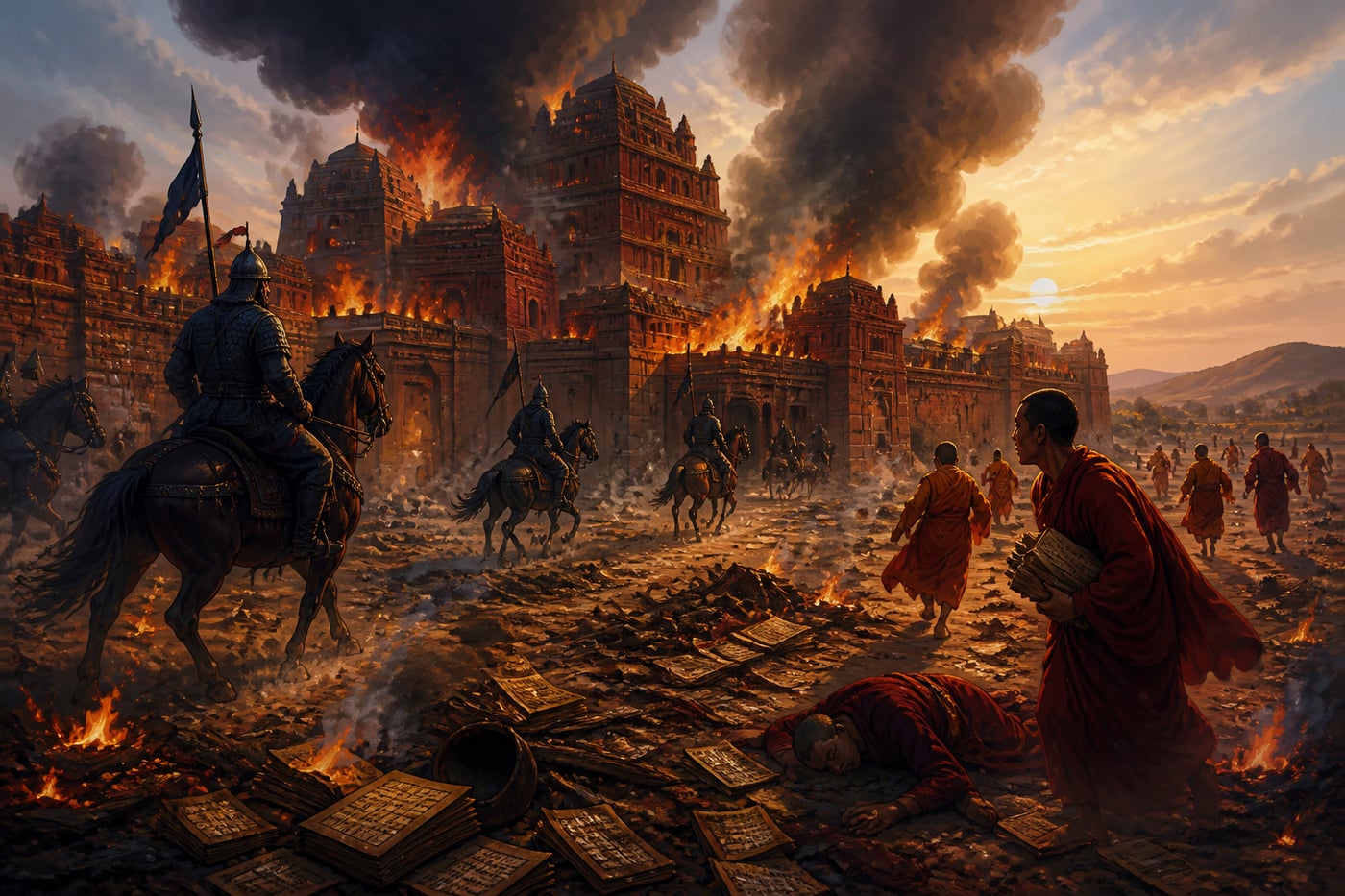
The Persian historian Minhaj-i-Siraj, writing in his Tabaqat-i-Nasiri about half a century later, recorded what happened next. The cavalry stormed the gates. The monks were killed. The libraries were set on fire. Minhaj writes, in plain Persian, that the manuscripts burned for several months. Several months. The smoke from a library that took six centuries to assemble rose over the Bihar countryside through the winter and into the spring.
The debate halls of Nalanda fell silent that winter. They had been operating without break for eight hundred years.
At the same moment, four hundred kilometres east, the destruction reached Vikramashila, the Pala-dynasty university whose six Dvarapalas (gate-scholars) examined every entering student in formal debate before admission. Vikramashila's twin debate courtyards fell within months. Odantapuri, Jagaddala, Somapura: the entire interconnected network of Indian monastic universities was destroyed or abandoned within a single decade.
This lesson is about what was lost, what the loss cost for eight centuries, and what the current generation is rebuilding. The Sanskrit phrase for what burned at Nalanda is shastrartha sanskriti: the culture of formal public debate. An individual debater can be skilful. A civilization is skilful only when its skill is held by an institution that outlives any single debater.
What Made The Original System Work
The culture that died at Nalanda was a precise institutional system with five working parts. Each is missing in modern public discourse and must be rebuilt deliberately.
A trained ladder of competence. A child entering a monastic university at age twelve was not asked to debate. The child was asked to memorise. By age twenty, the student could parse the texts grammatically. By age twenty-four, the student could argue for and against any position in them. By age thirty, the student could enter the public debate hall as a junior speaker. The ladder took eighteen years. No shortcuts. The system selected for the patience that real scholarship requires.
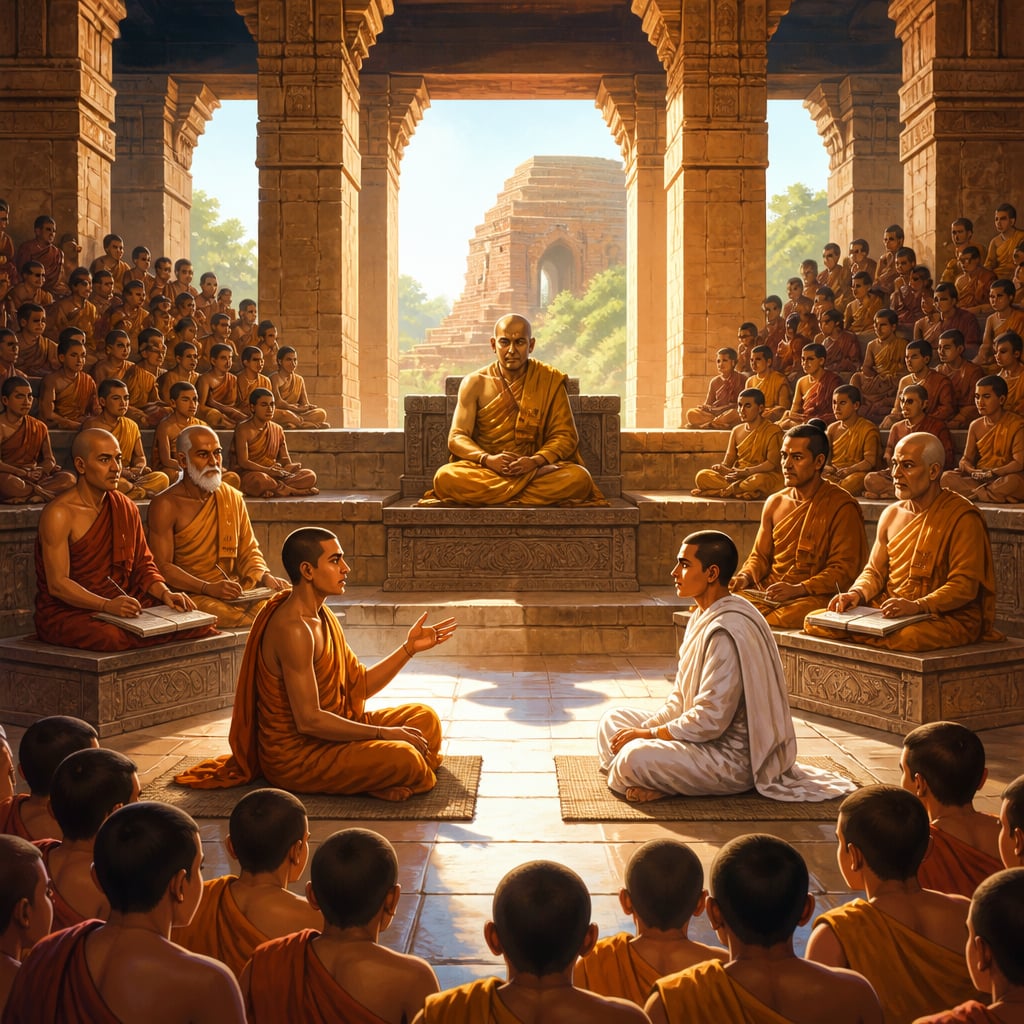
A formal arena with rules. The shastrartha hall at Nalanda had a presiding scholar called the Adhyaksha, a panel of arbiters, and a written record of the proceedings. The rules were the Nyaya Sutras' Nigrahasthana list: the twenty-two formal conditions of defeat. Either side could lose by name. The room itself certified the outcome.
Stakes that mattered. A monk who lost a major shastrartha accepted, by tradition, the philosophical position of the winner. Adi Shankara's eighth-century debate tour, in which he engaged Mandana Mishra at Mahishmati for weeks, ended with Mandana accepting Shankara's position and entering his order under a new name. Mandana was not humiliated. He was reorganized. Stakes turned debate into a vehicle for civilizational decision-making.
A culture of public viewing. The debates drew audiences of hundreds. The Chinese pilgrim Xuanzang, who studied at Nalanda for five years in the 630s, wrote that public debates were the central spectacle of the institution. The audience learned by watching. The watching trained the next generation's pattern recognition without anyone having to teach it explicitly.
A continuous lineage of teachers. Each teacher inherited the syllabus from a guru lineage, modified it slightly, and passed it on. Vasubandhu, Asanga, Dignaga, Dharmakirti, Candrakirti, Atisha. The names compose a single continuous chain across a thousand years. Modern public discourse has nothing structurally similar.
The five parts together constituted shastrartha sanskriti. Remove any one and the system weakens. Remove all five and you have what we have now.
What Hindus Lost
The destruction of 1193 was not an interruption. It was a catastrophic loss that reshaped what Hindus could think, write, and argue for eight centuries.
- Institutional memory died with the monks. The eighteen-year training ladder cannot be rebuilt from books alone. It required teachers who had themselves climbed it. When ten thousand monks at Nalanda were killed in a single winter, the chain broke. Tibetan refugees carried fragments of the Vikramashila curriculum across the Himalayas, where it survives in the Gelug monastic universities at Drepung, Sera, and Ganden. The Indian original did not survive on Indian soil.
- The vocabulary was preserved without the practice. The Nyaya Sutras, the Tarka Bhasha, the Mimamsa Sutras: all remained in manuscript libraries that escaped the burning. But studying the Nyaya Sutras without a working shastrartha hall is like reading a chess manual without a board. The texts became philosophy specimens instead of debaters' tools.
- Hindus stopped performing the public-arena debate. From the thirteenth century onwards, formal public debate in Hindu spaces shrank into ritualized recitation contests and a few surviving regional traditions. The grand civilizational debates of Adi Shankara's time, in which the future direction of Indian thought was decided in a public arena over weeks, ended.
- The colonial period found Hindus undefended. When James Mill, Macaulay, and the missionary apparatus arrived in the early nineteenth century with confident Western critiques, there was no working shastrartha culture to receive them. Hindus argued back as individuals, often defensively. The British had Oxford, Cambridge, and an academic infrastructure designed to produce confident debaters. Hindus had broken lineages and isolated scholars.
The cumulative cost is hard to measure but easy to feel. Eight centuries of discourse without a working public arena is what the modern Hindu inherits when they walk onto a television panel and try to debate alone.
The First Layer Of Rebuilding: The Long-Form Public Arena
The rebuilding began, slowly, in the late twentieth century and accelerated dramatically after 2015.
The first layer to come back was the public arena. Not the institution. The arena: the venue in which serious debates can occur and be witnessed by audiences large enough to matter. The unlikely instrument of this rebuilding is the long-form podcast.

A three-hour interview between a serious dharmic intellectual and a serious interlocutor, broadcast to an audience of hundreds of thousands, is a closer modern analogue to the Nalanda public debate than anything else available. The format restores three of the five original parts. It supplies stakes (reputations are made and unmade in real time on camera). It supplies an audience (millions watch). It supplies a record (the video remains searchable for decades).
J Sai Deepak, the Indian advocate, has spent the post-2018 years deploying the dharmic debate toolkit across long-form podcasts, conferences, and television panels. His method is the Nyaya method modernized: lead with primary sources, ask the ladder question, refuse the false-equivalence frame. Rajiv Malhotra, working a generation earlier, built the civilizational vocabulary (Purva Paksha, U-Turn theory, sameness vs difference) that Sai Deepak's generation now operates with. Ranveer Allahbadia, Abhijit Chavda, and others have used the podcast format to give civilizational topics multi-hour treatment that no television panel could supply. The format is imperfect. It lacks the formal arbitration of a true shastrartha. But it has restored the public arena, and the arena is the precondition for everything else.
The arena alone is not the institution. A great public debate that is watched by ten million people but produces no trained next generation is a spectacle, not a culture. The arena is the surface layer. The deeper layer takes longer to build.
The Second Layer Of Rebuilding: The Institutional Lineage
The deeper layer is the institutional one. The trained ladder of competence. The continuous lineage of teachers. The recovery of the eighteen-year training discipline that made Nalanda what it was.
This layer is being rebuilt by a small set of institutions that explicitly take Nalanda's protocol as their model. The Infinity Foundation, founded by Rajiv Malhotra in 1995, has produced a continuous stream of monographs, fellowships, and research programmes for thirty years on a single discipline: Purva Paksha-grounded engagement with Western academic frameworks. The Vivekananda International Foundation, founded in 2009, runs structured fellowships that produce trained civilizational scholars. The Indica Yoga and Indica Today ecosystem hosts long-form workshops, conferences, and debates. Newer venues like the Center for Soft Power and the Sangam Talks circuit add public-facing arms that connect the institutional work to the long-form podcast layer.
None of these is yet a Nalanda. None has the eighteen-year training ladder. None has the institutional autonomy that Pala-dynasty patronage gave Vikramashila. But each is a deliberate seedling of the same kind of institution. A civilization that lost its debate culture in a single winter cannot rebuild it in a single decade. The rebuilding takes generations.
The Sanskrit phrase for this kind of patient rebuilding is bija-ropana, the planting of seeds. The dharmic debater of the present generation is bija-ropana, not a Nalanda graduate. The Nalanda graduates of the future will only exist if this generation plants enough seeds and waters them long enough.
यदा यदा हि धर्मस्य ग्लानिर्भवति भारत। अभ्युत्थानमधर्मस्य तदात्मानं सृजाम्यहम्॥
yadā yadā hi dharmasya glānir bhavati bhārata | abhyutthānam adharmasya tadātmānaṃ sṛjāmy aham ||
Whenever there is a decline of dharma, O Bharata, and a rising of adharma, I send forth myself.
Bhagavad Gita 4.7
Group Dynamics: The Lead, The Amplifier, The Cleanup
Modern hostile debate is rarely one-on-one. A typical news panel, podcast ambush, or social-media pile-on deploys three roles in concert.
- The lead attacker opens with the strongest charge. The argument is the load-bearing one.
- The amplifier supports the lead, repeats the charges in different vocabulary, and creates the impression that the position is widely held. Often the moderator plays this role under the cover of neutrality.
- The cleanup hitter closes the segment by summarizing the exchange in the lead's terms. The cleanup ensures the audience walks away with the lead's framing as the takeaway.
The instinctive response is to engage all three. This is the wrong move. Three opponents is three times the cognitive load and produces a fragmented response. The correct move is to address only the lead's strongest point and ignore the amplifiers.
The amplifiers do not have a position; they have an echo. Refuting an echo produces no signal in the room. The cleanup hitter cannot summarize what they did not understand; if you have demolished the lead's strongest point with primary-source precision, the cleanup either reaches for a different topic (which the audience reads as evasion) or accepts your framing in the summary.
The anchor-and-return technique from the Shat-Khandana System (Chapter 8) is the operational form. Name the lead's strongest point. Counter it with the highest available pramana rung. When the amplifier interjects, do not turn to face them. Stay anchored. That is a separate point. I have not finished the original. The amplifier's intervention dies in air.
What The Dharmic Debater Owes The Culture
A Nalanda graduate asked what they owed the culture in return for the eighteen years it had given them. The standing obligation was three-fold: teach at least three students through the full ladder, write at least one work that engaged the major opponents of one's time, and accept at least one major shastrartha challenge.
The modern dharmic debater inherits the same three-fold obligation.
- Teach. Pass the toolkit to at least three younger students, formally or informally. Books do not teach the discipline. People do.
- Write. Produce at least one work that engages a real opponent on a real topic with primary-source rigour. A long Twitter thread does not count. A serious essay, monograph, or recorded long-form debate does.
- Engage. Accept challenges in your own field. Refuse challenges outside it. The eighteen-year ladder taught humility about competence as much as the courage to debate.
None of these is heroic. All are sustainable across a working life. A million dharmic debaters meeting these obligations for one generation is what Nalanda's rebuilding looks like at modern scale.
Modern Echoes
- The Tibetan Gelug monastic universities (Drepung, Sera, Ganden, refounded in exile in Karnataka after 1959) preserve the Vikramashila debate protocol intact, with eighteen to twenty-five years of formal training in pratijna-hetu-udaharana syllogism and ritualized clap-and-counter debate. They are the world's only continuously operating descendants of the Indian monastic university debate tradition. Indian researchers including the historian B B Lal and Tibetan scholars at the Central University of Tibetan Studies in Sarnath have documented the curriculum across the last forty years. The lineage that died in Bihar in 1193 lives on, in exile, less than a thousand kilometres from where it was destroyed.
- The Stanford University Encyclopedia of Philosophy entry on Indian Logic, written by Jonardon Ganeri and updated through the 2020s, treats the Nyaya tradition as a living philosophical resource for contemporary epistemology. The entry has been cited in over four hundred academic papers in the last decade. The vocabulary the modern academy is rebuilding under the heading of formal epistemology is, in many cases, the Nyaya vocabulary recovered.
- The Sangam Talks YouTube channel, founded in 2017, has hosted over a thousand long-form lectures and debates on civilizational topics, with a cumulative audience in the tens of millions. The channel is not a Nalanda. It is a public arena. The work it does is the same work the public debates at Nalanda did: training the audience's pattern recognition by letting them watch trained debaters at length.
The rebuilding is real. It is also slow. Both facts must be held together to participate in it without illusion or despair.
Back To The Burning Library
The smoke from the Nalanda libraries lifted in the spring of 1194. The civilization that depended on those libraries did not vanish. It scattered, narrowed, and learned to operate without its institutional centre for eight centuries. The current generation is the first since 1193 in which the centre is being rebuilt, in early form, in a different shape, on the same civilizational ground.
The dharmic debater of this generation does not need to be a Nalanda graduate. There are no Nalanda graduates yet. The dharmic debater needs to be a seed. The forest takes a hundred years.
In the next lesson, Kshetra Bodha teaches the platform-specific debate strategy that turns the seed's individual training into the right move on the right battlefield. Twitter is not Nalanda. A panel debate is not a podcast. The instrument must match the field.
Case studies
Nalanda Mahavihara: The Eight-Hundred-Year Debate Hall
Nalanda Mahavihara was founded in the early fifth century under the patronage of the Gupta emperor Kumaragupta I, on a site in present-day Bihar that had likely been a smaller monastic settlement for several centuries before. By the time the Chinese pilgrim Xuanzang visited in the 630s, the institution housed approximately ten thousand resident monks, two thousand teachers, and a library of three multi-storey buildings holding what later Tibetan sources estimated at nine million manuscripts. The campus included multiple debate halls, a central assembly hall capable of seating several thousand, and residential quarters for students drawn from across Asia. The curriculum spanned eighteen years for a fully trained scholar. Admission required passing a formal debate examination at the gate, conducted by senior scholars whose role was to filter for intellectual readiness, not for sectarian alignment. Internal debates were a daily occurrence and large public debates were the institution's central spectacle. Xuanzang records that visiting challengers from rival philosophical schools regularly arrived and that public defeats and conversions were a routine part of the institution's life. The lineage of teachers ran from Vasubandhu and Asanga in the fifth century through Dignaga, Dharmakirti, Candrakirti, Shilabhadra, and onwards across nearly thirty generations. In the winter of 1193, a Turkic cavalry force under Bakhtiyar Khilji stormed the gates. The monks were killed, the libraries were burned, and the eight-hundred-year continuous operation ended in a single season.
Nalanda is the canonical instantiation of shastrartha sanskriti at full institutional scale. All five working parts of the lesson's framework operated continuously: the trained ladder of competence (eighteen-year curriculum), the formal arena (the debate halls with adhyaksha, arbiters, and audience), the stakes (formal conversion of philosophical loyalty followed major losses), the public viewing culture (debates as central spectacle), and the continuous lineage of teachers (Vasubandhu through Shilabhadra and beyond). The Nyaya Sutras' definition of Vada (Sutra 1.2.1) was operational rather than theoretical: every major Nalanda debate met the Sutra's five conditions of valid debate. The institution's patronage by successive imperial dynasties (Gupta, Vardhana, Pala) ensured that the institutional layer outlived any single ruler's attention span, the way the Mundaka Upanishad's samit-pani transmission requires generational continuity to function. The destruction of 1193 violated, simultaneously, every layer of the Sutra-prescribed debate culture: the scholars, the manuscripts, the buildings, the lineage, and the political patronage that made the rest possible.
The institution's physical destruction was complete. The lineage was scattered. A small fraction of the curriculum survived in Tibet through the work of Atisha Dipankara and his successors and is preserved today in the Gelug monastic universities at Drepung, Sera, and Ganden, refounded in exile in Karnataka after 1959. The Indian original did not recover for eight centuries. A modern Nalanda University was inaugurated in 2014 at a nearby site under the patronage of the Government of India and several East Asian governments; as of 2026 it operates as a multidisciplinary university with an aspirational connection to the original tradition but does not yet replicate the eighteen-year shastrartha curriculum. The civilizational lesson is dual. The infrastructure can be rebuilt physically. The lineage cannot be rebuilt without the patient apprenticeship work that takes generations.
Civilizational debate culture is not a single building, a single teacher, or a single curriculum. It is a system of all three operating in continuous transmission across generations. Lose any one for too long and the system collapses. Lose all three at once and the recovery takes centuries. The dharmic debater of today must understand that they participate in a recovery that is closer to its beginning than to its end. The work is patient, structural, and cannot be substituted with personal brilliance.
The Persian historian Minhaj-i-Siraj's Tabaqat-i-Nasiri (composed c. 1259-1260, roughly seventy years after the destruction) records that the manuscripts at Nalanda burned for several months. Modern conservative estimates of the library's manuscript count range from three to nine million volumes; even the lower estimate represents the largest single act of book destruction in pre-modern human history. Archaeological excavation of the Nalanda site since the 1860s has uncovered eleven monasteries, six major temple structures, and continuous occupational evidence from the fifth through twelfth centuries; the excavation reports are available through the Archaeological Survey of India and form the primary documentary record of the institution's physical scale.
The Long-Form Podcast as Public Arena
Between 2017 and 2025, a new format of public intellectual exchange achieved cultural prominence in India and globally. Long-form audio and video podcasts, typically two to four hours per episode, began hosting serious debates and conversations on civilizational, philosophical, and policy topics. Indian dharmic intellectuals and their interlocutors found in the format a venue that television panel debate had never offered: time to develop arguments in primary-source detail, time to follow chains of reasoning across multiple steps, and time for the audience to watch the texture of intellectual exchange rather than merely the sound bites. J Sai Deepak's appearances on Sangam Talks, Ranveer Allahbadia's BeerBiceps, Abhijit Chavda's own channel, and a network of allied venues collectively hosted thousands of hours of long-form civilizational discussion. Audiences for individual episodes regularly reached into the hundreds of thousands and occasionally the millions. The format simultaneously emerged in the West through Lex Fridman, Joe Rogan, and others, providing a global infrastructure that Indian creators plugged into rather than having to build alone. By 2025, several Indian podcasts had cumulative audiences in the tens of millions and were arguably the largest single venue for sustained dharmic public discourse since the destruction of the monastic universities.
The long-form podcast restores three of the five working parts of shastrartha sanskriti: the public arena, the audience, and the durable record. It is incomplete on the other two. It does not yet have the trained ladder of competence (anyone can host a podcast, regardless of their position on the Mundaka's samit-pani ladder of training). It does not yet have a continuous lineage in the formal Vikramashila sense (podcasters do not inherit their format from a guru parampara that examined them at the gate). The Nyaya Sutras' definition of Vada (1.2.1) is partially met: serious long-form podcasts often deploy pramana, do include both pakṣa and pratipakṣa, and do allow for sadhana and upalambha. They less reliably stay consistent with established doctrine and do not strictly follow the five-part syllogism. By the Sutra's audit, the long-form podcast is closer to Vada than television panel debate (which often degenerates to Jalpa or Vitanda) but not yet a full Vada in the institutional sense. It is, however, the first format in eight centuries that even reaches that proximity. The arena is real. The arena is the precondition for everything else.
By 2026, the long-form podcast has produced a generation of dharmic intellectuals whose public reputations were made primarily in the format. The format has shifted the centre of gravity of Indian public discourse decisively away from the older television-and-newspaper duopoly. It has also surfaced challenges that the original Nalanda system would have handled through its institutional layer. The podcast venue lacks formal arbitration (no adhyaksha or panel of arbiters declares a debate's outcome). It lacks gate-keeping (the dvarapala filter does not exist; anyone can present as an intellectual without having done the eighteen-year ladder). It lacks lineage transmission (the most-watched podcasters have no formal obligation to train successors). The format is therefore a genuine public arena, but it is not yet a complete civilizational debate culture. The next decade's institutional work must add the missing layers around the existing arena.
The long-form podcast is the first restored layer of the rebuilding. The dharmic debater who participates in it should treat it as that: a real but partial restoration. The format's strengths (audience, time, durable record) should be used. The format's weaknesses (no formal arbitration, no gate-keeping, no lineage transmission) should be compensated for through other parallel structures (institutional fellowships, formal curricula, mentor-student relationships). The mistake to avoid is treating the podcast as the whole rebuilding rather than as the surface layer of it.
By the end of 2025, the Sangam Talks YouTube channel had hosted over one thousand long-form lectures and debates with a cumulative view count exceeding fifty million. The BeerBiceps Podcast and its allied channels in the Ranveer Allahbadia ecosystem had cumulative subscribers across platforms exceeding fifty million. J Sai Deepak's appearances across podcast venues collectively accounted for tens of millions of views in the post-2020 period. Aggregated, the Indian dharmic-civilizational long-form podcast space had a cumulative reach by 2025 that exceeded the audience of any single Indian English-language television news channel and rivaled the largest Hindi news venues. The arena is, by any reasonable measure, the largest unmoderated dharmic-discourse venue since 1193.
Civilizational Fellowships: The Institutional Seed Layer
Beginning in the 1990s and accelerating after 2010, a small set of Indian institutions began running structured research-and-debate fellowships explicitly modeled on the patient training pattern of the destroyed monastic universities. The Infinity Foundation, founded by Rajiv Malhotra in 1995, ran multi-year scholar fellowships that produced a generation of Purva Paksha-trained civilizational scholars. The Vivekananda International Foundation, established in 2009 in Delhi, ran shorter but structured research fellowships in policy and civilizational studies. The Indica ecosystem, including Indica Today, Indica Yoga, and the Indica Books imprint, hosted long-form workshops that brought together younger scholars under the supervision of senior teachers for weeks at a time. Newer institutions including the Center for Soft Power, Sangam Talks, and the Shaurya Bhardwaj Foundation added specialised arms. None of these institutions ran an eighteen-year shastrartha curriculum. None had Nalanda's ten-thousand-monk scale. But each was a deliberate institutional seed: a small set of senior teachers, a structured training pattern, a stipend or fellowship that allowed younger scholars to commit time to the work, and an output of trained personnel who entered public discourse with civilizational vocabulary already in place.
These fellowships are bija-ropana in the operational sense the lesson defines. They restore the layer the long-form podcast cannot supply: the trained ladder of competence and the early form of a continuous lineage. The Mundaka Upanishad's requirement that the seeker approach a teacher samit-panih, with sacred wood in hand, is met in modernized form when a younger fellow enters a structured programme under a senior scholar. The eighteen-year ladder is not yet replicated, but two-year, three-year, and five-year programmes are at least the start of one. The Nyaya Sutras' Vada conditions begin to be met more fully here than in the podcast venue, because the fellowships embed structured argumentative practice as part of the curriculum. The institutions are also small relative to Nalanda. The Infinity Foundation across thirty years has produced perhaps fifty to a hundred fully trained scholars; Nalanda produced thousands per generation. The asymmetry is what bija-ropana looks like in its first decades. The seeds are real. The forest does not exist yet.
The cumulative output of the civilizational fellowship layer over the last thirty years is visible in the public discourse of the 2020s. The vocabulary of Purva Paksha, U-Turn theory, the difference vs sameness debate, and the digestion-vs-assimilation framework are now in circulation among a generation of younger debaters who acquired them through the fellowship ecosystem. The institutional scale remains small. The total number of fully trained civilizational scholars produced through structured fellowships across all Indian institutions in the post-1990 period is, conservatively, in the low hundreds. Nalanda at its peak produced a comparable number per year. The gap is the measure of how much rebuilding remains. The trajectory, however, is positive. New institutions continue to enter the space. Older institutions have begun training their first generation of senior scholars who themselves came through the fellowship ladder. By the 2030s, the institutional layer should be capable of producing scholars at multiples of the current rate, which is when the recovery from the 1193 destruction can be said to have moved from the seeding phase to the early-growth phase.
The institutional layer is the slow, undervalued, and decisive part of the rebuilding. The dharmic debater who has the means to support a fellowship, to enter one, or to start one, is doing the highest-leverage work the current generation can do. Public arenas are visible. Institutions are not. The visible work and the invisible work are complementary, but only the institutional work compounds across generations. The lesson is to treat fellowship support, attendance, and creation as a first-tier civilizational obligation rather than a peripheral one.
The Infinity Foundation has, since 1995, funded over four hundred research grants, fellowships, and academic projects across thirty years, with a cumulative scholarly output of dozens of monographs, hundreds of papers, and an unmeasured number of public lectures and debates. The Vivekananda International Foundation publishes an average of fifteen to twenty research monographs per year and runs fellowship programmes for several dozen scholars at any given time. The Sangam Talks platform, while primarily a public-facing arena, also runs a series of structured masterclasses with cumulative enrolment in the tens of thousands. The aggregate civilizational fellowship layer in 2025 supports an estimated several hundred active scholars in fellowships of various lengths, the largest such ecosystem in India since 1193 by an order of magnitude, and still less than one tenth of one percent of what Nalanda alone supported continuously for eight centuries.
Reflection
- Think about the dharmic discourse you participate in over the course of an average week. Twitter threads, podcast subscriptions, reading, conversations, occasional appearances. Audit your participation honestly. How much of it is consuming the surface layer (watching, sharing, commenting on the visible victories of others)? How much is contributing to the institutional layer (teaching someone, funding a fellowship, attending a structured programme, supporting primary-source translation work)? If the ratio is heavily tilted toward consumption, what one specific change can you make this month to add even a small contribution to the institutional layer? The change does not have to be large. It has to be specific.
- The Bhagavad Gita 4.7 promises that whenever there is a decline of dharma, the dharmic principle sends forth its own restoration. The destruction of Nalanda is one such decline in the historical record. The current rebuilding is one such restoration. Do you experience yourself as part of the restoration, or as a passive observer of it? What would change about your daily decisions, your professional priorities, your social relationships, and your financial choices if you took seriously the idea that you are a small but real instrument of the verse's promise in your own generation?
- Civilizations have collapsed and rebuilt before in human history. The Hellenistic world rebuilt after the destruction of Alexandria. The Christian intellectual tradition rebuilt after the fall of Rome. The Confucian tradition rebuilt after multiple Chinese dynastic collapses. In each case, the rebuilding took centuries and was led by patient institutional founders rather than by spectacular individual figures. What does the dharmic tradition's rebuilding share with these other civilizational recoveries, and what is structurally different about it? Is the dharmic case harder, easier, or differently shaped, and what follows for the strategy of the current generation of rebuilders?