The Dharmic Warrior: Precision Without Ego
The Final Synthesis
The closing lesson of Vaada Shastra. The Dharmic warrior is the figure who carries every tool the course has built into a single integrated practice: Viveka to see clearly, Maya-detection to see through the illusion, the Chatur-Vadin Framework to recognise the twenty-two archetypes, the Shat-Khandana System to counter precisely, Nirmana Yukti to construct, the Vaada Vriksha to decide which kind of debate is in front of her, Kshetra Bodha to adapt to the battlefield, and Sthitaprajna to remain unshakeable while doing all of it. Yajnavalkya across Janaka's full court and Vivekananda at the 1893 Parliament of Religions are two cases, twenty-five centuries apart, of the same figure operating identically. The course ends here. The practice begins now.
The Charioteer Who Walked Into Hastinapura
In the Udyoga Parva of the Mahabharata, on a morning before the war, Krishna walked into Hastinapura's assembly hall as the Pandavas' peace envoy. He had come to attempt one last sandhi, one last negotiated settlement, with a court that had every intention of refusing him. Duryodhana was on his throne. Karna was beside him. Shakuni was in the room. Dhritarashtra was on the dais. Bhishma and Drona, the elders, were silent, knowing what was coming. The audience hall had been prepared for an envoy's humiliation, not for an envoy's negotiation.
Krishna was not the supplicant the court expected. He was, in the form the lesson now teaches, the complete Dharmic debater. He had, before stepping into the hall, already classified the room: Vitanda from Duryodhana, Jalpa from Shakuni, Vaada possible only with Vidura. He had named the archetypes. Duryodhana the Moral Shamer who would invoke ancestral pride. Shakuni the Pseudo-Intellectual whose jargon would substitute for argument. Karna the wounded combatant whose loyalty was bound to a man he himself partly judged. Dhritarashtra the blind father whose Vaada Vriksha had collapsed forty years before any of this and who would not now classify anything correctly. Krishna had Anchored the Frame in his opening sentence: I have come on behalf of the Pandavas and on behalf of the kingdom's continued life. He had Redirected the Burden in his second: the question is not what the Pandavas will accept, but what dharma now requires. He delivered the propositional argument. He delivered the Akhyana of an old kingdom on the edge of self-destruction. He read the room continuously and adapted his register from sentence to sentence. And when, finally, the court rose to seize him, he disclosed his Vishvarupa, gathered his cloak, and walked out the way he came.
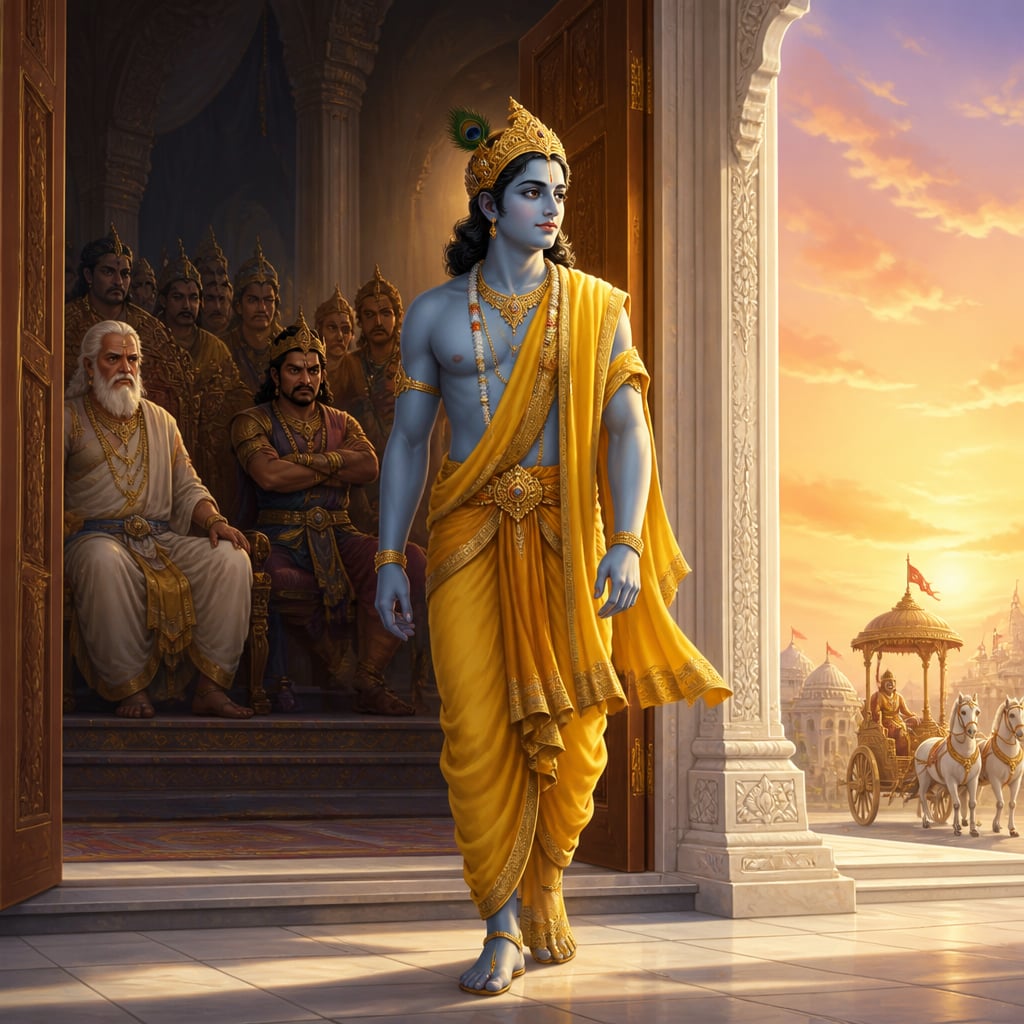
Krishna did not win the negotiation. The war happened. The Mahabharata preserves this scene precisely because the outcome is not the synthesis the lesson is teaching. The synthesis is the figure of the man who walked in already in possession of every tool, deployed each tool when it was the right tool, refused to deploy a tool when it was not, and walked out without his Sthitaprajna having shifted by a degree. The negotiation failed. The Dharmic warrior did not.
This is the final lesson of Vaada Shastra. Forty hours of the course are now behind you. Fifty-five lessons. Twenty-two archetypes named. Six counters mastered. One decision tree internalised. Five battlefields mapped. One inner state cultivated. The lesson now is not new content. The lesson is the figure who carries the prior content as a single integrated practice. The Sanskrit name for the figure is Dharmika Vadin, the Dharmic debater. The English translation in the course's own register is plainer: the figure you have been training to become.
The Eight Systems, Ordered as One
The course taught eight named systems. They are not eight separate skills. They are eight components of a single integrated practice, deployed in a specific order on every encounter that warrants it. Studying them as a whole now, after each has been built individually, is the move that turns the toolbox into a hand.
| System | What It Does | When It Fires |
|---|---|---|
| Viveka | Sees clearly through the immediate situation | First, before any move |
| Maya-detection | Sees through the illusion the opponent is offering | Second, naming what is hidden |
| Vaada Vriksha | Decides which kind of debate is in front of her | Third, picking engage / control / exit |
| Chatur-Vadin Framework | Recognises which archetype the opponent is deploying | Fourth, naming the move |
| Shat-Khandana System | Counters the named archetype precisely | Fifth, deploying the right Khandana |
| Nirmana Yukti | Constructs the Dharmic debater's own positive argument | Sixth, building once defence is set |
| Kshetra Bodha | Adapts the deployment to the battlefield's constraints | Continuously, modulating register |
| Sthitaprajna | Holds the inner state from which all of the above is deployed | Throughout, the substrate of all of it |
The order is not rigid. Viveka and Sthitaprajna are simultaneous; you cannot see clearly without being unshakeable, and you cannot be unshakeable without seeing clearly. The Chatur-Vadin recognition and the Shat-Khandana counter often fire together at conversational speed. Kshetra Bodha is the modulating layer, not a discrete step. But in slow-motion, on a difficult encounter, the eight do unfold roughly in this sequence, and naming the sequence lets the practitioner audit her own deployment afterward and identify which step she missed.
The Posture, Not the Toolkit
There is a temptation, having mastered the eight systems, to treat the practice as a toolkit. Which counter do I deploy here? The temptation is structurally subtle and structurally wrong. The Dharmic warrior is not, in the end, a collection of tools. She is a posture from which tools become available.
The posture has three components, named in the course's opening positioning statement and now returned to as the closing one.
The goal is not to defeat the opponent. This was the first sentence of Lesson 1.1. It is also the last operating instruction of the course. A debater who has internalised the eight systems but has not internalised this sentence will deploy the systems for the wrong reason and will, across years, drift into the ego-driven debater the Sthitaprajna lesson warned against. The Bhagavad Gita's term for the drift is rajasic mode, and the diagnostic is precise: a debater whose internal scoring runs on did-I-win is operating in rajas regardless of how dharmic her external speech sounds.
The goal is to reveal truth. The eight systems are instruments of revelation, not weapons of victory. Viveka reveals what is actually happening. Maya-detection reveals what is hidden. Chatur-Vadin reveals the archetype. Shat-Khandana reveals the structure of the opponent's position. Nirmana Yukti reveals the Dharmic debater's own constructive case. Vaada Vriksha reveals which kind of engagement is in front of her. Kshetra Bodha reveals the constraints of the field. Sthitaprajna reveals the inner state from which revelation is possible. Every system serves prakasha, the Sanskrit word for the light that makes truth visible.
Defeat is a byproduct. When the opponent's position cannot survive scrutiny, the opponent is defeated, and that is the form working as designed. When the opponent's position can survive scrutiny, the Dharmic debater learns from the encounter, which is also the form working as designed. The distinction is not, in the end, between victory and loss; it is between scrutiny and avoidance. A debater who scrutinises has done her dharma. The downstream scoreboard is not the form's concern.
The Image
The course's opening positioning statement asked you to imagine a debater who walks away from a Vitanda trap, engages a Vaada challenge, reframes a hostile question using Nirmana Yukti, and leaves the audience thinking. That image, after fifty-five lessons, is now decomposable into named operations.
She walks away from the Vitanda trap because Vaada Vriksha has classified the encounter and Sthitaprajna has given her the inner permission to disengage. She engages the Vaada challenge because the same decision-tree has classified that one differently and the eight systems are available to deploy. She reframes the hostile question because Nirmana Yukti's reframing technique (Lesson 9.4) is now an internalised reflex and the Akhyana she follows it with (9.5) is composed in real time from her actual life. The audience leaves thinking because the Dharmic warrior has not been performing for the audience; she has been operating on the truth in front of her, and the audience, watching that, has been re-introduced to a register of public discourse most of them had forgotten was possible.
The image is not aspirational. It is what the course has been training. Two cases, twenty-five centuries apart, demonstrate the figure operating concretely.

Yajnavalkya at Janaka's court (Brihadaranyaka 3-4). Eight challengers in succession across two chapters of the Upanishad. Asvala the head priest demanding ritual proof. Artabhaga asking about death and the afterlife. Bhujyu testing him with the story of the Parikshitas. Ushasta Cakrayana demanding the Self be produced on the spot. Kahola repeating the demand. Gargi Vacaknavi twice, with her famous two-question right. Uddalaka Aruni asking about the inner controller. Sakalya, finally, attempting to take Yajnavalkya down by atipraśna. Eight different challengers. Eight different counters. Asvala met with Pramana Khandana (the priestly authority audited at its own source). Gargi anchored with Avaccheda (limited to her two-question right). Uddalaka redirected through Tarka. Sakalya closed with Anavastha demand-for-position. The same Yajnavalkya, the same court, the same eight-system practice, deployed flexibly across two hours of disputation, ending with the cows quietly grazing at his ashram and the court's intellectual standing of the late-Vedic period restored to the figure who had operated the form correctly.

Vivekananda at the Parliament of Religions, Chicago, 11 September 1893. Six minutes. Six paragraphs of speech in front of roughly four thousand attendees, the majority of whom had been told by their churches that Hinduism was a dying superstition. Vivekananda opened with Akhyana (sisters and brothers of America as relational entry, not as rhetorical decoration). He deployed Pramana Khandana implicitly when he named the missionary archetype's own logic. He delivered the frog-in-the-well story as compressed Itihasa. He held Sthitaprajna in front of an audience whose initial posture was sceptical-hostile and whose final posture, six minutes later, was a multi-minute standing ovation. He had read the Kshetra Bodha of Chicago perfectly. He left without overstaying. The civilisational standing of the Dharmic tradition in Western public discourse, before that morning at very near zero, was after that morning at a different number entirely. Six minutes.
Neither Yajnavalkya nor Vivekananda was performing the eight systems consciously. The systems are formalisations of what they were already doing. The course you have just completed is the formalisation made teachable; the figure each of them embodied is the figure you have been training to become.
What Comes Next
The course ends here. The practice does not. Three concrete next moves.
One. The thirty-day deployment program. For the next thirty days, deploy at least one tool from the course in one real conversation per day. Day one: name an archetype out loud. Day two: deploy one Khandana. Day three: deliver one ninety-second Akhyana. Day four: run the Vaada Vriksha on one encounter. Day five: anchor the frame at the start of one debate. Continue rotating across the eight systems. By day thirty, the toolbox has become the hand. The exercise lives in the practice exercises section of this lesson.
Two. The teaching loop. Pick one person in your life, a colleague, a sibling, a friend, who would benefit from one of the eight systems and teach it to them in a single sitting. The Dharmic tradition's Sanskrit term for this is paramparā, the lineage transmission, and it is the only structural mechanism by which a discipline survives a generation. Teach what you have learned. The loop closes when the person you taught teaches a third person.
Three. The encounter that finds you. Within roughly six weeks of finishing the course, you will encounter a debate that you would have lost before this course and now, through some specific combination of the eight systems, you will not lose. Not because you became more aggressive. Not because you became cleverer. Because, on a particular Tuesday, the figure of the Dharmic warrior was available to you in a way it was not available before, and you operated from that figure rather than from your prior reactive habits. Note the encounter when it happens. It is the moment the course became real.
The Closing Sentence
The Sanskrit tradition has a phrase for the moment a long teaching ends and the student stands up to walk back into the world. Sā vidyā yā vimuktaye. That is knowledge which liberates. The eight systems of Vaada Shastra are not the liberation; the figure who carries them, in the inner state of Sthitaprajna, in the service of truth rather than of ego, is. You are now equipped to carry them. The carrying, across years and across encounters, is the practice you have just begun.
Modern Echoes
In contemporary Indian public discourse, three figures across the last three decades have demonstrated multi-decade deployment of the toolkit at scale. Rajiv Malhotra's Purva Paksha program (across his books from Breaking India in 2011 to The Battle for Sanskrit in 2016) operationalised the steelman discipline of Lesson 2.6 as a public method, requiring opponents to be represented better than they could represent themselves before any counter was deployed. J. Sai Deepak's courtroom deployments across the Sabarimala case (2018) and the constitutional arguments of his book trilogy (India that is Bharat, 2021, and successors) brought the full Shat-Khandana System into formal Shastrartha at the highest stakes the Indian republic offers. S. Gurumurthy's three decades of economic-policy debate, from the 1980s Bofors investigations through the 2010s demonetisation defence and ongoing Swadeshi Jagran Manch advocacy, demonstrated the integration of source-hierarchy discipline, Akhyana, Anavastha closure, and Sthitaprajna under withering hostile interview across an entire career. The figure of the Dharmic warrior is not a museum-piece; it is operating in contemporary Indian public life, and the practitioners are visible.
The Stanford communication scholar Robert Cialdini, whose Influence (1984) and Pre-Suasion (2016) are the contemporary Western canon on persuasion, has documented across forty years that the most effective long-term persuaders are those whose internal posture is oriented toward truth-revelation rather than victory-extraction. The mechanism Cialdini's data identifies in Western corporate and political contexts is the same mechanism the Bhagavad Gita identified in 2.54 to 2.72 under the name Sthitaprajna. The cross-civilisational convergence on the same finding is not a coincidence; it is the structural fact that human persuasion, across cultures and centuries, rewards the same inner posture, and the Sanskrit tradition merely formalised the posture earliest and most explicitly.
The Court Empties
Krishna walked out of Hastinapura's hall on the morning the negotiation failed. The eight systems had been deployed. The room had been read correctly. The Vaada Vriksha had classified the encounter and the Sthitaprajna had held. He gathered his cloak, mounted his chariot, and drove back to the Pandavas' camp with the news. The war was now inevitable. He had done his dharma. The figure of the Dharmic warrior had operated at the highest stakes available, and the operation had not depended on the outcome.
You have, fifty-five lessons later, the same figure available to you. The cloak is yours now. The chariot is yours. The encounter is yours. The course ends. The practice begins.
Case studies
Yajnavalkya Across Janaka's Full Court (Brihadaranyaka 3 to 4)
In the third and fourth chapters of the Brihadaranyaka Upanishad, conservatively dated to the seventh through fifth centuries BCE, the sage Yajnavalkya handled the full assembled court of King Janaka of Videha across what the text describes as a continuous disputation. Eight challengers rose in succession. Asvala, the head priest, opened with ritual-authority questions about the yajna form. Artabhaga continued with questions about death and the persistence of the self after the body. Bhujyu followed with the difficult Parikshita-lineage problem on consciousness and continuity. Ushasta Cakrayana demanded that Yajnavalkya produce the Self directly, on the spot, in front of the court. Kahola repeated the demand. Gargi Vacaknavi rose twice, with her famous two-question right that Yajnavalkya himself had to anchor against further questioning. Uddalaka Aruni asked the deepest of the metaphysical questions, on the inner controller (antaryamin). Sakalya, finally, attempted the atipraśna strategy you met in Lesson 7.6. Eight challengers, eight different strategies, eight different counters required, all preserved with verbatim Sanskrit dialogue across two chapters of the Upanishad. The setting is the most demanding formal-disputation venue of the late-Vedic period.
By the eight-system framework the course has built, Yajnavalkya is operating each of the eight components in succession as the disputation requires. With Asvala, Pramana Khandana auditing the priestly authority at its own source. With Gargi, Avaccheda Khandana anchoring the scope (her two-question limit) so the disputation does not regress into infinite questioning. With Uddalaka, Tarka Khandana redirecting to the structure of the question itself rather than the surface formulation. With Sakalya, Anavastha Khandana demanding the symmetric audit you met in Lesson 7.6. Throughout, Sthitaprajna holds: Yajnavalkya is not anxious during any of the eight encounters, despite the fact that the cows of Janaka's court (the publicly stated prize) are at stake on the outcome. The figure operating across the two chapters is the Dharmika Vadin in the strict classical sense: the eight systems deployed flexibly, in service of prakāśa, without any of the engagements being driven by the prize.
The cows arrive at Yajnavalkya's ashram quietly during the disputation (he had instructed his student to drive them home before the questioning began, a pre-emptive Nigamana you met in Lesson 8.6). The eight challengers depart the court each having had their question genuinely answered; the disputation is not a winner-take-all extraction but a producer of nirnaya across eight separate questions. The Brihadaranyaka preserves the entire two-chapter exchange in the Upanishad's central position because the editor recognised what was being demonstrated: the eight-system practice operating across a continuous high-stakes session, with the inner state preserved throughout, and the prize accruing as a byproduct of the form rather than as a target of it.
The eight systems are not deployed serially against a single opponent. They are deployed flexibly across a sequence of opponents, each requiring a different counter, each addressed in the register that opponent's specific archetype demands. The Dharmika Vadin's signature is not mastery of one counter but the fluency to deploy all of them as the encounter unfolds, while the inner state remains the constant substrate. Yajnavalkya across Brihadaranyaka 3 to 4 is the locus classicus of this fluency, and the Sanskrit text's preservation of the verbatim dialogue across all eight encounters is the tradition's structural commitment to making the practice teachable across millennia.
8 challengers, 8 different counters deployed, 2 chapters of verbatim Upanishadic dialogue, ~25 centuries of continuous transmission. The classical Indian fluency-case of the eight-system practice operating across a single high-stakes session.
Vivekananda at the Parliament of Religions, Chicago, 11 September 1893
On the morning of 11 September 1893, in the Hall of Columbus at the World's Columbian Exposition in Chicago, the World Parliament of Religions opened with addresses from delegates of major world religions. Roughly four thousand attendees were present. The audience had been told, across decades of missionary literature, that Hinduism was a dying superstition, that India was a civilisation in terminal decline, and that the speakers from the Dharmic tradition (if any survived to attend) would represent a tradition not worth preserving. Swami Vivekananda, a thirty-year-old Bengali monk, was a late and partially unofficial addition to the speaker list. He had no institutional backing, no published reputation in the West, and no credentials by the standards the Parliament's organisers used. When his turn came, he stood, and instead of opening with the formal ecclesiastical salutation the prior speakers had used, he opened with a different sentence. *Sisters and brothers of America.* The audience rose. The applause continued for over two minutes before he could continue. The remaining speech ran roughly six minutes.
By the eight-system framework, Vivekananda's six minutes deploy the entire toolkit. The opening salutation is Akhyana in compressed form: a relational entry-point that bypasses the analytical defences the audience had been preparing against the lecture-form they expected. Pramana Khandana operates implicitly throughout: by speaking from the lived authority of his own tradition rather than citing missionary-mediated sources, he audits the framework the audience had inherited. The frog-in-the-well story he tells later in the same address is full Itihasa, the form Lesson 9.5 named, transmitting the Dharmic claim about plural paths to truth without propositional argument. Kshetra Bodha is operating throughout: he reads Chicago's specific register correctly, neither performing for the missionary skeptics nor flattering the converts. Sthitaprajna holds the entire address: he is not anxious in front of four thousand people, and the lack of anxiety is itself the demonstration of the inner state the closing-lesson teaches. Six minutes, eight systems, one continuous deployment.
The civilisational standing of the Dharmic tradition in Western public discourse, near zero on the morning of 11 September 1893, was at a measurably different position by the close of the Parliament's two-week run. Vivekananda spoke at multiple subsequent sessions, drew larger audiences than the headlining speakers, and received ovations the Parliament records describe as unprecedented. He spent the next four years (1893-1897) lecturing across the United States and England, founded the Vedanta Societies in New York and elsewhere, and returned to India to establish the Ramakrishna Mission. The downstream effect on Hindu civilisational confidence in the colonial period is documented in primary sources from contemporaries: Tagore, Aurobindo, Subramania Bharati, and Gandhi all cite the Chicago address as a turning-point in Indian intellectual self-understanding. The eight-system practice, deployed in six minutes by a thirty-year-old monk with no Western credentials, produced a multi-decade civilisational shift that no policy argument or treaty had been able to produce.
The eight-system practice is not constrained by stakes, format, or duration. Six minutes is enough when the practitioner is operating from the inner state Krishna defines and the systems are deployed in the register the field demands. Vivekananda was not, by his own description, performing a debate-technique consciously; he was operating from the figure of the Dharmika Vadin that his own tradition had trained him in across the decade of his pre-Parliament discipleship under Sri Ramakrishna. The course you have just completed is the formalisation of what he was already doing, made teachable across millennia in a register the contemporary student can pick up. The figure is available now. The encounter, when it comes, will be yours.
6 minutes of speech, 4,000 attendees, 1 standing ovation lasting over 2 minutes, 4 years of subsequent lecture circuit, ~130 years of continuous citation. The contemporary canonical case of the eight-system practice operating in a single deployment with measurable civilisational impact.
Reflection
- Identify one debate or significant difficult conversation you have had within the last six months, before this course, where you would have wished, in retrospect, to deploy a different posture or tool than the one you actually used. Re-imagine the encounter applying the eight-system synthesis: which of the eight systems would have been the right entry-point, which counter-strategies would have followed, and what inner state would you have needed to hold to deploy them cleanly? What does the audit reveal about which of the eight systems you most need to practise across the coming month?
- Why does the Dharmic tradition insist that the same techniques deployed from different inner states produce structurally different results? What does it mean, in the Sanskrit register, that the eight systems can become either vimukti-vidyā (knowledge that liberates) or bandha-vidyā (knowledge that binds), and how should this awareness shape the practitioner's relationship to her own debate-mastery across years?
- What is the relationship between individual Dharmika Vadin practice and civilisational standing? Why does a civilisation whose public discourse is dominated by Vitanda and Jalpa decline regardless of its material wealth, and why does a civilisation whose public discourse is even partially restored to Vaada strengthen across generations? What is the practitioner's responsibility, given this relationship, to the discourse-environment she inhabits?