The Gita on Equanimity in Conflict
Care Deeply. Act Precisely. Without Attachment
Arjuna's paralysis on the battlefield is the universal debater's dilemma. Care deeply, act precisely, hold the outcome lightly. The steady wisdom that remains unshaken in public conflict is what the Gita calls Sthitaprajna. This lesson names the Four Inner States of the debater, Ahamkara (ego-driven), Bhaya (fear-driven), Kama (desire-driven), and Sthitaprajna (anchored). It teaches the debater to recognise her own inner state mid-exchange, pause, and return to Dharma. The counter to a bad inner state is not suppression. It is awareness.
The Archer Who Could Not Lift His Bow
The morning of the first day of the Kurukshetra war. Two armies face each other across the plain, silent, waiting. Arjuna, the greatest archer of his age, asks his charioteer to draw the chariot into the centre of the field so he can see the men he is about to fight. Krishna, holding the reins, obeys. The chariot rolls forward. Arjuna looks.
He sees his grandfather Bhishma, who had carried him on his shoulders as a child. He sees Dronacharya, the teacher who had given him every skill he possesses. He sees cousins, uncles, boyhood friends, now drawn up in battle formation on the opposite side. His bow slips from his hand. His knees give way. He sits down in the chariot and tells Krishna that he cannot fight. He will not fight. Let them kill him. The kingdom is not worth it. The victory is not worth it.
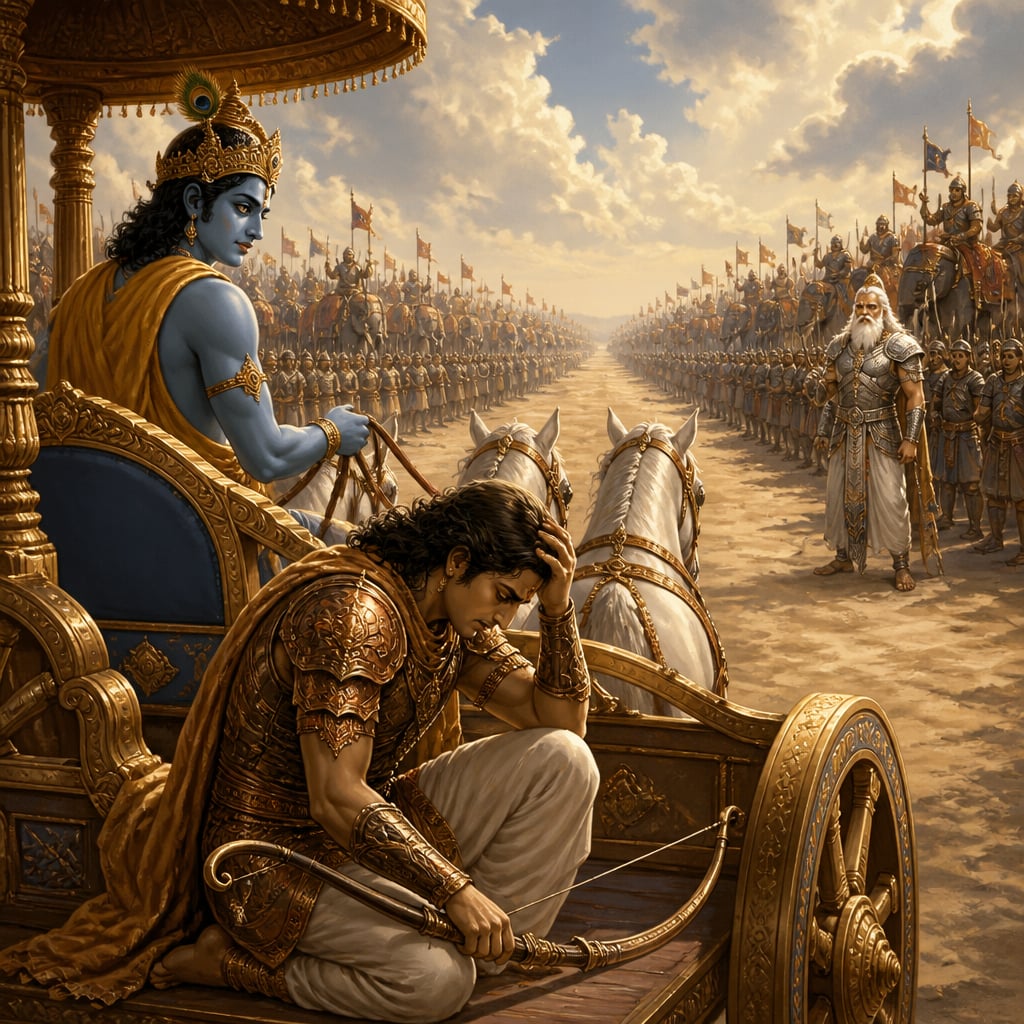
This is the scene every Dharmic debater eventually meets. Not on a battlefield. In a studio, a panel, a long comment thread, a family dinner, a courtroom, a company meeting. The form changes; the moment does not. You are called upon to defend something you care about, against people you may know, in front of an audience that may not be on your side. Your bow slips. Your voice catches. Some part of you wants to sit down in the chariot and say let it go, it is not worth it.
What Krishna says next across eighteen chapters is the longest and most precise treatment of this moment in any world literature. And for the Dharmic debater, its single most load-bearing concept is one word. Sthitaprajna. The one whose wisdom is steady. This lesson is about what that word means, what its opposite looks like, and how to recognise which of the two you are in before you speak.
What Sthitaprajna Actually Is
Sthitaprajna is often translated, a little weakly, as the person of steady wisdom. The Sanskrit is sharper. Sthita is not steady in the sense of calm. It is firmly placed, anchored, rooted, settled into its ground. Prajna is not wisdom in the sense of information. It is the knowing that cuts through appearance, the discernment that sees what is actually there. Sthitaprajna, joined, means one whose discernment is rooted in its ground. It is a specific inner condition, not a personality trait. A Dharmic debater can be Sthitaprajna on Monday and not Sthitaprajna on Tuesday. The question is not am I a calm person. The question is am I anchored in this moment.
Krishna defines the state directly. In Chapter Two, from verses 54 to 72, he gives Arjuna the fullest portrait of the Sthitaprajna the tradition possesses. Three features stand out.
One: emotions come and go, but they do not move the discernment. The Sthitaprajna is not an unfeeling person. She feels sorrow, pleasure, anger, affection. What is different is that these feelings do not relocate her. She remains in her ground while the weather moves through.
Two: the outcome is held lightly. The Sthitaprajna acts with full care for Dharma and full skill at the action, while holding the result of the action as not-hers. This is the famous Nishkama Karma, action without attachment to the fruit. The debater who must win to feel herself cannot be Sthitaprajna. The debater who will defend Dharma whether she wins or loses, can be.
Three: the senses do not lead. Krishna uses a precise image. A tortoise draws her limbs under her shell. The Sthitaprajna, when the senses are pulled toward their objects, pulls her attention back into its centre. The senses serve the discernment. They do not lead it.
These three together are not a mood. They are a technique. The Gita's entire claim is that Sthitaprajna is learnable. Not by birth, not by temperament, but by practice.

यदा संहरते चायं कूर्मोऽङ्गानीव सर्वशः। इन्द्रियाणीन्द्रियार्थेभ्यस्तस्य प्रज्ञा प्रतिष्ठिता॥
yadā saṃharate cāyaṃ kūrmo'ṅgānīva sarvaśaḥ | indriyāṇīndriyārthebhyas tasya prajñā pratiṣṭhitā ||
When, like a tortoise drawing in her limbs, a person withdraws the senses from their objects, then her wisdom is firmly placed.
Bhagavad Gita 2.58
The Four Inner States of the Debater
Sthitaprajna is one of four possible inner states you can speak from in a debate. The other three are the failures. Learning to name them is the first discipline. The Gita's chapters on Asura qualities, on the three Gunas, and on the nature of bondage supply the vocabulary.
State 1. Ahamkara (ego-driven). The debater who must win. Who takes the bait. Who makes the exchange about herself. The tell is that she remembers slights from earlier in the exchange and returns to them out of sequence. She cannot let a personal attack pass without immediate response. When she scores a point, her voice lifts. When she is corrected, her voice sharpens. The Sanskrit word Ahamkara literally means I-maker, the faculty that manufactures a self-image and then defends it. In Ahamkara, the debate is no longer about the question. It is about the debater.
State 2. Bhaya (fear-driven). The debater who submits. Who concedes too quickly to stop the discomfort. Who laughs nervously at the opponent's joke even when the joke was at her own side's expense. Who softens every sharp claim until the sharpness is gone. The tell is the body. Shoulders rising, voice pitching up, eye contact breaking, hands retreating. Bhaya is not cowardice in the moral sense; it is a physiological state, and the body shows it before the mind admits it. Debating from Bhaya, the Dharmic position always gets thinner than it deserves.
State 3. Kama (desire-driven). The debater who manipulates. Who wants something from the exchange other than truth: to be seen as clever, to be invited back on the show, to be liked by the host, to get a viral clip. The tell is tonal. The argument gets shaped to the audience in a way that the Sthitaprajna argument would not be. Edges are sanded. The line that would land with the Dharmic audience is replaced by the line that will land with the media producer. Kama is the most socially rewarded of the four failure states, because it is the one that most resembles professionalism.
State 4. Sthitaprajna (anchored). Clear, precise, calm. Still cares. Still fights. But the caring and the fighting are done from a settled ground. The tell is negative space. She does not take the bait she had every reason to take. She does not raise her voice at the provocation. She does not soften the sharp claim. She does not shape the argument to the room. She speaks from somewhere the room cannot move.
These four are not moral categories. They are diagnostic categories. The Dharmic debater does not shame herself for being in Ahamkara, Bhaya, or Kama. She names the state out loud, inside her own mind, and resets. The counter to a bad inner state is not suppression. It is awareness.
| State | Sanskrit | The Tell | The Reset |
|---|---|---|---|
| Ego-driven | Ahamkara | Returning to slights, lifting voice at scores | Remember: this is about Dharma, not me |
| Fear-driven | Bhaya | Body retreating, conceding to stop discomfort | Hold the sharp claim. The audience needs it |
| Desire-driven | Kama | Sanding edges to be liked | Speak the Dharmic line, accept the cost |
| Anchored | Sthitaprajna | Does not take the bait | This is the working state |
The Mid-Debate Self-Diagnosis
The most useful skill this lesson teaches is the three-second mid-debate check. You can run it silently while the opponent is speaking. It has three questions.
- What is my body doing right now? Shoulders up or down? Voice pitched higher than normal or same as baseline? Hands still or fidgeting? The body is the first and most reliable reporter on the inner state. Bhaya shows in the shoulders and voice pitch. Ahamkara shows in the jaw and the hands. Kama often shows in the smile held a fraction too long.
- What do I want the audience to think of me right now? The Sthitaprajna answer is I want them to see the Dharmic claim clearly, whether they like me or not. Any other answer points to one of the three failure states. I want them to think I won points to Ahamkara. I want them to not be angry at me points to Bhaya. I want them to call me back on the show points to Kama.
- If I paused for three seconds right now, would the question I was about to answer still matter to me? The Sthitaprajna answer is yes. If the honest answer is no, I was about to speak from Ahamkara or Kama. The three-second pause is the reset.
Three questions. Five seconds of internal attention. You can run the check three or four times in a ten-minute exchange without anyone noticing. That is how the Gita's ethical teaching becomes a live-room reflex.
Dharmic Lens: Western Emotional Intelligence vs Sthitaprajna
The Western tradition has also noticed that emotions affect argument quality. Its response, developed over the last thirty years, is the literature on emotional intelligence. Daniel Goleman's 1995 book of that title argued that self-awareness, self-regulation, motivation, empathy, and social skill together predict success better than pure intellect. The research is solid. The vocabulary is real. And yet the framework, compared to the Gita, is strangely thin.
Western frame: emotions as data to be managed. The emotionally intelligent person recognises her feelings, labels them, regulates them, and channels them into socially effective behaviour. The goal is effective social performance. The purpose of the work is pragmatic: better relationships, better teams, better outcomes.
Dharmic frame: the inner state as a question of Dharma, not performance. The Sthitaprajna is not trying to perform well. She is trying to remain anchored to Dharma while acting. The anchor is not pragmatic; it is ontological. Her discernment is settled because it is placed in something larger than her own success. The Gita is not teaching her to manage her feelings for better outcomes. It is teaching her that outcomes are not what she anchors to.
| Western Emotional Intelligence | Dharmic Sthitaprajna |
|---|---|
| Emotions as data to manage | Inner state as a Dharmic question |
| Goal: effective social performance | Goal: anchor to Dharma, not to outcome |
| Private hygiene | Public discipline with Dharmic stakes |
| Skills model | Stitha, a condition of being rooted |
| Culturally neutral | Grounded in a specific cosmology of action |
The two frameworks are not in conflict at the descriptive level. The techniques overlap: awareness of the body, labelling of the state, pause before response. What differs is the why. The Dharmic debater who adopts the Western techniques without the Dharmic ground often drifts into Kama, because effective social performance is the Kama goal stated aloud. The Sthitaprajna ground is what keeps the techniques honest. Adopt the techniques, yes. But anchor them to Dharma, not to the career.
The Reset Protocol
When the mid-debate check reveals Ahamkara, Bhaya, or Kama, there is a three-step reset. It works in under ten seconds and is invisible to the audience.
Step 1: Name the state silently. Inside your own mind, in one word. Ahamkara. Bhaya. Kama. The naming is half the reset. The tradition is specific about this: a state that is named has lost half its hold on the namer. This is an empirical claim the modern neuroscience literature on affect labelling also confirms. Naming reduces amygdala activation. The Sanskrit verb here is praj-na, literally fore-knowing, the knowing that sees what is there.
Step 2: Return to the Dharmic question. What is actually on the table. Not what the ego wants, not what would relax the fear, not what would please the room. The single Dharmic question the exchange was meant to address. Restate it to yourself in one sentence, internally.
Step 3: Speak from the sentence. Your next spoken line comes from the internal sentence, not from the reactive impulse. You may lose a second or two of tempo. You will lose nothing the audience values.
The reset is a portable protocol. It is not a meditation retreat. It does not require you to leave the room. A trained debater can run it three or four times in a single segment. With a few weeks of practice, it arrives automatically whenever the body signals a state shift.
Modern Echoes
Sthitaprajna is being rediscovered, usually without the Sanskrit name, by a handful of modern practitioners who have had to hold themselves in public under severe pressure.
Jonathan Haidt, the American social psychologist, has written at length on what he calls the rider and the elephant, the image of the conscious mind as a small rider on a large emotional animal. His prescription (train the elephant through practice, do not expect the rider to win by argument) is structurally close to the Gita's own claim that Sthitaprajna is built by abhyasa, repeated practice, over time. Susan David's work on emotional agility asks the reader to recognise her emotion, label it, and choose a response aligned with her values. That is the three-step reset this lesson teaches, delivered in English with a different vocabulary.

The closest modern Indian model is Sadhguru Jaggi Vasudev on hostile media platforms. Watch his 2012 BBC HardTalk exchange with Stephen Sackur, where Sackur ran a sustained baiting attack for twenty-four minutes, including a direct challenge on the Isha Foundation's land and financial affairs. Sadhguru's visible inner state never moved out of Sthitaprajna. He did not take the bait. He did not raise his voice. He did not sand his answers. He addressed substance, not tone. The clip has been studied by Indian debate-training circles for over a decade precisely because it is the cleanest public demonstration of the fourth inner state at interview length. The technique is recognisable to anyone who has read the Gita, even when the Sanskrit label stays in the background.
Across these three modern voices, the underlying discipline is the same one Krishna teaches Arjuna. Name the state. Return to the anchor. Speak from the anchor, not the state. The Sanskrit word is the tradition's. The discipline is available to anyone.
Back to the Chariot
Krishna's first full instruction to Arjuna, after the portrait of the Sthitaprajna in Chapter Two, is simple. Stand up. Pick up your bow. Fight, but without attachment to victory or defeat. The instruction is not a motivational speech. It is a description of the inner state from which the fight must be fought. Arjuna does not become Sthitaprajna in that moment. It takes him sixteen more chapters. But the portrait has been given, and the direction has been set.
For the modern Dharmic debater, the scene is the same and the direction is the same. Stand up to the question. Hold the bow. Fight for Dharma. Hold the outcome lightly. Run the mid-debate check. Reset when the body reports a state shift. Do the ten thousand small practices that, over a year, make Sthitaprajna a working state rather than a poetic idea.
In the next lesson, the counsel shifts from the inner state to strategic communication. Kautilya's Arthashastra on when to speak, when to stay silent, when to reveal, when to conceal. The inner state is the foundation. The outer strategy is the building.
Case studies
Vivekananda at Chicago, 11 September 1893
On the afternoon of 11 September 1893, the World Parliament of Religions convened at the Art Institute of Chicago. Swami Vivekananda, thirty years old, unknown in America, representing a Dharma many in the hall had been trained to view as exotic or inferior, was scheduled to speak. He had no prepared text in his hand. Earlier speakers had delivered academic papers, each reading from careful notes. Vivekananda rose, walked to the podium, and opened with five words that were not in any prepared text he had been working from: 'Sisters and Brothers of America.' The hall erupted. The ovation lasted, by several contemporary accounts, for two to three minutes. Only after the ovation finally settled did he deliver his short address, which ran for about ten minutes. What is less often noted in popular retellings is the inner state he was holding. He was young, unknown, speaking in a language that was not his mother tongue, representing a civilisation that the host culture had trained itself to condescend to, without notes, in front of an audience that had prepared itself for polite tolerance rather than attention. An Ahamkara response would have grandstanded, met the condescension with cultural assertion, and performed confidence. A Bhaya response would have read from notes, softened the claims, qualified everything, and made a forgettable paper. A Kama response would have flattered the American audience, minimised the specifically Dharmic material, and won applause by adjacency. He chose none of the three.
The Chicago address is the cleanest historical modern demonstration of Sthitaprajna in a hostile international venue. Every element Krishna names in Chapter Two is visible in the contemporary accounts. The senses are withdrawn from their objects; the condescension of the room does not relocate the speaker. The result is held lightly; he does not perform for applause, and the applause comes anyway. The body shows the anchor; multiple witnesses noted that his voice did not lift, his posture did not tighten, and he paused in the silences without filling them. The opening address itself, 'Sisters and Brothers of America', is the Sthitaprajna signature: it is warm without being ingratiating, specific without being demanding, and it refuses both the Ahamkara impulse to assert cultural priority and the Kama impulse to flatter. The Gita would read the moment as the condition where his prajna was pratishthita, firmly placed. The young monk was not performing wellness. He was anchored to a Dharma larger than the hall.
The two-to-three-minute ovation was unprecedented for a previously unknown Asian speaker at that Parliament. Vivekananda's subsequent American tour, over the next three years, drew consistently large audiences and planted the seed of a serious American engagement with Vedanta that has continued unbroken for over a century. The Ramakrishna-Vivekananda Vedanta Centers founded in his wake now operate across several continents. The speech itself is recited annually in Indian schools and is quoted routinely in diplomatic and cultural contexts. The civilisational outcome was produced not by a stronger argument, which he had not yet delivered, but by the visible inner state from which he spoke the first five words.
The opening words of any public exchange are where the inner state is most visible and most consequential. The audience reads the state before it processes the content. A Sthitaprajna opening, even of five words, can reset the room's entire posture toward the speaker. An Ahamkara, Bhaya, or Kama opening locks the audience into a lower engagement from which later content cannot easily recover. Design the opening from the anchor, not from the strategy.
Contemporary newspaper accounts of the Parliament's opening day, including the Chicago Daily Inter Ocean and the Boston Evening Transcript, reported that Vivekananda's opening ovation lasted between two and three minutes, unprecedented at that Parliament for a speaker with no prior American reputation. His subsequent lecture schedule across the United States between 1893 and 1896 filled venues in thirty American cities.
Sadhguru on BBC HardTalk, 2012
In 2012, the BBC's HardTalk programme, hosted by Stephen Sackur, interviewed Sadhguru Jaggi Vasudev, founder of the Isha Foundation. The HardTalk format is built around adversarial questioning; Sackur is practised at running sustained chains of skeptical and provocative questions over a twenty-four-minute segment, across categories. In this interview, Sackur moved from direct challenges on the Isha Foundation's land acquisition and financial affairs, to pointed questions about guru authority and cultic tendencies in Indian spiritual organisations, to philosophical challenges on whether Sadhguru's teachings could survive outside an Indian cultural context. The interview is structurally an Ahamkara-bait laid on top of a Bhaya-bait laid on top of a Kama-bait. The Ahamkara response would have taken the personal attack seriously and defended the self-image. The Bhaya response would have softened the claims and qualified the positions until the teaching was unrecognisable. The Kama response would have shaped the answers toward what would play well with a BBC international audience, disowning the more distinctly Dharmic material. Sadhguru chose none of the three.
The interview is a twenty-four-minute sustained demonstration of the Gita's portrait of Sthitaprajna applied in a modern adversarial media format. Every element is present. The sense-withdrawal that the tortoise image names, Sadhguru's voice pitch and posture do not move across the full segment, despite the escalating pressure. The result held lightly, he does not fight for the interviewer's approval and the approval is therefore not a lever that can be used against him. The motivation placed on the act and not on the fruit, each answer is given at the Dharmic level he would have given it had no camera been running, which is why the answers land as consistent across the varied questioning. The Nyaya debater watching the segment can also count the number of times Sackur offers a standard bait, a bait that would, in a less-anchored interviewee, trigger a visible state shift. The count is repeatedly. The bait is not taken. The tradition would read the whole segment as a training case in the second and third features of Sthitaprajna working together: the emotions come and go but do not move the discernment, and the outcome is held lightly throughout.
The interview has circulated widely in the years since 2012 and is regularly cited by Indian debate-training circles, public-communication coaches, and Dharmic teachers as a canonical live example of interview-length Sthitaprajna in a hostile format. Viewers from across the political spectrum tend to notice, even when they disagree with Sadhguru's content, that the exchange did not produce the usual outcome for a HardTalk interview: the interviewee was not destabilised, the segment did not generate a humiliation clip, and the interviewer was left visibly reaching by the end. The teaching value of the segment, for the Dharmic debater, is independent of agreement with Isha Foundation's specific positions.
The inner state is invisible to the public while the debate is going well. The inner state becomes visible, and decisive, at the exact moments a trained interviewer escalates the baiting pressure. A Sthitaprajna debater invests most of her preparation in the reset protocol for those moments, and relatively less in the content of the answers. Content is the floor. Anchor is the ceiling. Train both, but know that the second decides the outcome of any adversarial exchange.
BBC HardTalk, launched in 1997, has averaged over one hundred and fifty interviews per year, with a standard adversarial format pressing the interviewee for roughly twenty-four minutes of sustained challenge. Sadhguru's 2012 episode is one of a small number of HardTalk segments that have been subsequently used as a positive training example in public-speaking curricula, including in at least three Indian corporate leadership programmes.
Amethi 2019: The Exchange Where Neither Side Reached Sthitaprajna
The 2019 Lok Sabha campaign in the Amethi constituency of Uttar Pradesh, between Smriti Irani of the BJP and Rahul Gandhi of the Indian National Congress, produced several months of televised and social-media debate exchanges that are, in hindsight, a study in what a debate looks like when neither principal is in Sthitaprajna. Rahul Gandhi's campaign appearances in the constituency, across multiple interviews and public rallies, showed the tells of what the Gita would call Bhaya combined with Kama. The body language was restless; answers softened at the moment they most needed to be sharp; positions shifted across audiences to seek approval from different segments. Smriti Irani's appearances, by contrast, showed tells of Ahamkara combined with Kama. Personal slights from the opponent were returned to repeatedly and out of sequence; the voice lifted at scoring moments; some answers were shaped to the media clip rather than to the Dharmic substance. This is not a partisan reading. Observers aligned with both parties, writing after the election, noted that neither debater held the anchor consistently across the campaign. The exchanges produced many viral clips. They produced relatively little civilisational clarity.
The Amethi campaign is a teaching case by inversion. The Gita's portrait of Sthitaprajna is most useful not when it is being performed, but when its absence is costing the debate. Both principals had genuine political talents. Both had substantive positions they could have argued at Sthitaprajna register. What they did not have, in the sustained pressure of a months-long high-stakes campaign, was the trained inner reset protocol. The Ahamkara tells on one side, the Bhaya and Kama tells on the other, are visible in the body and the voice, and they are visible in real time to any viewer who has been trained in the four inner states. The tradition does not moralise the failure. The Gita's teaching is that the Sthitaprajna state is rare and hard-won. Most public debaters, most of the time, are not in it. That is a descriptive claim about the state of public discourse, not a partisan claim about the individuals involved. The value of the case, for the modern Dharmic debater, is that it lets her see the tells of the three failure states at political scale, and calibrate her own training accordingly.
Smriti Irani won the Amethi seat in 2019, unseating a long-standing Congress incumbent. The electoral outcome was decided by many factors, only some of them rhetorical. The long-term effect of the campaign on public debate norms is harder to assess, but the dominant register of subsequent Indian political television debate has tracked closer to the Ahamkara-Kama pattern of the campaign than to the Sthitaprajna alternative. The case therefore sits in the current lesson not as a hero template but as a cautionary template. The debater who wants to train toward the fourth inner state will learn more from watching the tells of the three failure states in action than from only watching the rare examples of Sthitaprajna.
Public debate norms compound. A single debater in Sthitaprajna on an otherwise Ahamkara-Kama stage can shift the norm of the stage. A generation of debaters trained in the three failure states cements those states as the default. The individual training choice, for the young Dharmic debater, is therefore not only personal but civilisational. Her reset protocol is a public good. The audience absorbs the register she brings; the register she brings is a function of the inner state she trained.
The Amethi constituency had been held by members of the Nehru-Gandhi family in seven of the ten Lok Sabha elections between 1980 and 2014. Rahul Gandhi's 2019 loss, by a margin of approximately fifty-five thousand votes to Smriti Irani, was the first time an incumbent Gandhi family member lost the seat.
Reflection
- Think back to one significant debate or difficult conversation you were in during the last month. Which of the Four Inner States were you primarily in during that exchange, Ahamkara, Bhaya, Kama, or Sthitaprajna? What specifically in your body or voice signalled that state to an outside observer? If you had run the three-second check at the midpoint of that exchange, what would you have named internally, and what single Dharmic question would you have returned to before your next spoken sentence?
- The Gita places the portrait of the Sthitaprajna in Chapter Two, very early in Krishna's teaching, and only returns to its foundations in later chapters. Why might the tradition have arranged the teaching so that the destination is described before the path to it is taught? What does this order of presentation suggest about how Sthitaprajna is actually learned, and about the relationship between seeing a state and being in it?
- The Gita's distinction between caring for the outcome and being motivated by the outcome is fine-grained and philosophically loaded. What exactly is the difference, in the lived experience of a debater, between caring deeply about a Dharmic outcome and being motivated by that outcome? Is this distinction coherent? If the motivation is not the outcome, what is it? And what implications does the answer have for how the Dharmic debater should prepare for a debate she cares about but may lose?