Kshetra Bodha: Know Your Battlefield
Platform-Specific Debate Strategy
A debater is only as good as the kshetra (battlefield) she is debating on. The same Shat-Khandana counters that win a podcast lose a panel. The same reframe that lands in a written essay collapses in a WhatsApp group. The Sanskrit tradition called this Kshetra-Jnana, field knowledge, and treated it as inseparable from any other debating skill. The lesson maps the six Shat-Khandana counters to five modern platforms (Twitter/X, panel debate, podcast/long-form, written, WhatsApp/group), names which counter leads in each venue, and teaches the diagnostic for choosing the correct opening move within the first ten seconds of any exchange. The skill is venue-fluency. The cost of not having it is decades of skilled debaters losing rooms they could have held.
The Same Debater, Two Battlefields
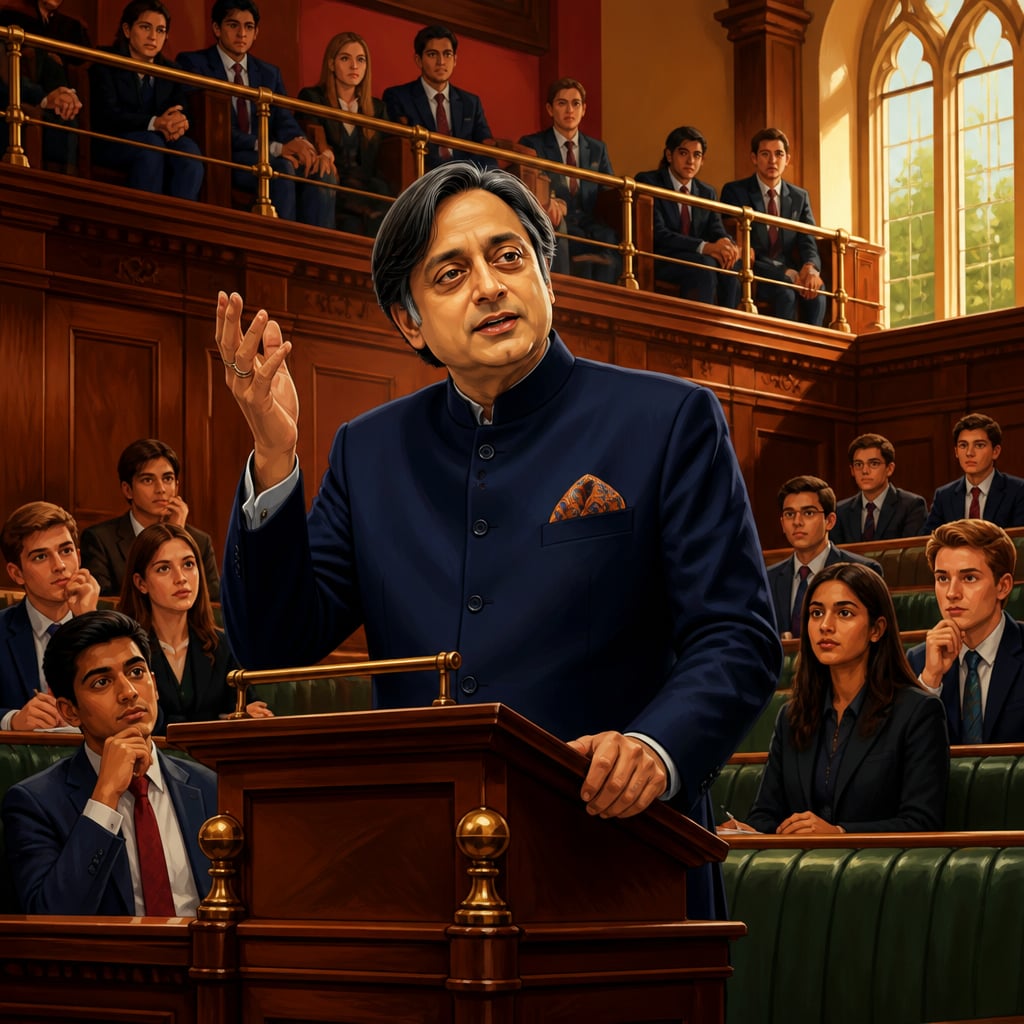
On the afternoon of 28 May 2015, in a wood-panelled debating chamber on St Michael's Street in Oxford, a fifty-nine year old former Indian Foreign Service officer named Shashi Tharoor stood up to argue, in fifteen minutes of unbroken speech, that Britain owed reparations to its former colonies. The chamber was the Oxford Union. The format allowed each speaker fifteen uninterrupted minutes and accepted only structured points-of-information from the audience. Tharoor began with a concession (he was not asking for actual money), pivoted to the moral question (the symbolic acknowledgement of historical wrong), and then walked the audience through five centuries of colonial extraction with names, dates, and figures. He closed by quoting Mahatma Gandhi. The Oxford Union recorded the speech as a matter of routine. Within forty-eight hours, the recording had crossed three million views. Within a week, the Indian Prime Minister, on a state visit to Bangladesh, had quoted from it. Tharoor had won the kshetra completely.
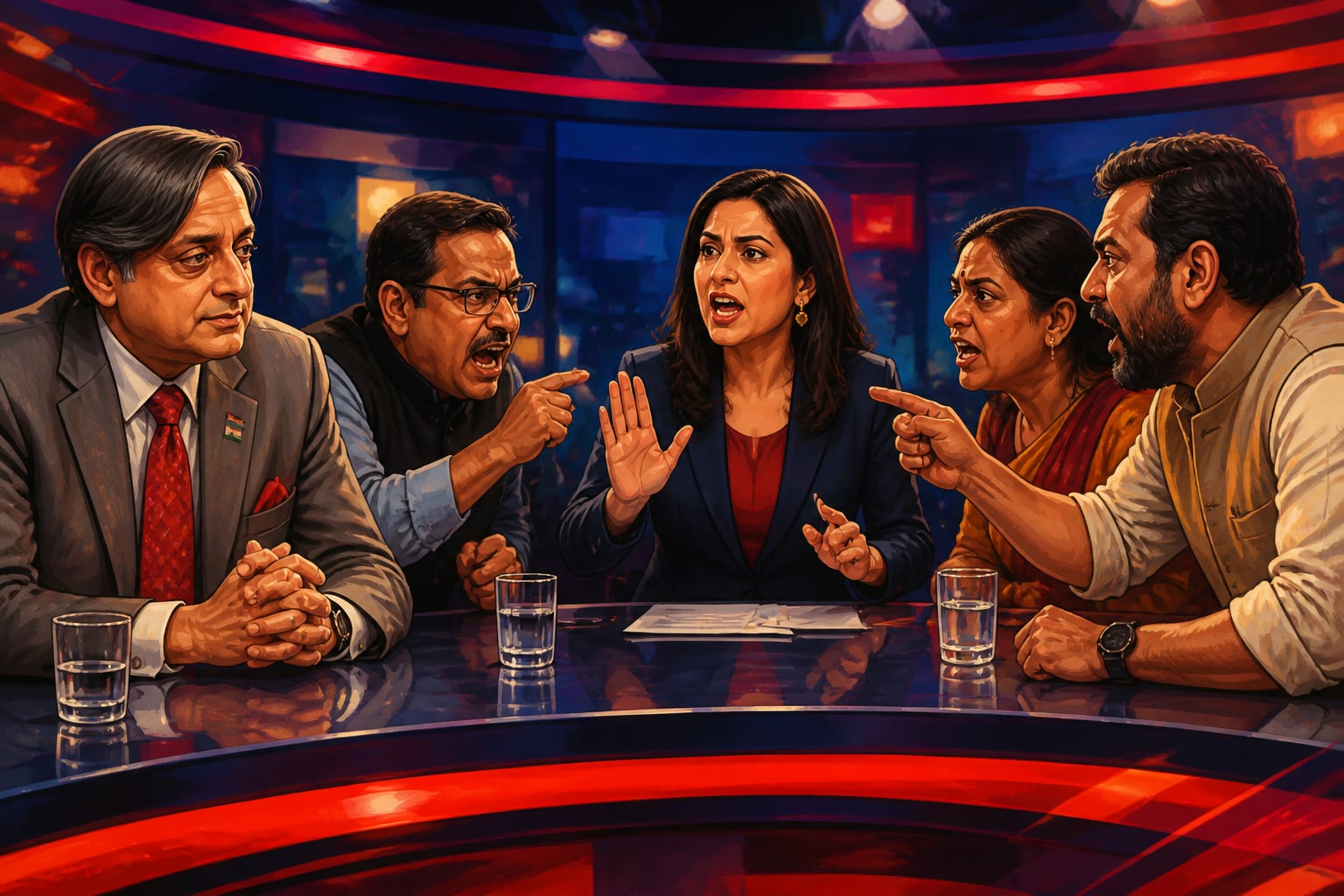
Three years later, on a Friday evening in September 2018, the same Shashi Tharoor was on a Times Now television panel debate. The chyron at the bottom of the screen read DEBATE OF THE NIGHT. The format allowed each panellist roughly twenty seconds of speaking time before the host cut to the next speaker. Tharoor began, as he had at the Oxford Union, with a concession and a pivot. The host interrupted him at the seventh second. He tried again. The host interrupted at the fifth second. By the end of the segment, three minutes after he had been introduced, Tharoor had not completed a single sentence. The clip that travelled the next morning was a forty-second compilation of his attempts to begin a sentence, intercut with the host's interruptions, scored with a meme-track. The same debater. The same skills. A different kshetra. He had lost the venue completely.

The Sanskrit name for what determined the outcome of those two afternoons is Kshetra-Jnana, field knowledge. The Bhagavad Gita opens, in its very first verse, with the word dharma-kshetre, on the field of dharma. The Sanskrit verse begins with the field, not with the warriors, because the field shapes what the warriors can do. This lesson is the working manual for that ancient principle, applied to the five battlefields a modern Vaada debater actually fights on.
What Kshetra-Jnana Actually Demands
Kshetra-Jnana is not a list of platform tips. It is a diagnostic. Within the first ten seconds of any exchange, the debater must read three properties of the venue and adjust her opening move accordingly.
- Time per turn. Twenty seconds, two minutes, twenty minutes, twenty hours. The available time per uninterrupted move determines which Shat-Khandana counter can land. A counter that takes ninety seconds to deliver does not exist as a move on a thirty-second-turn battlefield.
- Audience composition. Who is actually watching, listening, or reading? A studio audience, a partisan rally, a podcast subscriber base, a public Twitter timeline, a closed family WhatsApp group: each is a different audience, and the debater's job is the same in all of them only at the highest level of abstraction. At the level of which sentence to deliver first, they differ entirely.
- Editorial control. Who controls what survives the exchange? The host on a panel cuts what does not fit her narrative. The Twitter algorithm down-ranks what does not produce engagement. The podcast publishes the unedited recording. The Times of India op-ed page edits at sentence level. The WhatsApp group preserves screenshots indefinitely. Editorial control determines what a successful move actually means after the exchange ends.
The same six Shat-Khandana counters (Expose the Pattern, Anchor the Frame, Redirect the Burden, Isolate the Weakness, Dissolve the Emotion, Close the Loop) are available in every venue. The order in which they should lead, the elaboration they receive, and the closing move that seals them differ from venue to venue. The Vaada debater carries the full toolkit. The Kshetra-Jnana decision is which tool comes out of the kit first.
The Five Battlefields
1. Twitter / X (the speed battlefield)
Time per turn: as long as your post takes to read, capped by the algorithm at roughly the first two sentences for most readers. Audience: public, asymmetric, hostile-by-default for civilisational topics. Editorial control: zero, with permanent screenshot risk.
Lead with: Expose the Pattern (Pramana Khandana). The first sentence must name the tactic the opponent is using, in plain language, in under twenty words. "That is a strawman." "That is a Whatabout move." "That is concern-trolling at scale." The naming does the work; the elaboration is wasted in a venue where the median reader scrolls past after one and a half sentences. The other counters cannot lead in this venue because they require setup that the venue will not let you deliver.
The deeper rule for Twitter is do not enter the thread the opponent set up. Quote-tweet to your own audience instead. Twitter rewards moves that travel, and threads do not travel as well as quote-tweets do.
2. Panel Debate (the speed-plus-host battlefield)
Time per turn: ten to thirty seconds, controlled by the host. Audience: studio audience plus a passive television audience trained on conflict. Editorial control: the host's, sometimes followed by the channel's clip-curation team for next-day social media.
Lead with: Anchor the Frame (Avaccheda Khandana). The first sentence must define the terms and the scope of the debate, in plain language, in under twenty seconds. The host's job, structurally, is to keep the debate moving by introducing tension. The skilled debater takes the first turn to fence the battlefield, so that subsequent interruptions land on her terms. "Before we go further, the actual question on the table is X. Not Y, which is what the framing is suggesting." The anchor sentence is the move that survives the host's first interruption.
The deeper rule for panels is assume every twenty-second segment is the only one you will get. Do not save your best material for the third turn; the host may not give you a third turn. Front-load the structural reframe in the first turn and the case-level documentation in the second turn. If a third turn arrives, it is for closing. Panels are won in the first thirty seconds or not at all.
3. Podcast / Long-Form (the depth battlefield)
Time per turn: two to ten minutes per uninterrupted answer; total interview length two to five hours. Audience: self-selected, attentive, intellectually engaged, often substantially more sympathetic than panel audiences. Editorial control: usually the podcaster's, who will publish the unedited recording.
Lead with: the full Shat-Khandana sequence as needed. The podcast is the only venue in which the entire six-counter sequence can be deployed in its full elaborated form. Anchor the Frame in answer one. Redirect the Burden in answer two. Isolate the Weakness in answer three. Dissolve the Emotion when the conversation drifts toward feeling. Close the Loop at each natural conclusion. Expose the Pattern as a running diagnostic throughout. The podcast is the Dharmic debater's strongest medium because it is the only modern medium that resembles the shastrartha format the tradition originally evolved for.
The deeper rule for podcasts is bring primary sources, not soundbites. The audience that has chosen to listen for two hours wants the substance the panel format would not allow. The debater who has prepared substance and is willing to go thirty minutes on a single thread out-performs the one who arrives with rehearsed soundbites.
4. Written (the asynchronous battlefield)
Time per turn: as long as the writer chooses, with the reader free to spend any amount of time. Audience: self-selected, more careful, far less impulsive than any synchronous venue. Editorial control: depends on venue (op-ed pages edit; Substack does not; book chapters give the writer almost complete control).
Lead with: Isolate the Weakness (Vyapti Khandana). The asynchronous venue is the only one in which the reader is willing to follow a careful logical argument all the way to the load-bearing assumption. The opening move in a written piece is the identification of the single assumption on which the opposing position rests, followed by the argument that pulls the assumption out. The other counters work in writing too, but Isolate the Weakness is the one written form rewards above all others.
The deeper rule for the written venue is structure as a teacher, not as a debater. The reader is a student, not an opponent. The piece that wins is the piece the reader can quote a year later. Headings, named frameworks, numbered moves, dated specifics. Writing is the venue in which the Dharmic tradition's gift for structured exposition (the five-part syllogism, the sixteen padarthas, the twenty-two nigrahasthanas) is the natural medium.
5. WhatsApp / Closed Group (the asymmetric-ratio battlefield)
Time per turn: variable, often interrupted by ten other participants. Audience: known, often family or community, with social cost for any exchange. Editorial control: zero, with permanent screenshot-and-share risk to other groups.
Lead with: Dissolve the Emotion (Prayojana Khandana). WhatsApp groups are emotional venues. Most arguments start in feeling and stay in feeling. The first move is the three-beat dissolution from Lesson 8.5: acknowledge the feeling, separate it from the mechanism, name the gap between the stated and the actual purpose. Then, only then, deliver the case-level facts.
The deeper rule for WhatsApp groups is address only the lead argument; ignore the amplifiers. Most coordinated emotional escalations in groups have one lead poster and three to five amplifiers. The amplifiers do not survive engagement; they are following the lead's framing. Engage the lead's strongest claim once, with the three-beat dissolution, then stop. The amplifiers will retreat without engagement. Five years of replying to amplifiers is the canonical mistake of well-meaning Vaada-untrained debaters in family groups.
The Mapping Table
| Venue | Time per turn | Lead Counter | Secondary Counter | Closing Counter |
|---|---|---|---|---|
| Twitter / X | One scroll | Expose the Pattern | Isolate the Weakness | Quote-tweet, do not reply in thread |
| Panel | 10 to 30 seconds | Anchor the Frame | Redirect the Burden | Close the Loop in last 5 seconds |
| Podcast | 2 to 10 minutes | Anchor the Frame | All others elaborated | Close the Loop on each thread |
| Written | Reader's choice | Isolate the Weakness | All others structured | Close the Loop in final paragraph |
| Variable | Dissolve the Emotion | Anchor the Frame | Address lead only, ignore amplifiers |
The table is the working manual. Print it. Tape it to the inside of your notebook. The Vaada debater walks into any of the five venues with the table in working memory, reads the venue's three properties in the first ten seconds, and selects the lead counter accordingly. The mistakes most skilled debaters make are not skill mistakes; they are kshetra mistakes. The Oxford Union speech delivered at a panel format loses. The panel-format clip-friendly soundbite delivered at a podcast under-uses the venue. The same skill, applied to the wrong kshetra, is the canonical failure mode this lesson exists to prevent.
Group Debate Dynamics: Three Roles, One Defence
Most coordinated hostile encounters across all five venues use a three-role pattern. The Lead Attacker delivers the strongest framing, often the most-credentialed speaker. Two or three Amplifiers repeat the framing in slightly different words to make it feel like consensus. The Cleanup Hitter arrives late with a character attack designed to make the responder reluctant to continue.
The Vaada defence is asymmetric. Engage only the Lead's strongest claim, once, with the venue-appropriate counter from the table above. Do not engage the amplifiers; they retreat without engagement. Do not engage the cleanup hitter at all; engagement is what the cleanup hitter exists to provoke. The audience reads the asymmetry correctly. The responder addressed the strongest argument and ignored the noise. That is what the audience remembers.
Dharmic Lens: Western Genre vs Dharmic Kshetra
The Western tradition has a partial concept for this in rhetorical genre theory, developed by scholars like Carolyn Miller and Charles Bazerman in the 1980s. The diagnosis is that different venues require different forms, and that effective communicators learn the form of their venue. The diagnosis is correct as far as it goes.
The Sanskrit tradition's Kshetra-Jnana goes further in two ways. Genre theory primarily addresses the production of texts; Kshetra-Jnana addresses the moment-by-moment selection of which counter to deploy in a live exchange. And genre theory tells you what the audience expects; Kshetra-Jnana tells you what the venue allows the truth to do. The Vaada tradition holds that the field changes what truth can be delivered, but never changes what truth is. Genre theory is symmetric across positions, which is why it can be used as easily for advertising as for honest debate. The Dharmic debater carries both: the genre (what the audience expects) and the kshetra (what the venue allows the truth to do).
Marshall McLuhan's Understanding Media (1964) supplied the most-quoted modern formulation of the kshetra principle: the medium is the message. The Sanskrit tradition's Kshetra-Jnana, fifteen hundred to four thousand years older depending on the dating one prefers, was making the same diagnostic move with finer resolution. The political-debate consultant Frank Luntz, whose 2007 book Words That Work shaped two decades of US Republican messaging, has built a career on a partial Kshetra-Jnana for consultants. The half he is missing is the Dharmic insistence that the truth itself does not change across kshetras; only its packaging does.
Back At The Two Battlefields
Shashi Tharoor at the Oxford Union in May 2015 did not lose because his case was wrong. Shashi Tharoor at the Times Now panel in September 2018 did not lose because his case was wrong. The same case, in both rooms. The first room rewarded the case. The second room rewarded the soundbite. He had not yet trained for the second kshetra. By the late 2020s, the better Indian English-language media operations have started training their spokespeople explicitly for both, with the Sanskrit name of the discipline taught as part of the curriculum. The discipline is older than the venues. The venues changed; the principle did not.
In the next lesson, the chapter and the course close. The final synthesis names every move the Dharmic debater has now learned, and integrates them into a single working stance: precision without ego.
Case studies
Arjuna's Chariot at Kurukshetra: The Field Read Before the First Arrow
On the first morning of the eighteen-day Kurukshetra war, before the first conch was blown for engagement, Arjuna asked his charioteer Krishna to drive the chariot, drawn by four white horses and bearing the standard of Hanuman, into the open ground between the two armies. The Bhagavad Gita preserves the request word for word at verse 1.21. Place my chariot, O Achyuta, between the two armies, so that I may see clearly those drawn up here, eager to fight. Krishna complied. He drove the chariot to the centre of the field, equidistant from both armies, and positioned it so that Arjuna could see, in a single sweep, the entire opposing line. The Mahabharata's tradition has Arjuna recognising, in that single sweep, his teacher Drona, his patriarch Bhishma, his cousins, his uncles, and his sons-in-law. The recognition produced the emotional collapse that occupies the rest of the Gita's first chapter and that Krishna's eighteen-chapter response then resolves. The entire philosophical exchange that follows is structurally a consequence of the field-reading move that Arjuna performed in verse 1.21. Without the chariot's positioning, the recognition does not happen, and without the recognition, the Gita does not happen.
The case is the Sanskrit tradition's canonical model for pre-engagement Kshetra-Jnana. The lesson reads from it three operational principles. First, the field-reading move is performed by the warrior, with the charioteer's assistance, before the engagement begins. The Vaada equivalent is the debater reading the venue's three properties (time per turn, audience composition, editorial control) before opening the first counter. Second, the field-reading position is the centre, equidistant from both sides, with full sight of who is on each side. The Vaada equivalent is the debater holding the centre of the venue's discourse rather than committing to a side before the field is read. Third, the field-reading produces information that may itself change the engagement. Arjuna's recognition that his teachers and elders are on the opposing side changes the emotional terms of the war. The Vaada equivalent is that an honest field-reading sometimes reveals the venue is not the right venue for the case the debater intended to deliver, in which case Lesson 10.3's Vaada Vriksha allows the redirect or the exit.
The eighteen-day Kurukshetra war proceeds, with Arjuna fighting from a position that the field-reading made philosophically supportable. The Gita's eighteen chapters are the Sanskrit tradition's longest and most sustained consequence of a single in-engagement field-reading move. Across the Mahabharata's subsequent narrative, the Pandava cause holds, the dharmic kingdom is restored, and the philosophical conversation between Krishna and Arjuna becomes the most-read Hindu philosophical text in history. The field-reading was load-bearing for everything that followed; without it, the Gita does not exist as a text.
The Vaada debater performs the same move in microcosm before every engagement. Position the chariot. Read the field. See clearly who is on each side, what the venue allows, what the time-per-turn permits, what the editorial control will preserve. Only then deliver the first counter. The cost of skipping the field-reading is engaging blind. The reward of doing it is that the engagement becomes philosophically supportable, regardless of what the engagement reveals.
Shashi Tharoor: Oxford Union Triumph and Times Now Panel Defeat
On 28 May 2015, Shashi Tharoor delivered a fifteen-minute speech at the Oxford Union arguing that Britain owed reparations to its former colonies. The format allowed each speaker fifteen uninterrupted minutes and accepted only structured points-of-information from the audience. Tharoor opened with a concession (he was not asking for actual money), pivoted to the symbolic-acknowledgement question, walked the audience through five centuries of colonial extraction with names and dates, and closed with a Mahatma Gandhi quotation. The Oxford Union's recording of the speech crossed three million views within forty-eight hours of upload and was quoted by the Indian Prime Minister within a week, becoming one of the most-watched contemporary Indian English-language speeches of the decade. The same Shashi Tharoor, on multiple Times Now and India Today panel formats between 2018 and 2024, has consistently been outperformed by combative panel-format specialists like Arnab Goswami and Anand Ranganathan. The panel-format clip-reels of Tharoor attempting to begin sentences and being interrupted within five to seven seconds have themselves become a recurring social-media genre. The same person, the same case, the same skills. Two kshetras with opposite outcomes.
The Vaada diagnosis is structural. The Oxford Union format is a podcast-equivalent kshetra: long-form, self-selected attentive audience, full editorial control with the Union itself, and a venue that rewards the elaborated Shat-Khandana sequence Tharoor delivered. The Times Now panel format is a speed-plus-host kshetra: ten-to-thirty-second turns, hostile-by-default audience, editorial control with the host and the channel's clip team, and a venue that rewards Anchor-the-Frame as the lead counter. Tharoor's training, both as a UN diplomat and as a writer, has equipped him fully for the first kshetra and only partially for the second. His standard panel-format opening is the Oxford Union opening: concession, pivot, elaboration. The host interrupts before the elaboration arrives, and the panel-clip team selects the interrupted moments for next-day social. The defeat is venue-mismatch, not skill-deficit. The lesson is precisely the lesson this lesson is teaching: kshetra-jnana is a separately-trainable discipline, and skilled debaters who do not train it lose venues they could have held.
Tharoor's Oxford Union speech remains the single most-quoted modern Indian English-language argument for colonial reparations and is taught in undergraduate post-colonial history modules at multiple Indian and British universities. His panel-format performances, by contrast, are increasingly avoided by his own communications team, with selective participation in only those panels (Karan Thapar's longer-format Wire interviews, Faye D'Souza's longer segments) that approximate podcast conditions. The institutional pattern across Indian English-language commentary, from 2020 onward, has been a measurable migration of substantive case-makers from short-form panels toward podcast-format engagements. The kshetra mismatch has been recognised; the migration is the response.
The same skill that wins a podcast loses a panel. The Vaada response is not to retrain the skill but to read the kshetra and choose the venue. When the venue cannot be chosen, the response is to retrain the lead-counter selection for that venue's specific time-and-host conditions. The Oxford Union and the Times Now panel are not the same battlefield; treating them as the same is the canonical kshetra-jnana failure that the lesson exists to prevent.
Shashi Tharoor's 28 May 2015 Oxford Union speech crossed 3 million YouTube views within forty-eight hours of upload and 8 million views by mid-2016. By contrast, Tharoor's average Times Now panel-debate clip from 2018 to 2024, by the channel's own publicly available analytics, averaged under 200,000 views per clip, with the highest-engagement clips being interruption-compilation videos rather than substantive arguments. The same person, the same political position, two different orders of magnitude in audience reach by venue.
Rajiv Malhotra: Long-Form Dominance, Short-Form Vulnerability
Rajiv Malhotra is the contemporary writer and debater whose work this Vaada Shastra course draws on most heavily for its Purva Paksha methodology and its named civilisational frames (Breaking India, Being Different, Indra's Net). Across two-and-a-half decades of public engagement, his case-making record across venues has shown a sharp kshetra asymmetry. In long-form podcasts (multiple appearances on Sangam Talks, Tom Bilyeu's Impact Theory, Lex Fridman's podcast format equivalents in the Indian context, and his own Infinity Foundation programming), Malhotra is consistently effective. The full Shat-Khandana sequence (Anchor-the-Frame, Redirect-the-Burden, Isolate-the-Weakness, Dissolve-the-Emotion, Close-the-Loop) lands cleanly across two-to-five-hour conversations. In thirty-to-sixty-minute single-host interview formats with sympathetic interviewers, the record is also strong. In short-form panel formats (sub-five-minute segments, multi-panellist debates, hostile-host conditions) and on Twitter, the record is more mixed. Twitter exchanges in particular have, on multiple documented occasions, produced viral counter-clips in which his elaborated frames were truncated and reframed by hostile quote-tweeters. The same case-maker, same body of scholarship, two very different kshetras with measurably different success rates.
The Vaada diagnosis matches the case-mapping table from this lesson. Malhotra's strongest kshetra is the podcast/long-form battlefield, where the full Shat-Khandana sequence is the lead counter. His method is structurally the shastrartha format the Sanskrit tradition originally evolved for, transplanted into a modern medium with comparable affordances. His weaker kshetra is Twitter (where Expose-the-Pattern leads, in under twenty words, with no elaboration permitted) and the panel format (where Anchor-the-Frame leads, in under twenty seconds, with the host controlling the cut). His own preferred move-set, optimised for the long-form, requires setup time the short-form does not allow. The kshetra-jnana lesson is twofold. First, the long-form is his correct primary venue; choosing it is itself a kshetra-jnana win. Second, when the short-form is unavoidable (he is invited onto Twitter by quote-tweet, he is dragged into a panel by the news cycle), the lead-counter selection must shift to the venue's affordances rather than to his preferred elaborated style. The skill is trainable; some of the recent Infinity Foundation media-training programmes have begun teaching it explicitly.
Malhotra's long-form work, including his books and his Sangam Talks programming, has shaped the modern Indian Purva Paksha movement and is the primary intellectual scaffolding of this Vaada Shastra course. His Twitter presence, by contrast, has been the subject of multiple documented short-form vulnerabilities in which hostile quote-tweeters have selectively excerpted his elaborated arguments to produce caricature versions. The institutional response from the Infinity Foundation since approximately 2022 has been a measurable shift in venue allocation: more podcast and long-form, less reactive Twitter engagement, with explicit kshetra-jnana training for younger associates entering the same case-making space. The shift is the lesson's recommendation, applied at institutional scale.
Pick your kshetra when you can; train your secondary kshetras for the venues you cannot avoid. The first move of Vaada Shastra in the modern English-language Indian space, applied to one's own time-allocation, is to spend the largest share of one's hours on the venue that rewards one's own move-set. The second move is to install lead-counter retraining for the venues that one is occasionally pulled into. The third move is to refuse the venues whose kshetra is structurally incompatible with one's case (a fifteen-second cable-news soundbite for a position that requires three minutes to set up). All three moves are forms of kshetra-jnana; together they are how a case-maker outlasts the news cycle.
By the publicly available view-counts on YouTube as of early 2026, Rajiv Malhotra's Sangam Talks long-form interviews have ranged from 100,000 to over 1 million views per episode for the most-watched conversations on Hindu civilisational topics. His average Twitter engagement metrics across the same period (2022 to 2025) show median post engagement at roughly the 99th percentile of the platform but with frequent high-attention reframing by hostile quote-tweeters, which the long-form medium structurally precludes.
Reflection
- Recall the last debate or argument you participated in (face-to-face, online, in a meeting) where you felt afterwards that you had lost a case you should have won. Which of the five kshetras was the venue (Twitter, panel, podcast/long conversation, written, WhatsApp/group)? Looking back, did the lead counter you used match the venue's affordances, or were you using a counter that fit a different kshetra? What would the venue-appropriate lead counter have been, and how would the conversation have gone differently if you had used it?
- The Bhagavad Gita opens with the field, not with the warriors (dharma-kshetre kuru-kshetre). The Sanskrit tradition's signal is that the field shapes everything that happens on it. Modern communications-studies has a partial concept for this in McLuhan's medium-is-the-message. What specifically does the Sanskrit framing capture that McLuhan does not? Why does the Sanskrit tradition place the field-naming in the very first verse of its longest philosophical text, and what does that placement tell us about the priority the tradition assigned to kshetra-jnana relative to the philosophy that follows?
- Kshetra-Jnana teaches that the same truth, spoken in different venues, can produce opposite outcomes. A panel debate may distort the truth into a soundbite; a long-form podcast may elaborate the same truth into wisdom. If the truth is invariant across venues but its reception is not, what is the dharmic obligation of the Vaada debater? Is she obliged to choose only the venues where the truth can be received, or is she obliged to deliver the truth in venues where it will be distorted? The Mahabharata's tradition records both Krishna's choice to deliver Vidura's counsel (a venue where it would be distorted) and his choice to deliver the Gita to Arjuna alone (a venue where it would be received). What does each choice tell us about the dharmic limit of kshetra-jnana?