Kautilya's Arthashastra: Strategic Communication

When to Speak, When to Stay Silent

Debate as statecraft. The Arthashastra treats speech as a strategic instrument with four toggles: when to speak, when to stay silent, when to reveal, when to conceal. The lesson teaches Mantra-Rakshana (the secrecy of counsel), the Sadgunya six-fold policy of communication, the Vak-Mauna calculus (the speech-silence trade-off), and the Vakya-Yantra (the four-toggle decision matrix). The same discipline that placed Chandragupta on the Magadhan throne operates today in Indian foreign policy, in geopolitical press conferences, and in any high-stakes public exchange where the wrong word reveals more than the right one.

The Press Conference That Was Not A Press Conference

On the afternoon of 3 March 2022, in Bratislava, Slovakia, India's External Affairs Minister Subrahmanyam Jaishankar sat at a small conference table beside Slovakia's foreign minister and answered, in measured English, a question from a European journalist. The question was the same question Western media had been pressing on India for ten days. Russian forces had crossed into Ukraine on 24 February. The Western capitals had condemned the invasion, levied sanctions, and issued joint statements. India had abstained at the UN Security Council, declined to join the Western sanctions, continued purchasing Russian crude, and refused to use the word condemn in any official statement. The journalist's question was direct. Why had India not condemned Russia.
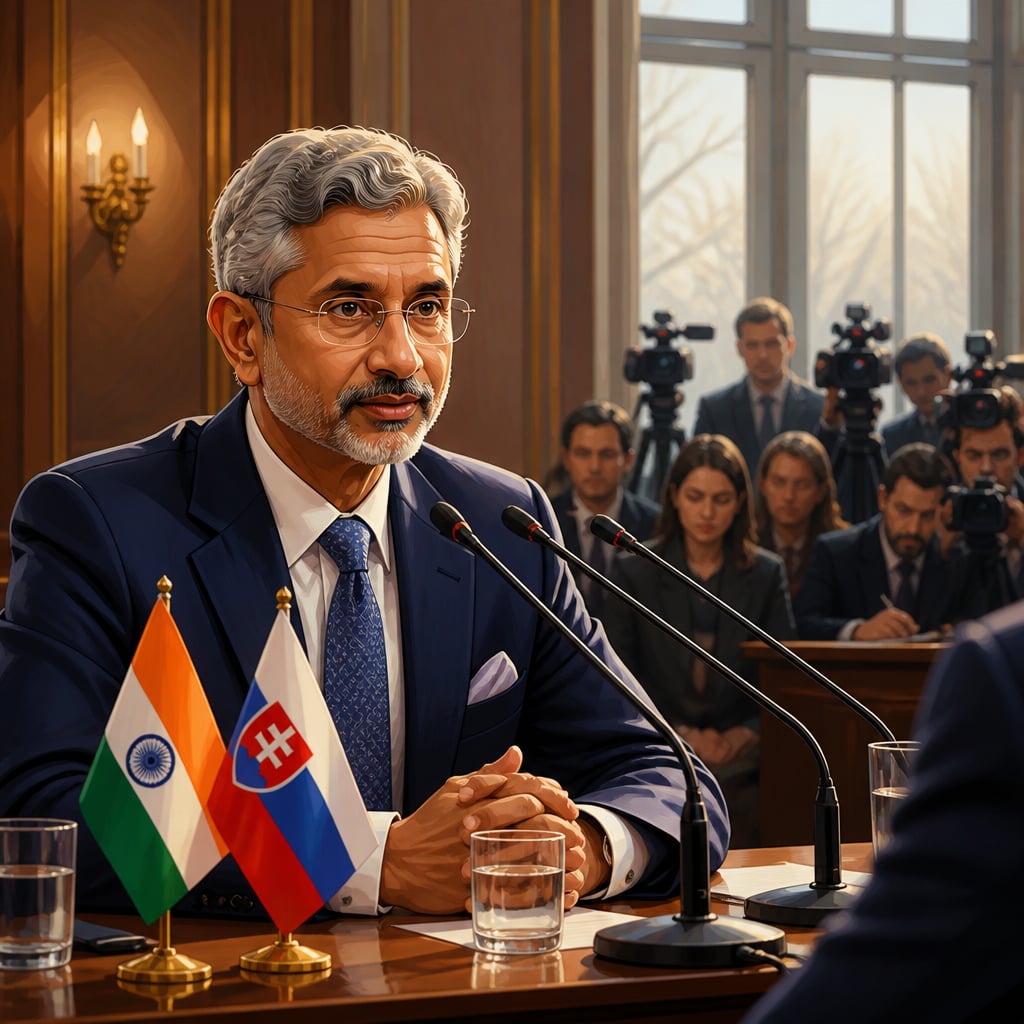
S. Jaishankar at a Bratislava press table, calmly answering a European journalist

Jaishankar's answer was approximately ninety seconds long. It contained no condemnation. It also contained no defence of Russia, no apology, no pivot to whataboutism, and no rhetorical heat. He named, in sequence, four things. India's energy security. India's defence procurement history. India's principle of strategic autonomy. India's concern for the safety of Indian students still in Ukraine. He named no fifth thing. He did not say what India would not do, only what India had done and would continue to do. The silence on the demanded condemnation was load-bearing. Inside the four things he had named was the entire Indian position. Outside them, by deliberate omission, was the moral framework the question had attempted to impose.

In the next eighteen months, the Western press's framing on India and Ukraine slowly adjusted. The demand for condemnation receded. The phrase strategic autonomy entered the European policy vocabulary. By the time of the G20 New Delhi declaration of September 2023, Western capitals had agreed to a paragraph on Ukraine that did not contain the word condemn, and the framing was widely read as Indian. The Indian frame had held because the silence had held. What had been at stake in Bratislava in March 2022 was not Indian honesty; India's position was clear from the outset. What was at stake was whether the Indian frame would survive contact with the Western framing. It survived because the foreign minister knew which words to use, which words to omit, which positions to reveal, and which positions to conceal.

This is Mantra-Rakshana, the Sanskrit name for the discipline of strategic communication. The phrase is preserved across Books One and Five of Kautilya's Arthashastra, the foundational classical Indian treatise on statecraft. Mantra in this register means counsel, the deliberation that informs action. Rakshana means protection, guarding, the keeping-safe of a thing under hostile conditions. Mantra-Rakshana is the protection of counsel against premature, careless, or hostile revelation. The Arthashastra treats it not as a virtue or a personality trait but as a structural discipline of statecraft. The cabinet that protects its counsel out-deploys the cabinet that does not. The diplomat who protects their counsel out-negotiates the diplomat who does not. The debater who protects their counsel out-frames the debater who does not.

The lesson teaches the Arthashastra's communication discipline in modern register. It is the second lesson in the Sthitaprajna Vadin chapter because it presupposes the first: a debater who is not yet established in equanimity cannot deploy strategic silence; the silence becomes evasion or freeze rather than instrument. With Sthitaprajna in place, the four toggles of Arthashastra communication become available as deliberate moves.

The Four Toggles: The Vakya-Yantra

The Arthashastra's communication discipline reduces, for the modern debater, to a four-toggle decision matrix the lesson names the Vakya-Yantra, the speech-instrument. Every public utterance involves a choice on each of the four toggles. The toggles are independent, which means there are sixteen possible combinations, of which only one is fully appropriate to any given moment.

Toggle one. Speech or silence. The first decision is whether to speak at all. Most debaters treat speech as the default and silence as the exception. The Arthashastra reverses this: silence is the default and speech is the deployment. The reversal is not stylistic; it is structural. Speech consumes counsel. Silence preserves it. The Sanskrit term for unnecessary speech is prakriti-vakya, speech that arises by ordinary disposition rather than by deliberate strategic decision. Kautilya's instruction to the king's counsellors is direct: every word spoken in deliberation is a word that may be carried out of the chamber by an unfaithful servant, an enemy spy, or the speaker's own indiscretion. Therefore each word must justify the risk of its escape. A word that does not justify the risk is a word that should not have been spoken.

Toggle two. Reveal or conceal. Once the decision is to speak, the second toggle determines what is revealed and what is concealed within the speech. The Arthashastra's discipline is that revelation is calibrated to deployment. A position is revealed only at the moment its revelation serves a deployment that has already been prepared. A position revealed earlier than that moment is a position that has been disarmed before it could be fired. Krishna's negotiation in the Kuru Sabha, treated in the case study below, is the classical worked example: he revealed the five-village offer publicly and concealed the contingency of the Vishvarupa darshan until the moment Duryodhana's seizure attempt made the revelation tactically required. The order of revelation was the negotiation. Modern Indian foreign policy operates on the same discipline: ISRO's communication during Chandrayaan-3 in July and August 2023 made every technical update public only at the milestone where the update served a deployment that had completed; no premature claims, no defensive responses to Russian Luna-25 framing, no emotional communication until the soft-landing was confirmed on 23 August.

Toggle three. Direct or indirect. The third toggle determines whether the message is delivered in plain register or in coded register. Vidura's coded warning to Yudhishthira about the lakshagriha plot, delivered in Mleccha-bhasha so the Kaurava conspirators present could not understand, is the canonical example. The principle generalises. Direct register is the default when the audience is friendly and the channel is secure. Indirect register, including coded vocabulary, layered allusion, third-party intermediation, and what diplomats call deniable signalling, is required when the channel is mixed, when hostile listeners are present, or when the message must be received by allies without arming opponents. The Arthashastra's Book 1.16 on Duta-Pranidhi, the envoy protocol, treats indirect communication as a primary instrument of statecraft, not as an evasion of clarity.

Toggle four. Soft or hard. The fourth toggle determines the affective register: conciliatory or confrontational, warm or cold, gentle or sharp. The Arthashastra's Sadgunya, the six-fold policy of state action, supplies the strategic frame: Sandhi (peace, conciliation), Vigraha (war, confrontation), Yana (advance, escalation), Asana (waiting, stillness), Samshraya (seeking shelter or alliance), and Dvaidhibhava (the double-policy, soft with one and hard with another simultaneously). Each of the six maps to a specific affective register in the speech-act. Most modern debaters operate on a binary of soft or hard. The Arthashastra operates on a six-fold register, of which the double-policy (Dvaidhibhava) is the most subtle: speaking softly to one party while speaking hard to another, in the same exchange, without contradiction.

The four toggles together, with sixteen possible combinations, are the Vakya-Yantra, the speech-instrument. Most exchanges in modern public life operate on a single combination by default: speak, reveal, direct, soft. The Arthashastra-trained communicator recognises that this default is one combination among sixteen, and that the moment determines which combination is appropriate. The discipline is not to memorise the sixteen; it is to consciously choose each toggle before the speech-act, rather than defaulting to the modern public life standard.

Mantra-Rakshana: Why Counsel Must Be Protected

Chanakya studying palm-leaf strategy map by lamplight at midnight

The Arthashastra is, on this question, ruthlessly practical. Counsel revealed is counsel that the opponent now possesses. Counsel possessed by the opponent is counsel that the opponent will deploy against you. Therefore counsel must be protected from the moment it is formed until the moment it is deployed. Kautilya's Book 1, Chapter 15, on the structure of legitimate deliberation (the Mantra-adhikara), opens with this observation and never softens it.

मन्त्रविस्रावो हि कार्यनाशः।

mantra-visrāvaḥ hi kārya-nāśaḥ

The leakage of counsel is the destruction of the work.

Arthashastra, Book 1, Chapter 15, in the Mantra-adhikara

The sentence is short and final. Visrava means leakage in the strict sense of fluid escaping its container. Karya-nasha means the destruction or annihilation of the work. The cause-effect link is asserted, not argued. Kautilya treats the connection as so well-established by Mauryan and pre-Mauryan experience that it requires no defence. The work, whatever it is, perishes when the counsel that informed it is leaked. The implication for the cabinet is direct. Counsel is taken in chambers. Counsel is recorded only when essential. Counsel is shared with the king alone, or with the inner three or four counsellors, never with the broader court. Counsel is implemented through subordinates who do not know the larger plan, only the part assigned to them. The Mauryan empire was, by Kautilya's own framing, the kingdom whose Mantra-Rakshana was tighter than its competitors'. Tighter counsel produced longer reign.

The modern adaptation is straightforward. The Hindu civilisational debater, the diplomat, the senior counsel, the institutional spokesperson all hold counsel that must be protected from premature revelation. The temptation in modern public life to share counsel through tweets, podcasts, and off-the-record briefings is, in Arthashastra terms, structural Mantra-Visrava. Each impulsive disclosure is a small leakage; the cumulative effect, over months and years, is karya-nasha at the scale of the cause being defended. The discipline is to recognise the temptation as the temptation it is and to refuse it consistently, not on every occasion but on the consequential ones where the leakage would convert preparation into destruction.

Silence as a Debate Move

The Arthashastra's most counter-intuitive contribution to modern debate practice is the treatment of silence as a deliberate move, not as an absence of move. Most modern debate pedagogy treats silence as failure: the moment the speaker has nothing to say. The Arthashastra treats silence as one of the most powerful instruments in the Vakya-Yantra. The Sanskrit term is Mauna, and the Arthashastra distinguishes three kinds.

Strategic Mauna is silence deployed to deny the opponent the response they expect. The opponent has framed a question, an accusation, or a provocation that requires a reply to consummate the rhetorical structure. The strategic Mauna refuses the consummation. The opponent is left holding the question without the response that would complete it. The audience reads the asymmetry: the opponent has spoken, the debater has not, and yet the debater has not lost ground. PM Modi's near-total public silence in the seventy-two hours after the Galwan Valley clash of 15 June 2020 is the contemporary template. The Western press's expectation was of an immediate Indian government statement that would, by its content, allow Chinese counter-framing to begin. The silence denied that consummation. By the time the Indian statement came, the military counter-deployment had completed, the Cabinet Committee on Security had finalised its decisions, and the Chinese propaganda window had closed.

Diagnostic Mauna is silence deployed to read the opponent. When the speaker withholds speech, the opponent's behaviour fills the vacuum. The opponent's nervousness, over-explanation, repetition, or escalation reveals what the opponent's prepared statement would have concealed. The Arthashastra's Book 1.16 on Duta-Pranidhi instructs envoys to deploy diagnostic Mauna in the early phase of any negotiation: speak less than expected, observe more than expected, and let the opponent reveal their position by the order in which they introduce it. Modern interview pedagogy, when practised by serious journalists, knows this discipline; the long pause after a politician's first answer often produces the second answer that the politician had not intended to give.

Dharmic Mauna is silence deployed when speech itself would corrupt the act. The Bhagavad Gita's instruction at 17.16 on the Mauna of the mind, the atma-vinigraha of self-restraint, treats silence as the discipline that prevents speech from arising in conditions where speech would damage the speaker, the listener, or the truth. The Arthashastra's parallel discipline is the silence of the counsellor in the presence of the king's anger, the silence of the envoy in the presence of the hostile court's provocation, the silence of the king himself in the presence of grief or rage. Dharmic Mauna is the most demanding because it requires the speaker to recognise, in the heat of the moment, that speech would be corrupting, and to choose silence even when the surrounding pressure to speak is overwhelming.

The three kinds of Mauna are sequentially deployable. A debater under hostile examination may begin in strategic Mauna (to deny the consummation), shift to diagnostic Mauna (to read the opponent's filling of the vacuum), and conclude in dharmic Mauna (to refuse the corrupting reply that the room is now demanding). The trained Sthitaprajna debater carries the three in working memory and deploys them as the moment requires.

Dharmic Lens: Western Rhetoric Versus Arthashastra Communication

The Western rhetorical tradition, from Aristotle's three modes (logos, ethos, pathos) through Cicero's five canons through the modern public-speaking pedagogy, is structurally content-and-delivery oriented. It teaches how to construct an argument and how to deliver it persuasively. Within its scope, the tradition is rigorous, and modern Western political communication, from the State of the Union address to the European Council press conference, is the product of two and a half millennia of refinement.

The Arthashastra is not in conflict with this tradition; it is structurally larger. The Western tradition optimises the speech-act. The Arthashastra optimises the decision to speak-act, of which the speech-act is one possible outcome among sixteen. A communicator trained in the Western tradition will deliver a polished speech where the moment called for silence. A communicator trained in the Arthashastra will, when silence is called for, remain silent, and will deliver a polished speech only when the moment requires speech. The asymmetry is not in delivery quality. It is in the strategic logic that precedes the decision to deliver at all.

The second structural difference is the place of concealment. The Western tradition, in its modern democratic register, treats concealment with suspicion: transparency is a virtue, openness is the default, and concealment is structurally aligned with bad faith. The Arthashastra treats concealment as one of the four toggles, neither virtuous nor vicious in itself, but appropriate or inappropriate to the moment. A position concealed at the moment that calls for revelation is bad faith. A position revealed at the moment that calls for concealment is poor statecraft. Both are errors. The Western default in democratic public life leans towards over-revelation, and the cumulative cost is the loss of strategic coherence: every preliminary thought becomes public before it has matured into a deployable position. The Arthashastra default leans towards calibrated concealment until deployment is ready, and the cumulative benefit is that positions, when revealed, arrive in the public sphere as already-deployable rather than as raw material for opponents to disarm.

Vidura whispering coded Mleccha-bhasha warning to Yudhishthira

The third difference is the place of indirection. The Western tradition, particularly its post-Enlightenment register, valorises directness as honesty: say what you mean, mean what you say, plain language without ornament. The Arthashastra treats indirection as a primary instrument when the channel is mixed. A message delivered in plain register before a mixed audience reaches the wrong receivers as well as the right ones. A message delivered in coded or layered register reaches the intended receivers and passes opaquely past the unintended ones. Vidura's Mleccha-bhasha warning is the classical example; modern diplomatic signalling, particularly the Indian foreign ministry's habit of releasing carefully ambiguous statements that mean one thing in Hindi for the domestic audience and something subtly different in English for the international audience, is the contemporary continuation of the same discipline. The Western reading often misclassifies this as duplicity. The Dharmic reading recognises it as the appropriate use of indirect register for a mixed channel, which is the structurally larger pedagogy.

When Silence Is Failure: The Bhishma Setback

The Arthashastra's discipline of silence is not unconditional. Silence deployed when speech is dharmically required is not Mantra-Rakshana; it is the corruption of Mantra-Rakshana into evasion. The Mahabharata's most painful demonstration of this corruption is Bhishma's silence in the dice hall during the disrobing of Draupadi. Bhishma was the most senior figure in the Kuru court, the bearer of the dharmic standard for the dynasty, and the only person in the hall whose intervention would have stopped the act. He chose silence. His later attempt to justify the silence on grounds of dharmic ambiguity (the technical question of whether Yudhishthira's wager of Draupadi after losing himself was binding) is treated by the Mahabharata's later narrative as the catastrophic moral failure that produced the war.

The lesson for the modern debater is precise. The four toggles of the Vakya-Yantra are decisional, not absolute. Each toggle is set by the requirements of the moment, including the dharmic requirements. A toggle set against the moment's dharmic requirement is not Mantra-Rakshana; it is its opposite. The silent counsellor in the room where dharma is being violated is not protecting counsel; the counsellor is failing to deploy the speech-act that the moment required. The Arthashastra's discipline includes, as its outer limit, the recognition that some moments require speech and that strategic silence in those moments is structural failure. The Sthitaprajna debater carries this recognition as the upper bound of the silence discipline, not as a contradiction of it.

Where The Lesson Lands

The Vakya-Yantra is the practical artefact. The Sanskrit terms (Mantra-Rakshana, Sadgunya, Mauna, Sandhi, Vigraha, Dvaidhibhava) are the structural vocabulary. The four toggles, with sixteen combinations, are the decision matrix. The three kinds of Mauna are the silence-deployment options. The Bhishma setback is the upper bound. Together, they constitute the modern Dharmic debater's strategic communication discipline.

The next lesson, the Vaada Vriksha, builds on this foundation by teaching the decision tree of when to engage, when to control the frame, and when to exit. The Vaada Vriksha presupposes the Vakya-Yantra: the choice of engagement mode is itself a choice across the four toggles, made consciously rather than by default. A debater who has internalised this lesson's discipline arrives at the Vaada Vriksha with the four toggles already in working memory, and the decision tree becomes deployable in seconds rather than in minutes.

Case studies

Krishna's Selective Revelation in the Kuru Sabha (Mahabharata, Udyoga Parva)

In the late phase of the Pandavas' thirteen-year exile, with the Kauravas continuing to refuse the return of the kingdom, Krishna travelled to Hastinapur as the Pandavas' envoy. The Mahabharata's Udyoga Parva, in the Bhagavad-yana sub-parva, records the negotiation across more than 190 verses. Krishna's communication discipline in the Kuru Sabha is the Mahabharata's most precise classical demonstration of the four-toggle Vakya-Yantra. Toggle one (speech or silence): Krishna spoke when the moment required public articulation of the Pandava position and remained silent when the Kaurava court attempted to widen the discussion to questions outside the agreed scope. Toggle two (reveal or conceal): Krishna revealed the five-village offer in open court, calibrated precisely to the political moment that allowed Duryodhana to refuse it visibly before the assembly. Krishna concealed the contingency plans, including the military readiness of the Pandava armies and the spiritual reality that would be revealed at the Vishvarupa darshan, until the moment Duryodhana's seizure attempt made revelation tactically required. Toggle three (direct or indirect): Krishna addressed Yudhishthira's claim in plain register before the assembly while addressing Bhishma and Vidura through layered allusion that the Kaurava partisans in the hall could not parse, deploying indirect register for the mixed channel. Toggle four (soft or hard): Krishna deployed Sandhi towards Bhishma and Vidura, Vigraha towards Duryodhana and Karna, and Dvaidhibhava in the same exchange, the affective register modulating from sentence to sentence, with no internal contradiction visible to those listeners trained to read the Sadgunya register.

Krishna's negotiation in the Kuru Sabha is the Mahabharata's worked example of the entire Vakya-Yantra in simultaneous operation. The Arthashastra's six-fold Sadgunya is visible across the negotiation: Sandhi towards the dharmic faction in the Kaurava court, Vigraha towards the adharmic faction, Asana when Duryodhana attempted to widen the scope to philosophical questions about kingship, Yana when the five-village offer was made and the consequence of refusal was named, Samshraya in the public alignment with Bhishma's prior counsel, and Dvaidhibhava in the simultaneous deployment of all the above. Krishna's Mantra-Rakshana is also visible: the Vishvarupa darshan was protected as concealed counsel until the seizure attempt forced its deployment, and once deployed it accomplished its strategic purpose with no further external display. The negotiation closed with the Kauravas in the moral wrong, the Pandavas in the moral right, the dharmic faction of the court correctly positioned, and the war's eventual onset already aligned with the dharmic axis. None of this would have been possible with content-and-delivery alone; it required the prior strategic decision to deploy the Vakya-Yantra in full.

The Kauravas refused the five-village offer. Duryodhana attempted to seize Krishna and was rebuffed by the Vishvarupa darshan, the concealed counsel deployed at the moment its revelation served the strategic purpose. War followed at Kurukshetra. The Mahabharata's framing is unambiguous: the war was not Krishna's communication failure. The communication had operated correctly. The Kauravas, having rejected the offer in public, in the open court, before the assembled witnesses, had positioned themselves as the adharmic party in the conflict that followed. The Pandavas, having had their offer refused publicly through Krishna's deployment of the four toggles, entered the war from a position of moral clarity that an unprepared communication could not have produced. The Mahabharata treats the negotiation as Krishna's preservation of dharma through the precise calibration of speech, silence, revelation, and concealment, not through the volume or the content of the words themselves.

The Vakya-Yantra is most powerful when all four toggles are deployed simultaneously rather than as a sequence of binary choices. Modern debaters tend to set one toggle at a time, often by default, often without recognising that the other three are also being set. Krishna's negotiation demonstrates that the deliberate simultaneous setting of all four, calibrated to a specific outcome in a specific assembly, is what separates a strategic communicator from a content-and-delivery communicator. The simultaneous deployment is the discipline; the four separate decisions, made consciously together, is the technique. Modern Dharmic communicators in any high-stakes assembly (parliamentary committee, international press conference, courtroom, podcast cross-examination) can study Krishna's Sabha performance as the canonical four-toggle template.

The Udyoga Parva of the Mahabharata, in the BORI Critical Edition, devotes more than 190 verses to the Kuru Sabha negotiation across multiple chapters of the Bhagavad-yana sub-parva. Of these, the explicit verses of dialogue (where Krishna or another speaker is speaking) are approximately 130; the remaining 60 are descriptions of silences, gestures, glances, and the affective registers of the various parties. The Mahabharata's narrative ratio of approximately one in three verses devoted to non-verbal or silent register, in a recorded negotiation, is itself an Arthashastra-aligned witness to the importance of the unspoken in the speech-act.

Chanakya's Silent Reading of the Nanda Court (4th c. BCE)

Following his ejection from the Nanda court at Pataliputra, the Brahmin scholar known to the Sanskrit tradition as Chanakya, Kautilya, or Vishnugupta did not return to the court for confrontation, lecture-tour, or open denunciation. He withdrew to Takshashila, took on a disciple in the young Chandragupta, and over the next decade conducted what the Mudrarakshasa of Vishakhadatta would later dramatise as one of the longest sustained campaigns of strategic silence in classical Indian political history. Chanakya re-entered Pataliputra periodically in disguise, in the role of an itinerant scholar, an ascetic teacher, and on occasion a court-sanctioned ritualist. His purpose on each entry was diagnostic Mauna: read the court, identify which Nanda generals carried unresolved grievances, locate the points at which the dynasty's authority was thinnest, and map the political terrain without revealing himself as a hostile presence. He never engaged in open debate at the Nanda court during these periods. He never published criticisms of Dhana Nanda. He maintained Mantra-Rakshana on the entire campaign for the duration of the preparation. The Arthashastra's Book 5, on the Yogavritta (the secret operations of the king), preserves the doctrinal compression of this discipline: the king's hostile preparations against an opposing power are conducted without external announcement until the moment the deployment is irreversibly underway. Chanakya's preparation embodied this principle at unusual scale and over unusual duration. The Mauryan succession, when it arrived, was the deployment of years of concealed counsel.

Chanakya's preparation is the Arthashastra's own author's worked example of the doctrine of Mantra-Rakshana sustained across years rather than across days. The four toggles of the Vakya-Yantra are visible in his discipline. Toggle one (speech or silence): default silence on the Nanda question, speech only when speech served the diagnostic or recruiting purpose. Toggle two (reveal or conceal): the entire campaign concealed, with Chandragupta's role itself unknown to the Nanda court until the alliance-building phase had completed. Toggle three (direct or indirect): direct register with trusted recruits, indirect register through intermediaries with prospective allies whose loyalty was not yet certain. Toggle four (soft or hard): predominantly Asana (waiting) towards the Nandas, Sandhi towards the disaffected generals being recruited, Samshraya towards the frontier kingdoms whose military assistance was needed. The discipline was not personality-driven; the Mudrarakshasa portrays Chanakya as a man of considerable rhetorical capacity who could have engaged in open court debate at any moment. The choice of sustained silence was strategic, calibrated to the timeline of the deployment, and reversed only at the moment the deployment was already in motion. The Mauryan empire's eventual establishment was, in Kautilya's own framing, the kārya-siddhi (the accomplishment of the work) that the years of Mantra-Rakshana had made possible.

Chandragupta Maurya took the Magadhan throne around 322 BCE. The Mauryan empire that followed reached its greatest extent under his grandson Ashoka and remained a continuous polity for approximately 137 years. The Arthashastra itself, preserved in the version recovered by R. Shamasastry in 1905, became the foundational classical Indian text on statecraft and continues to inform Indian strategic thinking into the twenty-first century. The campaign's success is not, in the Arthashastra's own framing, attributable to Chanakya's eloquence in the moment of confrontation. It is attributable to the years of concealed preparation that preceded the moment, with the Mantra-Rakshana protecting the counsel from the time it was first formed in Takshashila to the moment it was deployed at Pataliputra. The doctrine of strategic communication is the codified compression of the discipline that produced the empire.

Strategic silence is not a weakness, a refusal, or an evasion. It is, when correctly deployed, the most precise communication available to the strategic actor, because it is the only communication that simultaneously preserves preparation, denies the opponent their expected counter, and reveals the opponent's posture through the way they fill the vacuum. Modern Dharmic communicators (legal advocates, civilisational defenders, foreign-policy practitioners) can study Chanakya's preparation as a multi-year worked example of Mantra-Rakshana sustained at civilisational scale. The principle that revelation must be calibrated to deployment, and that any revelation earlier than that moment is a leakage, applies as strictly to a six-month constitutional case preparation as it did to the decade-long Mauryan succession campaign. The form is the same; only the scale changes.

The Arthashastra of Kautilya, as preserved in the Kangle critical edition, runs to fifteen books and approximately 6000 sutras, of which Book 1 (Vinayadhikarika), Book 5 (Yogavritta), and Book 7 (Sadguna-samuddesha) deal most directly with strategic communication and Mantra-Rakshana. The text's references to named procedures of counsel-protection (chamber-construction, oath-administration, role-segregation, intelligence-network compartmentalisation) are without parallel in any contemporaneous classical political treatise from any other civilisation. The Roman writers on statecraft (Cicero, Tacitus) operate at the level of moral exhortation; the Greek (Aristotle's Politics, Plato's Laws) at the level of theoretical typology. The Arthashastra alone operates at the level of the operational protocol. The asymmetry is itself a witness to the Dharmic tradition's commitment to strategic communication as a transmittable, institutionalised discipline.

S. Jaishankar's Triangulated Communication on Russia and Ukraine (2022 onwards)

In the days and weeks following Russia's military operations into Ukraine on 24 February 2022, Western capitals demanded that all major democratic powers join a public condemnation of Russia, support the sanctions regime, and align their communications with the unified Western framing. India did none of these. India abstained at the United Nations Security Council vote on 25 February. India did not join the financial sanctions. India continued purchasing Russian crude at scale, eventually becoming, by 2023, the second-largest importer of Russian oil after China. Western media demanded, in interview after interview, that the Indian foreign minister explain or correct this position. The foreign minister's response across the next eighteen months was an extended demonstration of the Vakya-Yantra deployed at modern diplomatic scale. In Bratislava in March 2022, in Vienna in April 2022, in Washington in September 2022, in Munich in February 2023, and across dozens of subsequent press conferences and interviews, S. Jaishankar declined to condemn Russia, declined to defend Russia, declined to apologise for India's position, and declined to pivot to whataboutism. Instead, he named, consistently, the four substantive Indian interests: energy security, defence procurement history, principle of strategic autonomy, and the safety of Indian nationals. Each interview deployed the Sadgunya in calibrated form: Asana (stillness) towards the demanded condemnation, Sandhi (warmth) towards the bilateral relationship with the questioning country, Yana (forward escalation) towards the moral framing being imposed, Dvaidhibhava (the simultaneous double posture) across the entire exchange. The silence on the demanded condemnation was load-bearing: it denied the Western framing the consummation it required to function, while the named substantive interests gave the Indian position a positive content that no opponent could caricature as evasion.

Jaishankar's communications discipline across the 2022-2024 period is the most extensively documented contemporary instance of the Arthashastra's Vakya-Yantra in operation at high-stakes diplomatic scale. The four toggles are visible across the body of his interviews. Toggle one (speech or silence): speech on the four substantive interests, strategic Mauna on the moral framework being imposed. Toggle two (reveal or conceal): full revelation of the Indian rationale (energy, defence, autonomy, citizen safety), full concealment of the underlying calculation about the long-term direction of the Russia-China-India strategic triangle. Toggle three (direct or indirect): direct register on the named interests, indirect register through phrases like strategic autonomy and the right to choose our partners, which signalled to specific audiences without arming opponents. Toggle four (soft or hard): the full Sadgunya in deployment, including Dvaidhibhava simultaneous posture towards multiple Western audiences. Modern observers trained on the Sandhi-Vigraha binary read the Indian position as either incoherent or evasive. Observers trained on the six-fold Sadgunya read the same position as a precise simultaneous deployment of three or four of the six modes towards three or four different audiences, with no internal contradiction. The Arthashastra's prediction, that Mantra-Rakshana sustained across an extended communication campaign would produce frame-adoption rather than frame-rejection, has played out in real time: by the September 2023 G20 New Delhi declaration, the Western capitals had agreed to a paragraph on Ukraine that did not contain the word condemn, and the framing was widely read as Indian. The Indian frame held because the silence held.

By mid-2024, the Western media's framing on India and Ukraine had substantially adjusted. The demand for condemnation receded from front-page coverage. The phrase strategic autonomy entered the European Council's vocabulary. The G20 New Delhi declaration of September 2023 established the diplomatic precedent that consensus on the Ukraine question could be reached without the explicit condemnation language Western capitals had previously insisted on. The 2024 European Parliament's revised position on relations with India formally acknowledged the Indian principle of strategic autonomy as a legitimate framework for partnership. The cumulative effect over twenty-eight months was that the Indian frame had not only survived contact with the Western framing but had partially displaced it. The displacement is not attributable to Indian rhetorical brilliance in any single interview; it is attributable to the sustained discipline of the Vakya-Yantra across hundreds of public communications, with Mantra-Rakshana protecting the strategic calculation, the Sadgunya deploying calibrated registers towards multiple audiences, and the strategic Mauna denying the Western framing the consummation it required to function. The Arthashastra's doctrine, applied at twenty-first-century scale by a foreign minister explicitly trained in the tradition, produced exactly the outcome the doctrine predicts.

The Arthashastra's strategic communication doctrine is not a museum piece. It is operationally live in twenty-first-century Indian foreign policy and produces measurable outcomes. The lesson for the modern Dharmic communicator in any field is that the same four-toggle Vakya-Yantra, the same six-fold Sadgunya register, the same three-fold Mauna deployment, and the same Mantra-Rakshana over extended campaigns are available to anyone willing to perform the disciplined preparation. The Sthitaprajna inner state of the previous lesson is the precondition. With the inner state in place, the Arthashastra's tools become deployable in any high-stakes communication campaign, from a courtroom advocacy effort to a multi-year cultural defence programme. Modern Dharmic communicators who study Jaishankar's published interviews and books (The India Way, Why Bharat Matters) gain access to a contemporary template that is structurally continuous with the Mauryan tradition while being expressed in the diplomatic vocabulary of the present.

Between February 2022 and December 2023, S. Jaishankar gave more than 60 substantial public interviews and press conferences in Western capitals or to Western media outlets on the Russia-Ukraine question. In none of them did he use the word condemn in reference to Russia. In all of them he named the four substantive Indian interests (energy security, defence procurement, strategic autonomy, citizen safety) in some combination. The communication discipline across 60-plus high-pressure exchanges, with Western journalists actively attempting to extract the prohibited word, is among the most sustained applications of Arthashastra Mantra-Rakshana in twenty-first-century democratic foreign policy. The framing displacement that resulted is documented in the comparative analysis of G20 declarations from Bali (November 2022) to New Delhi (September 2023), where the language on Ukraine moves from Western-framed to Indian-framed across approximately ten months of sustained communication.

Reflection

More in Sthitaprajna Vadin: The Unshakeable Debater

All lessons in Sthitaprajna Vadin: The Unshakeable Debater · Vaada Shastra: The Dharmic Art of Debate course