Vivada-Nirnaya: Guild-Based Dispute Resolution

Commercial Arbitration Before Courts

How ancient Indian guilds created the world's first commercial arbitration systems, faster, more expert, and more trusted than royal courts, principles that live on in modern international arbitration and India's push to become a global arbitration hub.

The Pepper Dispute
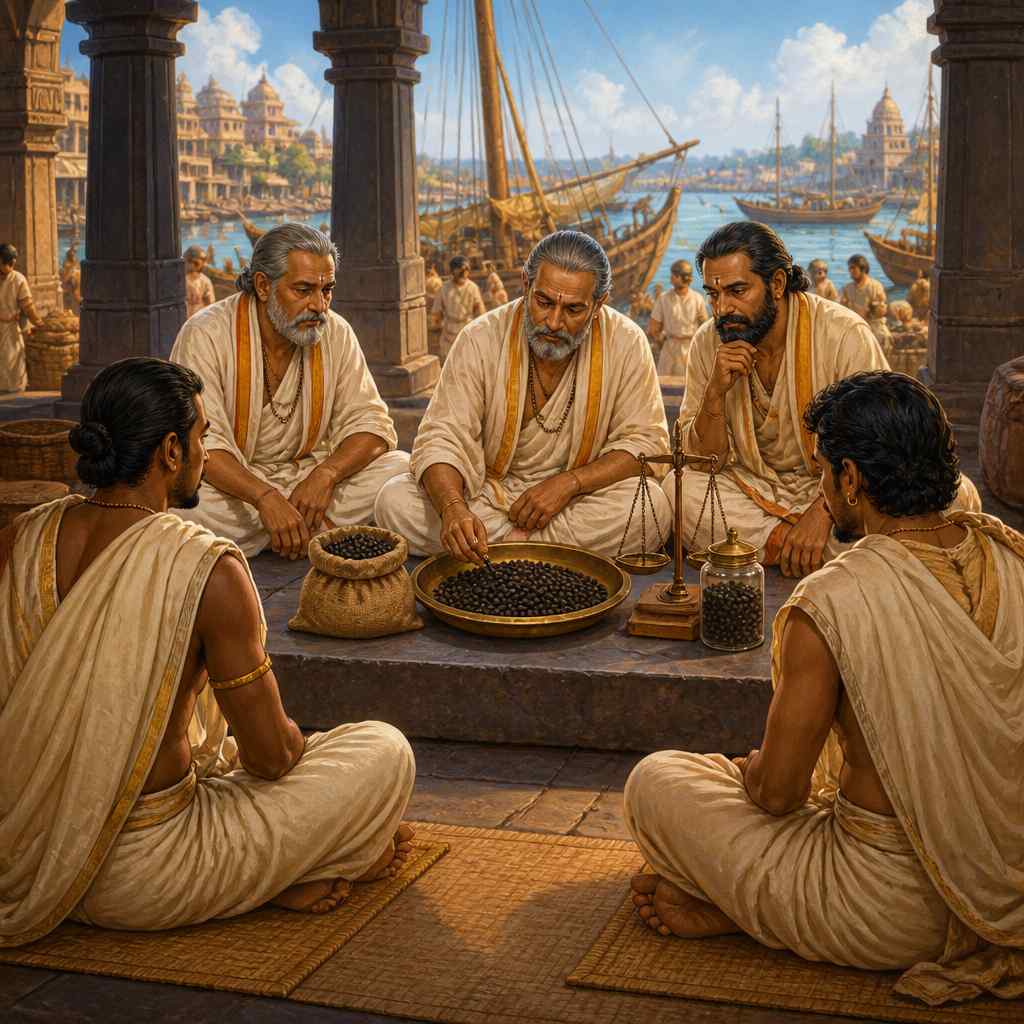
The Bharukaccha pepper-guild arbitrating a quality dispute between two merchants

In the trading city of Bharukaccha (modern Bharuch, Gujarat), a crisis was unfolding. Dhananjaya, a pepper merchant from the Malabar coast, had delivered 500 bags of pepper to Rudradatta, a buyer with connections to the Roman trade. But Rudradatta claimed the pepper was inferior, dusty, aged, not the premium grade he'd ordered.

Dhananjaya insisted the quality was exactly as specified. Rudradatta demanded a price reduction. Neither would yield. The dispute threatened to freeze payment, strand goods, and damage both men's reputations.

They could take the matter to the royal court. But that meant weeks of waiting, judges who knew nothing about pepper grades, and a verdict that might satisfy neither party. Instead, they did what merchants had done for centuries.

They went to the shreni.

Within three days, the pepper guild's elders had examined the goods, heard both sides, and rendered judgment: the pepper was madhyama (middle grade), not uttama (premium) as contracted. Rudradatta would pay 85% of the agreed price. Both parties accepted. Trade resumed.

This was vivada-nirnaya (विवाद-निर्णय), dispute determination. The world's first commercial arbitration system.

Why Courts Failed Commerce

Royal courts existed. They had authority, enforcement power, and legitimacy. So why did merchants prefer guild arbitration?

The answer lies in understanding what commercial disputes actually require:

Speed: Trade moves fast. Goods spoil. Markets shift. A dispute that takes months to resolve destroys value for everyone. Guild arbitration was designed for speed, days, not months.

Expertise: Was that pepper really substandard? A royal judge, expert in dharmashastra but ignorant of spice grades, couldn't assess. Guild elders had spent decades trading pepper. They knew quality by sight, smell, and touch.

Confidentiality: Court proceedings were public. A merchant's business disputes, his margins, his suppliers, his problems, became known to competitors. Guild arbitration was private.

Flexibility: Royal law applied rigid categories. Guild arbitration could craft solutions that worked commercially: partial payments, extended terms, substitute goods, future consideration.

Reputation: A merchant who lost in royal court was legally defeated. A merchant who lost in guild arbitration had failed to meet community standards, a different, often more powerful deterrent.

"श्रेणिविनिश्चयः सर्वेषां विवादानां परमं प्रमाणम्।" "Guild determination is the highest authority for all [trade] disputes." , Narada Smriti 10.3

The law itself recognized guild superiority in commercial matters. This wasn't state weakness, it was state wisdom. Specialized communities resolve specialized disputes better than general authorities.

The Hierarchy of Dispute Resolution

Ancient Indian legal texts describe an elegant escalation system:

Level 1: Direct Negotiation (Svayam-Nirnaya) Parties first attempted to resolve disputes themselves. Many commercial conflicts were simply misunderstandings clarified through direct discussion.

Level 2: Guild Arbitration (Shreni-Vivada) If negotiation failed, disputes went to the shreni. Elders, typically three to five senior members, heard both sides, examined evidence, and rendered judgment. Their decision was binding within the guild.

Level 3: Inter-Guild Arbitration (Puga-Vivada) Disputes between members of different guilds went to a puga, an assembly of multiple guilds. This prevented bias toward one's own members.

Level 4: State Courts (Raja-Vivada) Only if guild systems failed, or if disputes involved parties outside guild networks, did matters reach royal courts. Even then, courts often sought guild expertise as assessors.

This system had a genius: it matched resolution mechanisms to dispute types. Simple conflicts resolved quickly at lower levels. Complex or cross-guild disputes escalated appropriately. State resources weren't wasted on matters communities could handle.

Three shreni elders deliberating over a palm-leaf contract by oil-lamp

How Guild Arbitration Worked

The process followed established protocols:

Petition: The complaining party presented their case to guild elders, typically in writing but sometimes orally. They described the dispute, their position, and the remedy sought.

Response: The responding party presented their side. Guild rules typically required response within a specified period, often three days for urgent commercial matters.

Evidence: Elders examined contracts (written or witnessed), goods in dispute, testimony from relevant witnesses. The standard was commercial reasonableness, not formal legal proof.

Deliberation: Elders deliberated privately. They applied guild standards (shreni-dharma), trade custom, and commercial sense. Unanimous decisions were preferred; majority sufficed.

Judgment: The decision, called nirnaya (determination), was announced to both parties. It specified what each must do and by when.

Enforcement: Guild decisions were enforced through guild power: access to markets, credit networks, and reputation systems. A merchant who defied guild judgment faced commercial isolation.

Global Perspectives on Commercial Arbitration

Commercial arbitration wasn't uniquely Indian, but India's institutional development was remarkably early.

Frank Sander (1927-2018), Harvard Law professor, sparked the modern Alternative Dispute Resolution (ADR) movement with his famous 1976 "Roscoe Pound Conference" paper. Sander argued that courts were poorly suited for many disputes; alternatives like mediation and arbitration could be faster, cheaper, and more satisfying. His "multi-door courthouse" concept, matching disputes to appropriate resolution mechanisms, revolutionized American legal thinking.

The Lex Mercatoria tradition in medieval Europe developed similar insights. Merchant courts in trading cities resolved commercial disputes according to trade customs, not royal law. The English "Piepowder Courts" (from French pieds poudrés, "dusty feet", for traveling merchants) operated at fairs, delivering same-day justice.

Medieval Islamic commerce developed the role of the qadi (judge) with expertise in commercial matters, and informal arbitration through respected merchants. The Cairo Geniza documents reveal sophisticated dispute resolution in Mediterranean trade.

System Era Key Feature Resolution Speed
Indian Shreni 600 BCE - 1200 CE Guild autonomy; integrated with trade networks Days
Lex Mercatoria 1100-1600 CE Merchant custom; portable across kingdoms Days to weeks
Modern ADR 1970s-present Multi-door approach; party choice Months
ICC Arbitration 1923-present International; neutral forum Months to years

What distinguishes the Indian system: it was integrated with the entire commercial ecosystem. Guilds didn't just resolve disputes, they set standards, provided credit, and controlled market access. This integration gave guild arbitration teeth that standalone arbitration systems lacked.

The Arthashastra's Dispute Framework

Kautilya's Arthashastra provides the theoretical foundation:

Recognition of Guild Authority: "In all matters concerning a guild's internal affairs, the guild's decision is authoritative." This delegated jurisdiction to specialists.

Defined Escalation: The Arthashastra specifies when disputes move from guild to state authority, typically when guild resolution fails or when non-guild parties are involved.

State as Backstop: Royal courts served as appeal mechanisms and enforcement arms for guild decisions. The king's power backed guild authority without supplanting it.

Assessors (Dharmastha): For commercial cases reaching state courts, Kautilya mandates inclusion of trade experts as assessors. Judges decided law; assessors explained commerce.

"वाणिज्यविवादेषु वाणिजः साक्षिणः।" "In commercial disputes, merchants are the witnesses." , Arthashastra 3.11

This wasn't just procedural, it was epistemological. Kautilya recognized that commercial knowledge resides in commercial communities. Law without expertise produces injustice.

Modern Resonance: India as Arbitration Hub

India is repositioning itself as a global arbitration center, reviving ancient vivada-nirnaya principles.

A Mumbai Centre for International Arbitration panel hearing an international case

The Mumbai Centre for International Arbitration (MCIA), established in 2016, aims to make India a venue of choice for international commercial disputes. Its goals echo shreni arbitration:

Speed: MCIA rules emphasize expedited procedures. The goal is resolution in months, not years.

Expertise: Arbitrators are drawn from practitioners with deep domain knowledge, shipping lawyers for maritime disputes, IP specialists for technology conflicts.

Neutrality: Like ancient pugas (multi-guild assemblies), MCIA provides neutral ground for parties from different backgrounds.

Enforcement: India's 2015 amendments to the Arbitration and Conciliation Act strengthen enforcement of arbitral awards, providing the state backing that ancient kings gave guild decisions.

The Singapore International Arbitration Centre (SIAC) and London Court of International Arbitration (LCIA) dominate international commercial arbitration. India's goal: join them as a preferred venue. The ancient insight, that specialized dispute resolution serves commerce better than generalist courts, drives this ambition.

Lok Adalat: ADR with Indian Roots

Closer to home, the Lok Adalat (People's Court) system represents vivada-nirnaya principles in modern form:

Origin: Formalized in 1987, Lok Adalats draw on Gandhian principles of village-level dispute resolution, themselves echoing ancient panchayat and guild arbitration.

Process: Parties appear before a bench (typically a judge, lawyer, and social worker). The bench facilitates settlement; if parties agree, the settlement becomes a decree.

Speed: Cases often resolve in a single sitting, hours, not months.

Volume: Lok Adalats have resolved over 50 million cases since 1987. The 2023 National Lok Adalat resolved over 1.6 crore (16 million) cases in a single day.

Scope: From motor accident claims to matrimonial disputes to commercial conflicts, Lok Adalats handle what courts cannot efficiently process.

The principle is identical to ancient shreni arbitration: match resolution mechanisms to dispute types, prioritize speed and party satisfaction, keep matters out of overburdened formal courts.

Your Turn

Dhananjaya and Rudradatta's pepper dispute was resolved in three days by people who understood pepper. Modern commercial disputes often take years in courts before judges who must learn the industry from scratch.

The ancient insight remains valid: specialized disputes deserve specialized resolution. Commercial arbitration, industry panels, ombudsmen, mediation, all represent the same principle the shrenis understood.

What disputes in your life could benefit from expert, efficient resolution outside courts? If you're in business, do you include arbitration clauses in contracts? Do you know the arbitration forums relevant to your industry?

The guild elders of Bharukaccha understood that justice delayed is commerce destroyed. Their system, fast, expert, trusted, enabled trade across continents. As India rebuilds its arbitration infrastructure, it's recovering ancient wisdom: the best judges of commercial matters are commercial experts.

Comparative institutional analysis, different institutions have different strengths; matching problems to appropriate institutions maximizes efficiency.

Oliver Williamson's transaction cost economics analyzes when markets, hierarchies, or hybrid forms work best. Frank Sander's multi-door courthouse applies similar logic to dispute resolution. The ancient Indian system anticipated both, matching resolution mechanisms to dispute characteristics centuries before economists formalized the analysis.

The shreni system was integrated with commerce, not separate from it. Guilds resolved disputes, but also set standards, provided credit, and controlled market access. This integration created enforcement mechanisms that standalone arbitration lacked. A merchant who defied guild judgment lost more than the case, they lost their commercial ecosystem.

India's commercial court backlog exceeds 4 lakh (400,000) cases. Meanwhile, the 2023 National Lok Adalat resolved 1.6 crore (16 million) cases in a single day. The efficiency gap proves the ancient insight: courts can't handle everything; appropriate alternatives are essential.

Division of labor and specialization, experts in their domains produce better outcomes than generalists attempting everything.

Modern courts use expert witnesses for technical matters. Patent disputes require technical experts; medical malpractice needs medical assessors. The ancient dharmastha system institutionalized this insight: courts should seek expertise, not pretend to have it.

Verses

श्रेणिविनिश्चयः सर्वेषां विवादानां परमं प्रमाणम्।

śreṇiviniscayaḥ sarveṣāṃ vivādānāṃ paramaṃ pramāṇam |

Guild determination is the highest authority for all [trade] disputes.

Transaction costs include dispute resolution costs. When disputes are resolved quickly by experts, trade friction decreases. The shreni system minimized these costs, enabling commerce that wouldn't have been viable with slower, less expert alternatives.

Narada Smriti, 10.3 (Richard Lariviere)

वाणिज्यविवादेषु वाणिजः साक्षिणः।

vāṇijyavivādeṣu vāṇijaḥ sākṣiṇaḥ |

In commercial disputes, merchants are the witnesses.

Expert assessment reduces decision errors. Judges applying law without commercial understanding produce bad outcomes, merchants suffer, trade shrinks, state revenue falls. Involving experts produces commercially sensible results that sustain economic activity.

Arthashastra, 3.11.8 (R.P. Kangle)

पूर्वं श्रेणिपुगादिभिर्विवादं निर्णयेत्ततः। अनिर्णीतं राजद्वारे।

pūrvaṃ śreṇipugādibhir vivādaṃ nirṇayet tataḥ | anirṇītaṃ rājadvāre |

Disputes should first be determined by guilds, assemblies, and similar bodies. Only if undetermined should they go to the king's court.

Escalation systems optimize resource allocation. Simple disputes resolved at lower levels preserve court capacity for complex matters. The principle anticipates modern case management and court diversion strategies.

Yajnavalkya Smriti, 2.186 (Ganganath Jha)

Key figures

The Dharmastha (Expert Assessor)

Technical expert who assisted royal courts in understanding commercial matters, ensuring that judges' decisions were informed by trade knowledge. · c. 300 BCE - 500 CE

Justice D.Y. Chandrachud

Chief Justice of India (2022-2024) who championed alternative dispute resolution, mediation, and arbitration as essential to justice delivery. · Contemporary (b. 1959)

Frank Sander

Harvard Law professor who sparked the modern Alternative Dispute Resolution (ADR) movement with his 'multi-door courthouse' concept. · 1927-2018

Case studies

MCIA: Making India a Global Arbitration Hub

For decades, Indian companies resolved international commercial disputes in Singapore, London, or Hong Kong, not India. The perception: Indian courts were slow, arbitration infrastructure was weak, and enforcement was uncertain. This represented a massive outflow of legal services revenue and, more importantly, a loss of commercial convenience. Indian businesses had to travel abroad, hire foreign counsel, and submit to foreign procedures for disputes that could have been resolved at home. In 2016, the **Mumbai Centre for International Arbitration (MCIA)** was established to change this. Founded with support from the government of Maharashtra, major law firms, and industry, MCIA aimed to make India a venue of choice for international commercial arbitration. MCIA's design echoes shreni principles: **Expertise**: Arbitrators are drawn from practitioners with deep domain knowledge, shipping lawyers, construction experts, IP specialists. Parties get adjudicators who understand their industry. **Speed**: MCIA rules emphasize expedited procedures. Emergency arbitrators can act within 24 hours. The goal is resolution in months, not the years common in court litigation. **Neutrality**: Like ancient pugas, MCIA provides neutral ground. Parties from different countries, industries, and backgrounds can trust the forum.

MCIA embodies vivada-nirnaya principles in modern form: **Shreni expertise**: Ancient guilds adjudicated because they understood their trade. MCIA arbitrators are selected for domain expertise, a shipping dispute gets maritime lawyers, not generalists. **Speed as justice**: The shreni system resolved disputes in days because trade required it. MCIA's expedited procedures recognize the same truth: delayed resolution destroys commercial value. **Escalation hierarchy**: MCIA represents institutional arbitration, a level between direct negotiation and court litigation. The ancient hierarchy (negotiation → guild → puga → court) is being rebuilt (negotiation → mediation → arbitration → court). **State backing**: Ancient kings recognized guild authority and enforced guild decisions. Modern India's 2015 Arbitration Act amendments strengthen award enforcement, providing the state backing that arbitration requires. The dharmic insight: specialized commercial dispute resolution serves dharma better than forcing all disputes through general courts. Justice is both process and outcome, and appropriate process produces better outcomes.

Since 2016, MCIA has handled hundreds of arbitrations with combined claims worth thousands of crores. The center has gained recognition for: **Quality arbitrators**: A diverse panel including senior lawyers, retired judges, and industry experts. **Efficient procedures**: Median case duration significantly shorter than court litigation. **International recognition**: Increasingly chosen by parties from outside India for neutral, expert adjudication. The broader impact: India's amendments to arbitration law (2015, 2019, 2021) have improved the legal framework, reduced court interference in arbitration, and strengthened enforcement. India's ranking in contract enforcement (World Bank Doing Business) has improved. The vision: India joining Singapore and London as a global arbitration hub. The ancient insight, that commercial disputes deserve commercial resolution, is driving modern institution-building.

Commercial arbitration infrastructure is a competitive advantage. Cities and countries that provide fast, expert, trustworthy dispute resolution attract business. India is rebuilding what the shrenis once provided: specialized resolution that serves commerce better than general courts.

International arbitration hubs generate billions in legal services revenue and attract business headquarters. London, Singapore, and Hong Kong compete fiercely for arbitration market share. India's entry through MCIA signals recognition that dispute resolution infrastructure is as important as physical trade infrastructure.

International arbitration is a $50+ billion global industry. Singapore and London dominate. India's share is growing but remains small. MCIA and similar institutions aim to capture a larger portion by offering quality, efficiency, and cost advantages, the same competitive proposition ancient shrenis offered.

National Lok Adalat: 16 Million Cases in One Day

On December 9, 2023, something extraordinary happened in India's justice system. Over 1.6 crore (16 million) cases were resolved in a single day through the National Lok Adalat. Lok Adalats ('People's Courts') are India's institutionalized alternative dispute resolution system. Parties appear before a bench, typically including a retired judge, a lawyer, and a social worker. The bench facilitates settlement; if parties agree, the settlement becomes an enforceable decree. The system handles everything from motor vehicle accident claims to matrimonial disputes to commercial conflicts. It's free for parties (no court fees), fast (often single-sitting resolution), and final (no appeal from consensual settlement). The 2023 National Lok Adalat's achievement: - **89,000+ sitting benches** across India - **Rs 11,000+ crore** settled in motor accident claims alone - **Lakhs of bank recovery cases** resolved - **Family disputes, consumer complaints, and commercial matters** cleared All in one day.

Lok Adalats represent vivada-nirnaya principles adapted for mass justice: **Community resolution**: Like ancient panchayats and shreni assemblies, Lok Adalats emphasize community-based resolution. Social workers and local lawyers bring community knowledge to the process. **Escalation avoided**: Cases settle before court adjudication, preserving court resources for matters that truly require them. The ancient principle, resolve at the lowest appropriate level, operates at scale. **Relationship preservation**: Lok Adalat settlements are negotiated, not imposed. Parties maintain relationships better when they participate in outcomes. The shreni understood this: imposed judgments breed resentment; facilitated agreements create buy-in. **Speed as dharma**: Delayed justice is injustice. Accident victims waiting years for compensation suffer twice. Lok Adalats deliver resolution in hours what courts might take years to adjudicate. The dharmic insight: justice isn't just correct outcomes, it's timely, appropriate, and relationship-preserving outcomes. Lok Adalats optimize for what courts cannot: speed, participation, and volume.

Since the Legal Services Authorities Act (1987), Lok Adalats have resolved over 5 crore (50 million) cases. The system has become integral to India's justice delivery: **Cost savings**: No court fees, reduced lawyer costs, faster resolution. **Court decongestion**: Millions of cases resolved outside the overburdened court system. **Access to justice**: Free legal services make dispute resolution accessible to those who couldn't afford court litigation. **Satisfaction rates**: Settlement-based resolution typically produces higher party satisfaction than court imposition. The model is being studied internationally. The combination of institutional framework, legal enforceability, and mass participation represents a unique approach to justice delivery. The ancient insight scales: what shrenis did for commerce, Lok Adalats do for the broader justice system, resolve disputes at appropriate forums, quickly, with expertise, and with party participation.

Alternative dispute resolution can operate at massive scale when properly institutionalized. Lok Adalats prove that the ancient principle, match disputes to appropriate forums, works for millions of cases, not just merchant conflicts. The shreni insight has become national policy.

Lok Adalats' ability to resolve 16 million cases in a single day demonstrates that alternative dispute resolution can operate at population scale. Online dispute resolution platforms like eBay's system (resolving 60 million disputes annually) follow the same principle: match the resolution mechanism to the dispute complexity.

India's court pendency exceeds 5 crore (50 million) cases. Lok Adalats resolve over 1 crore cases annually, a 20%+ reduction in what would otherwise clog courts. The ancient escalation hierarchy, modernized, is essential to managing justice at scale.

Historical context

c. 600 BCE - present (continuous evolution)

Guild arbitration was central to India's ancient trade dominance. Disputes resolved in days, not months, kept commerce moving. When British courts replaced traditional systems, dispute resolution slowed dramatically, contributing to commercial disruption. Modern reforms (Arbitration Act amendments, MCIA establishment, Lok Adalat expansion) represent recovery of indigenous resolution principles.

The Lex Mercatoria tradition in medieval Europe developed similar merchant-court concepts, but later (11th-15th centuries) and with less legal integration. Modern international arbitration (ICC, SIAC, LCIA) now provides what shrenis once did, specialized, fast, expert resolution. India's position as an arbitration venue is improving but still lags Singapore and London.

Medieval Piepowder Courts (England) delivered same-day justice at trade fairs, the Western parallel to shreni arbitration. The name derives from French 'pieds poudrés' (dusty feet), referring to traveling merchants who couldn't wait for regular courts.

India's courts face massive backlogs (5+ crore pending cases). Understanding why shreni arbitration worked, expertise, speed, integration with commerce, informs modern reform. The ancient system wasn't primitive; it was optimized for commercial reality. Modern arbitration, mediation, and Lok Adalats are recovering that optimization.

Living traditions

Reflection

More in Shreni & Hundi: India's Financial Innovations

All lessons in Shreni & Hundi: India's Financial Innovations · Trade Routes of Ancient Bharat course