Guna-Mana: Quality Standards and Certification
Self-Regulation Before Governments
How ancient Indian guilds created the world's first quality certification systems, standards that enabled strangers to trust goods from distant sources, principles that live on in modern BIS marks and ISO certification.
The Merchant's Dilemma
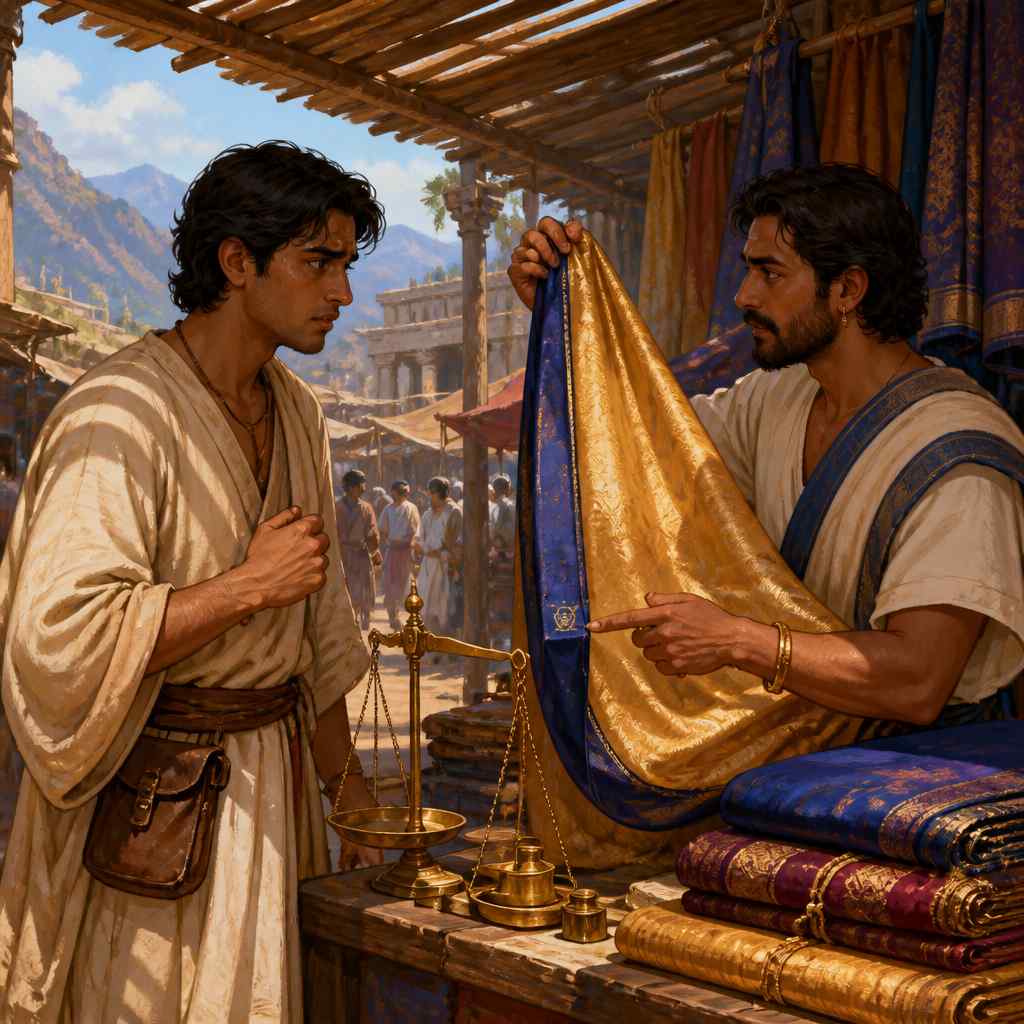
Vasumitra was sweating, and not from the Taxila heat. Before him lay bolts of silk from Varanasi, or so the seller claimed. The fabric was beautiful, the price fair. But how could he know?
Vasumitra had never been to Varanasi. He didn't know silk weaving. The seller could be lying about the origin, the quality, even the material itself. In a world without laboratories, without global brands, without consumer protection laws, how could buyers trust?
The seller smiled and pointed to a small mark woven into the fabric's edge: the seal of the Kashi Reshmi Shreni, the Varanasi Silk Guild. Vasumitra relaxed. He knew that seal. Every merchant on the Uttarapatha knew it. Goods bearing that mark had passed guild inspection. The guild's reputation, built over generations, stood behind every thread.
This was guna-mana (गुण-मान), quality measurement. The ancient solution to a problem that still challenges global commerce today: how do you trust what you cannot verify?
The Economics of Quality Uncertainty
Modern economists call this the "lemons problem", named after George Akerlof's famous 1970 paper on used cars. When buyers can't verify quality, they assume the worst. Sellers of good products can't get fair prices. Eventually, only low-quality goods remain in the market.
Ancient Indian merchants understood this intuitively. The Arthashastra dedicates extensive sections to quality standards, not because Kautilya was a quality enthusiast, but because trade collapsed without them.
"गुणानुसारेण मूल्यम्।" "Price according to quality." , Arthashastra 2.13
This simple principle required an entire institutional infrastructure. Someone had to define quality grades. Someone had to inspect goods. Someone had to certify that standards were met. Someone had to punish fraud. The shrenis did all of this.
How Guild Quality Control Worked
Ancient guild quality systems had multiple components:
Grade Classification: Goods were classified into quality tiers. The Arthashastra mentions three grades for most commodities: uttama (highest), madhyama (middle), and adhama (lowest). Each grade had defined characteristics and appropriate price ranges.
Production Standards: Shrenis specified how goods must be made. The Mandsaur inscription describes silk weavers' techniques in detail, not as art, but as enforceable standards. Deviation meant the goods couldn't bear the guild mark.

Inspection Protocols: Senior guild members, often retired master craftsmen, inspected goods before certification. Their reputation depended on accurate assessment. A guild that certified bad goods would lose trust and trade.
Marks and Seals: Certified goods bore identifying marks. These might be woven into textiles, stamped on metals, or sealed on containers. The mark wasn't just a brand, it was a warranty.
Fraud Punishment: Misusing guild marks or selling substandard goods as certified was severely punished. The Narada Smriti prescribes fines and expulsion. For a merchant, losing guild membership meant losing access to trade networks, credit, and reputation. It was commercial death.
The Three-Layer Trust System
Guild quality control created trust at three levels:
Level 1: Product Trust The guild mark certified that specific goods met defined standards. A buyer in Taxila could trust Varanasi silk because the guild had inspected it.
Level 2: Guild Trust The guild's reputation stood behind all its members' products. A buyer might not know individual weavers, but they knew the Kashi Reshmi Shreni's standards. Trust transferred from institution to product.
Level 3: System Trust The entire shreni system was self-reinforcing. Guilds that maintained standards prospered; those that didn't failed. This created evolutionary pressure for quality. The system selected for trustworthy institutions.
"श्रेणिमुद्रा प्रमाणम्।" "The guild seal is authoritative." , Traditional merchant saying
This three-layer system solved the quality verification problem without requiring buyers to be experts. Trust was delegated to institutions with expertise and incentives to maintain it.
Global Perspectives on Quality
Quality assurance wasn't uniquely Indian, but India's institutional approach was distinctive.
W. Edwards Deming (1900-1993), the American statistician who transformed Japanese manufacturing, emphasized that quality must be built into systems, not inspected into products. His famous "Deming Cycle" (Plan-Do-Check-Act) became the foundation of modern quality management. Yet shrenis had implemented similar principles two millennia earlier: plan standards, execute production, check through inspection, act on failures.
Joseph Juran (1904-2008), another quality pioneer, argued that quality is "fitness for use", meeting customer needs, not abstract specifications. The shreni approach aligned with this: grades were defined by what traders and consumers actually valued, not by theoretical ideals.
Medieval European guilds (11th-15th centuries CE) developed similar quality marks, but with key differences. European guild marks often indicated who made the product (hallmarks), while Indian guild marks indicated that standards were met. European systems were producer-focused; Indian systems were buyer-focused.
| Approach | Focus | Enforcement | Key Insight |
|---|---|---|---|
| Ancient Shreni | Buyer trust | Community reputation | Quality as collective responsibility |
| European Guilds | Producer identity | Royal charter | Quality as individual accountability |
| Deming/Japan | System efficiency | Statistical process | Quality built in, not inspected in |
| Modern ISO | Global standardization | Third-party audit | Quality as documented compliance |
The shreni approach anticipated Deming's key insight: quality is a system property. Individual craftsmen mattered, but the system, training, standards, inspection, enforcement, created consistent quality.
The Arthashastra's Quality Bureaucracy
Kautilya's Arthashastra reveals a sophisticated state-guild partnership in quality control:
The Panyadhyaksha (Superintendent of Commerce) oversaw market quality. This official ensured that goods sold met stated grades, weights were accurate, and guild marks were legitimate.
The Samsthadhyaksha (Superintendent of Standards) maintained official weights and measures. Merchants' instruments were checked against royal standards, the ancient equivalent of calibration.
The Shaulkika (Customs Official) inspected goods at trade checkpoints. This wasn't just tax collection, it was quality verification. Substandard goods could be rejected or downgraded.
The state didn't replace guild quality control, it supplemented it. Guilds handled within-trade standards; the state handled cross-trade consistency and fraud prevention.
Modern Resonance: The ISI Mark

The Bureau of Indian Standards (BIS) mark, the familiar ISI stamp on everything from cement to packaged water, is the direct descendant of ancient guna-mana.
Established in 1947 (as the Indian Standards Institution), BIS creates standards, certifies products, and enforces quality. Its functions mirror the ancient shreni:
Standard Setting: Like guild elders defining grades, BIS committees (including industry experts) define product specifications. Over 22,000 standards cover everything from steel grades to toy safety.
Certification: Manufacturers apply for BIS certification. Products are tested; factories are inspected. Passing products can bear the ISI mark. This is the ancient guild seal in modern form.
Enforcement: Using the ISI mark without certification is a criminal offense. BIS conducts market surveillance, tests products, and prosecutes fraud. The Narada Smriti's penalties have become IPC sections.
Hallmarking: BIS gold hallmarking, mandatory since 2021, continues ancient traditions of precious metal certification. A hallmarked gold ornament carries the same trust as a guild-sealed ingot from Mauryan times.
The ISI mark works because it solves the same problem shreni marks solved: allowing buyers to trust goods they cannot personally verify. The psychology hasn't changed; only the scale.
From Guild Marks to Global Standards
The shreni quality model has scaled globally:
ISO Certification: The International Organization for Standardization creates global standards that mirror shreni-dharma. ISO 9001 (quality management) codifies principles that guild elders transmitted orally.
AGMARK: India's agricultural quality certification ensures that spices, grains, and ghee meet defined grades, continuing traditions that enabled the spice trade.
FSSAI: Food safety certification protects consumers exactly as shreni inspection protected ancient buyers from adulterated goods.
BIS Hallmarking: Gold and silver hallmarking continues the precious metal certification that made India the trusted source for the Roman Empire's gold trade.
These modern systems are more formal, more documented, more global, but structurally identical to what the Kashi Reshmi Shreni provided two millennia ago.
Your Turn
Vasumitra's dilemma hasn't disappeared, it's multiplied. Modern consumers face an avalanche of products from global sources. How do you trust an Amazon seller you've never met? A food product from a factory you've never seen? A medication from a pharmaceutical company in another country?
The ancient answer remains relevant: trust institutions that have reputation at stake. Look for certification marks. Understand what they guarantee (and what they don't). Build relationships with trusted intermediaries.
More practically: What quality marks do you rely on? Do you know what ISI, BIS, ISO actually certify? Understanding these systems, descendants of ancient guna-mana, makes you a smarter consumer and a more trustworthy producer.
The guild masters of Varanasi understood: quality isn't just ethics, it's economics. Consistent quality enables trade; inconsistent quality destroys it. That insight, encoded in guild seals millennia ago, now appears on every certified product in your home.
Information asymmetry and signaling, certification solves the problem of buyers knowing less than sellers about product quality.
George Akerlof's 'Market for Lemons' (Nobel Prize 2001) shows how quality uncertainty can destroy markets. Michael Spence's signaling theory (Nobel Prize 2001) shows how credible signals, like certifications, solve this. Ancient shrenis implemented both insights millennia before economists formalized them.
Shreni certification was comprehensive: it covered not just product quality but also producer reputation, transaction reliability, and dispute resolution. Modern certifications are typically narrower. The integrated shreni approach created deeper trust than single-dimension certification.
BIS has issued over 1 million product certifications across 22,000+ standards. The ISI mark appears on products worth trillions of rupees annually, all solving the same information problem that guild seals solved.
Process quality vs. product quality, building quality into production systems rather than inspecting it at the end.
Deming's famous teaching: 'You cannot inspect quality into a product.' Japanese manufacturers embraced this, building quality into processes (Kaizen, TQM). Western manufacturers, focused on end-inspection, were outcompeted. Shrenis had implemented process-quality centuries earlier.
Verses
गुणानुसारेण मूल्यम्।
guṇānusāreṇa mūlyam |
Price should be according to quality.
Quality-based pricing creates incentives for quality production. When buyers can distinguish grades, producers are rewarded for excellence. Without quality verification, markets race to the bottom, Akerlof's 'lemons problem.' Shreni certification solved this two millennia before economists named it.
Arthashastra, 2.13.42 (R.P. Kangle)
कूटमानं च कूटतुलां च कूटमुद्रां च ये नराः कुर्वन्ति तेषां दण्डः।
kūṭamānaṃ ca kūṭatulāṃ ca kūṭamudrāṃ ca ye narāḥ kurvanti teṣāṃ daṇḍaḥ |
Those who use false measures, false weights, or false seals shall be punished.
Trust systems require enforcement. Without punishment for fraud, honest actors are disadvantaged and trust erodes. Ancient India understood that quality certification is only as strong as fraud prevention. Modern consumer protection law operates on the same principle.
Narada Smriti, 5.6 (Richard Lariviere)
पण्याध्यक्षो वणिग्भिः सह गुणमानं परिशोधयेत्।
paṇyādhyakṣo vaṇigbhiḥ saha guṇamānaṃ pariśodhayet |
The Superintendent of Commerce, together with merchants, should verify quality standards.
Co-regulation works better than pure state or pure industry regulation. State involvement provides enforcement; industry involvement provides expertise and buy-in. Modern regulatory partnerships (industry consultations, public-private standards bodies) follow this ancient model.
Arthashastra, 2.16.1-2 (Patrick Olivelle)
Key figures
The Panyadhyaksha (Superintendent of Commerce)
Royal official responsible for market quality, commercial standards, and trade regulation in the Arthashastra system, the ancient equivalent of a consumer affairs commissioner. · c. 300 BCE - 500 CE
Lal Chand Hirachand
Industrialist and first Chairman of the Indian Standards Institution (now BIS, 1947-1950), who established India's modern quality certification infrastructure. · 1890-1967
W. Edwards Deming
American statistician and management consultant whose quality management principles transformed Japanese manufacturing and became the foundation of modern Total Quality Management (TQM). · 1900-1993
Case studies
The ISI Mark: Ancient Guild Seals in Modern Form
In 1947, newly independent India faced a quality crisis. Industries were nascent, standards were inconsistent, and consumers had no way to verify product quality. Imports dominated, not because Indian producers couldn't compete, but because buyers couldn't trust Indian goods. The Indian Standards Institution (now Bureau of Indian Standards) was created to solve this ancient problem in modern form. Its mission: create standards, certify products, and build trust through the ISI mark. The parallels to shreni systems are striking: **Standard Setting**: Like guild elders defining grades, BIS committees (including industry experts) develop standards. Over 22,000 standards now cover everything from steel grades to children's toys. **Certification Process**: Manufacturers apply for certification. BIS inspects factories, tests products, and conducts regular surveillance. Products that pass can bear the ISI mark, the modern guild seal. **Enforcement**: Using the ISI mark without authorization is criminal. BIS conducts market surveillance, tests products randomly, and prosecutes fraud. The 2016 BIS Act strengthened penalties, continuing the ancient tradition of severe punishment for quality fraud.
The ISI/BIS system embodies guna-mana principles: **Satya (Truth)**: The ISI mark is a truth claim, this product meets stated standards. False claims are punished not just legally but reputationally. Companies caught with fake marks lose market trust entirely. **Shreni-dharma (Guild Law)**: BIS standards are developed with industry participation, modern shreni-dharma. Industry knows what's practical; BIS ensures what's safe. The collaboration creates standards that are both enforceable and commercially realistic. **Vishwas (Trust)**: The entire system exists to create trust. A consumer buying an ISI-marked product is trusting BIS, just as Vasumitra trusted the Kashi Reshmi Shreni. Trust is delegated to institutions with expertise and accountability. The dharmic insight: quality certification is trust infrastructure. Without it, markets function poorly, good products can't command fair prices. With it, commerce flourishes.
BIS has issued certifications for over 40,000 products across 1,000+ manufacturers. The ISI mark appears on: - 100% of packaged drinking water (mandatory since 2000) - All LPG cylinders and regulators (safety critical) - Cement, steel, and construction materials - Electrical appliances and electronics - Toys, helmets, and safety equipment Mandatory certification has expanded steadily, recognizing that some products are too important for voluntary compliance. Gold hallmarking (mandatory since 2021) continues the precious metal certification traditions that enabled ancient trade. The BIS mark has become what guild seals were: the trust infrastructure that enables commerce. Consumers may not understand the technical standards, but they trust the mark, exactly as ancient buyers trusted guild certification.
Quality certification systems, whether ancient guild seals or modern BIS marks, solve the fundamental problem of trust in commerce. The technology changes; the principle doesn't. Buyers need trusted intermediaries to verify what they cannot verify themselves.
Quality certification remains one of the most powerful tools for market access. Today, ISO certifications, FSSAI marks, and CE markings serve the same function as ancient guild seals. Companies that invest in visible quality standards consistently outperform those that rely on word-of-mouth reputation alone.
BIS employs over 5,000 technical staff and operates 7 regional offices and 26 branch offices. Annual certifications cover products worth over ₹50,000 crore. The institutional scale required to maintain quality trust has grown, but the function remains unchanged from shreni times.
Gold Hallmarking: 3,000 Years of Quality Certification
Gold has been India's trusted store of value for millennia. But gold creates a quality problem: purity is invisible. A 22-karat ornament looks identical to 18-karat or worse. How could buyers trust? Ancient solutions were guild-based. Goldsmith shrenis certified purity through reputation. The Arthashastra specifies gold grades and punishments for adulteration. Temple treasuries developed expertise in gold verification, becoming trusted assayers. The problem intensified with scale. When India imported most of the Roman Empire's gold, verification infrastructure became geopolitically important. Roman merchants trusted Indian gold precisely because shreni certification was reliable. Modern India faced the same challenge. With Indians holding an estimated 25,000 tonnes of gold (worth over $1.5 trillion), quality verification mattered enormously. Small-scale jewelers might adulterate; consumers couldn't tell. The market for honest gold was being destroyed by the market for lemons.
Gold hallmarking represents guna-mana in its purest form: **Ancient Practice**: The Arthashastra (2.13) specifies 16 types of gold by quality and appropriate uses. Goldsmith guilds maintained standards; state assayers verified claims. The partnership created trust that enabled gold commerce. **Medieval Continuity**: Temple treasuries became trusted gold verifiers. Tirupati, Somnath, and other major temples developed expertise precisely because they needed to verify donation quality. Their reputation for honest assessment transferred to commercial verification. **Modern Implementation**: BIS gold hallmarking (mandatory since 2021) continues this tradition. Hallmarked gold carries four marks: BIS logo, purity grade, assaying center mark, and jeweler identification. Each mark adds accountability. The dharmic principle: gold's value depends on trust, and trust requires verification infrastructure. Without it, honest jewelers can't compete with adulterators. With it, the entire market can function fairly.
Since mandatory hallmarking in 2021: - Over 1.5 lakh (150,000) jewelers have registered with BIS - 1,000+ assaying and hallmarking centers operate nationwide - Consumer complaints about gold purity have declined significantly - Export quality has improved, enhancing India's reputation The transition wasn't smooth, small jewelers initially resisted. But the logic of guna-mana is self-reinforcing: once hallmarking becomes standard, non-hallmarked gold becomes suspect. The market pressure that once favored adulterators now favors compliance. India's gold hallmarking represents 3,000 years of quality certification evolution: from shreni seals to state assayers to BIS marks. The technology changed; the principle, trusted verification enabling trade, remained constant.
Quality certification must evolve with markets but serves the same function across millennia. Ancient goldsmith shrenis, medieval temple assayers, and modern BIS hallmarking all solve the same problem: enabling trust in what buyers cannot verify themselves. The form changes; the need persists.
India's mandatory gold hallmarking, phased in from 2021, mirrors the global trend toward traceability in precious metals and gemstones. Blockchain-based supply chain tracking for diamonds (De Beers' Tracr) and gold (LBMA's responsible sourcing) are digital versions of the same ancient principle: certified provenance builds buyer confidence.
India's gold market, over $50 billion annually, now operates largely on hallmarked products. The hallmarking infrastructure (1,000+ centers) represents modern institutional capacity that ancient shrenis provided through reputation alone. Scale required formalization, but the function is identical.
Historical context
c. 600 BCE - present (continuous evolution)
Quality certification was essential to India's ancient trade dominance. Roman merchants trusted Indian goods precisely because shreni certification was reliable. When guild systems declined under colonial rule, quality suffered, contributing to Indian products' loss of global reputation. Modern BIS/ISI systems represent recovery of ancient quality infrastructure.
Medieval European guilds developed hallmarks and quality marks, but typically indicating maker identity rather than quality certification. The ISO system (20th century) created global quality standards, essentially scaling shreni-dharma to international commerce. India's contribution was the principle that quality must be institutionally certified, not just individually claimed.
The Arthashastra identifies over 20 distinct quality-related official positions and specifies quality grades for dozens of commodities. This level of systematic quality thinking was unmatched in the ancient world.
Modern quality systems, BIS, ISO, FSSAI, are direct descendants of ancient guna-mana. Understanding the shreni quality model illuminates why certification works, what makes it credible, and how quality infrastructure enables commerce. These aren't just regulatory requirements, they're the evolved form of trust systems that enabled civilization-scale trade.
Living traditions
- Gold hallmarking certification
- ISI/BIS product certification
- AGMARK agricultural grading
- BIS Headquarters and Museum: The Bureau of Indian Standards headquarters includes historical displays on Indian quality certification evolution. See how ancient principles became modern institutions.
- Assay Office, Zaveri Bazaar: Historic gold trading center where traditional assaying practices continue alongside modern hallmarking. Some families have verified gold quality for generations.
- Meenakshi Temple: Temple markets around this ancient complex maintained strict quality standards for goods sold in temple precincts, enforced by merchant guilds who funded temple maintenance.
- Kanchipuram Varadaraja Perumal Temple: Historic silk weaving center where temple-sponsored weavers maintained quality traditions. The famous Kanchipuram silk carries quality certification traceable to temple guild standards.
Reflection
- Ancient buyers trusted guild seals because guild reputation was at stake. When you buy products today, online or in stores, what quality signals do you actually rely on? Are you consciously choosing based on certification, or are you trusting brands, reviews, or convenience?
- Shrenis built quality into production processes, not just end-product inspection. Where in your work or life are you relying on end-stage checking rather than built-in quality? Could you redesign your processes so that quality is more automatic?