Vanij-Sangh: Merchant Associations and Trade Bodies

Organizing Trade Across Regions and Sectors

How ancient Indian merchants created associations that transcended individual guilds, coordinating trade across regions, sectors, and kingdoms to build the world's first chamber of commerce systems.

The Fifty-Five Merchants of Arikamedu
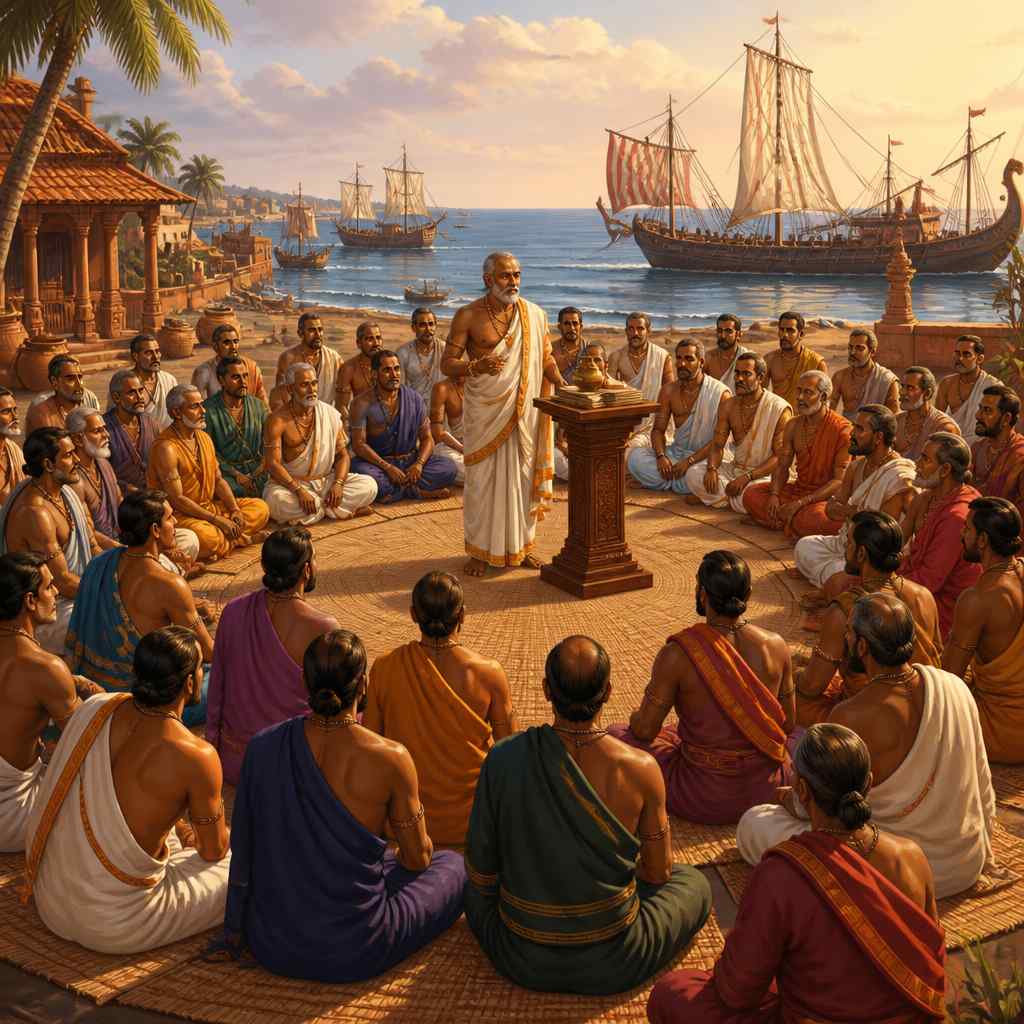
Fifty-five merchants assembling at the seaward courtyard of Arikamedu

In the bustling port of Arikamedu (near modern Puducherry), a remarkable assembly gathered. Merchants from across the subcontinent, Tamil traders from Madurai, Gujarati shroffs from Bharukaccha, Telugu weavers from the Krishna valley, and even representatives from overseas trading posts, had come together for the annual vanij-sangh (वणिज्-संघ), the merchants' assembly.

They weren't discussing one trade or one guild. They were coordinating the entire commercial ecosystem:

No king had summoned them. No law required their gathering. They came because collective coordination created value that individual action couldn't.

This was the vanij-sangh, a merchant assembly that transcended individual shrenis to organize trade at regional, interregional, and even international scales. It was the world's first chamber of commerce.

Beyond the Guild: The Need for Coordination

Shrenis organized individual trades, silk weavers, pepper merchants, ivory carvers. But long-distance trade required coordination across trades:

Logistics: A merchant shipping pepper to Rome needed ships (a different guild), insurance (shroffs), porters (another guild), documentation (scribes), and warehousing (yet another guild). Someone had to coordinate these diverse services.

Standards: If the silk guild used one weight standard and the cotton guild another, trade became complicated. Cross-guild standards required cross-guild coordination.

Representation: When kings made policy, tariffs, route permits, market regulations, individual guilds had limited voice. Collective representation amplified merchant interests.

Dispute Resolution: Disputes between guilds couldn't be resolved within either guild. A higher body was needed.

Information: Market intelligence, prices, routes, risks, opportunities, was most valuable when shared across trades. Networks beat isolation.

The vanij-sangh emerged to fill these coordination gaps.

Structure of the Vanij-Sangh

Ancient texts and inscriptions describe a sophisticated organizational structure:

Nagarasheth (City Merchant-Chief): The president of the urban merchant community, typically the most respected and successful merchant, who convened assemblies and represented merchants before authorities.

Sabha (Assembly): The full gathering of merchant representatives, which met for major decisions, annual planning, major disputes, policy responses.

Samiti (Standing Committee): A smaller executive body that handled ongoing coordination between full assemblies.

Panchayat (Council of Five): Smaller bodies for specific functions, dispute resolution, standard-setting, route coordination.

Adhyaksha (Superintendents): Officials responsible for specific functions, market regulation, weights and measures, customs coordination.

This structure closely resembles modern chambers of commerce: elected leadership, representative assemblies, executive committees, and functional departments.

"नागरश्रेष्ठी सर्ववणिग्जनानां प्रधानः।" "The Nagarasheth is the chief of all merchant communities." , Commercial tradition

The Nagarasheth: Merchant Prince

Shantidas Jhaveri presenting a merchant petition at a Mughal subedar's court

The Nagarasheth was more than a title, it was an institution. The position combined:

Representative Function: The Nagarasheth spoke for the entire merchant community before kings, officials, and foreign traders. When the king wanted merchant input on trade policy, he summoned the Nagarasheth.

Judicial Function: Major commercial disputes, especially those between guilds, came to the Nagarasheth for resolution. His decisions carried the weight of community consensus.

Coordination Function: The Nagarasheth convened assemblies, set agendas, and ensured that cross-guild activities were synchronized.

Charitable Function: The Nagarasheth often led community philanthropy, funding temples, rest houses, water facilities, and emergency relief. This built legitimacy and demonstrated that merchant prosperity benefited all.

The position was typically not hereditary but earned through commercial success and community respect. A Nagarasheth who failed to serve community interests could be replaced.

Inscriptions from across India record Nagarasheth activities: funding temples at Ellora, building caravanserais on trade routes, negotiating with regional kings, and resolving inter-guild conflicts.

The Ainnurruvar: Merchants of the Five Hundred

An Ainnurruvar bull-flag caravan trading textiles and spices in medieval Java

The most famous ancient vanij-sangh was the Ainnurruvar (ஐந்நூற்றுவர்), the "Five Hundred" merchant association based in the Karnataka region during the Chola, Chalukya, and Hoysala periods (9th-14th centuries CE).

The Ainnurruvar was remarkable for several reasons:

Geographic Reach: They operated not just in South India but established branches in Southeast Asia, Sri Lanka, and possibly China. Their inscriptions have been found in Sumatra and Myanmar.

Cross-Sectoral Membership: Unlike single-trade guilds, the Ainnurruvar included merchants from multiple trades, textiles, spices, metals, gems, unified by shared commercial interests.

Institutional Sophistication: They had their own flag (a bull), their own troops (for protecting caravans), and their own legal system for member disputes.

Charitable Infrastructure: They funded temples, tanks, and rest houses across their trading range, building the soft infrastructure that supported trade.

An inscription from Balagami (Karnataka, 1055 CE) describes the Ainnurruvar as:

"Renowned throughout the world, wandering over all countries, setting tariffs, and protecting trade."

This was a medieval corporation with international operations, a prototype for modern trading companies.

Coordination Mechanisms

How did vanij-sanghs actually coordinate? Several mechanisms:

Annual Assemblies: Major gatherings, often timed to festivals or seasons, where representatives deliberated on shared concerns. These were ancient trade conferences.

Standardization: Vanij-sanghs established common weights, measures, quality grades, and contract terms that applied across member guilds. Standardization reduced transaction costs.

Information Networks: Members shared market intelligence, prices at distant ports, route conditions, political changes. The network was a collective intelligence system.

Collective Representation: When dealing with kings or foreign powers, the vanij-sangh spoke with one voice. Collective bargaining was more effective than individual pleading.

Mutual Aid: Members supported each other in crises, shipwrecks, bandit raids, market collapses. The association was insurance.

Infrastructure Investment: Vanij-sanghs collectively funded trade infrastructure, roads, rest houses, tanks, ports, that no individual merchant could build alone.

Global Perspectives: Trade Associations Across Civilizations

Merchant associations existed in other civilizations, but India's were distinctive:

The Hanseatic League (13th-17th centuries CE) united German trading cities for collective bargaining and mutual defense. Like vanij-sanghs, the League coordinated across cities and provided collective representation. But the League was later and more politically organized, almost a state itself.

Chinese Merchant Guilds (huiguan, 會館) organized merchants by region of origin rather than trade. They provided mutual aid and community identity for merchants far from home. Indian communities (Marwaris, Chettiars) similarly organized by origin, but vanij-sanghs also organized across origins.

Medieval European Guilds focused on single trades within single cities. Pan-trade, pan-regional organization like the Ainnurruvar was rare in Europe until much later.

Association Era Scope Key Function
Vanij-Sangh/Ainnurruvar 6th-14th C CE Multi-trade, multi-regional Coordination + representation
Hanseatic League 13th-17th C CE Multi-city (German) Trade monopoly + defense
Chinese Huiguan Ming-Qing Regional origin-based Mutual aid + identity
European Guilds Medieval Single trade, single city Trade regulation + monopoly

India's distinctive contribution: multi-trade, multi-regional coordination that remained merchant-led rather than state-dominated.

The Economics of Collective Action

Why did vanij-sanghs form and persist? Economic logic:

Public Goods: Some trade infrastructure, roads, security, standards, benefited everyone but couldn't be provided individually. Collective organization solved the free-rider problem.

Bargaining Power: Individual merchants were weak before kings and foreign powers. Collective voice was stronger. The vanij-sangh was a cartel for good.

Information Sharing: Market knowledge was valuable but hard to monopolize. Sharing information within the association created collective advantage against outsiders.

Risk Pooling: Trade was risky. Mutual aid through the association spread risk that would crush individuals.

Reputation Networks: The association's reputation backed individual members. An Ainnurruvar merchant in Sumatra could trade on the association's credibility.

Modern economists call this collective action, coordinating individual interests to achieve shared benefits. Ancient Indian merchants practiced it for millennia before economists named it.

Your Turn

The fifty-five merchants at Arikamedu understood something modern business learns repeatedly: individual effort has limits. The most successful merchants weren't the most isolated, they were the best networked.

Vanij-sanghs provided what modern chambers of commerce provide: collective voice, shared standards, pooled resources, and network effects. The form changes; the function persists.

What associations do you belong to? Professional networks, alumni groups, industry forums, these are modern vanij-sanghs. Are you participating actively? Are you contributing to collective goods? The ancient merchants knew: those who help the network, the network helps.

The Nagarasheth of Arikamedu built something larger than his business. He built infrastructure, physical and social, that outlasted him. That's the vanij-sangh legacy: individual success through collective investment.

Collective action and public goods, coordination problems that require organized solutions beyond individual incentives.

Mancur Olson's 'The Logic of Collective Action' (1965) analyzes how groups overcome free-rider problems. Elinor Ostrom's work (Nobel Prize 2009) shows how communities manage common resources. Both describe what vanij-sanghs practiced: solving collective problems through organized cooperation.

Indian vanij-sanghs integrated economic coordination with social structure. Membership meant community belonging, not just commercial convenience. This integration made cooperation more natural and defection more costly than purely contractual associations.

Modern trade associations (FICCI, CII) represent companies generating over 50% of India's GDP. Collective representation remains as valuable as in Ainnurruvar times, amplifying business voice in policy discussions.

Interest group formation and political economy, how economic interests organize for political influence.

Political scientists study interest group formation: how diffuse interests organize for collective action. Business associations (Chamber of Commerce, industry lobbies) are the organized form of commercial interests. The Nagarasheth was the ancient equivalent of a chamber president, the organized voice of business.

Verses

वाणिज्यसंघानां सामूहिकं बलं राज्ञा मान्यताम्।

vāṇijyasaṅghānāṃ sāmūhikaṃ balaṃ rājñā mānyatām |

The collective power of merchant associations should be respected by the king.

Collective bargaining creates countervailing power. Individual merchants were weak before the state; organized merchants could negotiate. The vanij-sangh created balance between commercial and political power, essential for sustainable trade.

Arthashastra, 4.1.1-3 (R.P. Kangle)

विश्वविख्यातं वणिजं संघं सर्वदेशेषु भ्रमन्तम्।

viśvavikhyātaṃ vaṇijaṃ saṅghaṃ sarvadeśeṣu bhramantam |

The world-renowned merchant association, wandering in all countries.

Reputation was transferable across geographies. The Ainnurruvar's brand traveled with its members, a merchant in Sumatra could trade on the association's credibility. Modern brands work the same way; ancient merchants pioneered the concept.

Ainnurruvar Inscriptions, Balagami Inscription, 1055 CE (N. Karashima)

संघानां निर्णयः सर्वेषां बध्नाति वणिजाम्।

saṅghānāṃ nirṇayaḥ sarveṣāṃ badhnāti vaṇijām |

The decision of associations binds all merchants.

Binding decisions create credibility. If association decisions could be ignored, the association would be meaningless. Enforcement, through reputation, exclusion, or community pressure, made vanij-sangh coordination effective.

Narada Smriti, Supplement on Merchant Law (Richard Lariviere)

Key figures

The Ainnurruvar (Merchant Association of the Five Hundred)

South India's most famous merchant association, operating across the subcontinent and Southeast Asia with sophisticated institutional structure. · 9th-14th centuries CE

Shantidas Jhaveri

Nagarasheth (City Merchant-Chief) of Ahmedabad during the Mughal period, who exemplified the political and commercial power of organized merchants. · 1590-1659

The Hanseatic League

A confederation of German trading cities that coordinated trade, maintained trading posts, and wielded political influence across Northern Europe. · 13th-17th centuries CE

Case studies

The Ainnurruvar in Southeast Asia: Ancient Multinationals

In the 11th-12th centuries CE, the Ainnurruvar faced an opportunity and a challenge. South Indian kingdoms had trade connections across Southeast Asia, Sumatra, Java, the Malay Peninsula, and beyond. Rich markets beckoned. But operating at such distances created problems: **Information**: How to know market conditions, prices, and opportunities 3,000 kilometers away? **Trust**: How to enforce contracts with partners in distant kingdoms with different laws? **Infrastructure**: Who would build the warehouses, rest houses, and temples that traders needed abroad? **Protection**: Who would guard caravans and ships against pirates and bandits? The Ainnurruvar's solution was institutional: they exported their organization. The association established branches in Southeast Asian trading cities, complete with officers, meeting halls, and armed guards. Inscriptions in Sumatra (Barus), Thailand (Takua Pa), and Myanmar record Ainnurruvar presence and activities.

The Ainnurruvar's expansion embodied key principles: **Sangha (Community)**: They didn't send individual merchants abroad, they replicated their community. The association provided identity, support, and governance for members far from home. Community traveled with trade. **Dharmic Infrastructure**: Ainnurruvar inscriptions record temple donations, tank construction, and charitable works across Southeast Asia. They didn't just extract wealth, they built institutions that served local communities. This soft power built goodwill. **Self-Governance**: Rather than relying on foreign law, the Ainnurruvar applied their own dispute resolution and standards. This created predictability for members operating in unfamiliar legal environments. **Collective Security**: The association maintained armed guards (veera-bala) for caravan and ship protection. Collective defense made trade routes safer than individual merchants could ensure. The dharmic insight: institutions, not just individuals, enable long-distance trust. The Ainnurruvar created portable trust infrastructure, a community that worked wherever it was planted.

The Ainnurruvar's Southeast Asian operations lasted over three centuries. Their inscriptions reveal: **Scale**: Operations spanning from Karnataka to Sumatra, over 3,000 kilometers. This was medieval globalization. **Integration**: Members operated seamlessly across their range. An Ainnurruvar merchant could trade in Barus using the same standards and dispute resolution as in Bangalore. **Legacy**: Their temple donations and infrastructure investments left permanent marks on Southeast Asian culture. Indian influence in the region owes much to merchant associations like the Ainnurruvar. The eventual decline came from external factors: changing trade routes, political upheavals, and the arrival of new powers (Portuguese, Dutch). But for centuries, the Ainnurruvar demonstrated that organized merchant associations could operate at intercontinental scale, a model that modern multinationals would eventually replicate with different technologies.

Institutions travel. The Ainnurruvar's success abroad came from exporting their organization, not just their goods. Modern companies expanding internationally face the same challenge: how to maintain identity, standards, and trust across distances. The Ainnurruvar's answer, replicate the community, remains relevant.

The Ainnurruvar's model of exporting organizational structure alongside goods anticipates modern franchise and multinational expansion strategies. Companies like Toyota, IKEA, and McDonald's succeed abroad not by exporting products alone but by replicating their management systems and quality cultures.

Over 100 Ainnurruvar inscriptions have been found across South India and Southeast Asia, documenting donations, activities, and organizational structure. This epigraphic record makes them the best-documented ancient merchant association in Asia.

The Nagarasheth of Ahmedabad: Merchant Power in the Mughal Empire

In the 17th century, Ahmedabad was one of India's richest trading cities, a hub for textiles, indigo, and the western trade routes. The city's merchant community was organized under the **Nagarasheth**, the city merchant-chief. **Shantidas Jhaveri** (1590-1659), a Jain merchant, exemplified the Nagarasheth's power. He was enormously wealthy, possibly the richest merchant in Mughal India, but his influence came from his position as community representative, not just personal wealth. Shantidas faced challenges that tested the limits of merchant power: **Imperial Finance**: Mughal emperors needed money for wars and building projects. They turned to wealthy merchants, but on what terms? **Religious Tensions**: As a Jain, Shantidas navigated between Mughal Islamic rulers and Hindu-Jain merchant communities. **Community Welfare**: Famines, natural disasters, and political upheavals threatened the merchant community. Who would provide relief? **Competitive Pressure**: Portuguese, Dutch, and English trading companies were arriving with new forms of commercial organization. How would traditional merchant communities respond?

Shantidas's career illustrates vanij-sangh principles in action: **Representation with Power**: Shantidas negotiated directly with Mughal emperors, Shah Jahan and Aurangzeb both sought his counsel and credit. He represented not just himself but all Ahmedabad merchants. This collective backing gave him negotiating power that individual wealth alone couldn't provide. **Dharmic Capitalism**: Shantidas built temples, funded famine relief, and supported Jain institutions. This wasn't just charity, it was investment in community infrastructure and legitimacy. The Nagarasheth's philanthropic role reinforced his representative authority. **Balance of Interests**: Shantidas served multiple masters, emperors, community, and personal business. His success came from balancing these interests, not subordinating all to one. The Nagarasheth role required diplomatic skill, not just commercial acumen. **Institutional Resilience**: Shantidas died in 1659, but the Nagarasheth institution continued. The position was larger than any individual holder. This institutional resilience, succession mechanisms, defined roles, community legitimacy, distinguishes organizations from personal networks. The dharmic insight: leadership positions are held in trust. Shantidas was Nagarasheth because the community accorded him that role, and the role came with obligations to serve community interests, not just personal ones.

Shantidas's legacy extended beyond his lifetime: **Institutional Precedent**: He demonstrated that organized merchants could negotiate with empires on equal footing. This precedent empowered later Nagarasheths. **Physical Infrastructure**: Temples, caravanserais, and institutions he funded still exist. His Hathisinh Jain Temple complex remains an Ahmedabad landmark. **Community Models**: The Nagarasheth institution he strengthened continued functioning until British disruption. Similar institutions existed across India, Bombay, Surat, Benares, providing merchant self-governance. The position eventually declined under British rule, which didn't recognize or need merchant self-governance. But the model, community-elected leadership representing collective interests, reappeared in FICCI (1927) and CII (1895), the modern successors to vanij-sangh institutions.

Organized communities can negotiate with states. Shantidas's power came from representing all merchants, not just himself. Modern business associations (FICCI, CII) operate on the same principle: collective representation creates influence that individual lobbying cannot match.

The Nagarasheth's role as a collective merchant representative has direct parallels in modern trade associations and chambers of commerce. In cities from Dubai to Hong Kong, organized business communities negotiate tax policies, infrastructure priorities, and trade regulations as a bloc rather than individually.

Shantidas financed multiple Mughal military campaigns and was one of Shah Jahan's primary creditors. His influence reached the imperial court, demonstrating that merchant collective organization could affect even the mightiest states.

Historical context

c. 300 BCE - 18th century CE (indigenous period)

Vanij-sangh institutions reflected India's urban commercial sophistication. Major cities, Pataliputra, Ujjain, Varanasi, Ahmedabad, Surat, all had merchant assemblies and Nagarasheth positions. These institutions provided the coordination that enabled India's dominant position in world trade. British colonial rule disrupted these indigenous institutions, substituting colonial commercial law and undermining merchant self-governance.

The Hanseatic League (13th-17th centuries) achieved similar coordination in Northern Europe, but with more political power, the League was almost a state. Chinese huiguan organized merchants by regional origin. Medieval European guilds focused on single trades in single cities. Indian vanij-sanghs were distinctive in their multi-trade, multi-regional scope while remaining primarily commercial rather than political.

Inscriptions document vanij-sangh activities across India and Southeast Asia spanning over a millennium. The Ainnurruvar alone left over 100 inscriptions, the most documented merchant association in premodern Asia.

Understanding vanij-sanghs illuminates how commerce self-organized before modern corporate law. These institutions solved coordination, representation, and governance problems that modern chambers of commerce still address. FICCI and CII are direct successors to Nagarasheth institutions, the organizational logic persists despite institutional discontinuity.

Living traditions

Reflection

More in Shreni & Hundi: India's Financial Innovations

All lessons in Shreni & Hundi: India's Financial Innovations · Trade Routes of Ancient Bharat course