Shreni: The World's First Trade Guilds

Professional Associations That Built India's Commercial Empire

Discover how Indian merchants invented the world's first professional associations, organizations that set quality standards, trained apprentices, and wielded political power centuries before European guilds emerged.

The Silk Weavers' Defiance
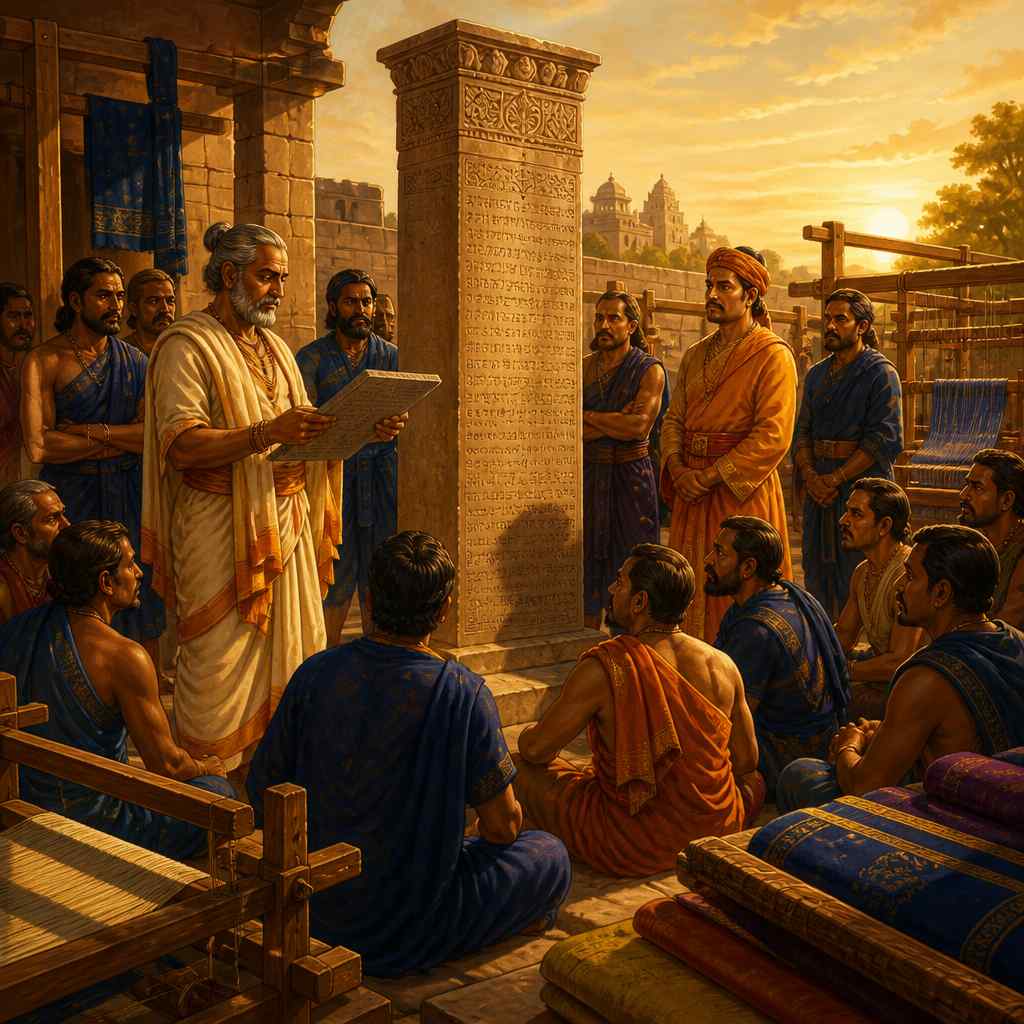
The Dashapura silk weavers reading a guild petition at their Mandsaur inscription

In 473 CE, the silk weavers of Dashapura (modern Mandsaur, Madhya Pradesh) faced a crisis. The local king had demanded they relocate to his new capital, abandoning their ancestral homes, their temples, their way of life. Any individual weaver would have been powerless. But these were not individuals acting alone.

They were a shreni (श्रेणी), a guild. And guilds had power.

The weavers petitioned collectively. They negotiated as one body. When the king persisted, the shreni threatened economic consequences: no silk for the royal court, no silk for export, no taxes from silk trade. The king backed down. The weavers stayed. And they commemorated their victory with a stone inscription that survives to this day, one of the most detailed records of ancient guild power.

This was not unusual. Across ancient India, shrenis wielded influence that rivaled kingdoms. They were the world's first trade guilds, predating European equivalents by over a millennium.

What Made Shrenis Different?

The Sanskrit word shreni derives from the root shri (to arrange, to organize). A shreni was precisely that: an organized body of people practicing the same trade or craft. But shrenis were far more than medieval European guilds, which focused narrowly on trade monopolies.

A shreni combined the functions of:

The Gautama Dharmasutra (c. 600-400 BCE) grants shrenis legal standing to create their own rules (shreni-dharma), binding on all members. The state couldn't override these internal regulations, an extraordinary recognition of corporate autonomy.

"श्रेणीनां च समयाः प्रमाणम्।" "The conventions of guilds are authoritative." , Gautama Dharmasutra

This meant that when a dispute arose between guild members, the guild's own rules, not royal law, applied first. Kings recognized that commerce required specialized knowledge and trusted shrenis to govern themselves.

The Hierarchy of Shrenis

Not all shrenis were equal. Ancient texts describe an elaborate hierarchy:

A sarthavaha caravan guild planning routes by firelight in the Thar desert

Sarthavaha shrenis led by caravan leaders commanded the highest prestige. These master merchants organized long-distance trade, managing logistics, finance, and risk across thousands of kilometers.

Craftsmen shrenis organized specialized producers: silk weavers, ivory carvers, iron smiths, goldsmiths. The Mandsaur inscription lists separate shrenis for different types of silk work.

Service shrenis organized specialized services: guards, porters, scribes. Even elephants had their handlers organized into shrenis.

A typical shreni was led by a shreshthin (guild president) and jetthaka (elder council). Decisions were made collectively, often requiring consensus. Members paid dues, attended meetings, and were bound by guild rules on quality, pricing, and conduct.

Membership was valuable. A guild member could trade on the guild's reputation, access guild banking facilities, and benefit from collective bargaining. But membership also meant obligations: maintaining quality standards, not undercutting fellow members, contributing to guild activities.

Global Perspectives: Guilds Across Civilizations

Guilds were not uniquely Indian, but India's were the earliest and most sophisticated.

Ibn Khaldun (1332-1406), the Arab historian, described how craftsmen's associations in Islamic cities maintained quality and set prices. But he was writing 1,800 years after the Gautama Dharmasutra granted Indian shrenis legal autonomy.

Adam Smith (1723-1790), in The Wealth of Nations, criticized European guilds as monopolistic restraints on trade. He argued they kept prices artificially high and blocked innovation. But Smith was observing guilds in their declining, corrupt phase, not the dynamic institutions that had built medieval commerce.

Max Weber (1864-1920) contrasted Indian guilds favorably with European ones, noting their banking functions and social mobility. Weber observed that Indian shrenis accepted members across castes (though this varied by period and region), while European guilds were more rigidly hierarchical.

Thinker Key Insight Indian Parallel
Ibn Khaldun Craftsmen's associations maintain quality Shreni-dharma codified quality standards
Adam Smith Guilds can become monopolistic India's shrenis competed; monopoly was rare
Max Weber Indian guilds more flexible on caste Shrenis created cross-caste identity

The critical difference: Indian shrenis were not granted power by kings, they developed organically and kings recognized their pre-existing authority. European guilds were typically royal charters granting monopoly rights. This meant Indian shrenis had to earn their legitimacy through service, while European guilds could rely on royal protection.

Modern Resonance: FICCI, CII, and NASSCOM

The shreni model never died, it evolved. India's modern industry associations are direct descendants of ancient shrenis.

The founding meeting of FICCI in Calcutta led by G.D. Birla in 1927

FICCI (Federation of Indian Chambers of Commerce and Industry), founded in 1927 by G.D. Birla and Purushottamdas Thakurdas, was created explicitly to give Indian business a collective voice against British commercial interests. Like ancient shrenis petitioning kings, FICCI lobbied the colonial government, and after 1947, shaped independent India's economic policies.

CII (Confederation of Indian Industry), founded in 1895 as the Engineering Association of India, similarly organized industrialists for collective action. Today, CII represents over 9,000 companies.

NASSCOM (National Association of Software and Services Companies), founded in 1988, organized India's nascent IT industry. It set quality standards (CMM certification drives), trained the workforce (NASSCOM Foundation), represented the industry politically, and built India's global IT reputation. NASSCOM did for software what ancient shrenis did for silk, created the institutional infrastructure that enabled an industry to dominate global markets.

The Gem and Jewellery Export Promotion Council in Surat governs the world's largest diamond cutting and polishing industry. Ninety percent of the world's diamonds pass through Surat, and the industry operates on trust networks that mirror ancient shreni practices: reputation-based credit, guild-enforced quality standards, and collective self-regulation.

Your Turn

The Dashapura weavers understood something profound: individual powerlessness could become collective strength. A single merchant could be exploited; a shreni could negotiate with kings.

Today, the same logic applies. Freelancers, gig workers, and small businesses often feel powerless against platforms and large corporations. Professional associations, from bar associations to tech communities, offer the same benefits shrenis provided: collective bargaining, reputation networks, dispute resolution, skill certification.

What shrenis do you belong to? What guilds might you join, or create? The ancient wisdom is clear: organization creates power. The weavers of Dashapura proved it 1,500 years ago. Their descendants, from NASSCOM to your local professional network, prove it still.

Collective bargaining and institutional economics, organized groups can achieve outcomes that individuals cannot.

Mancur Olson's 'The Logic of Collective Action' (1965) analyzes how groups overcome free-rider problems to achieve collective goods. Nobel laureate Elinor Ostrom's work on common-pool resources shows how self-governing communities manage shared resources effectively.

Indian shrenis combined multiple functions, trade, banking, law, training, into single institutions. This integration reduced coordination costs. European guilds typically had narrower functions, requiring separate institutions for banking, law, and training.

NASSCOM's collective advocacy helped India's IT industry grow from $150 million (1991-92) to $245 billion (2023-24). Collective organization created policy conditions that individual companies couldn't have achieved alone.

Information asymmetry and signaling, self-regulation solves the problem of quality verification when buyers can't easily assess products.

George Akerlof's 'Market for Lemons' (1970 Nobel Prize) shows how quality uncertainty can destroy markets. Self-regulating guilds solve this by certifying member quality, buyers trust the guild mark even when they can't verify quality themselves.

Verses

श्रेणीनां च समयाः प्रमाणम्।

śreṇīnāṃ ca samayāḥ pramāṇam |

The conventions of guilds are authoritative.

Self-regulation reduces transaction costs. When guilds set and enforce their own standards, the state doesn't need to monitor every transaction. This creates efficient, specialized governance, the same logic behind modern professional licensing and industry self-regulation.

Gautama Dharmasutra, 11.21 (Patrick Olivelle)

श्रेण्याद्याश्च प्रमाणं स्युः स्वधर्मस्थापने नृणाम्।

śreṇyādyāśca pramāṇaṃ syuḥ svadharmasthāpane nṛṇām |

Guilds and similar bodies have authority to establish their own rules for their members.

Delegated self-governance allows specialization. Textile guilds knew textiles; the king didn't. By delegating rule-making to experts, the system created better regulation than centralized control could achieve. Modern professional associations operate on the same principle.

Narada Smriti, 10.2-3 (Richard Lariviere)

श्रेणीप्रामाण्यं व्यवहारेषु।

śreṇīprāmāṇyaṃ vyavahāreṣu |

Guild authority is valid in commercial and legal matters.

Specialized dispute resolution reduces friction. Merchants preferred guild arbitration because guild elders understood trade. This speed and expertise lowered transaction costs, enabling more commerce.

Arthashastra, 3.14.27 (R.P. Kangle)

Key figures

The Dashapura Silk Weavers

Silk weavers' guild whose inscription at Mandsaur (Madhya Pradesh) provides the most detailed ancient record of guild organization and power. · 473 CE

Ghanshyam Das Birla (G.D. Birla)

Industrialist who co-founded FICCI (1927) to give Indian business a collective voice against British commercial interests, creating modern India's most influential industry association. · 1894-1983

Adam Smith

Scottish economist and philosopher whose 'The Wealth of Nations' (1776) criticized European guilds as monopolistic restraints on trade and innovation. · 1723-1790

Case studies

NASSCOM: Building a $245 Billion Industry Through Collective Action

In 1988, India's software industry was negligible, a few hundred million dollars, largely doing data entry for foreign firms. The industry had potential but lacked infrastructure: no quality standards, no training ecosystem, no global reputation, no policy support. A group of IT pioneers, Dewang Mehta, Nandan Nilekani, and others, created NASSCOM (National Association of Software and Services Companies) to build collectively what no individual company could build alone. NASSCOM's early priorities mirrored ancient shreni functions: - **Quality standards**: Drove CMM/CMMI certification adoption, establishing India's reputation for quality software. - **Training**: Created the NASSCOM Foundation to address skills gaps, training millions. - **Collective voice**: Lobbied government for IT-friendly policies, STPI scheme, tax benefits, telecom liberalization. - **Dispute resolution**: Created mechanisms for resolving industry disputes without costly litigation. - **Global reputation**: Represented Indian IT at global forums, building the 'India brand' for outsourcing.

NASSCOM's approach embodied shreni principles: **Sangha (collective organization)**: Individual companies, even giants like Infosys or TCS, couldn't have lobbied as effectively or built industry reputation as quickly as a unified association. **Shreni-dharma (self-regulation)**: Rather than waiting for government to impose standards, NASSCOM drove quality certification from within. This self-regulation built trust faster than external mandates could have. **Vishwas (trust-building)**: NASSCOM's certification and standards created the trust infrastructure that enabled global clients to outsource to India. Buyers trusted 'NASSCOM member' as ancient buyers trusted guild marks. The dharmic insight: collective institution-building creates prosperity that individual competition cannot. The shreni model, cooperation within the community enabling competition in the wider world, proved as powerful in 1988 as in 473 CE.

India's IT industry grew from $150 million (1991-92) to $245 billion (2023-24), a 1,600x increase in three decades. The industry employs over 5 million people directly and millions more indirectly. NASSCOM members now include not just Indian giants but global firms recognizing the power of collective representation. The association continues to evolve: from Y2K boom to BPO to AI, NASSCOM adapts while maintaining shreni functions. The lesson: industries that organize collectively outperform those that don't. NASSCOM didn't just represent existing companies, it created conditions for an entire industry to emerge. The Dashapura weavers would recognize the pattern.

Collective organization creates conditions for individual success. NASSCOM built the infrastructure, standards, training, reputation, policy, that individual companies couldn't have built alone. The ancient shreni insight remains valid: organize first, compete second.

NASSCOM's model of collective industry building is now studied in MBA programs worldwide as a case study in 'pre-competitive collaboration.' Israel's tech ecosystem (Unit 8200 alumni networks) and Taiwan's semiconductor cluster (ITRI) followed similar patterns of collective capability building before individual competition.

NASSCOM members generate over $250 billion in annual revenue. The association's collective advocacy achieved policy wins (STPI, SEZ benefits) worth tens of billions in tax savings and infrastructure support.

Surat's Diamond Shreni: $24 Billion on Handshakes

Surat, Gujarat, processes 90% of the world's diamonds, a $24 billion industry. Rough diamonds arrive from Antwerp, are cut and polished by thousands of small workshops, and return as finished gems. The industry operates almost entirely on trust. Diamonds worth crores change hands on verbal agreements. Payment terms extend for months. Disputes are resolved within the community, rarely reaching courts. How does this work? Through guild-like structures that mirror ancient shrenis: **The Surat Diamond Bourse** (3,500 offices) provides physical infrastructure and community visibility. Members know each other; reputation spreads instantly. **The Gems and Jewellery Export Promotion Council** sets standards, represents the industry, and provides collective services, exactly like an ancient shreni. **Family and community networks** provide the social enforcement that makes trust work. Cheating isn't just business failure, it's social death. Your family's reputation collapses; your children can't marry well; you're expelled from the community.

Surat's diamond industry demonstrates shreni principles operating in the 21st century: **Shreni-dharma (guild law)**: Disputes are resolved within the community using established norms, not courts. This is faster, cheaper, and more informed than legal proceedings. **Vishwas (trust)**: The system runs on trust because the community enforces accountability. This trust is not naive, it's backed by social consequences that make cheating irrational. **Sangha (community identity)**: Diamond traders identify as a community first, competitors second. This collective identity enables the cooperation that makes the industry possible. The dharmic insight: trust isn't just ethics, it's infrastructure. Surat's trust networks enable transactions that would be impossibly expensive to contract and monitor formally. Ancient shrenis understood this; Surat's diamond traders prove it daily.

Surat's diamond industry, built on shreni-like trust networks, dominates global diamond processing. The industry has survived multiple disruptions (lab-grown diamonds, Russian sanctions) through community adaptation. The trust-based model keeps transaction costs low. Western diamond centers with more formal, contractual approaches have higher costs and lower volumes. Surat's 'primitive' trust networks are actually a competitive advantage. The model is expanding: Surat has added gold and textile industries, applying the same guild-like patterns. The shreni template, proven over millennia, continues to create prosperity.

Trust networks are infrastructure. Surat's diamond industry succeeds not despite informal, trust-based practices but because of them. The ancient shreni insight, that community accountability enables commerce, remains a competitive advantage in the 21st century.

Surat's trust-based diamond trade challenges the assumption that modern commerce requires formal contracts and legal enforcement. Studies in behavioral economics now recognize that community-enforced trust networks can process transactions faster and cheaper than contract-based systems, particularly where goods are difficult to standardize.

Over 8 lakh (800,000) people work in Surat's diamond industry. The city's diamond exports exceed $20 billion annually, all moving through trust networks that formal contracts couldn't replicate.

Historical context

c. 600 BCE - 1200 CE (height of shreni system)

Shrenis flourished during periods of political fragmentation when no single ruler could dominate. Guilds provided stability and continuity that kings couldn't. The decline of shrenis correlates with centralized empires (Mughals, British) that didn't need guild intermediation.

European guilds emerged in the 11th-12th centuries CE, over 1,500 years after Indian shrenis were legally recognized. European guilds were typically royal grants of monopoly; Indian shrenis developed organically and states recognized pre-existing authority. This difference shaped how guilds functioned: Indian shrenis had to earn legitimacy; European guilds relied on royal protection.

Archaeological evidence identifies over 100 different trade shrenis across ancient India, from silk weavers to ivory carvers to elephant handlers. Inscriptions from across the subcontinent document guild activities spanning two millennia.

Modern industry associations, FICCI, CII, NASSCOM, are direct descendants of ancient shrenis. Understanding the shreni model illuminates why collective organization creates prosperity, and how self-regulation can work better than state control.

Living traditions

Reflection

More in Shreni & Hundi: India's Financial Innovations

All lessons in Shreni & Hundi: India's Financial Innovations · Trade Routes of Ancient Bharat course