Sagarmala: Port-Led Development Strategy
From Lothal to Modern Megaports: Reclaiming India's Maritime Destiny
How India's ₹8+ lakh crore Sagarmala initiative transforms 7,500 km of coastline into world-class port infrastructure, building on a maritime heritage that dates back 4,500 years to the Indus Valley's Lothal.
The World's First Dock
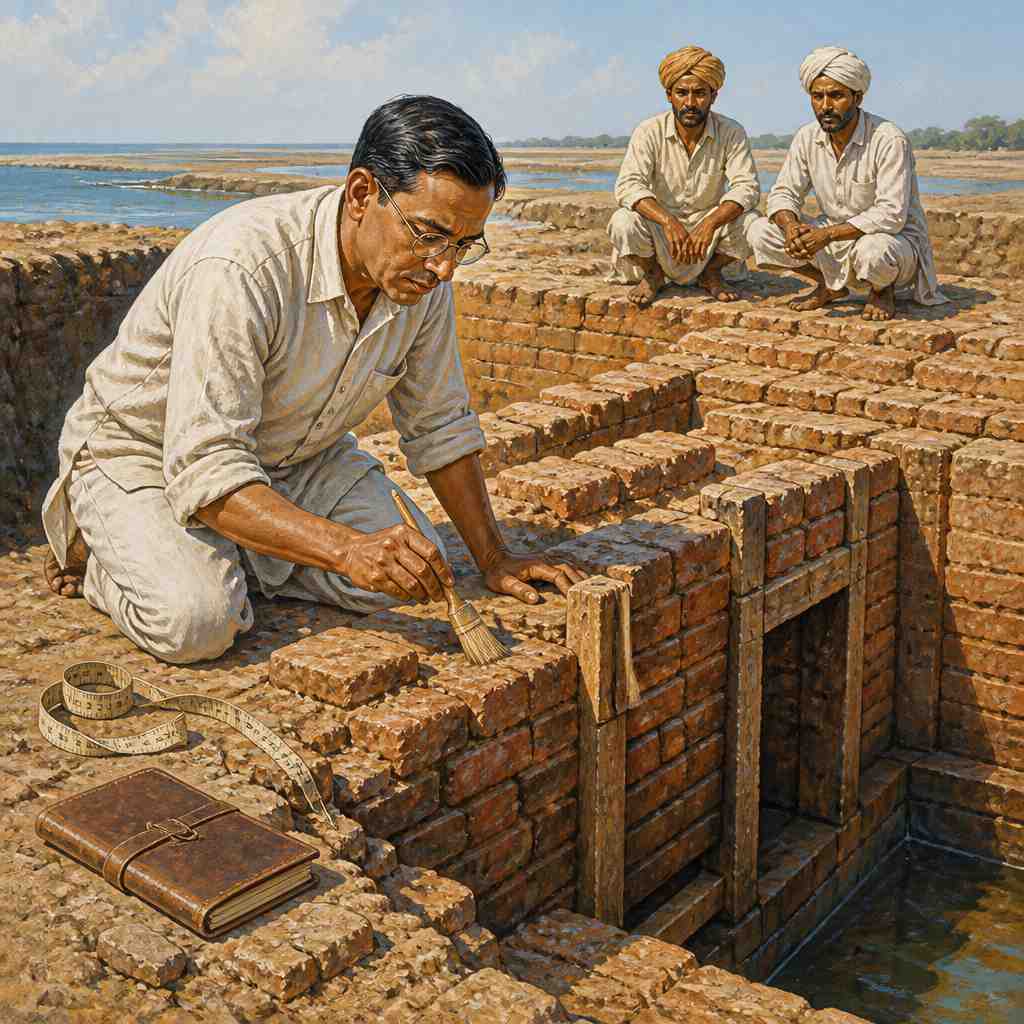
In 1954, archaeologist S.R. Rao discovered something remarkable in the salt marshes of Gujarat: a rectangular basin, 218 meters long and 37 meters wide, connected to an ancient river channel. Carbon dating placed it at 2400 BCE, making Lothal home to the world's oldest known dock.
The Harappan engineers who built Lothal solved problems that would challenge port designers four millennia later: tidal management (the dock had sluice gates), cargo handling (warehouses lined the wharf), and urban integration (the port city had dedicated industrial and residential zones). Ships from Mesopotamia docked here, loading carnelian beads and cotton textiles.
Today, less than 200 kilometers away, Mundra Port handles 15 million tonnes of cargo monthly. But for two centuries between these achievements, India's ports languished, overtaken by Singapore, Dubai, and Chinese megaports while the nation with the world's first dock fell behind.
Sagarmala is India's answer: a ₹8+ lakh crore ($100 billion) initiative to reclaim maritime excellence.
Why Ports Matter: The Logistics Gap
India's logistics costs consume 13-14% of GDP, nearly double Singapore's 8% or China's 9%. For every ₹100 of goods produced, ₹13-14 disappear into inefficient transport, storage, and handling. This invisible tax makes Indian exports uncompetitive.
The port problem is central:
Capacity: India's major ports handled ~800 million tonnes in 2023, impressive, but Singapore alone handles 580 million tonnes with a fraction of India's coastline.
Turnaround time: Ships at Indian ports wait 2-3 days on average; at Singapore, it's under 1 day. Every hour of delay costs shipping lines $10,000-50,000.
Draft depth: India's ports average 12-14 meters draft; modern container ships need 18+ meters. Ships can't come fully loaded, requiring costly transshipment via Colombo or Singapore.
Connectivity: Ports exist in isolation; factories lack rail connections to harbors. A container from Ludhiana to Europe spends more time traveling to Mumbai port than crossing the ocean.
"पोतस्थानं वाणिज्यद्वारम्।" "The harbor is the gateway to trade."
Ancient texts recognized what modern economists confirm: port efficiency determines trade competitiveness.
The Sagarmala Vision
Launched in 2015, Sagarmala rests on four pillars:
Port Modernization: Upgrading 12 major and 200+ minor ports with deeper drafts, automated terminals, and digital systems. JNPT's fourth terminal, operated by PSA Singapore, demonstrates world-class capability.
Port Connectivity: The PM Gati Shakti master plan integrates rail, road, and waterway connections. Dedicated Freight Corridors link industrial zones directly to ports.
Port-Led Industrialization: Coastal Economic Zones (CEZs) cluster manufacturing near ports. Ship components made in Vizag, petrochemicals in Dahej, electronics in Krishnapatnam, each reducing the distance goods travel.
Coastal Community Development: Skill training for fishing communities, maritime clusters, and cruise tourism. The coast should prosper, not just serve as cargo gateway.
Finance Minister Nirmala Sitharaman's 2024 budget allocated ₹28,000 crore for port development alone, a signal of strategic priority.
Global Perspectives on Port Economics
India competes in a world where ports are strategic weapons.
Singapore's PSA International transformed a colonial trading post into the world's second-largest transshipment hub. Chairman Fock Siew Wah led PSA's global expansion, applying lessons learned in Singapore to ports worldwide, including India's JNPT. Singapore's secret: relentless efficiency obsession, investing billions annually in automation.
China's port expansion under the Belt and Road Initiative has created a global network. Cosco Shipping operates terminals in 36 countries. The Port of Shanghai handles more cargo than all Indian ports combined. China understood that controlling ports means controlling trade.
Dubai's DP World, led by Sultan Ahmed bin Sulayem, built Jebel Ali into the Middle East's largest port, then exported the model globally. DP World now operates terminals in 78 countries, including India's Mundra and Visakhapatnam.
| Port Operator | Global Terminals | Strategy | Lesson for India |
|---|---|---|---|
| PSA Singapore | 60+ ports in 42 countries | Efficiency + technology | Automation reduces turnaround |
| China Cosco | 36 countries | State-backed expansion | Strategic ports = trade control |
| DP World | 78 countries | Commercial excellence | Private participation accelerates growth |
India's response: create conditions for both public investment and private operators to develop world-class infrastructure.
Adani Ports: The Private Sector Catalyst
Gautam Adani's entry into ports transformed India's maritime landscape. In 1998, Mundra was a fishing village in Gujarat's Kutch district. Today, Adani Ports and SEZ Limited (APSEZ) operates India's largest port ecosystem.

The Mundra model combined:
Deep draft: 18+ meters enabling the largest ships to dock fully loaded, eliminating transshipment via Colombo.
Private efficiency: Turnaround times of under 24 hours, comparable to Singapore.
Integrated zones: Mundra SEZ houses 170+ companies, manufacturing goods that load directly onto ships.
Expansion: APSEZ now operates 15 ports handling 25% of India's cargo, more than all public ports combined.
Critics note concentration risks; supporters argue that private efficiency demonstrated what was possible, forcing public ports to modernize. JNPT's new terminals now match private port performance.
Vizhinjam: Challenging Colombo
India's biggest maritime embarrassment: 30% of container cargo bound for India transships through Colombo in Sri Lanka. Indian exporters pay Sri Lankan ports to handle goods that should move through Indian facilities.
Why? Indian ports lacked the draft depth for large container ships. Colombo, with 18-meter drafts, captured the business.

Vizhinjam International Seaport, under construction in Kerala, changes this. Located just 10 nautical miles from major shipping lanes (compared to Colombo's 300-mile detour), Vizhinjam offers:
- 20+ meter natural draft, no dredging required
- Direct access to the East-West shipping route
- Transshipment hub capability to serve all Indian ports
When Phase 1 opens (expected 2025), Vizhinjam will immediately become India's deepest port. Adani Group, the developer, projects it will capture significant transshipment traffic currently going to Colombo and Singapore.
The strategic value extends beyond commerce: a world-class port on India's southern tip strengthens naval logistics in the Indian Ocean.
The Blue Economy Vision
Sagarmala isn't just about cargo. India's 7,500 km coastline supports:
4 million fishing families whose livelihoods depend on maritime resources.
Shipbuilding that once made India a global leader, Cochin Shipyard now builds aircraft carriers and complex vessels.
Maritime services: manning, insurance, legal, sectors where India could compete with London and Singapore.
Cruise tourism: India hosts just 0.5% of global cruise passengers despite having world-class coastal destinations.
The Samudra Nyaya (Ocean Justice) principle from dharmic texts suggests that ocean resources should benefit coastal communities, not just distant traders. Sagarmala includes ₹2,500 crore for fishing harbor upgrades, ₹1,000 crore for coastal community skills, and integrated development of 1,400 islands.
Your Turn: Thinking Coastal
The engineers of Lothal understood something modern planners are rediscovering: India is fundamentally a maritime civilization. The subcontinent has more coastline than most countries have borders. Every major ancient capital, Pataliputra, Vijayanagara, Thanjavur, maintained connections to the sea.
Sagarmala creates opportunities beyond the obvious:
For manufacturers: Coastal locations now make sense. Land near Mundra or Vizhinjam could be more valuable than inland industrial estates.
For logistics professionals: Port operations, shipping, freight forwarding, these sectors need skilled Indians as India's cargo grows.
For investors: Port-adjacent real estate, maritime services, coastal tourism, all sectors set to grow as Sagarmala matures.
For coastal communities: The skills your grandparents used for fishing and boat-building translate to modern maritime industries. Preservation of this knowledge matters.
The dock at Lothal stood for a thousand years, serving civilizations we barely remember. Sagarmala aims to build infrastructure for the next thousand.
In our next lesson, we travel north to examine Chabahar, India's strategic port investment in Iran that opens Central Asian markets.
Infrastructure economics and development theory, investment in physical capital creates multiplier effects throughout the economy.
Paul Romer's endogenous growth theory shows that infrastructure investment generates sustained economic growth, not just one-time boosts. The Erie Canal, Panama Canal, and Suez Canal all transformed regional economies for centuries.
India has coastline comparable to major maritime powers but handles a fraction of their cargo. This gap represents opportunity: every percentage point improvement in port efficiency translates to billions in trade gains.
Sagarmala projects reducing logistics costs from 13-14% to 8% of GDP, saving ₹3-4 lakh crore annually. This single improvement would add 1%+ to GDP growth.
Sea power theory, nations controlling maritime trade routes exercise disproportionate influence on global affairs.
Alfred Thayer Mahan's 'The Influence of Sea Power Upon History' (1890) argued that naval dominance creates commercial dominance. Britain, America, and now China have followed this principle.
Verses
पोतस्थानं वाणिज्यद्वारम्।
pota-sthānaṃ vāṇijya-dvāram |
The harbor is the gateway to trade.
Port efficiency creates trade multipliers. Every rupee invested in port infrastructure generates ₹3-4 in economic activity through reduced logistics costs and increased trade volume. Sagarmala's ₹8 lakh crore investment projects ₹25+ lakh crore in economic impact.
Arthashastra, Book 2, Chapter 28 (R.P. Kangle)
समुद्रः सम्पत्तिदायकः।
samudraḥ sampatti-dāyakaḥ |
The ocean is the bestower of prosperity.
India's blue economy potential exceeds $500 billion annually when fishing, maritime transport, offshore energy, and coastal tourism are combined. Most remains untapped due to infrastructure gaps that Sagarmala addresses.
Traditional Maritime Wisdom, Coastal Gujarat saying (Folk tradition)
Key figures
Lothal Engineers (Harappan Civilization)
Anonymous engineers and planners of the Indus Valley Civilization who designed and built Lothal, the world's first known dock and one of history's most sophisticated ancient ports. · 2400-1900 BCE
Gautam Adani
Founder and Chairman of Adani Group, whose Adani Ports and SEZ Limited (APSEZ) operates India's largest port ecosystem, handling 25% of national cargo. · Contemporary (b. 1962)
PSA International (Singapore)
Singapore's port operator that transformed a colonial trading post into the world's second-largest container hub, and now operates 60+ terminals in 42 countries including India's JNPT. · Founded 1964; global leader since 1990s
Case studies
Mundra: From Fishing Village to India's Largest Port
In 1995, Mundra was an obscure fishing settlement in Gujarat's Kutch district, dry, remote, and seemingly worthless. The population survived on fishing and salt production. No road connected it to major cities; the nearest railway was 100 km away. Gautam Adani saw what others missed: Mundra had natural deep water (15+ meters with minimal dredging), was close to India's industrial heartland (Gujarat, Maharashtra, Rajasthan), and had vast land available for development. The Gujarat government, under Chief Minister Keshubhai Patel, granted the initial license. Construction began in 1998. By 2001, the first berth opened. Unlike government ports that developed incrementally over decades, Mundra was built to global specifications from day one: automated container terminals, rail connectivity, and an integrated Special Economic Zone (SEZ). The SEZ proved crucial. Rather than just handling cargo, Mundra attracted manufacturing. Companies set up factories within the zone, processing imports, manufacturing goods, loading directly onto ships. The port became an industrial cluster.
Mundra's transformation reflects dharmic principles of value creation (artha) combined with service (seva). The port created prosperity not just for Adani but for the region: - **Employment**: 50,000+ direct jobs in a previously impoverished area - **Industrialization**: 170+ companies in the SEZ, from power plants to refineries - **Connectivity**: Road and rail links that benefit the entire region - **Skills**: Local fishing communities transitioned to port operations The dharmic question: Is concentrated private ownership compatible with public benefit? Critics argue monopoly risks; supporters note that Mundra's efficiency forced other ports to improve. The Arthashastra recognizes private merchants as essential to prosperity, but also mandates regulation to prevent exploitation.
Mundra today: - **150+ million tonnes** annual cargo (India's largest port) - **25% of India's container traffic** passes through APSEZ ports - **18+ meter draft** enabling world's largest ships to dock fully loaded - **<24 hour turnaround** matching Singapore standards - **₹2+ lakh crore investment** in the port-SEZ complex The impact extends beyond Mundra. APSEZ's efficiency demonstrated what was possible, forcing JNPT and other ports to modernize. The PSA-operated terminal at JNPT now achieves similar turnaround times. Mundra's lesson for Sagarmala: private efficiency combined with public infrastructure (roads, rail) creates world-class facilities. The question is ensuring benefits reach beyond shareholders to coastal communities.
Transformation requires vision beyond current reality. When Adani proposed Mundra, no Indian port operated at global standards; conventional wisdom held that Indian conditions prevented world-class performance. Mundra disproved this, Indian workers, Indian management, Indian conditions could produce Singapore-level efficiency. The constraint was investment and vision, not inherent limitation.
Mundra's transformation from fishing village to global port in 25 years is comparable to Shenzhen's transformation from fishing village to tech metropolis in 30 years. Both prove that with the right investment and vision, geographic advantages can be activated rapidly, rewriting regional economic maps within a single generation.
Mundra's container traffic grew from zero (1998) to 9+ million TEUs (2023), surpassing Singapore's Pasir Panjang terminal. In 25 years, a fishing village became one of the world's largest container facilities.
Vizhinjam: India's Bet to Beat Colombo
Every year, 30% of container cargo destined for India takes a detour: ships too large for Indian ports offload at Colombo, Sri Lanka, where cargo transfers to smaller vessels for final delivery. Indian exporters pay Colombo for the privilege. This embarrassment has strategic implications: cargo moving through foreign ports creates dependency. During political tensions, this dependency becomes vulnerability. Vizhinjam changes the equation. Located on Kerala's southern tip, the port site offers: - **Natural 20+ meter depth** (no dredging required) - **10 nautical miles from major shipping lanes** (vs Colombo's 300-mile deviation) - **Year-round operability** (sheltered from monsoons) - **Direct access** to the East-West shipping route connecting Europe to Asia After decades of planning (proposals date to 1991), the Adani Group won the contract in 2015. Construction has faced challenges, COVID delays, environmental protests, engineering complexities, but Phase 1 completion is expected in 2025.
Vizhinjam embodies the dharmic tension between development and environmental protection. The port displaced fishing communities; protests delayed construction for years. The Kerala High Court eventually balanced interests, mandating rehabilitation and environmental measures. From an artha (economic) perspective, Vizhinjam is essential: India cannot be a manufacturing power while dependent on foreign transshipment. From a dharmic perspective, development must respect those affected, the fishing communities whose ancestors worked these waters for generations. The project includes: - ₹750 crore for fishermen rehabilitation - Harbor protection structures to prevent coastal erosion - Employment priority for affected families Whether these measures adequately address displacement remains debated. But the attempt to balance interests reflects dharmic economics: prosperity without justice is incomplete.
Vizhinjam's projected impact: - **4 million TEU capacity** (Phase 1), immediately capturing transshipment business from Colombo - **30% cost reduction** for Indian shippers currently using foreign ports - **24/7 operations** with world-class automation - **Naval logistics** support for the Indian Navy in the Indian Ocean The strategic value exceeds commerce: India has lacked a deepwater port on its southern coast, handicapping both trade and naval operations. Vizhinjam fills this gap. Global shipping lines have expressed interest: Maersk, MSC, and CMA CGM are evaluating Vizhinjam as an Indian Ocean hub. If successful, Vizhinjam could do for India what Singapore did for Southeast Asia, become the natural transshipment hub for an entire region.
Strategic infrastructure takes decades but shapes centuries. Vizhinjam's first proposal dates to 1991; construction began 2015; completion expected 2025. This 35-year journey reflects the patience major infrastructure requires, and the vision to persist. Lothal took generations to build; Vizhinjam will serve generations.
Vizhinjam's deep-water port addresses the same transshipment dependency that drives mega-port investments in Tanjung Pelepas (Malaysia), Khalifa (UAE), and Piraeus (Greece). Every major trading nation eventually builds the port infrastructure needed to handle its own cargo directly rather than routing through intermediaries.
Colombo handles 7+ million TEUs of transshipment annually, earning $400+ million. Even capturing 25% of this business justifies Vizhinjam's ₹7,500 crore investment multiple times over.
Historical context
2400 BCE Lothal to 2025 Vizhinjam completion
India's ports declined from global leadership (Cambay, Surat) to colonial dependency (Calcutta, Bombay served British extraction) to post-independence neglect (underinvestment while Asian tigers invested massively). Sagarmala represents belated but comprehensive correction.
Singapore handles 580 million tonnes with 120 km coastline; India handles 800 million tonnes with 7,500 km coastline. This 50x efficiency gap represents Sagarmala's opportunity, and the challenge.
India's logistics costs (13-14% of GDP) are nearly double global best practice (8%). Sagarmala's primary goal is closing this gap.
Manufacturing competitiveness depends on logistics efficiency. 'Make in India' requires 'Ship from India', Sagarmala provides the infrastructure.
Living traditions
- Traditional boat-building
- Coastal fishing community knowledge
- Salt production traditions
- Lothal Archaeological Site: The world's first known dock, preserved with museum displaying Harappan artifacts, bead-making facilities, and trade goods from Mesopotamia.
- Mundra Port: India's largest private port. Tours available showing container operations, SEZ facilities, and the scale of modern port infrastructure.
- Vizhinjam Port (under construction): India's deepwater transshipment hub under construction. The site offers views of the engineering challenges of building a major port.
- Dwarkadhish Temple: Ancient coastal temple at legendary port city mentioned in Mahabharata. Archaeological evidence shows Dwarka was major maritime trading center, with temple supported by merchant patronage.
- Padmanabhaswamy Temple: Temple treasury containing vast wealth accumulated through centuries of maritime trade. Located near Vizhinjam, demonstrating historic connection between ports and temple prosperity.
Reflection
- The engineers of Lothal created infrastructure that served civilization for a millennium, yet we don't know their names. What infrastructure today will outlast its creators? What would it mean to work on something with a thousand-year impact?
- Sagarmala represents India's bet on maritime trade. If you were advising a young professional or entrepreneur, what opportunities would you point them toward in this emerging sector? What skills would you suggest they develop?