Chabahar: Gateway to Central Asia

Reviving the Northern Silk Road Through Iran

How India's strategic investment in Iran's Chabahar port creates a land bridge to Afghanistan and Central Asia, bypassing geographic constraints while reviving trade routes that flourished two millennia ago.

The Geography Problem

Look at a map of South Asia, and India's strategic dilemma becomes immediately clear. To the west lies Pakistan, a hostile neighbor through which no trade flows. Beyond Pakistan sits Afghanistan, rich in minerals and starving for development. Further north: the vast Central Asian republics, Kazakhstan, Uzbekistan, Turkmenistan, landlocked nations desperately seeking ocean access.

For these countries, reaching the sea means crossing either Russia, China, or Pakistan. None offers ideal terms. Russia demands its cut; China builds ports with strings attached; Pakistan's Karachi faces its own capacity constraints.

Chabahar offers an alternative. This Iranian port on the Gulf of Oman provides what geography otherwise denies: direct ocean access for landlocked nations, bypassing Pakistan entirely. For India, it's the key to a northern corridor, a modern Silk Road running from Mumbai to Moscow.
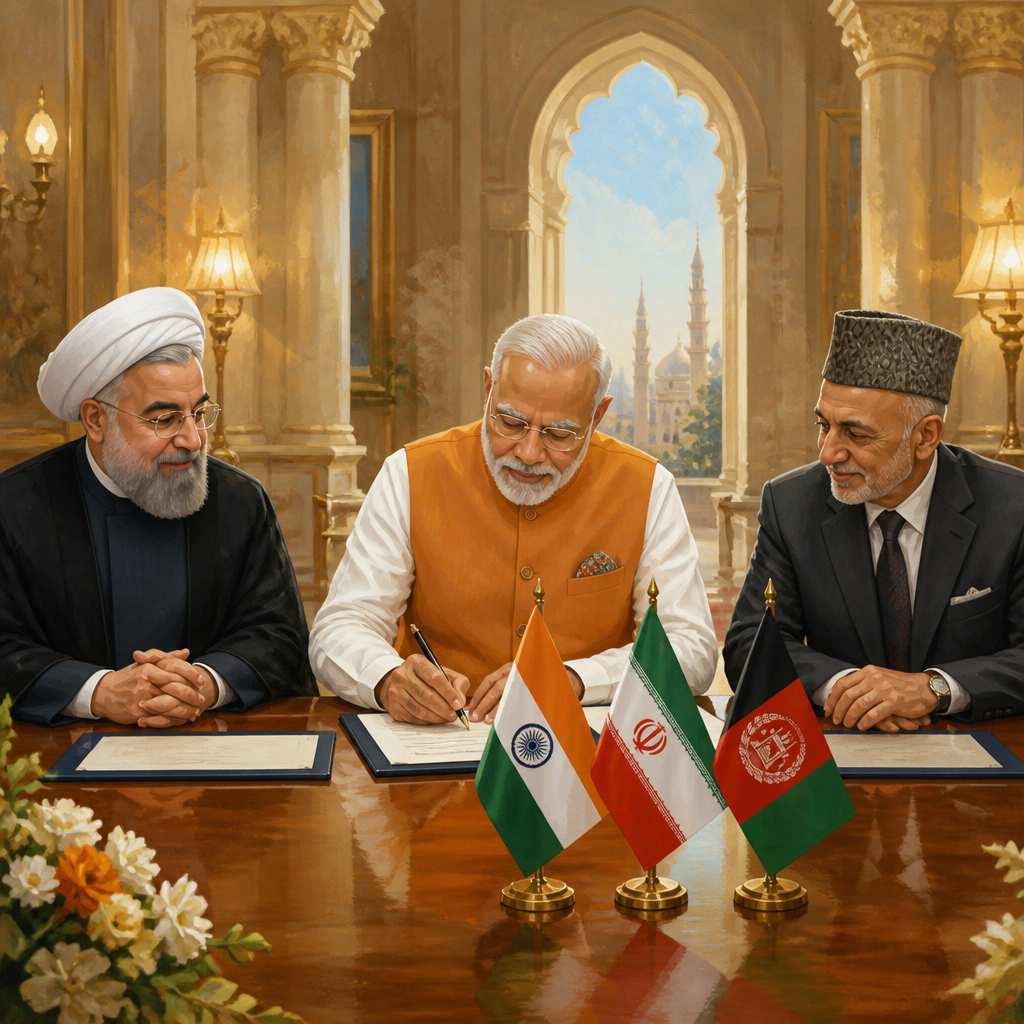
Modi, Rouhani, Ghani signing the Chabahar trilateral

In May 2016, Prime Minister Narendra Modi stood in Tehran beside Iranian President Hassan Rouhani and Afghan President Ashraf Ghani to sign the trilateral agreement. The vision: an International North-South Transport Corridor (INSTC) connecting India to 13 countries and beyond.

The Ancient Template: Gandhara's Trading Networks
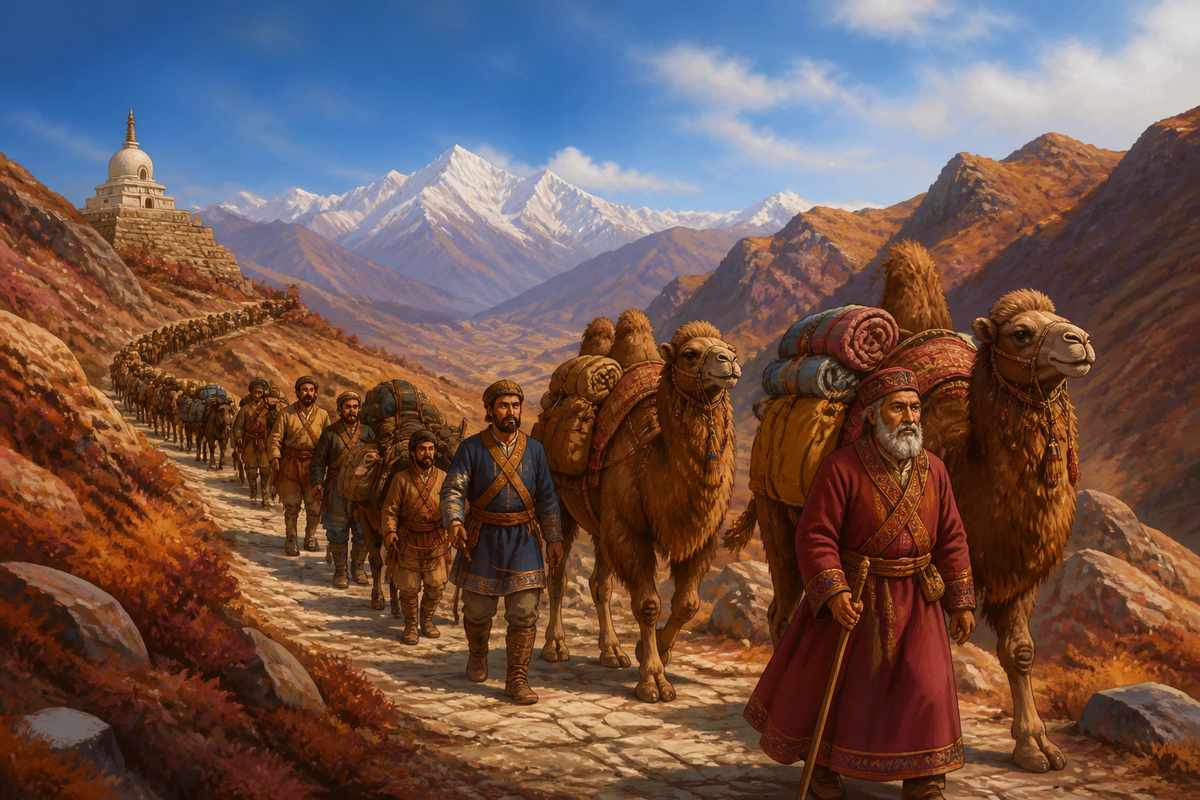
Gandhara merchant caravan crossing northern mountain foothills

Two thousand years ago, merchants of Gandhara, the region spanning modern Afghanistan and Pakistan, operated one of history's most lucrative trade networks. Their caravans connected India to Central Asia, Persia, and the Mediterranean.

Taxila (near modern Islamabad) was the hub. Silk from China, gold from Central Asia, spices from India, and horses from Ferghana all passed through. Gandharan merchants developed sophisticated financial instruments: partnership contracts, profit-sharing arrangements, and credit networks that preceded European banking by centuries.

The Kushans (1st-3rd century CE), ruling from Gandhara, facilitated this trade. King Kanishka's empire stretched from the Ganges to Central Asia, creating a unified commercial zone. Coins minted in Gandhara have been found from Rome to China, evidence of trade spanning the known world.

"उत्तरापथस्य व्यापारः राज्यस्य वृद्धिकरः।" "Trade along the northern route brings growth to the kingdom."

The Uttarapatha, the ancient northern highway, connected Pataliputra to Taxila and beyond. Chabahar revives this route, substituting sea passage for the first leg but following the same logic: India's manufactured goods moving north; Central Asian resources moving south.

Chabahar's Strategic Architecture

Chabahar port lies in Iran's Sistan-Baluchestan province, just 72 km from Pakistan's Gwadar port, China's flagship BRI project in the region. The proximity is not coincidental; both powers recognized the same geographic opportunity.

India's Chabahar investment includes:

Port Development: Two terminals, Shahid Kalantari (cargo) and Shahid Beheshti (container). India has committed $85 million for equipment and infrastructure, with rights to operate Shahid Beheshti for 10 years.

Rail Link: A 628 km railway connecting Chabahar to Zahedan on the Afghan border, enabling goods movement from ship to Central Asia without transiting Pakistan.

Free Trade Zone: 140 hectares of industrial development, welcoming Indian investment in aluminum, urea, and petrochemicals.

Road Connectivity: The 218 km Zaranj-Delaram highway (built by India in Afghanistan) connects to Chabahar, creating a complete surface route.

Total Indian commitment: over $500 million invested or pledged, India's largest infrastructure investment in a foreign country.

Global Perspectives on Corridor Competition

Chabahar exists in the shadow of China's massive infrastructure ambitions.

The Belt and Road Initiative represents President Xi Jinping's signature project, over $1 trillion invested across 140+ countries. In the region, BRI's crown jewel is the China-Pakistan Economic Corridor (CPEC): $62 billion connecting Kashgar in Xinjiang to Gwadar port in Pakistan.

Gwadar, just 72 km from Chabahar, offers China what it seeks: a port outside the Malacca Strait chokepoint, closer to Middle Eastern oil, and deep in the Indian Ocean. Pakistan gains infrastructure investment; China gains strategic depth.

Halford Mackinder's geopolitical theory remains relevant: control of the Eurasian "Heartland" determines global power. Central Asia is this heartland, landlocked, resource-rich, strategically vital. China's BRI seeks heartland control through infrastructure; India's Chabahar offers an alternative path.

The key difference: China's investments often come with sovereignty implications, 99-year leases, debt that converts to equity, military base rights. India's Chabahar model emphasizes partnership: Iran operates the port; India provides equipment and expertise. Afghanistan chooses which corridor to use.

Corridor Investment Operator Model
CPEC (China) $62 billion China-Pakistan joint Debt financing, Chinese control
Chabahar (India) ~$500 million Iran operates, India equips Partnership, shared benefit
INSTC (Multiparty) Various Multiple countries Coalition approach

The International North-South Transport Corridor

Chabahar is one node in a larger vision: the International North-South Transport Corridor (INSTC), a 7,200 km multi-modal route connecting Mumbai to Moscow.

The route:

  1. Sea: Mumbai to Chabahar (850 nautical miles)
  2. Road/Rail: Chabahar through Iran to Azerbaijan
  3. Caspian: Ship or rail through Azerbaijan to Russia
  4. Rail: Through Russia to Moscow, St. Petersburg, or Europe

Traditional routing via Suez takes 45-60 days; INSTC promises 25-30 days at lower cost. For time-sensitive goods (machinery, pharmaceuticals, electronics), this represents transformative advantage.

INSTC membership includes 13 countries: India, Iran, Russia, Azerbaijan, Armenia, Kazakhstan, Kyrgyzstan, Tajikistan, Turkey, Ukraine, Belarus, Oman, and Syria. Each gains from faster, cheaper movement.

External Affairs Minister S. Jaishankar has called INSTC "a game changer for connectivity." The corridor offers India what it lacks: land routes to Eurasia that don't depend on Pakistani goodwill.

Sanctions and Strategic Patience

Chabahar's development hasn't been smooth. US sanctions on Iran, imposed 2018-2020 under the Trump administration, threatened to derail the project entirely. Indian companies faced secondary sanctions for doing business with Iran.

India's response demonstrated strategic patience:

Sanctions exemption: India successfully lobbied for Chabahar-specific exemptions, arguing the port's humanitarian role (Afghanistan access) and strategic importance (alternative to Chinese dominance).

Rupee-rial trade: To circumvent dollar-based sanctions, India and Iran developed rupee-rial payment mechanisms, a precursor to broader de-dollarization efforts.

Quiet persistence: While loudly backing maximum pressure publicly, India continued Chabahar development quietly. The port remained operational throughout the sanctions period.

With sanctions partially relaxed under the Biden administration, development accelerated. India Ports Global Limited (IPGL) began operating Shahid Beheshti terminal in December 2018; by 2024, cargo handling had grown substantially.

Afghanistan: The Humanitarian Dimension

Chabahar's most visible success came through humanitarian crisis.

Indian wheat trucks rolling toward Afghanistan from Chabahar

In 2020, with COVID-19 disrupting supply chains and Afghanistan facing food insecurity, India shipped 75,000 tonnes of wheat to Afghanistan, not through Pakistan (which would have blocked it), but through Chabahar.

The shipments demonstrated Chabahar's operational capability:

Even after the Taliban takeover in August 2021, humanitarian shipments continued. India faced a dilemma: the Taliban is hostile, but Afghan civilians need food. Chabahar provided the answer, humanitarian aid could reach Afghanistan without legitimizing Taliban governance.

This represents Chabahar's ultimate value: strategic infrastructure that serves regardless of political changes. Regimes come and go; geography endures.

Your Turn: Thinking Geographically

The merchants of Gandhara prospered because they understood geography's constraints and opportunities. Modern India faces the same imperative: how do you reach markets when hostile neighbors block direct routes?

Chabahar offers lessons beyond geopolitics:

For entrepreneurs: Geographic constraints create opportunities for those who find alternatives. The companies that will profit from Chabahar are those positioning now, in logistics, commodities, or services.

For strategists: Infrastructure investments take decades to mature but pay dividends for centuries. India's ₹4,000+ crore Chabahar investment may seem small next to China's trillions, but strategic positioning matters more than scale.

For students of history: The Silk Road didn't die, it shifted routes. Understanding ancient trade patterns reveals modern opportunities. Gandhara's merchants would recognize Chabahar's logic immediately.

The northern route to Central Asia, closed for decades by geopolitics, reopens. Those who understand it first will prosper most.

In our next lesson, we examine another dimension of trade independence: Rupaya-Vyapara, India's push to trade in rupees rather than dollars.

Alternative routing and supply chain resilience, the strategy of developing multiple paths to markets and resources.

Michael Porter's competitive strategy emphasizes that companies must develop options when direct paths are blocked. Nations face the same logic: the Suez Canal's blockage (2021) demonstrated how single-route dependencies create vulnerability.

India's geographic position enables multiple corridors: IMEC westward, Chabahar northward, Act East corridor toward Southeast Asia. This optionality reduces dependence on any single route, or any single relationship.

Before Chabahar, India's trade with Afghanistan was virtually zero (Pakistan blocked transit). In 2020, India shipped 75,000 tonnes of wheat via Chabahar, proof that alternative routing works.

Long-term infrastructure investment and patient capital, the strategy of investing for returns that materialize over decades, not quarters.

Warren Buffett's investment philosophy emphasizes patient capital: 'Our favorite holding period is forever.' Infrastructure investments follow this logic, the Erie Canal took 8 years to build but served for 150+ years.

Verses

उत्तरापथस्य व्यापारः राज्यस्य वृद्धिकरः।

uttarāpathasya vyāpāraḥ rājyasya vṛddhikaraḥ |

Trade along the northern route brings growth to the kingdom.

Landlocked regions (Central Asia) desperately need ocean access; coastal regions (India) need resource hinterlands. Corridors connecting both generate surplus for all parties. This complementarity drove ancient Silk Road prosperity, and drives INSTC logic today.

Ancient Trade Wisdom, Reconstructed from Gandharan trading traditions (Traditional)

विरोधिपरिवेष्टनं सिद्धिकरम्।

virodhi-pariveṣṭanaṃ siddhi-karam |

Encirclement of an adversary leads to success.

Geographic constraints can be overcome through alternative routing. What Pakistan denies by blocking direct transit, Iran provides via Chabahar. Strategic investment in alternative routes reduces dependency on any single relationship.

Arthashastra, Book 7, Foreign Policy (R.P. Kangle)

Key figures

Merchants of Gandhara

Trading communities of the Gandhara region (modern Afghanistan/Pakistan) who operated trans-continental commerce connecting India, Central Asia, Persia, and Rome. · 3rd century BCE - 3rd century CE

S. Jaishankar

External Affairs Minister of India (2019-present), former Foreign Secretary, architect of India's multi-alignment foreign policy and Chabahar strategy. · Contemporary (b. 1955)

Belt and Road Initiative (China/Xi Jinping)

China's $1+ trillion global infrastructure initiative, including the China-Pakistan Economic Corridor (CPEC) and Gwadar Port, direct competitors to India's Chabahar strategy. · Launched 2013, ongoing

Case studies

Wheat for Afghanistan: Chabahar's Humanitarian Proof of Concept

In early 2020, Afghanistan faced a food crisis. Drought had devastated domestic wheat production; COVID-19 disrupted global supply chains; the country's fragile economy couldn't afford market prices. Millions faced hunger. India, one of the world's largest wheat producers, wanted to help. But the direct route, through Pakistan, was blocked. Pakistan had denied India transit rights to Afghanistan since 1947, viewing any Indian presence in Afghanistan as strategic encirclement. Chabahar offered the alternative. In February 2020, India announced it would ship 75,000 tonnes of wheat to Afghanistan via the Iran port. The logistics were complex: 1. Wheat loaded at Kandla port in Gujarat 2. Shipped to Chabahar (4-5 day voyage) 3. Unloaded at Shahid Beheshti terminal (operated by India Ports Global Limited) 4. Trucked via Zaranj-Delaram highway (built by India) to Afghanistan 5. Distributed by World Food Programme and Afghan authorities The first shipment, a vessel carrying 15,000 tonnes, departed Kandla on February 24, 2020. By May, the full 75,000 tonnes had reached Afghanistan.

The wheat shipments embody dharmic economics at multiple levels: **Dana (Giving)**: India provided wheat as humanitarian aid, not commercial sale. The giving served those in genuine need, a core dharmic value. **Upaya (Skillful Means)**: Rather than confronting Pakistan's blockade directly, India used the alternative route Chabahar provided. The obstacle was circumvented, not fought. **Loka-Sangraha (World Welfare)**: The shipments served universal human needs, hunger relief, while also advancing Indian strategic interests. Dharmic action often achieves both; the wheat built goodwill in Afghanistan while demonstrating Chabahar's operational capability. The ethical complexity: India continued humanitarian shipments even after the Taliban takeover in August 2021. Critics argued this legitimized Taliban rule; supporters noted that Afghan civilians shouldn't starve for their rulers' sins. India chose the dharmic path: help those in need regardless of politics.

The wheat shipments achieved multiple objectives: **Humanitarian impact**: 75,000 tonnes of wheat fed approximately 5 million Afghans for several months. The World Food Programme confirmed successful distribution. **Operational proof**: Chabahar's logistics chain, port, highway, border crossing, all functioned as designed. India Ports Global Limited demonstrated it could handle significant cargo volumes. **Strategic positioning**: India's ability to reach Afghanistan despite Pakistan's blockade was demonstrated to all regional players. The 'geographic hostage' narrative, that India couldn't engage Afghanistan without Pakistani permission, was decisively refuted. **Goodwill**: Even post-Taliban takeover, ordinary Afghans remember Indian assistance. This soft power asset persists regardless of regime changes. IMPORTANT: The success came despite US sanctions on Iran being at their maximum. India's successful lobbying for Chabahar exemptions, and the humanitarian nature of the wheat shipments, enabled the operation to proceed legally.

Infrastructure investments prove their worth in crises. Chabahar's years of patient development, often criticized as slow and underfunded, paid off when Afghanistan needed help and the primary route was blocked. Strategic infrastructure is insurance: you hope not to need it, but you're grateful when you do.

Chabahar's humanitarian use during the Afghanistan crisis demonstrated that strategic infrastructure has value beyond commercial returns. Development finance institutions increasingly evaluate infrastructure investments by their 'option value,' the ability to serve unforeseen future needs, not just projected traffic volumes.

The 75,000 tonnes of wheat shipped via Chabahar represented India's largest single humanitarian shipment to Afghanistan. The logistics cost (shipping, trucking, handling) was borne by India, total investment approximately $15-20 million for this operation alone.

Chabahar vs Gwadar: Two Ports, Two Models

Seventy-two kilometers separate India's Chabahar investment from China's Gwadar project. The proximity isn't coincidental, both powers identified the same geographic opportunity: a port providing Indian Ocean access for landlocked regions. But the models differ dramatically: **Gwadar (China-Pakistan)**: - Investment: $62+ billion in CPEC (corridor includes port) - Model: Chinese financing, Chinese construction, 40-year Chinese operations - Terms: Pakistan granted China 91% of port revenue for 40 years - Military: Reported discussions on Chinese naval base - Progress: Deep-water port operational but traffic remains low **Chabahar (India-Iran)**: - Investment: ~$500 million (equipment and infrastructure) - Model: Iranian ownership, Indian equipment, joint operation - Terms: India Ports Global Limited operates one terminal for 10 years - Military: No Indian military presence discussed - Progress: Operational since 2018, handling growing cargo volumes The contrast in scale is dramatic: China's investment exceeds India's by 100x. But scale alone doesn't determine success.

The Chabahar-Gwadar comparison illuminates different approaches to international development: **Dependency vs Partnership**: China's model creates dependencies, debt that can't be repaid, operations controlled by Beijing, revenue that flows outward. India's model emphasizes Iranian sovereignty: they own, they operate, India provides tools. **Scale vs Sustainability**: China's massive investment generates massive obligations. Pakistan's debt burden from CPEC threatens its fiscal stability. India's modest investment creates modest obligations, sustainable for both parties. **Kautilyan Wisdom**: The Arthashastra warns against creating relationships where the other party feels trapped. Such relationships breed resentment and ultimately fail. Better a smaller partnership between equals than a larger dependency that generates hostility. Gwadar's struggles, low traffic, security concerns, local protests, reflect these dynamics. Chabahar's quieter progress reflects a different model.

As of 2024: **Gwadar**: Despite $62+ billion invested, Gwadar handles minimal traffic. Security concerns (Baloch insurgency) limit operations. Local protests over displacement and resource extraction persist. The fishing community that predates the port sees little benefit. Chinese personnel require armed escort. **Chabahar**: Growing cargo volumes, particularly for Afghanistan trade. Iranian operation proceeds smoothly. No significant security incidents. Limited local displacement (the port expanded existing facilities rather than building from scratch). The ultimate test: choice. Afghanistan, the landlocked nation both ports claim to serve, increasingly chooses Chabahar. The route is shorter, the terms are better, the relationship less fraught. When the customer chooses the smaller option, scale has failed to deliver value. This doesn't mean India 'wins', both ports may ultimately succeed. But Chabahar demonstrates that partnership can compete with scale.

Development models matter as much as investment amounts. China's scale advantage in Gwadar hasn't translated to operational success because the model creates problems (debt, dependency, local resentment) that scale doesn't solve. India's partnership model, smaller but more sustainable, may prove more durable.

The Chabahar-Gwadar contrast has become a reference case in development economics for comparing partnership-based versus debt-based infrastructure financing. Multilateral institutions like the World Bank now explicitly evaluate whether infrastructure projects build or erode borrower sovereignty.

Pakistan owes China $30+ billion from CPEC investments, approximately 10% of GDP. Repayment strains Pakistan's already stressed finances. Iran owes India nothing for Chabahar; the investment was grant and equipment, not loan.

Historical context

Gandharan trade networks (300 BCE) to INSTC (2020s)

India's trade with Central Asia has been minimal for decades, blocked by Pakistan to the west, limited by Himalayan terrain to the north. Chabahar provides the first viable route to these resource-rich nations since Partition.

China's BRI invests over $1 trillion globally; India's total connectivity investments (Chabahar, IMEC, Act East) total perhaps $10 billion. India competes through partnership quality, not investment scale.

Before Chabahar, virtually no Indian trade reached Central Asian republics. INSTC projects cutting Mumbai-Moscow transit time from 45-60 days to 25-30 days, transformative for time-sensitive goods.

Central Asia holds vast natural resources (gas, oil, minerals, rare earths) that India's growing economy needs. Chabahar is the key to accessing these resources without Chinese or Pakistani intermediation.

Living traditions

Reflection

More in India's Trade Revival: IMEC, Sagarmala & Beyond

All lessons in India's Trade Revival: IMEC, Sagarmala & Beyond · Trade Routes of Ancient Bharat course