Rupaya-Vyapara: De-Dollarization and Rupee Trade
From Ancient Karshapana to Modern Currency Sovereignty
How India is reclaiming currency sovereignty through rupee trade settlements, from paying Russia for oil in rupees to UPI going global, building on a heritage of indigenous financial instruments that predates Western banking.
The Question Behind Every Transaction
When an Indian company buys oil from Saudi Arabia, a curious ritual unfolds. The Indian buyer first converts rupees to dollars. The dollars travel to Saudi Arabia. The Saudi seller converts dollars to rials. Three currencies, two conversions, significant fees, all for a transaction between parties who need neither rupees nor rials.
Why dollars?
The answer lies in Bretton Woods, the 1944 agreement that made the US dollar the world's reserve currency. For 80 years, global trade has run on dollars. Oil is priced in dollars. Commodities settle in dollars. Even India-Russia trade historically cleared through New York banks.
But in 2022, something changed. Western sanctions froze $300 billion in Russian reserves held in dollars and euros. Suddenly, every nation saw that dollar holdings could be weaponized. Currency sovereignty became a strategic imperative.
India's response: Rupaya-Vyapara, trade in rupees. And the strategy has ancient roots.
The Ancient Template: India's Currency Heritage
Two thousand years before the dollar, India had its own international currency system.
The Karshapana (कार्षापण), punch-marked silver coins, circulated from Afghanistan to Sri Lanka between 600 BCE and 300 CE. Merchants of the Mauryan Empire trusted these coins because of standardized weight and purity. When Chandragupta Maurya established his empire, he inherited a sophisticated monetary system already centuries old.
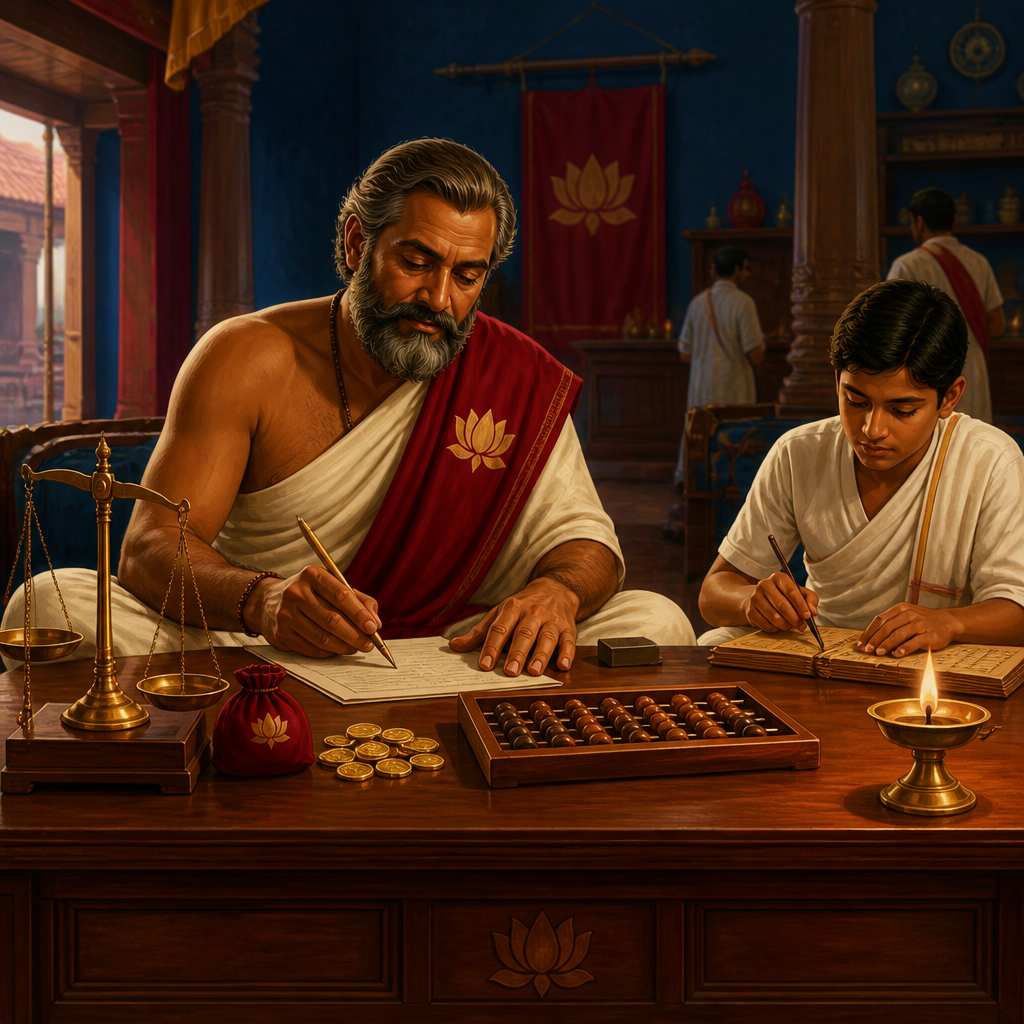
The Shreni (guild) bankers took this further. Operating from trade centers like Mathura, Ujjain, and Varanasi, they developed financial instruments that preceded European banking:
- Hundis: Bills of exchange honored across thousands of kilometers
- Adeshiya: Payment orders directing one person to pay another
- Shaukari: Credit networks linking merchants across regions
A merchant in Taxila could issue a hundi payable in Kanchipuram. The recipient trusted the paper because the issuing shreni had reputation, a guild mark that traveled with its members.
"विश्वासो मुद्रायाः मूलम्।" "Trust is the foundation of currency."
This ancient insight explains both why the dollar dominated, US economic might created trust, and why that dominance now wobbles as trust erodes.
The Dollar's Rise and Current Challenge
How did the dollar become the world's currency?
1944: Bretton Woods established the dollar-gold peg. All major currencies tied to the dollar; the dollar tied to gold. The US, with half the world's GDP after World War II, underwrote the system.
1971: Nixon Shock ended gold convertibility. The dollar became a pure fiat currency, trusted because of American economic and military power, not gold backing.
1974: Petrodollar System cemented dominance. Saudi Arabia agreed to price oil in dollars; in return, America provided security. Every oil-importing nation now needed dollars.
2022: Sanctions Shock revealed the risk. Russia's frozen reserves showed that dollar holdings could be seized. China, holding $3 trillion in dollar assets, took notice. India, dependent on dollar-denominated oil imports, saw vulnerability.
The result: a global search for alternatives. BRICS nations (Brazil, Russia, India, China, South Africa) now discuss common settlement mechanisms. The Shanghai Cooperation Organisation explores rupee-ruble-yuan arrangements. Individual countries negotiate bilateral alternatives.
Global Perspectives on Currency Competition
India navigates a transforming monetary landscape.
John Maynard Keynes (1883-1946), the British economist, proposed at Bretton Woods a neutral international currency called "Bancor", neither dollar nor pound nor any national currency. The US rejected this, preferring dollar dominance. Keynes warned that a single national currency as reserve creates imbalances; 80 years later, his prediction manifests.
Robert Triffin (1911-1993), Belgian-American economist, identified the fundamental contradiction: for the dollar to serve global needs, America must run deficits. But persistent deficits undermine confidence in the dollar. This "Triffin Dilemma" explains today's de-dollarization pressure.
President Vladimir Putin has made de-dollarization central to Russian strategy, especially post-2022 sanctions. Russia now settles most trade in rubles, yuan, or rupees. The Russia-India oil trade, India's largest import, increasingly uses rupees.
| Thinker/Actor | Key Insight | India Application |
|---|---|---|
| Keynes | Neutral reserve currency needed | India supports BRICS payment alternatives |
| Triffin | Dollar dominance self-undermining | Diversification away from single currency |
| Putin | Sanctions weaponize dollar | Rupee settlement reduces vulnerability |
| RBI | Rupee internationalization | Vostro accounts, UPI global expansion |
India's De-Dollarization Strategy
RBI Governor Shaktikanta Das has systematically built rupee trade infrastructure:
Rupee Trade Settlement Mechanism (July 2022): RBI authorized international trade invoicing, payment, and settlement in rupees. Banks in partner countries can open Special Rupee Vostro Accounts (SRVAs) to facilitate rupee trade.
As of 2024, 22 countries have arrangements for rupee trade including:
- Russia (oil and commodities)
- UAE (via CEPA)
- Sri Lanka (debt restructuring)
- Malaysia (trade settlement)
- Bangladesh (border trade)
UPI Internationalization: India's Unified Payments Interface now operates in:
- Singapore (since 2023)
- UAE (since 2023)
- France (pilot)
- Nepal and Bhutan (cross-border)
UPI isn't just payments, it's infrastructure for rupee acceptance abroad. A tourist paying via UPI in Singapore settles in rupees; the complexity is invisible.
Currency Swap Agreements: RBI has swap arrangements with multiple central banks, providing mutual access to currencies without dollar intermediation. The UAE swap (2022) covers $2 billion equivalent.
The Russia Test Case

When Western sanctions isolated Russia from the dollar system in early 2022, India faced a choice: stop buying Russian oil, or find alternative payment mechanisms.
India chose alternatives. Here's how:
Scale: India increased Russian oil imports from 2% to 40% of total between 2022-2024. At peak, Russia became India's largest oil supplier.
Payment Mix: Transactions settled through:
- Rupees (via SRVAs at Indian banks)
- UAE dirhams (as neutral intermediary)
- Rubles (limited, due to Indian export capacity to Russia)
The Rupee Balance Problem: India buys far more from Russia than Russia buys from India. Rupees accumulate in Russian accounts with limited use. This imbalance challenges full rupee settlement.
Solutions Emerging:
- Russia using rupees to buy Indian goods (defense, pharmaceuticals, machinery)
- Russia investing rupee surplus in Indian markets
- Third-country settlements (rupees → dirhams → rubles)
The Russia experiment isn't perfect, but it proves rupee trade is operationally feasible.
UAE: The CEPA Rupee Framework
The India-UAE CEPA (2022) includes a less-noticed provision: framework for rupee-dirham trade settlement.
Unlike Russia (necessity-driven), UAE-India rupee trade is choice-driven:
Trade Volume: Bilateral trade of $85 billion makes UAE India's third-largest partner. Even 10% rupee settlement means $8.5 billion avoiding dollar conversion.
UPI-NEOPAY Link: Indian payment systems now connect to UAE's domestic infrastructure. An Indian in Dubai pays in rupees; the Emirati merchant receives dirhams, no dollars involved.
Investment Integration: UAE investors can now invest in Indian markets in rupees, avoiding forex conversion costs.
Finance Minister Nirmala Sitharaman called the CEPA rupee provisions "a template for de-dollarization in friendly trade relationships."
UPI Goes Global
Perhaps India's most ambitious de-dollarization tool isn't policy, it's technology.
UPI processed 12 billion transactions monthly (as of late 2024), more than all credit cards in India combined. This infrastructure now exports:
Singapore (2023): UPI-PayNow linkage allows real-time transfers between Indian and Singaporean bank accounts. An Indian worker in Singapore sends money home in seconds, in rupees, at near-zero cost.
UAE (2023): Similar UPI linkage with UAE payment systems. The 3.5 million Indians in UAE can now transact in rupees seamlessly.

France (2024 pilot): UPI at Eiffel Tower acceptance points. Indian tourists pay in rupees; merchants receive euros, but the rupee is the origin currency.
BRICS Expansion: Discussions continue on UPI interoperability with Russian MIR, Chinese UnionPay, and Brazilian PIX. If achieved, rupee payments would span half the world's population.
The insight: currency adoption follows payment infrastructure. Where UPI goes, the rupee can follow.
Your Turn: Thinking in Rupees
The ancient shreni bankers understood what modern de-dollarizers rediscover: currency is trust infrastructure. The hundi worked because guilds had reputation; the dollar worked because America had power; the rupee will work if India builds systems that create trust.
What does this mean for you?
For exporters/importers: Rupee invoicing reduces forex risk. When you invoice in rupees, the buyer bears conversion risk, not you. Explore this with trading partners in countries with rupee arrangements.
For investors: Rupee assets become more attractive as rupee trade grows. Companies benefiting from rupee settlement (banks with SRVA operations, payment companies, exporters to rupee-trade countries) may outperform.
For professionals: The shift creates demand for expertise in rupee trade mechanisms, alternative payment systems, and multi-currency treasury management.
The dollar's 80-year reign isn't ending tomorrow. But a multipolar currency world is emerging, and India is positioning the rupee as a major player.
In our next lesson, we examine another dimension of India's global role: Global South Netritva, how India leads the developing world's economic agenda.
Monetary theory and currency trust, the understanding that money is a social construct resting on collective belief in its value and acceptance.
Georg Friedrich Knapp's 'State Theory of Money' (1905) argued that currency value derives from state power, not intrinsic worth. Modern MMT (Modern Monetary Theory) extends this: money is whatever the state says it is. Both align with ancient Indian insight: currency is institutionalized trust.
India's growing economy creates the foundation for rupee trust. $3.5 trillion GDP, stable institutions, 7%+ growth, these generate confidence that rupee holdings will retain value. Each successful rupee trade builds more trust.
The rupee has traded in a relatively narrow band (80-85 to dollar) despite significant rupee trade expansion. This stability reinforces the trust needed for further internationalization.
Monetary sovereignty and policy independence, the ability to set interest rates, control inflation, and manage economy without foreign currency constraints.
The 'Impossible Trinity' in economics states that a country can only have two of: fixed exchange rate, free capital movement, and independent monetary policy. Dollar dependence constrains this choice. Rupee trade expands India's policy space.
Verses
विश्वासो मुद्रायाः मूलम्।
viśvāso mudrāyāḥ mūlam |
Trust is the foundation of currency.
Currency is a form of collective belief. When America sanctioned Russian reserves, it signaled that dollar holdings could be weaponized, undermining the trust that made dollars valuable. India's rupee strategy requires demonstrating reliability that rebuilds trust in an alternative.
Merchant Guild Wisdom, Traditional Shreni teaching (Traditional)
मुद्रा स्वराज्यस्य चिह्नम्।
mudrā svarājyasya cihnam |
Currency is the mark of sovereignty.
Currency sovereignty enables monetary policy independence. When trade depends on dollars, Indian interest rates must consider dollar liquidity. Rupee trade gives RBI more policy space, setting rates for Indian needs, not dollar conditions.
Arthashastra, Book 2, Chapter 12 (on currency) (R.P. Kangle)
Key figures
Shreni Bankers of Ancient India
Guild-based bankers who operated India's indigenous financial system, issuing hundis (bills of exchange), providing credit, and facilitating trade across the subcontinent. · 3rd century BCE - 12th century CE
Shaktikanta Das
Governor of the Reserve Bank of India (2018-present), implementing rupee internationalization through trade settlement mechanisms and UPI global expansion. · Contemporary (b. 1957)
Vladimir Putin / BRICS De-Dollarization
Russian President whose response to Western sanctions accelerated global de-dollarization, providing India both opportunity (cheap Russian oil) and template (alternative payment mechanisms). · Contemporary
Case studies
India's De-Dollarization Triad: Russia, UAE, and UPI
In 2022-2024, India pursued de-dollarization through three complementary channels, each testing different aspects of rupee internationalization: **CHANNEL 1: Russia-India Oil Trade** When Western sanctions isolated Russia from dollar clearing, India faced a choice: stop buying Russian oil, or find alternative payment. India chose alternatives. From 2% of imports (2021) to 40% (2024), Russian oil flooded India, purchased at deep discounts (often $20+/barrel below market). But how to pay? - Initial settlements used UAE dirhams as neutral intermediary - RBI opened Special Rupee Vostro Accounts for Russian banks - By 2024, significant portions settled in rupees directly The challenge: Russia accumulates rupees it can't easily spend (India exports less to Russia than it imports). Solutions emerging include Russian investment in Indian markets and third-country settlements. **CHANNEL 2: UAE-India CEPA Framework** Unlike Russia (necessity-driven), the UAE framework is choice-driven. The 2022 CEPA included rupee-dirham settlement provisions. - Bilateral trade: $85 billion annually - UPI-NEOPAY linkage enables direct payments - Indian exporters can invoice in rupees; UAE buyers pay in dirhams - Settlement happens without dollar conversion This friendly-trade de-dollarization demonstrates that rupee settlement works outside crisis conditions. **CHANNEL 3: UPI Global Expansion** The most ambitious channel: exporting India's payment infrastructure. - Singapore (2023): UPI-PayNow linkage for real-time cross-border payments - UAE (2023): UPI acceptance at merchants; P2P transfers enabled - France (2024): Pilot at tourist locations - BRICS discussions: UPI interoperability with Brazilian PIX, Russian MIR UPI creates infrastructure for rupee acceptance, where UPI goes, the rupee can follow.
India's three-channel approach reflects dharmic pragmatism: **Necessity as Opportunity**: The Russia trade arose from sanctions, not Indian choice. But India converted necessity into learning opportunity, testing rupee settlement at scale. Dharmic wisdom sees opportunity in crisis. **Reciprocity in Partnership**: The UAE arrangement differs from Russia because both parties benefit symmetrically. Indian exporters get rupee invoicing; UAE gets a diversified currency partner. This balanced relationship (dana-pratidana) creates sustainability. **Technology as Liberation**: UPI's global expansion reflects the Arthashastra principle that infrastructure creates freedom. Where UPI operates, Indians transact in rupees regardless of destination. Technology enables sovereignty. The ethical complexity: Russia de-dollarization arguably undermines Western sanctions. India's position, maintaining sanctions compliance while pursuing legitimate trade, threads a narrow path. Dharmic action often requires navigating such tensions.
**Russia Channel Results (2022-2024)**: - $30+ billion in oil imported at discounts - Estimated $5-7 billion savings from below-market pricing - Rupee settlement operational, though imbalance challenges persist - Diplomatic capital preserved with both Russia and West **UAE Channel Results**: - Rupee-dirham settlement growing (precise figures undisclosed) - UPI-NEOPAY transactions increasing monthly - Template established for similar arrangements with GCC states **UPI Global Results**: - Singapore: Cross-border transactions operational - UAE: 3.5 million potential Indian users connected - Remittance costs reduced (traditional channels charge 5-7%; UPI costs <1%) The three channels together demonstrate that de-dollarization isn't theoretical, it's operational. Each channel tests different conditions: crisis (Russia), cooperation (UAE), and infrastructure (UPI).
De-dollarization requires multiple simultaneous approaches. No single channel works for all partners; crisis-driven and choice-driven mechanisms serve different needs. India's three-channel strategy, emergency alternatives (Russia), friendly frameworks (UAE), and infrastructure export (UPI), creates redundancy that accelerates progress. Like the ancient shrenis who operated multiple instruments (hundis, credit, deposits), modern de-dollarization needs diverse tools.
India's de-dollarization experiments through rupee trade settlements, UAE dirham arrangements, and UPI internationalization reflect a broader global trend. Over 60 countries are exploring alternatives to dollar-denominated trade. The shift parallels ancient multi-currency trade systems where merchants routinely transacted in whichever currency best served each specific exchange.
India's rupee trade settlements grew from virtually zero (2021) to an estimated $30-40 billion annually (2024) across all channels. Still small against total trade ($1+ trillion), but growth trajectory is steep.
Historical context
Ancient hundi system (3rd century BCE) to modern de-dollarization (2020s)
India's currency history includes colonial disruption (rupee subordinated to pound), post-independence rebuilding, and now reassertion. The journey from karshapana to modern rupee spans 2,500+ years of monetary evolution.
China has pursued yuan internationalization for decades with limited success (yuan is 3% of global reserves vs dollar's 60%). India's approach differs: building payment infrastructure (UPI) rather than just policy frameworks.
The US dollar represents 60% of global reserves and 88% of forex transactions (2024). But both figures have declined from peaks, dollar dominance is eroding, creating space for alternatives.
Currency in which trade settles determines who bears exchange risk, who earns transaction fees, and ultimately who has leverage. Rupee trade gives India more control over its economic relationships.
Living traditions
- UPI international expansion
- Rupee trade settlement
- Currency swap agreements
- RBI Monetary Museum: Comprehensive display of Indian currency history from punch-marked coins to modern rupee. Includes hundi specimens and shreni banking artifacts.
- Ahmedabad Heritage Walk (Financial District): Walking tour of traditional merchant quarters where shreni banks once operated. Historic buildings, ledger displays, trading artifacts.
- Hathisinh Jain Temple: Temple built by wealthy merchants whose financial expertise parallels modern rupee internationalization. Jain merchant communities developed sophisticated banking practices.
- Somnath Temple: Ancient coastal temple rebuilt after repeated destruction, symbolizing resilience. Temple economy historically integrated with maritime trade, with currency from across Indian Ocean found in offerings.
Reflection
- The ancient shreni bankers created trust networks that made paper promises (hundis) valuable across thousands of kilometers. What creates trust in modern financial systems? How might that trust erode, and what would replace it?
- If you engage in any international transactions (imports, exports, remittances, investments), how might rupee settlement options benefit you? What barriers would you need to overcome to use them?