IMEC: Modern Silk Road Through Middle East

India-Middle East-Europe Corridor: Reviving Ancient Trade Routes

How the India-Middle East-Europe Economic Corridor (IMEC) announced at the 2023 G20 summit revives ancient spice trade routes, connecting Mumbai to Mediterranean markets through rail and port infrastructure.

The Announcement That Shook Beijing
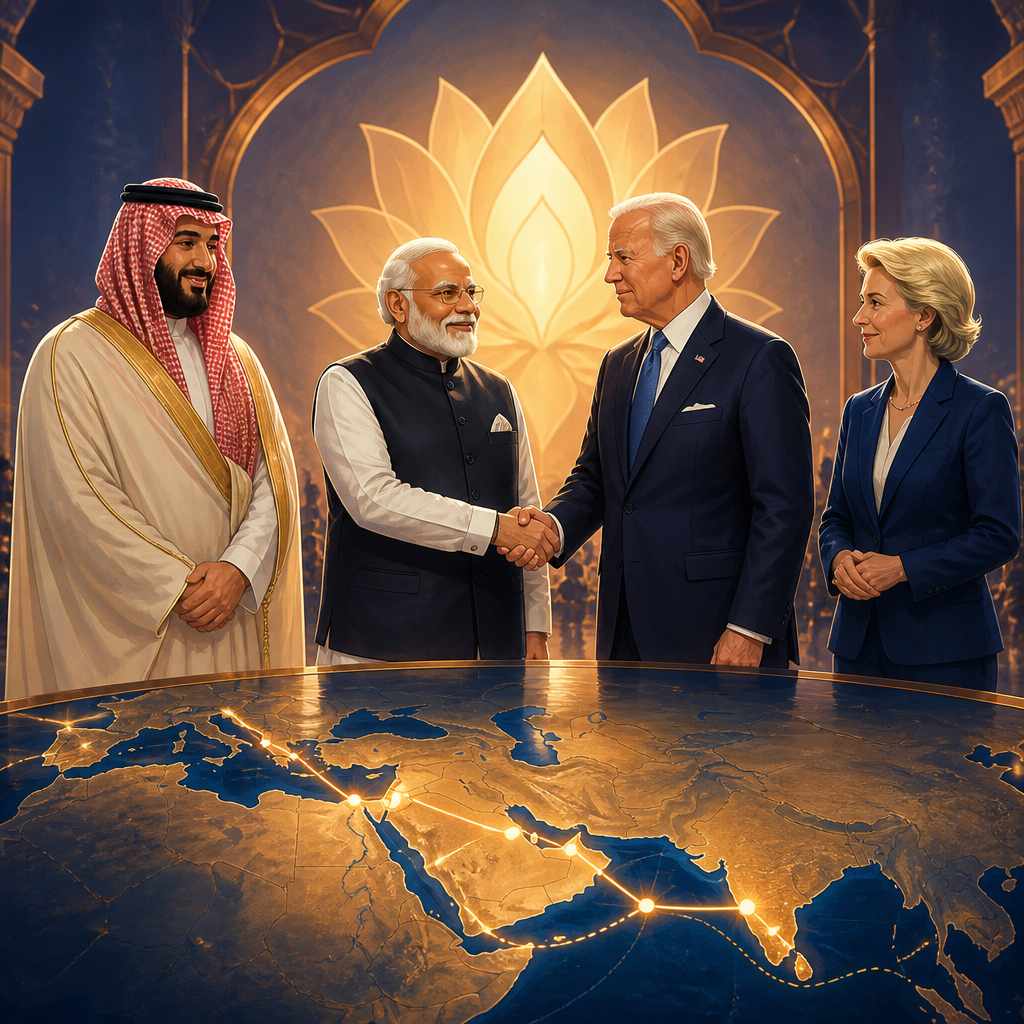
Modi at Bharat Mandapam launching the IMEC corridor

On September 9, 2023, something extraordinary happened in the halls of Bharat Mandapam in New Delhi. As leaders of the world's largest economies gathered for the G20 summit, Prime Minister Narendra Modi stood alongside US President Joe Biden, Saudi Crown Prince Mohammed bin Salman, and UAE President Sheikh Mohamed bin Zayed to announce a project that sent shockwaves through global geopolitics.

The India-Middle East-Europe Economic Corridor (IMEC), a $20 billion infrastructure network connecting India to Europe through the Arabian Peninsula, wasn't just another trade agreement. It was the resurrection of an ancient dream: the spice routes that once made India the economic center of the world.

A thousand years ago, Indian merchants sailed these same waters, their ships laden with pepper, textiles, and steel. Now, rail lines and modern ports would trace their wake.

The Ancient Template: India's Maritime Heritage

To understand IMEC's significance, we must travel back to the era when Indian ships dominated Indian Ocean trade.
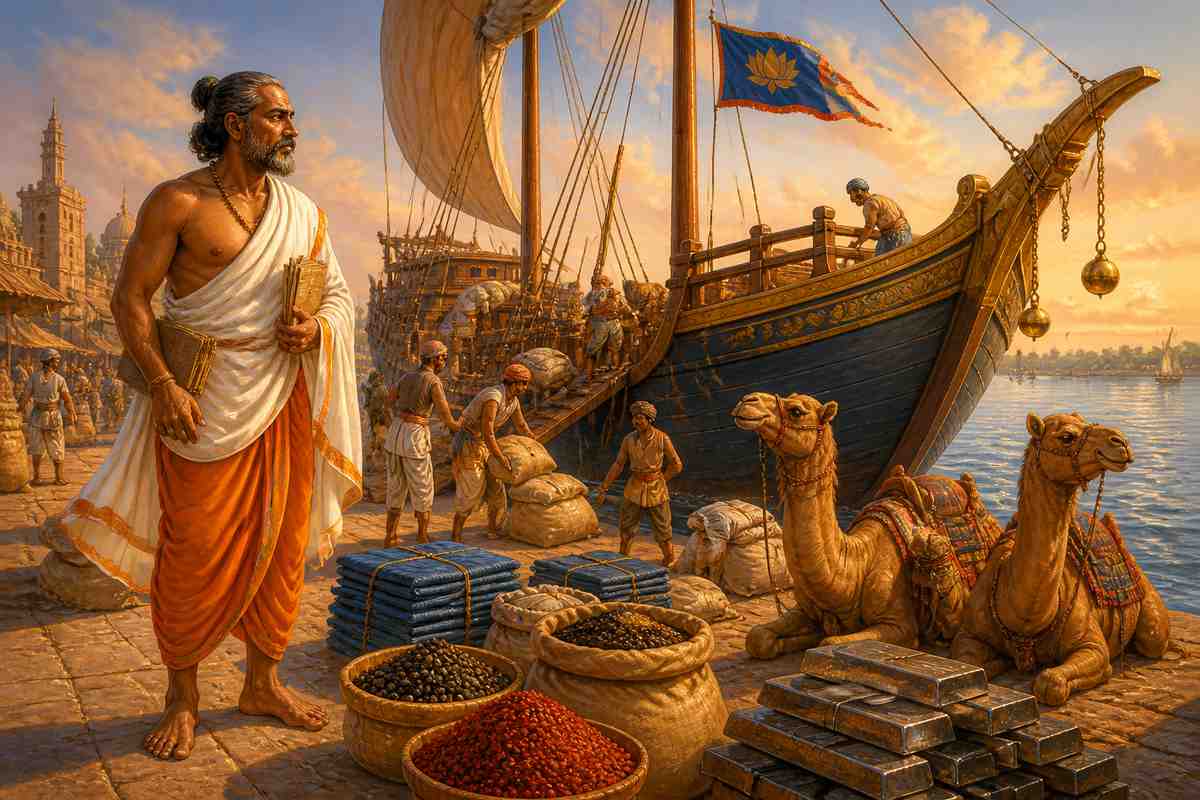
Cambay merchant supervising porters loading a dhow

Cambay (modern Khambhat in Gujarat) was once the world's most important port. In the 13th century, Marco Polo described it as handling more trade than any port in the Mediterranean. Gujarati merchants, Bohras, Memons, and Vanias, had established trading colonies from Aden to Malacca. Their hundis (bills of exchange) were honored from Cairo to Canton.

The Chola Empire under Rajendra Chola I (r. 1014-1044 CE) projected naval power across the Indian Ocean, securing trade routes that connected Tamil ports to Southeast Asia and beyond to Arabia. The Cholas understood what modern strategists call "sea lines of communication", whoever controls the trade routes controls the wealth.

The ancient pattern was clear: goods moved from India westward through the Red Sea and Persian Gulf, then overland to Mediterranean markets. European merchants paid in gold and silver, so much that Roman senators complained about wealth draining eastward.

"समुद्रवाणिज्यं राज्यस्य शक्तिः।" "Maritime trade is the strength of the kingdom."

This principle, articulated in texts like the Arthashastra, drove Indian economic policy for millennia. IMEC represents its modern application.

Global Perspectives on Corridor Economics

IMEC enters a crowded field of global infrastructure competition. How does it compare?

China's Belt and Road Initiative (BRI), launched in 2013, has invested over $1 trillion across 140+ countries. President Xi Jinping envisions a China-centered trade network controlling Eurasian commerce. But BRI has faced mounting criticism: debt traps in Sri Lanka and Pakistan, environmental concerns, and projects that benefit Chinese companies more than host countries.

Alfred Thayer Mahan (1840-1914), the American naval strategist, argued that control of sea routes determines global power. His doctrine shaped US naval policy for a century. IMEC channels Mahan's insight: the corridor combines sea and land routes, creating multiple pathways resistant to single-point disruption.

Halford Mackinder (1861-1947), the British geographer, proposed the "Heartland Theory", whoever controls Central Asia controls the world. BRI targets this heartland. IMEC offers an alternative: bypassing China's influence zones entirely through Middle Eastern partnerships.

Thinker Key Insight IMEC Application
Mahan Sea power determines wealth Multi-modal (sea + rail) diversification
Mackinder Land routes = control Bypasses China's heartland via Gulf states
Kautilya Maritime trade = state strength Revives India's ancient ocean advantage

The Architecture of IMEC

IMEC isn't a single project but an integrated network:

Eastern Corridor: India to UAE/Saudi Arabia

Freight train crossing the Saudi desert toward Haifa

Northern Corridor: Gulf to Europe

The genius lies in multimodality: ships where seas exist, rail where they don't. Total transit time from Mumbai to Milan could drop from 30+ days to under 15.

What makes IMEC different from BRI?

First, financing: IMEC uses transparent G7 financing rather than opaque Chinese loans. No debt traps.

Second, governance: Partner countries maintain sovereignty. Projects require local approval and benefit-sharing.

Third, diplomatic foundation: IMEC builds on the Abraham Accords (2020) that normalized Israel-Arab relations. This diplomatic breakthrough, unthinkable a decade ago, enables rail connections through territory once divided by conflict.

India-UAE: The CEPA Effect

The Comprehensive Economic Partnership Agreement (CEPA) between India and UAE, signed in February 2022, demonstrates what IMEC could achieve at scale.

Before CEPA: India-UAE bilateral trade was $60 billion (2021). After CEPA: Trade surged to $85 billion (2023), a 40% jump in two years.

Key CEPA provisions:

IMEC extends this template: bilateral agreements creating corridors of preferential trade, connected by world-class infrastructure.

Finance Minister Nirmala Sitharaman noted: "IMEC is not just about moving goods. It's about moving India from being a price-taker to a price-maker in global trade."

Your Turn: Thinking Like a Sarthavaha

The ancient sarthavaha (caravan leader) made fortunes by understanding trade routes better than competitors. He knew which paths were safe, which markets offered best prices, which currencies held value.

IMEC creates opportunities for modern sarthavahas, entrepreneurs who understand the new geography of trade:

For exporters: Which products will benefit most from faster Europe access? Pharmaceuticals requiring cold chains? Fresh agricultural produce? Time-sensitive fashion?

For investors: Port cities along IMEC (Mundra, Dubai, Haifa) will see real estate and infrastructure booms. Where should capital flow?

For professionals: The corridor needs project managers, logistics experts, trade lawyers. Skills that will be premium for decades.

The spice routes made Cambay merchants wealthy beyond imagination. IMEC could do the same for those who understand it early.

In our next lesson, we examine Sagarmala, India's port-led development strategy that provides IMEC's domestic foundation.

Location economics and transport cost theory, proximity to markets and trade routes determines competitive advantage.

Paul Krugman's Nobel Prize-winning work on economic geography shows that transport costs shape industrial location. Singapore, Dubai, and Rotterdam prospered by monetizing geographic position.

India's position is superior to Singapore's (larger hinterland), Dubai's (larger economy), or Rotterdam's (closer to Asian growth). IMEC finally provides the infrastructure to monetize this permanent advantage.

IMEC could reduce India-Europe shipping time from 30+ days to under 15, a 50%+ improvement. For time-sensitive goods (pharmaceuticals, perishables, fashion), this creates transformative competitive advantage.

Network effects and coalition economics, partnerships create value greater than the sum of parts.

Game theory shows that cooperative equilibria often dominate competitive ones. The EU itself is a sandhi that made European economies collectively more powerful than any could be alone.

Verses

समुद्रवाणिज्यं राज्यस्य शक्तिः।

samudra-vāṇijyaṃ rājyasya śaktiḥ |

Maritime trade is the strength of the kingdom.

Ocean-going trade generates higher margins than land trade due to volume capacity. Ancient India's maritime dominance created the wealth that built its civilization. IMEC seeks to restore this advantage.

Arthashastra, Book 7, Chapter 12 (R.P. Kangle)

देशकालौ विनिश्चित्य द्रव्यं कार्यं च तत्त्वतः।

deśa-kālau viniścitya dravyaṃ kāryaṃ ca tattvataḥ |

Having determined the place and time, one should conduct business and manage wealth according to their true nature.

Location advantage ('desha') combined with timing ('kala') creates extraordinary returns. India's geography as a natural bridge between East and West is a permanent advantage; IMEC monetizes it.

Manusmriti, Chapter 7, Verse 99 (Patrick Olivelle)

Key figures

Rajendra Chola I

Chola emperor who expanded Tamil maritime power across the Indian Ocean, securing trade routes from India to Southeast Asia and the Middle East. · 1014-1044 CE

Narendra Modi

Prime Minister of India who orchestrated IMEC's announcement at the 2023 G20 summit in New Delhi, positioning India as a central node in global trade infrastructure. · Contemporary (b. 1950)

Mohammed bin Salman (MBS)

Crown Prince and de facto ruler of Saudi Arabia, driving Vision 2030 economic diversification including IMEC partnership and the NEOM megaproject. · Contemporary (b. 1985)

Case studies

Abraham Accords to IMEC: How Diplomacy Built a Corridor

In September 2020, something unprecedented occurred: the UAE and Bahrain signed the Abraham Accords, normalizing relations with Israel. Saudi Arabia, while not formally joining, quietly enabled the agreements and began its own backchannel communications with Israel. This diplomatic breakthrough solved IMEC's fundamental problem: any land corridor from the Gulf to Europe must pass through either Israel or hostile territory (Syria, Iraq). For decades, Arab-Israeli conflict made such routes impossible. The Abraham Accords didn't just change politics, they changed economics. By December 2020, direct flights connected Dubai to Tel Aviv. By 2023, trade between UAE and Israel exceeded $2 billion. Israeli tech companies opened Dubai offices; Emirati investments flowed into Israeli ports. When IMEC was announced at the G20, it built on three years of quiet relationship-building. The rail corridor through Saudi Arabia and Jordan to Israel's Haifa port wasn't a new idea, it was an idea whose time had finally come because diplomacy created the preconditions.

The Arthashastra identifies six instruments of foreign policy: sandhi (alliance), vigraha (war), asana (neutrality), yana (mobilization), samshraya (seeking protection), and dvaidhibhava (dual policy). The Abraham Accords represent sophisticated sandhi, alliance-building that creates economic opportunity from political reconciliation. From a dharmic perspective, the Accords demonstrate that conflicts, however ancient, can be transcended when mutual benefit becomes visible. The UAE's calculation wasn't altruistic, normalization with Israel offered technology partnerships, security cooperation, and now IMEC connectivity. But mutual benefit, pursued ethically, creates sustainable relationships. India's role is instructive: maintaining relationships with Israel AND Arab states simultaneously (dvaidhibhava) positioned India to benefit when these parties reconciled. Kautilya would recognize the strategy.

The Abraham Accords unlocked economic value that exceeded expectations: - **UAE-Israel trade**: $0 in 2019 → $2.5+ billion by 2024 - **Tourism**: 300,000+ Israelis visited UAE in the first year alone - **Investment**: Over $1 billion in cross-border investments announced - **Technology**: Joint ventures in agritech, fintech, and cybersecurity More importantly, the Accords created the trust infrastructure for IMEC. Saudi Arabia's implicit endorsement, allowing flights over its territory, pursuing its own quiet normalization, signaled that the rail corridor could proceed. IMEC transforms these bilateral gains into a corridor: not just UAE-Israel trade, but India-Europe trade flowing through both. The diplomatic investment compounds economically.

Infrastructure requires diplomatic foundation. The physical corridor, rail lines, ports, roads, is the visible layer. The invisible foundation is the network of relationships that make construction possible and operation secure. India's multi-alignment strategy, maintaining relationships across geopolitical divides, positions it to benefit when those divides narrow.

The Abraham Accords-to-IMEC pipeline demonstrates how diplomatic breakthroughs create commercial opportunities. Businesses that track geopolitical normalization processes can position themselves years ahead of competitors who wait for trade agreements to formalize.

India-Israel trade grew from $200 million (1992, post-normalization) to $7.5 billion (2023), a 37x increase showing what diplomatic normalization enables. Abraham Accords could catalyze similar growth for Arab-Israeli commerce.

CEPA: The India-UAE Template for IMEC

On February 18, 2022, India and UAE signed the Comprehensive Economic Partnership Agreement (CEPA), India's first major FTA in a decade. Negotiated in just 88 days (a record for such agreements), CEPA demonstrated what focused diplomacy could achieve. The agreement's scope was ambitious: - Zero duties on 80% of Indian exports (covering 90% of trade value) - Immediate tariff elimination on jewelry, textiles, and agricultural products - Services liberalization in finance, telecom, and professional services - Mutual recognition of qualifications enabling easier professional mobility - Framework for rupee-dirham trade settlement Behind the formal provisions lay a deeper shift: UAE was betting on India as its primary economic partner for the coming decades, diversifying from both oil dependence and over-reliance on Western markets.

CEPA embodies the dharmic principle of reciprocity (pratidana): each party offers what the other needs. India offers a massive consumer market, skilled labor, and manufacturing capacity. UAE offers capital, logistics hub services, and gateway access to Gulf and African markets. The 88-day negotiation timeline reflects another dharmic principle: when interests align, bureaucratic friction should be minimized. Both governments recognized the moment (kala) and acted decisively. Contrast this with India-EU FTA negotiations, stalled for over a decade despite larger potential gains, testament to how misaligned interests create friction. Dharmic economics emphasizes that trade should benefit both parties. CEPA was designed for balanced gains: Indian exporters got market access; UAE got supply chain security and a hedge against China-dependent imports.

CEPA's first two years exceeded all projections: - **Bilateral trade**: $60 billion (2021) → $85 billion (2023), 40% growth - **Indian exports to UAE**: Up 16% in first year alone - **Services trade**: Growing faster than goods, especially in IT and professional services - **Investment**: UAE committed $75 billion to India infrastructure investments Perhaps more significantly, CEPA proved the template works. The rapid negotiation, balanced terms, and quick implementation showed that India could deliver on ambitious trade agreements when political will existed. India is now pursuing similar agreements with Gulf Cooperation Council (GCC), UK, and EU. Each builds on CEPA's template, and each strengthens IMEC's economic foundation.

Trade agreements are force multipliers for infrastructure. IMEC's ports and rail lines create physical connectivity; CEPA-style agreements create economic connectivity. The corridor's value depends on trade volume; trade volume depends on agreements that reduce friction. Physical and policy infrastructure must develop together.

The India-UAE CEPA's 88-day negotiation speed has become a benchmark for trade agreement efficiency. Traditional FTAs take 5-10 years. The CEPA model shows that when political will exists and economic complementarity is clear, agreements can move from concept to implementation in months.

India's exports to UAE increased 16% in CEPA's first year, compared to 6% growth to countries without FTAs. Each percentage point of export growth to a $85B trade partner represents $850 million in additional commerce.

Historical context

Ancient maritime trade to 2023 IMEC announcement

India was history's dominant exporter for millennia. The spice trade, textile exports, and steel production made it the world's largest economy until the 18th century. Colonial extraction disrupted these flows. IMEC represents attempted restoration of India's natural position in global trade.

China's BRI invests $1 trillion+ but faces mounting criticism for debt traps and governance issues. US infrastructure is domestically focused. EU has internal connectivity but limited Asian reach. IMEC fills a gap: transparent financing, democratic governance, and India-Europe connection.

Before colonial disruption, India and China together represented 50%+ of global GDP. IMEC, if successful, could help India reclaim a position commensurate with its population and geographic advantages.

Trade routes determine prosperity. For two centuries, routes bypassed India (Suez favored colonial powers; BRI favors China). IMEC creates routes with India at the center, potentially transformative for the next century.

Living traditions

Reflection

More in India's Trade Revival: IMEC, Sagarmala & Beyond

All lessons in India's Trade Revival: IMEC, Sagarmala & Beyond · Trade Routes of Ancient Bharat course