Global South Netritva: India's Leadership Role
From Ashoka's Dhamma to Voice of the Global South
How India leverages its G20 presidency and Voice of Global South summits to champion developing nations' interests, continuing a diplomatic tradition that stretches back to Ashoka's emissaries and the Mauryan vision of ethical interstate relations.
The January Summits
On January 12-13, 2023, something unprecedented happened in global diplomacy. Prime Minister Narendra Modi convened 125 countries for the "Voice of Global South Summit", the largest gathering of developing nations in history.
No G7 members attended. No European Union representatives. No Japan or South Korea. Instead: Africa, Asia, Latin America, the Caribbean, and Pacific islands. The message was clear: the developing world has a voice, and India will amplify it.
Five months later, India assumed the G20 presidency, bringing the concerns articulated in January directly to the world's most powerful economies. The African Union received permanent G20 membership. Debt relief for vulnerable nations entered mainstream discussion. Climate finance commitments faced serious scrutiny.
"Vasudhaiva Kutumbakam", the world is one family, became the G20's official theme. This ancient Sanskrit phrase, inscribed in India's Parliament building, now headlined the world's premier economic forum.
India was claiming leadership of the Global South, and doing so in distinctly Indian terms.
The Ancient Template: Ashoka's Ethical Diplomacy
Twenty-three centuries ago, Emperor Ashoka (r. 268-232 BCE) pioneered a form of diplomacy the world had never seen.
After the bloody Kalinga war, in which 100,000 died and 150,000 were deported, Ashoka experienced profound remorse. He renounced conquest and adopted dhamma (righteous conduct) as state policy.
Ashoka's diplomacy was revolutionary:
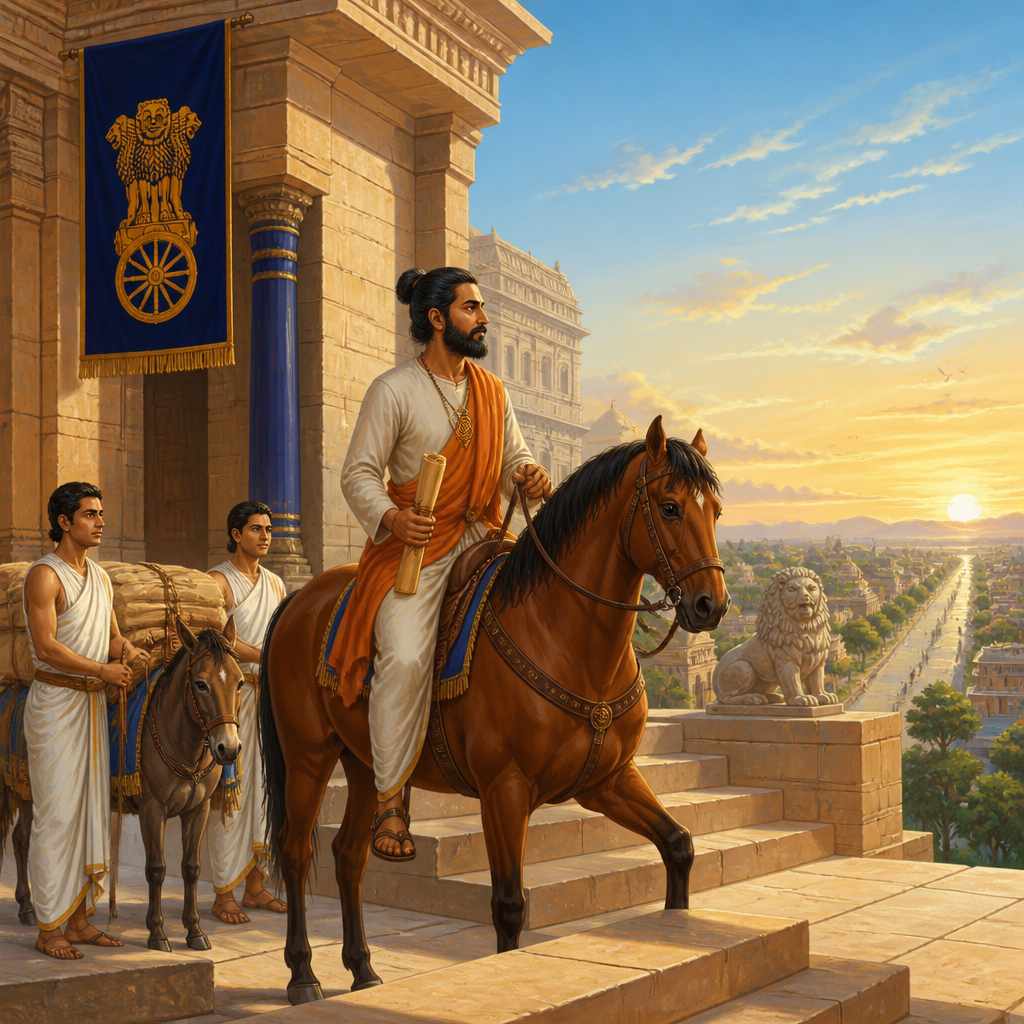
Emissary Networks: He dispatched ambassadors to Syria, Egypt, Macedonia, Cyrene, and Epirus, the first documented systematic diplomacy connecting India to the Mediterranean world.
Moral Suasion, Not Force: Unlike contemporaries who projected power through armies, Ashoka projected influence through ethical example and humanitarian missions.
Universal Concern: His edicts, inscribed on rocks and pillars across the subcontinent, proclaimed concern for all beings, not just his subjects. One edict established free hospitals and veterinary clinics for neighboring kingdoms.
"सर्वेषां हिताय सर्वेषां सुखाय।" "For the welfare of all, for the happiness of all."
This vision, leadership through ethical example rather than coercion, underlies India's Global South strategy.
What Is the Global South?
The term "Global South" replaces older framings: "Third World," "developing countries," "non-aligned nations." It refers broadly to countries in Africa, Latin America, Asia, and Oceania that share:
- Colonial history: Most were colonized by European powers
- Development challenges: Lower per-capita income, infrastructure gaps
- Limited voice: Underrepresented in global institutions (UN Security Council, IMF voting, WTO agenda-setting)
- Climate vulnerability: Suffer most from climate change while contributing least
The Global South includes 6.5 billion people, 85% of humanity. Yet G7 countries (population 770 million) dominate global economic governance.
India's position is unique: large enough to sit at G20 tables, yet developing enough to understand Global South concerns. This dual position enables bridge diplomacy.
India's Global South Strategy
External Affairs Minister S. Jaishankar has articulated India's approach:
"India is not a bridge. India is a voice, our own voice, but one that resonates with others because our experiences are shared."
The strategy has several elements:
Platform Provision: India creates forums where Global South nations can speak. The Voice of Global South Summit (2023) and subsequent gatherings provide platforms previously unavailable.
Agenda Setting: India brings Global South priorities into G20, BRICS, and multilateral discussions. Debt relief, climate finance, food security, issues the North prefers to minimize, become unavoidable.
Development Partnership: India's development assistance focuses on capacity building, not dependency. Solar panels in Africa, IT training in Asia, infrastructure in small island states, India exports capabilities, not just aid.
Institutional Reform: India advocates for UN Security Council expansion, IMF quota revision, and WTO reform, structural changes that would give the South greater voice.
G20 Delhi: The African Union Moment
India's G20 presidency (December 2022 - November 2023) demonstrated Global South leadership in action.
The signature achievement: permanent G20 membership for the African Union.
Before Delhi: G20 included the European Union but not the African Union. 55 African countries, 1.4 billion people, the world's youngest population, vast resources, had no seat at the table.
India made AU membership a priority. Finance Minister Nirmala Sitharaman argued that Africa's exclusion was "untenable." PM Modi personally lobbied G7 leaders.

The Delhi Declaration announced AU membership, a permanent change to global governance architecture.
Why does this matter?
The G20 makes decisions affecting global finance, trade, and climate policy. Without a seat, Africa was subject to rules made by others. With a seat, African nations participate in shaping those rules.
This exemplifies India's Global South strategy: not just speaking for others, but creating space for others to speak.
Development Cooperation: The India Model
India's development partnership differs from both Western aid and Chinese lending:
Western Model (OECD DAC): Grants with conditions, governance requirements, procurement rules, policy prescriptions. Recipients often feel condescension.
Chinese Model (BRI): Large loans for infrastructure, often with Chinese construction and labor. Creates debt and dependency.
Indian Model: Grants and concessional loans focused on capacity building. Indian projects train local workers, use local materials where possible, and transfer technology. Recipients build capability, not just infrastructure.
Examples:

Africa: India has trained 40,000+ African professionals through ITEC (Indian Technical and Economic Cooperation). Solar initiatives power villages in 15 countries. India-Africa health initiatives combat malaria and HIV.
SAARC: Neighbors receive preferential trade terms, currency swap access, and development credits. Bangladesh, Nepal, Bhutan, and Sri Lanka all benefit from Indian Lines of Credit.
Small Island States: India announced the SAGAR initiative (Security and Growth for All in the Region) providing coastal surveillance, disaster response capability, and maritime infrastructure to Indian Ocean nations.
Total Indian development cooperation: approximately $30 billion since 2004, modest compared to China's $1+ trillion, but structured for recipient ownership rather than donor control.
BRICS Expansion and the New Alignments
India operates within BRICS (Brazil, Russia, India, China, South Africa), a grouping representing 40% of world population and 25% of global GDP.
At the August 2023 summit, BRICS expanded: Egypt, Ethiopia, Iran, Saudi Arabia, and UAE joined (Argentina was invited but declined). The enlarged BRICS+ represents an even larger share of global economic activity.
India's BRICS position is nuanced:
Convergence with China: Both want Global South voice amplified, Western dominance reduced, and multilateral institutions reformed. On these, India and China align.
Competition with China: Both seek Global South leadership. India offers partnership; China offers investment. Countries choose based on their needs and China's strings.
Distinct from Russia: Unlike Russia, India maintains strong Western relationships. India participates in BRICS+ without abandoning G7 engagement.
This multi-alignment, participating in BRICS while engaging the West, championing Global South while sitting at G20, defines India's unique diplomatic position.
India-Africa: The Strategic Partnership
Africa represents the Global South's future:
- Demographics: 1.4 billion people; median age 19; working-age population will exceed China and India combined by 2050
- Resources: 30% of world's mineral reserves; vast agricultural potential; untapped energy resources
- Markets: Rising middle class; rapid urbanization; mobile-first digital adoption
India's Africa strategy emphasizes:
Trade: India-Africa bilateral trade reached $98 billion (2022-23). India is Africa's fourth-largest trading partner.
Investment: Indian companies have invested $75+ billion in Africa across energy, telecoms, banking, and manufacturing.
Education: Over 15,000 African students study in India annually. ITEC scholarships train African civil servants, military officers, and professionals.
Health: Indian pharmaceuticals (60%+ of Africa's generic drugs) and healthcare investments address the continent's medical needs.
The contrast with China is stark: China's Africa investment ($170+ billion) exceeds India's, but creates dependency through debt. India's approach builds African capacity, schools, hospitals, training programs, that remain after Indian involvement ends.
Your Turn: Thinking Globally
Ashoka sent emissaries across the known world not to conquer but to share. India's Global South leadership continues this tradition, creating platforms for shared voice rather than projecting power.
What does this mean for you?
For students: The Global South will shape 21st-century economics. Understanding African, Latin American, and Asian markets, their needs, cultures, and growth trajectories, creates professional advantage.
For professionals: Global South markets offer growth that mature markets cannot. The skills to navigate diverse regulatory environments, cultural contexts, and partnership models become premium.
For entrepreneurs: The next billion consumers come from the Global South. Products and services designed for these markets, affordable, mobile-first, culturally appropriate, have massive potential.
For citizens: India's global role affects every Indian. Trade agreements shape prices; diplomatic relationships affect opportunities; climate commitments determine environment. Informed citizenship requires global awareness.
The world is one family, but families need someone to convene discussions, mediate disputes, and advocate for the vulnerable. India is claiming that role.
In our next lesson, we examine the destination: Das-Lakh-Koti, India's path to becoming a $10 trillion economy.
Servant leadership and long-term relationship building, the strategy of creating value for others as foundation for sustainable influence.
Robert Greenleaf's 'servant leadership' theory (1970s) argues that leaders who serve followers' needs build deeper loyalty than those who command. Ashoka anticipated this by two millennia.
India's development partnership, training 40,000+ Africans, providing affordable medicines, building capacity, creates goodwill that outlasts any single government. Countries remember who helped them build; they resent who made them dependent.
India's favorability ratings in Africa exceed China's despite China's 5x larger investment. Quality of relationship matters more than quantity of dollars.
Capacity building vs dependency creation, development approaches that strengthen recipients' independent capability versus those that create permanent need for donor involvement.
The 'teach a man to fish' principle, giving capabilities rather than outputs. China's BRI has faced criticism for creating debt dependencies; India's ITEC training creates self-sustaining skills.
Verses
वसुधैव कुटुम्बकम्।
vasudhaiva kuṭumbakam |
The world is one family.
Global economic governance that ignores 85% of humanity (the Global South) is neither legitimate nor sustainable. 'Vasudhaiva Kutumbakam' provides philosophical foundation for inclusive institutions, not as charity to the South, but as recognition of shared family membership.
Maha Upanishad, Chapter 6, Verse 72 (Traditional)
सर्वेषां हिताय सर्वेषां सुखाय।
sarveṣāṃ hitāya sarveṣāṃ sukhāya |
For the welfare of all, for the happiness of all.
Leadership creates spillover benefits. India's advocacy for debt relief helps Sri Lanka and Zambia; advocacy for climate finance helps Pacific islands; advocacy for AU membership helps Africa. Creating collective benefit builds the moral authority that sustains leadership.
Ashokan Edicts, Major Rock Edict XIII (From inscriptions)
Key figures
Emperor Ashoka
Mauryan emperor who, after the Kalinga war, renounced conquest and pioneered ethical diplomacy, sending emissaries across the known world to spread dhamma rather than power. · 268-232 BCE
S. Jaishankar
External Affairs Minister of India articulating the philosophy of multi-alignment and Global South leadership through books, speeches, and diplomatic practice. · Contemporary (b. 1955)
African Union
The continental organization representing 55 African nations, admitted to permanent G20 membership during India's presidency, exemplifying India's Global South platform-creation strategy. · Founded 2002; G20 member 2023
Case studies
Voice of Global South and India-Africa Partnership: Platform Diplomacy in Action
**PART 1: The Voice of Global South Summit (January 2023)** In the months leading to India's G20 presidency, a strategic question emerged: how should India use this once-in-a-generation platform? G20 agendas traditionally reflect G7 priorities, climate commitments that burden developing nations, trade rules favoring industrialized economies, financial regulations designed for sophisticated markets. India chose a bold approach: convene the Global South before G20 meetings to identify shared priorities, then carry these into G20 discussions. On January 12-13, 2023, 125 countries participated in the virtual Voice of Global South Summit. Ten sessions covered: financing for development, climate action, food and energy security, health and resilience, technology and digital transformation. The outcome: a clear articulation of Global South priorities. Debt relief topped the list, over 60% of low-income countries faced debt distress. Climate finance came second, rich nations had promised $100 billion annually but delivered less. Technology access third, digital divides were widening during COVID recovery. **PART 2: The India-Africa Partnership** Parallel to multilateral summits, India deepened bilateral engagement with Africa, the Global South's demographic future. India's approach contrasted sharply with competitors: **China in Africa**: $170+ billion invested, primarily in infrastructure. But: Chinese loans created debt crises in Zambia, Kenya, and others; Chinese projects used Chinese labor rather than training Africans; 99-year port leases raised sovereignty concerns. **India in Africa**: $75+ billion invested, but structured differently: - 40,000+ African professionals trained through ITEC - Indian pharmaceutical companies provide 60%+ of Africa's generic medicines - Solar initiatives power villages in 15 countries - Lines of Credit emphasize local procurement and training The 2023 India-Africa Forum Summit commitment: $10 billion in Lines of Credit over five years, plus expanded training programs, health initiatives, and technology partnerships. A key metric: India's favorability ratings in Africa consistently exceed China's, despite smaller investment. Quality of partnership matters more than quantity of dollars.
India's dual strategy, multilateral Voice of Global South and bilateral Africa partnership, reflects dharmic principles: **Sarva-Bhuta-Hita (Welfare of All Beings)**: The Voice of Global South summit included the smallest Pacific islands alongside major developing economies. Every nation had voice, regardless of size or economic weight. This reflects the Ashokan principle that welfare concerns extend to all. **Dana Without Strings**: India's development partnership emphasizes unconditional assistance. Unlike Western aid (conditioned on governance reforms) or Chinese aid (conditioned on procurement from China), Indian assistance focuses on recipient priorities. This dana (giving) without pariṇāma (expected return) builds authentic relationships. **Dhamma-Vijaya (Righteous Influence)**: India gains influence not through debt leverage or military presence but through capacity building. Africans trained in India return with skills and goodwill. This 'conquest through righteousness' creates sustainable influence. The ethical tension: India competes with China for African markets while claiming moral high ground. Is this genuine dharmic leadership or strategic positioning dressed in ethical language? Perhaps both, dharmic action often serves both principles and interests.
**Voice of Global South Impact**: - G20 Delhi Declaration explicitly referenced Global South priorities - African Union admitted to permanent G20 membership - Debt restructuring gained G20 attention (though implementation remains incomplete) - India established itself as convener of developing-world voice - Second Voice of Global South Summit (November 2023) institutionalized the platform **India-Africa Partnership Impact**: - Bilateral trade reached $98 billion (2022-23) - Indian pharmaceutical exports keep African healthcare accessible - 15,000+ African students in Indian universities annually - Indian companies employed significant African workforce - Soft power advantage over China despite smaller investment **Strategic Positioning**: - India now recognized as Global South leader alongside China - Western nations engage India as interlocutor with developing world - BRICS expansion (6 new members) reflects India's coalition-building capability - G20 success positioned India for potential UN Security Council seat advocacy
Platform creation beats platform domination. India could have used G20 presidency for narrow national interest, securing trade deals, showcasing achievements. Instead, India created platforms for collective voice (Voice of Global South summit) and opened existing platforms to others (AU G20 membership). This approach builds the moral authority that sustains leadership. The leader who creates space for others attracts followers; the leader who dominates space repels them.
India's 'Voice of Global South' platform and AU inclusion in G20 established a diplomatic model now being replicated. Brazil's 2024 G20 presidency adopted similar inclusive approaches. The pattern shows that emerging powers gain more influence by creating platforms for collective voice than by demanding individual concessions.
125 countries participated in Voice of Global South summits, more than any previous developing-world gathering. India's G20 presidency achieved 83 outcome documents, the most productive presidency in G20 history by that measure.
Historical context
Ashokan diplomacy (3rd century BCE) to India's G20 presidency (2023)
India's Global South leadership continues the NAM legacy while adapting to 21st-century realities. Nehru's non-alignment becomes Modi's multi-alignment, engaging all powers while championing developing-world interests.
China also claims Global South leadership but through investment rather than voice amplification. The BRI model creates dependencies; India's model builds capacities. Both compete for influence; countries choose based on their assessment of which model serves them better.
The Global South includes 6.5 billion people (85% of humanity) but holds minority voting share in IMF and World Bank. India advocates reform of these institutions to reflect demographic and economic reality.
Leadership of 85% of humanity positions India as essential interlocutor in any global negotiation. Climate agreements, trade rules, technology standards, none can be legitimate without Global South buy-in, and India increasingly provides that bridge.
Living traditions
- ITEC training programs
- Yoga and Ayurveda diplomacy
- Generic pharmaceutical provision
- Ashokan Pillar at Sarnath: The original lion capital, now India's national emblem. Museum displays Ashokan edicts in multiple languages, testament to his international outreach.
- Bharat Mandapam (G20 Venue): The convention center that hosted the 2023 G20 summit where AU membership was announced. Now hosts major national and international events.
- Angkor Wat: World's largest Hindu temple complex demonstrates Indian soft power achieved through trade, not conquest. Ancient model for Global South leadership through cultural rather than military influence.
- Borobudur Temple: Massive Buddhist monument built during era of India-Indonesia trade. Evidence of Indian spiritual and commercial influence across Southeast Asia through peaceful exchange.
Reflection
- Ashoka chose ethical influence over military conquest after witnessing the horror of war. What experiences or realizations might prompt a modern leader, political, corporate, or community, to shift from domination to service as their leadership model?
- India creates platforms for others' voices (Voice of Global South) rather than speaking for them. In your own context, workplace, community, or family, how might you create platforms for underheard voices rather than speaking on their behalf?