Das-Lakh-Koti: The Path to $10 Trillion Economy
From Historical Prosperity to Viksit Bharat 2047
How India aims to become the world's third-largest economy en route to $10 trillion, reclaiming a position of global economic prominence it held for most of recorded history, powered by manufacturing revival, trade expansion, and the Viksit Bharat vision.
The Number That Defines a Generation
Das-Lakh-Koti: Ten lakh crore. In Western notation: ten trillion dollars. This is India's target, a GDP that would make it the world's third-largest economy, trailing only the United States and China.
To understand the magnitude: India's current GDP is approximately $3.5 trillion (2024). Reaching $10 trillion requires nearly tripling the economy. At 7% annual growth, this takes approximately 15 years. At 8%, about 12 years.
Prime Minister Narendra Modi has articulated the destination: Viksit Bharat (Developed India) by 2047, the centenary of independence. The $10 trillion target is a waypoint on this journey.
But here's the remarkable fact: for most of human history, India was already at or near this relative position. Economic historian Angus Maddison estimates that India represented 25% of global GDP in 1700, when the Mughal Empire was at its zenith. Even in 1947, after two centuries of colonial extraction, India retained 4% of global output.
Das-Lakh-Koti isn't about becoming something new. It's about restoration.
The Ancient Template: Kautilya's Economic Vision
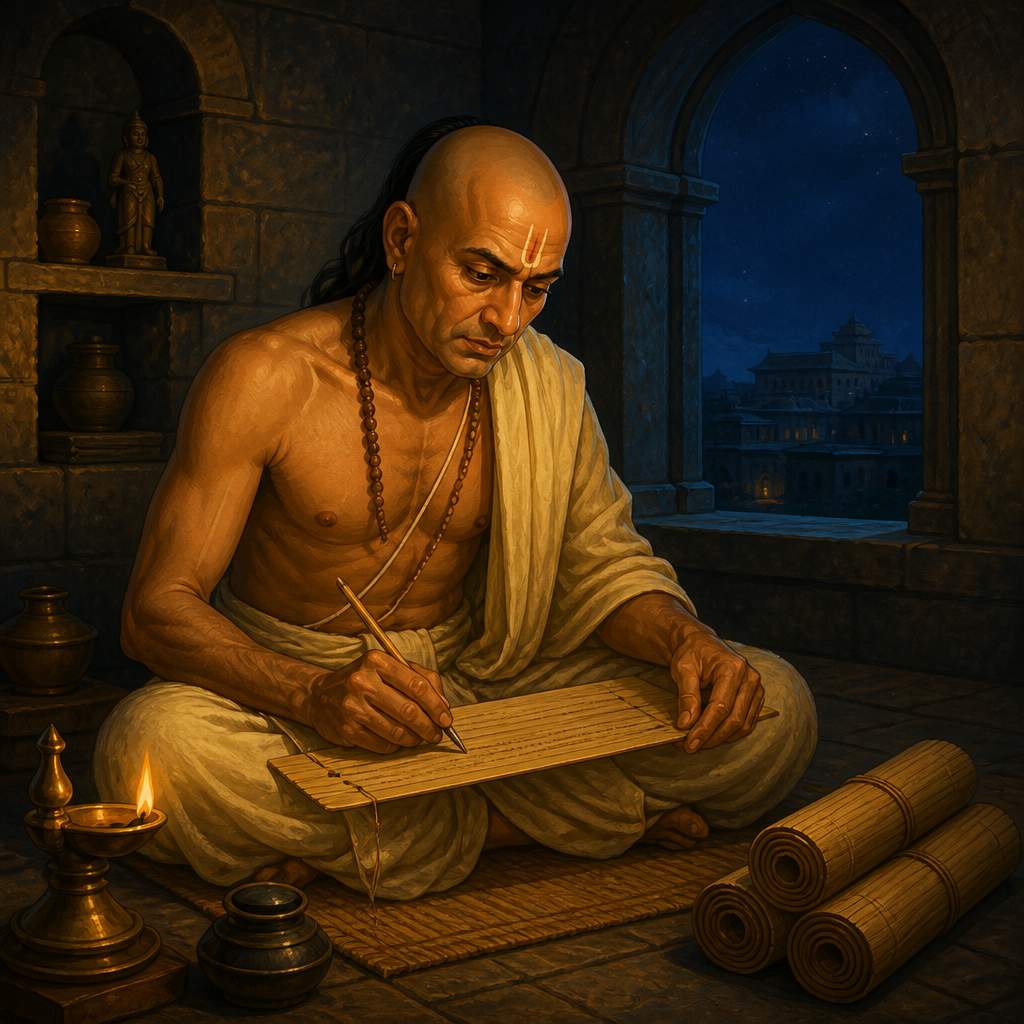
Chanakya (also known as Kautilya, 4th century BCE) wrote history's first comprehensive economic treatise: the Arthashastra. His vision of state prosperity provides framework for understanding India's economic ambitions.
Kautilya identified seven pillars of state power:
- Swami (the sovereign/leadership)
- Amatya (bureaucracy/administration)
- Janapada (territory and population)
- Durga (fortifications/infrastructure)
- Kosha (treasury/finances)
- Danda (military/enforcement)
- Mitra (allies/partnerships)
"कोषमूलो दण्डः।" "The treasury is the root of the state's power."
Kautilya understood that economic strength enables all other state functions. Without kosha (treasury), the military cannot be maintained, infrastructure cannot be built, allies cannot be retained. Economic policy was central, not peripheral, to statecraft.
His prescriptions remain relevant:
- Productive investment: The state should build infrastructure that enables private activity
- Trade promotion: Internal and external trade multiply wealth beyond what production alone achieves
- Fiscal prudence: The treasury should be built through prosperity, not extraction that kills the goose
India's Economic Trajectory
Where does India stand today?
Current Position (2024):
- GDP: ~$3.5 trillion (5th globally)
- Population: 1.4 billion (1st globally)
- Per capita GDP: ~$2,500 (138th globally)
- Growth rate: 6.5-7% (fastest major economy)
2030 Projections (various sources):
- GDP: $5-6 trillion (3rd globally, passing Japan and Germany)
- Per capita GDP: ~$4,000-4,500
2047 Vision (Viksit Bharat):
- GDP: $25-30 trillion
- Per capita GDP: $15,000-18,000
- Developed nation status
The IMF and World Bank project India becoming the third-largest economy by 2027-2028. The $10 trillion milestone falls between current position and 2047 vision, achievable within 10-15 years at sustained 7%+ growth.
Global Perspectives on Economic Ascent
How do nations achieve rapid economic transformation?
China's Model (1980-2020): Export-led manufacturing, massive infrastructure investment, state-directed capital allocation. China grew from $300 billion (1980) to $18 trillion (2023), a 60x increase in 43 years. The lesson: manufacturing exports at scale can transform economies.
Japan's Model (1950-1990): Technology absorption, quality manufacturing, export dominance in specific sectors (automobiles, electronics). Japan grew from devastation to the world's second-largest economy. The lesson: focused excellence in chosen sectors creates disproportionate returns.
Singapore's Model (1965-2000): Trade hub positioning, education investment, governance excellence. Singapore went from third-world port to first-world economy in one generation. The lesson: even small nations can prosper through strategic positioning.
| Model | Key Drivers | Relevance to India |
|---|---|---|
| China | Scale manufacturing, infrastructure | PLI schemes echo this approach |
| Japan | Quality + technology leadership | India's services excellence shows similar pattern |
| Singapore | Trade hub + governance | Sagarmala + ease of doing business reforms |
India's approach combines elements of all three: manufacturing push (PLI), services excellence (IT, pharma), and trade positioning (IMEC, Sagarmala).
PLI: The Manufacturing Revival
India's manufacturing share of GDP has stagnated at 15-17% for decades, well below China's 28% or even Southeast Asian averages. The Production Linked Incentive (PLI) scheme aims to change this.
Launched in 2020 and expanded through 2023, PLI offers:
- Cash incentives (4-6% of incremental sales) for manufacturing in India
- 14 sectors covered: electronics, pharmaceuticals, automobiles, textiles, food processing, semiconductors, solar panels, batteries, telecom equipment, and more
- ₹2+ lakh crore ($24 billion) allocated over five years
Results emerging:

Mobile Phones: India produced 600+ million smartphones in 2023, up from near-zero in 2014. Apple now manufactures iPhones in India; exports to Europe and US growing.
Pharmaceuticals: India already supplies 60% of global vaccines and 20% of generic medicines. PLI accelerates this into advanced formulations.
Semiconductors: Three major projects announced:
- Tata-PSMC (Taiwan) in Gujarat: 28nm chips
- Micron in Gujarat: assembly and test facility
- CG Power in Gujarat: outsourced chip manufacturing
Electronics: Foxconn, Wistron, Pegatron (Apple suppliers) expanding; Samsung investing ₹4,500 crore; local companies scaling up.
Finance Minister Nirmala Sitharaman has positioned PLI as "India's answer to China Plus One", as global companies diversify supply chains away from China, India offers scale, democracy, and PLI incentives.
Viksit Bharat 2047: The Vision
PLI addresses immediate manufacturing gaps. Viksit Bharat 2047 provides the overarching vision.

Announced by PM Modi, Viksit Bharat targets developed-nation status by India's independence centenary. The pillars:
Economic:
- $25-30 trillion GDP
- Per capita income of $15,000+
- Manufacturing share rising to 25%+ of GDP
- Global top-3 position in key sectors
Social:
- Universal access to healthcare and education
- Elimination of poverty (defined by international standards)
- World-class urban infrastructure
- Environmental sustainability
Technological:
- Indigenous capability in semiconductors, AI, space
- 5G/6G leadership
- Digital public infrastructure extending globally
Geopolitical:
- Permanent UN Security Council seat
- Global South leadership institutionalized
- Strategic autonomy maintained
The vision explicitly connects to historical legacy: India returning to economic prominence it held before colonial disruption.
Trade as Growth Engine
The lessons of this course converge on a central insight: trade expansion is essential to reaching $10 trillion.
Historical evidence: India's ancient prosperity was trade-driven. Roman gold flowed for Indian spices; Southeast Asian kingdoms paid for Indian textiles; Arab merchants carried Indian steel. When trade flourished, India prospered.
Modern economics: Export growth correlates strongly with GDP growth across developing economies. China's transformation was export-led; India's services exports (IT) drove growth in the 2000s.
India's trade gap: India's goods exports ($450 billion) significantly lag China's ($3.5 trillion). Closing this gap, through IMEC, Sagarmala, PLI-enabled manufacturing, is essential to the $10 trillion target.
The corridors and policies examined in this chapter all serve this goal:
- IMEC opens Europe through Middle East
- Sagarmala builds port infrastructure for exports
- Chabahar connects Central Asia
- Rupee trade reduces transaction costs
- Global South leadership builds market relationships
Each is a thread; woven together, they create the fabric of trade-led growth.
The Mathematics of Das-Lakh-Koti
What would $10 trillion mean concretely?
Per capita income: With 1.5 billion population by 2035-2040, $10 trillion GDP implies ~$6,500 per capita, upper-middle-income status by World Bank definitions.
Government revenue: At current tax-GDP ratios (~18%), government would collect $1.8 trillion annually, enabling massive public investment.
Global share: $10 trillion in a $150 trillion global economy represents 6-7%, significant, though still below India's historical 20-25% share.
Poverty reduction: At $10 trillion, extreme poverty ($2.15/day) would be essentially eliminated; even moderate poverty ($3.65/day) would decline dramatically.
Geopolitical weight: No major global decision, climate, trade, security, could be made without India. The third-largest economy commands different attention than the fifth.
Your Turn: Building the $10 Trillion Economy
Das-Lakh-Koti isn't an abstract national goal. It's the aggregate of millions of individual choices, by entrepreneurs, professionals, students, and policymakers.
For entrepreneurs: Which sectors offer the best opportunity? PLI-enabled manufacturing, export services, GCC-focused tech, where can you create value?
For professionals: What skills will the $10 trillion economy demand? Manufacturing management, international trade, supply chain logistics, digital infrastructure, invest in these capabilities now.
For students: Your career will span the journey from $3.5 trillion to $10 trillion and beyond. Choose fields that grow with the economy, not sunset sectors.
For investors: Which companies will capture the growth? Exporters, infrastructure builders, financial services, consumption plays, the $10 trillion economy needs capital allocated wisely.
Kautilya wrote that the treasury is the root of state power. But the treasury is filled by the productive activity of citizens. Das-Lakh-Koti happens when millions make individually sensible decisions that collectively build prosperity.
In our final lesson, we examine what all this means: Relevance in 2026 and Beyond, how ancient trade wisdom applies to your life today.
Fiscal capacity and state capability, the relationship between government revenue and ability to provide public goods, project power, and respond to crises.
Paul Kennedy's 'Rise and Fall of Great Powers' (1987) argues that economic strength determines military and geopolitical capacity over time. Empires that overextend militarily beyond economic means collapse; those that build economic foundation first project durable power.
India's approach prioritizes economic growth over premature power projection. The $10 trillion target would generate $1.8 trillion in annual government revenue, enabling massive investment in defense, infrastructure, and social programs that current revenues cannot support.
India's defense budget ($83 billion) is constrained by total revenue ($600 billion). At $10 trillion GDP with 18% tax-GDP ratio, defense budget could triple while maintaining the same GDP share, fundamentally changing India's military capability.
Comparative advantage and gains from trade, the economic principle that voluntary exchange benefits both parties by enabling specialization.
David Ricardo's theory of comparative advantage (1817) formalized what Kautilya understood intuitively: even if one party can produce everything more efficiently, trade still benefits both. Specialization and exchange create surplus.
Verses
कोषमूलो दण्डः।
koṣa-mūlo daṇḍaḥ |
The treasury is the root of the state's power.
The $10 trillion target represents kosha-building at national scale. At this GDP level, India's government would collect $1.8 trillion annually, enabling investments in defense, infrastructure, and social programs that current revenues cannot support.
Arthashastra, Book 2, Chapter 8 (R.P. Kangle)
वाणिज्यात् धनागमः।
vāṇijyāt dhanāgamaḥ |
Wealth comes from trade.
India's goods exports ($450 billion) are a fraction of China's ($3.5 trillion). Closing this gap through IMEC, Sagarmala, and PLI-enabled manufacturing is essential to reaching $10 trillion. Trade expansion multiplies the economic impact of domestic production.
Arthashastra, Book 7, Chapter 12 (R.P. Kangle)
Key figures
Chanakya (Kautilya)
Author of the Arthashastra, chief minister to Chandragupta Maurya, architect of the Mauryan Empire's administration and economic policies. · 4th century BCE
Narendra Modi
Prime Minister of India (2014-present), articulator of the Viksit Bharat 2047 vision and architect of policies including PLI, Sagarmala, Digital India, and Make in India. · Contemporary (b. 1950)
IMF/World Bank Projections
The International Monetary Fund and World Bank provide global economic forecasts that shape investment decisions, credit ratings, and policy discussions worldwide. · Contemporary institutions
Case studies
PLI and Viksit Bharat: Manufacturing Revival and National Vision
**PART 1: The Manufacturing Challenge** For decades, India's manufacturing sector stagnated. Despite 'Make in India' campaigns, manufacturing's GDP share remained stuck at 15-17%, well below China's 28% or even Southeast Asian averages. The consequences: - Trade deficit: India imported more manufactured goods than it exported - Employment gap: Manufacturing creates more jobs per unit output than services - Vulnerability: Critical products (electronics, pharmaceuticals, semiconductors) were import-dependent COVID-19 exposed these vulnerabilities. When supply chains broke, India couldn't source medical equipment, PPE, or active pharmaceutical ingredients. The 'China Plus One' movement, global companies diversifying away from China, offered opportunity. But India lacked the manufacturing ecosystem to capture it. **PART 2: The PLI Response** In 2020, Finance Minister Nirmala Sitharaman announced the Production Linked Incentive scheme: - **14 sectors**: Mobile manufacturing, pharmaceuticals, automobiles, textiles, food processing, solar panels, batteries, telecom equipment, medical devices, white goods, specialty steel, advanced chemistry, IT hardware, drones - **₹2+ lakh crore** ($24 billion) allocated over 5 years - **Cash incentives**: 4-6% of incremental production value for companies meeting investment and output targets The design was strategic: target sectors where India had potential (pharmaceuticals), where China dominated (electronics), or where future growth was certain (semiconductors, batteries). **PART 3: Viksit Bharat 2047 - The Overarching Vision** PLI addresses immediate manufacturing gaps. Viksit Bharat 2047 provides the 25-year vision: - **Developed nation status** by India's independence centenary - **$25-30 trillion GDP** (from current $3.5 trillion) - **Per capita income $15,000+** (from current $2,500) - **Manufacturing share 25%+** of GDP - **Global top-3** in key industries The vision explicitly invokes historical restoration: India reclaiming the economic prominence it held for most of recorded history, before colonial disruption.
PLI and Viksit Bharat reflect dharmic principles in economic policy: **Swadeshi (Self-Reliance) Renewed**: The Atmanirbhar Bharat (self-reliant India) framing recalls Gandhian swadeshi, but with crucial evolution. Modern swadeshi isn't autarky (which Kautilya would have rejected); it's building capability to participate in global trade from strength rather than dependency. **Dharma of the State**: Kautilya enumerated the state's dharma, its proper function. Building kosha (treasury) through prosperity (not extraction) was central. PLI represents the state enabling private prosperity, not replacing it but catalyzing it. **Generational Thinking**: Viksit Bharat 2047 sets a 25-year horizon, well beyond any political cycle. This long-term thinking echoes dharmic concepts of parampara (tradition) and santati (continuity). The current generation builds for successors. **Restoration Narrative**: The explicit framing of restoration, India returning to natural position, reflects dharmic understanding of cyclical time. India's colonial decline was aberration; restoration is return to dharmic order.
**PLI Results (2020-2024)**: **Mobile Manufacturing**: - Production: 600+ million smartphones annually (from near-zero in 2014) - Apple: All major manufacturers (Foxconn, Wistron, Pegatron) operational - Exports: $11+ billion annually (growing 40%+ year-on-year) **Pharmaceuticals**: - Bulk drug production: New facilities reducing API import dependence - Complex generics: Expanding into higher-value formulations - Global share: Maintained 20% of global generic supply **Semiconductors** (projects announced): - Tata-PSMC: 28nm fab in Gujarat (~₹91,000 crore investment) - Micron: Assembly and test facility (~₹22,500 crore) - CG Power: OSAT facility **Overall Manufacturing**: - PMI index: Consistent expansion since 2021 - FDI in manufacturing: Growing faster than services FDI - Export growth: Manufacturing exports growing 15%+ annually **Viksit Bharat Progress**: - GDP: $3.5 trillion (2024), on track for $5 trillion by 2027-28 - Third-largest economy: IMF projects this by 2027-28 - Per capita: Growing at 5-6% annually (real terms)
Industrial policy works when well-designed. PLI's success rests on specific features: targeting sectors with genuine potential, providing meaningful incentives, setting measurable targets, and time-limiting support. The contrast with past failures (where protection became permanent and inefficient) is instructive. Kautilya advocated state support for strategic activities, but also recognized that permanent subsidy breeds lethargy. PLI's time-bound design follows this principle.
India's PLI scheme, allocating over Rs 2 lakh crore across 14 sectors, represents the largest coordinated industrial policy since China's 'Made in China 2025.' Both programs recognize that manufacturing revival requires sector-specific incentives, not just general business-friendly policies. The approach is being studied by Indonesia, Vietnam, and Saudi Arabia as they design their own industrial strategies.
PLI schemes have attracted ₹1.07 lakh crore ($13 billion) in investment commitments and generated ₹8.6 lakh crore ($103 billion) in production (through FY24). Mobile phone exports alone reached $11+ billion, India's fastest-growing export category.
Historical context
Mauryan economic peak (3rd century BCE) to Viksit Bharat 2047
India's economic history has three eras: ancient prosperity (trade-based, manufacturing-led), colonial decline (extraction-based, deindustrialization), and post-independence recovery (initially slow, accelerating after 1991 reforms). Das-Lakh-Koti represents the culmination of recovery.
China grew from $300 billion (1980) to $18 trillion (2023), a 60x increase in 43 years. India's $10 trillion target requires similar (if less dramatic) transformation: ~3x growth over 12-15 years. Japan, Korea, and Singapore achieved comparable transformations in previous generations.
India was 32% of global GDP in 1 CE (Maddison estimates), 25% in 1700, 4% in 1950, and is projected to reach 6-7% by the time it reaches $10 trillion. Full restoration to historical levels would require $30+ trillion, Viksit Bharat's ultimate target.
Economic scale determines global influence, military capability, and domestic welfare. The difference between $3.5 trillion and $10 trillion isn't incremental, it's categorical. A $10 trillion India operates in a fundamentally different geopolitical tier.
Living traditions
- PLI manufacturing expansion
- Startup ecosystem development
- Digital India infrastructure
- Pataliputra (modern Patna): Ancient Mauryan capital where Chanakya advised Chandragupta. Archaeological museum displays artifacts from the empire that controlled most of the subcontinent.
- Mahindra City/Chennai Industrial Corridor: Modern industrial townships hosting PLI-beneficiary manufacturers including Apple suppliers. Tours available to see contemporary manufacturing in action.
- Meenakshi Temple: Temple complex funded by merchant wealth over centuries represents how economic prosperity enabled civilizational achievements. Das-Lakh-Koti vision aims to create prosperity enabling similar cultural flourishing.
- Nalanda University Ruins: Ancient center of learning funded by royal and merchant patronage. Economic prosperity enabled educational achievement; Das-Lakh-Koti aims to create wealth base for similar institutional excellence.
Reflection
- Kautilya wrote that 'the treasury is the root of state power.' In what ways does this ancient insight apply to your own life? What is your personal 'kosha,' and how does its strength or weakness affect your other capabilities and choices?
- India's path to $10 trillion will create and destroy industries, elevate some professions and diminish others. How might you position yourself, through skills, location, or sector choice, to ride this transformation rather than be swept aside by it?