Relevance in 2026 and Beyond
Skanda 7 wisdom for modern seekers
What can a five-year-old's fearlessness teach about facing adversity? How do the nine processes apply to modern devotion? From standing up against tyranny to the power of pure love - discover how Prahlada's story inspires contemporary seekers and offers timeless solutions to today's challenges.
Eternal Wisdom for Contemporary Times
As we conclude our journey through Skanda 7, a profound question emerges: How does a story told millennia ago speak to the challenges of 2026 and beyond? The Prahlada-Narasimha narrative isn't merely a tale for entertainment or even historical preservation, it is a living manual for navigating the complexities of modern existence while maintaining spiritual integrity.
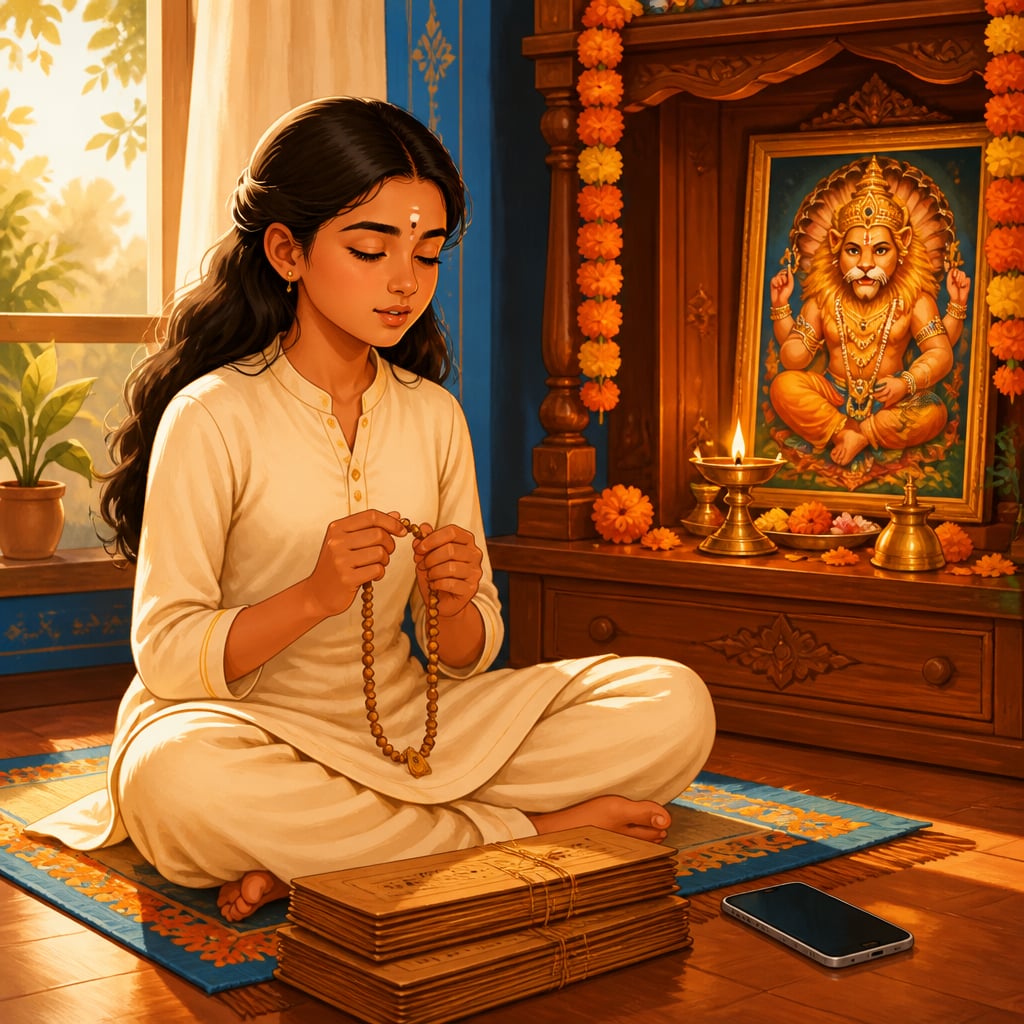
The brilliance of the Bhagavatam lies in its capacity to transcend temporal boundaries. The struggles Prahlada faced mirror the challenges confronting seekers today: oppressive systems that demand conformity, materialistic ideologies that dismiss spirituality, and the ever-present pressure to compromise one's values for worldly success.
The Child Who Stood Against the World
Perhaps the most striking aspect of Prahlada's story is his age. At five years old, he possessed a clarity of conviction that many adults struggle to achieve after decades of seeking. What does this teach us?
In an age of information overload, where conflicting ideologies compete for our attention daily, Prahlada's example demonstrates that spiritual truth isn't acquired through intellectual accumulation alone. His knowledge came from prenatal absorption during Narada's teachings, representing the power of environment, association, and intention over mere formal education.
For modern parents and educators, this offers revolutionary insight: the spiritual formation of children begins not at school age, but from conception. The conversations held in a household, the intentions cultivated during pregnancy, the atmosphere of devotion or its absence, all shape the spiritual trajectory of the next generation.
Navavidha Bhakti: A Complete System for Any Era
The nine processes of devotion that Prahlada taught remain the most comprehensive spiritual practice system ever articulated. Let us examine their modern applications:
Shravanam (Hearing)
In the age of podcasts, audiobooks, and digital content, shravanam has never been more accessible. Yet quantity doesn't equal quality. Prahlada's teaching reminds us to choose sources wisely, hearing about the Divine from realized souls, authentic scriptures, and genuine practitioners rather than mere entertainers or academic analysts.

Kirtanam (Glorification)
Social media offers unprecedented platforms for kirtanam. Every post, tweet, or video becomes an opportunity to glorify or to criticize, to uplift or to demean. The conscious seeker can transform their digital presence into modern kirtanam, sharing divine names, stories, and wisdom rather than contributing to the cacophony of complaint and controversy.
Smaranam (Remembrance)
In a world designed for distraction, notifications, algorithms, and endless content streams, smaranam becomes both more challenging and more essential. The practice of remembering the Divine throughout daily activities creates an internal sanctuary that no external noise can penetrate.
Pada-sevanam (Service to Lotus Feet)
Physical service remains powerful, visiting temples, maintaining sacred spaces, serving sadhus. But pada-sevanam extends to seeing the Divine presence in all beings and offering service accordingly. Environmental stewardship, ethical business practices, and compassionate action become expressions of serving the Lord's feet manifested throughout creation.
Archanam (Deity Worship)
Home altars, temple visits, and daily puja maintain their power in the modern age. For those in secular environments where such practices face resistance, internal archanam, visualizing and worshipping the Lord within the heart, offers an unassailable practice.
Vandanam (Prayers and Prostration)
Humility remains the rarest virtue in an age of self-promotion. The practice of vandanam, sincere prayer and acknowledgment of the Divine's supremacy, corrects the ego inflation that modern success often creates.
Dasyam (Servitude)
Considering oneself a servant of the Lord transforms the modern anxiety around "finding purpose." When every action becomes service, purpose isn't found, it's everywhere.
Sakhyam (Friendship)
Developing an intimate, friendly relationship with God removes the fearful distance that formal religion often creates. The Lord becomes not a distant judge but an ever-present companion.
Atma-nivedanam (Complete Surrender)
The ultimate practice, offering everything, including the results of our efforts, to the Divine. In a world obsessed with controlling outcomes, surrender paradoxically provides the deepest peace.
Standing Against Modern Hiranyakashipus
Hiranyakashipu represents more than a mythological demon. He embodies any system, ideology, or authority that demands surrender of spiritual principles. Today's seekers face numerous Hiranyakashipus:
Materialistic Corporate Culture: Demands that work identity supersede all other identities, often requiring ethical compromises for advancement.
Ideological Fundamentalisms: Both religious and secular ideologies that punish independent thinking and demand absolute conformity.
Digital Addiction Systems: Platforms designed to capture attention and monetize distraction, working against focused spiritual practice.
Scientific Materialism: Not science itself, but the philosophical position that only measurable phenomena are real, dismissing the entire domain of spiritual experience.
Prahlada's response to Hiranyakashipu offers the template: calm conviction without aggression. He didn't attack his father's position; he simply maintained his own. He didn't seek to convert others; he answered truthfully when asked. He didn't flee from consequences; he accepted them with faith in divine protection.
This is not passive resignation but active resistance through spiritual steadfastness. The most powerful revolutions in human history have been accomplished not through matching violence with violence, but through maintaining truth despite violence, a principle Gandhi termed satyagraha, directly inspired by Prahlada's example.
The Pillar Principle in Daily Life
"Is your God in this pillar?" Hiranyakashipu's mocking question receives history's most dramatic answer. But beyond the spectacular manifestation, the pillar represents a profound truth: the Divine is present in the ordinary.
Modern seekers often wait for dramatic spiritual experiences, visions, miracles, unmistakable signs. Meanwhile, they overlook the Divine presence in every pillar of their daily existence: in the morning light, in the face of a stranger, in the challenges that develop character, in the breath that sustains moment by moment.
Prahlada didn't hope God was in the pillar; he knew with certainty. This knowing, not hoping, not believing, but knowing, comes from the cultivation of spiritual vision through the nine processes. Regular practice gradually transforms perception until the ordinary world reveals its extraordinary nature.
Narasimha: The Form That Defies Categories
Why did God appear as half-man, half-lion? The form itself teaches: ultimate reality transcends human categories.
Modern minds, trained in rigid classifications, often struggle with spiritual truths that don't fit neat categories. Is God personal or impersonal? Transcendent or immanent? Loving or wrathful? Narasimha answers: yes.
The Lord simultaneously protected His devotee with infinite tenderness and destroyed the demon with terrible ferocity, same being, same moment, different relationship. This teaches that our experience of the Divine depends entirely on our relationship to the Divine.
For seekers who struggle to reconcile different descriptions of God across traditions, Narasimha offers liberation: the Divine is too vast for any single description. Different aspects appear to different seekers according to their needs, capacities, and approaches.
Prahlada's Prayer: The Template for Modern Devotion
When Prahlada pacified the fierce Lord, he didn't pray for wealth, power, or even liberation. He prayed for the welfare of all beings and for continued service. His prayer contains crucial lessons:
Selflessness: Not "grant me liberation" but "may all beings be liberated."
Humility: Despite being the greatest devotee, he considers himself unqualified.
Compassion: His heart breaks for those trapped in material existence.
Practicality: He doesn't ask for abstract blessings but for opportunities to serve.
In an age of manifestation practices focused on personal gain, Prahlada's prayer redirects spiritual intention toward its highest purpose: the upliftment of all.
Practical Applications for Contemporary Life
For Students
Prahlada was a student who prioritized spiritual education over materialistic instruction. Modern students can honor both by pursuing secular education with excellence while maintaining daily spiritual practice. Career success and spiritual growth aren't mutually exclusive.
For Professionals
The workplace becomes a field of karma yoga when approached correctly. Excellence in work offered as service to the Divine transforms ordinary jobs into spiritual practice. Integrity maintained despite pressure mirrors Prahlada's steadfastness.
For Parents
Kayadu's openness to spiritual instruction during pregnancy created Prahlada. Modern parents can cultivate devotional atmospheres, expose children to sacred sounds and stories, and demonstrate spiritual practice rather than merely preaching it.
For Those Facing Adversity
Prahlada's tortures represent the extreme, yet his faith didn't waver. Whatever challenges we face, they pale compared to being thrown into fire, off cliffs, or under elephant feet. If a five-year-old maintained faith through such trials, can we not maintain faith through ours?
For Those Seeking Purpose
The nine processes offer complete purpose: hear about God, speak about God, remember God, serve God, worship God, pray to God, become God's servant, become God's friend, surrender to God. Purpose isn't something to find "out there", it's available immediately through devotion.
The Eternal Relevance of Surrender
As artificial intelligence advances, as global systems grow more complex, as the pace of change accelerates, one might expect ancient teachings to become increasingly irrelevant. The opposite is true.
The more external circumstances change, the more the unchanging becomes valuable. Technologies will obsolete each other; spiritual principles remain eternal. Political systems rise and fall; devotion to the Divine transcends them all. Human problems evolve in form but not in essence, fear, desire, confusion, and suffering have plagued humanity since time immemorial.
Skanda 7's solution remains what it has always been: take shelter in the Divine. This isn't escapism but the most practical approach to existence. When the foundation is secure, all structures built upon it remain stable regardless of storms.
Prahlada, at five years old, in the most adverse circumstances imaginable, demonstrated perfect peace. Hiranyakashipu, with absolute power over the material world, lived in constant anxiety. Who was truly successful?
The question isn't academic. Every day, we choose: Will we build our identity on material foundations that will inevitably crumble, or on the spiritual foundation that cannot be shaken? Will we seek happiness through acquiring more, or through surrendering more? Will we live in fear of loss, or in faith in eternal gain?
Conclusion: The Story That Never Ends
The Prahlada-Narasimha narrative concludes not with "the end" but with continuation. Prahlada rules his father's kingdom with righteousness. Narasimha remains available to devotees in temples and hearts across the world. The teachings continue to liberate seekers who approach them with sincerity.
In 2026 and beyond, as in every age, those who hear this story with faith receive more than entertainment. They receive protection, not necessarily from material difficulties, but from the spiritual death of forgetfulness. They receive inspiration, proof that devotion can sustain through any trial. They receive methodology, the nine processes that systematically develop love of God. They receive hope, that the Lord appears in whatever form necessary to protect His devotees and establish dharma.
May we approach our lives with Prahlada's conviction, face our challenges with his composure, practice with his dedication, and ultimately achieve what he achieved: not merely liberation, but eternal loving service to the Lord who is present in every pillar, in every particle, in every heart.
The wisdom of Skanda 7 isn't merely relevant in 2026, it is essential. In a world increasingly lost in distraction, materialistic pursuit, and spiritual confusion, the child devotee's voice rings clearer than ever: "The Lord is everywhere. He protects those who surrender. Nothing else matters."
Om Namo Bhagavate Narasimhaya
Living traditions
- Daily Navavidha Bhakti Practice: Millions of practitioners worldwide structure their daily sadhana around Prahlada's nine processes. Morning practices typically include shravanam (hearing scripture), kirtanam (chanting), and archanam (deity worship), while smaranam (remembrance) and atma-nivedanam (surrender) are cultivated throughout the day.
- Narasimha Jayanti Celebrations: Annual celebration of Narasimha's appearance day observed worldwide with fasting until dusk, elaborate abhishekams, and continuous chanting of Narasimha mantras. Devotees recount the entire Prahlada-Narasimha narrative, often with dramatic performances.
- ISKCON Temples Worldwide
- Virtual Pilgrimage Resources
- Lakshmi Narasimha Temple, Mangalagiri
Reflection
- What are the 'Hiranyakashipus' in your life, systems, pressures, or influences that demand you compromise your spiritual values? How might you apply Prahlada's approach of calm conviction?
- Which of the nine processes of bhakti resonate most with you currently? Which feel most challenging? How might you strengthen your practice of one that's currently weak?
- If God truly exists in every pillar, in every part of creation, how would that awareness change your interaction with the world today? What would you see differently?