Prahlada: Pacifying the Lord
Love calms divine wrath
When gods and Lakshmi fail, Prahlada approaches Lord Narasimha fearlessly. His prayers - the famous Prahlada Stuti - calm the Lord's wrath. Narasimha offers boons, but Prahlada asks only for liberation for his demon father. The Lord grants this and more.
The Approach
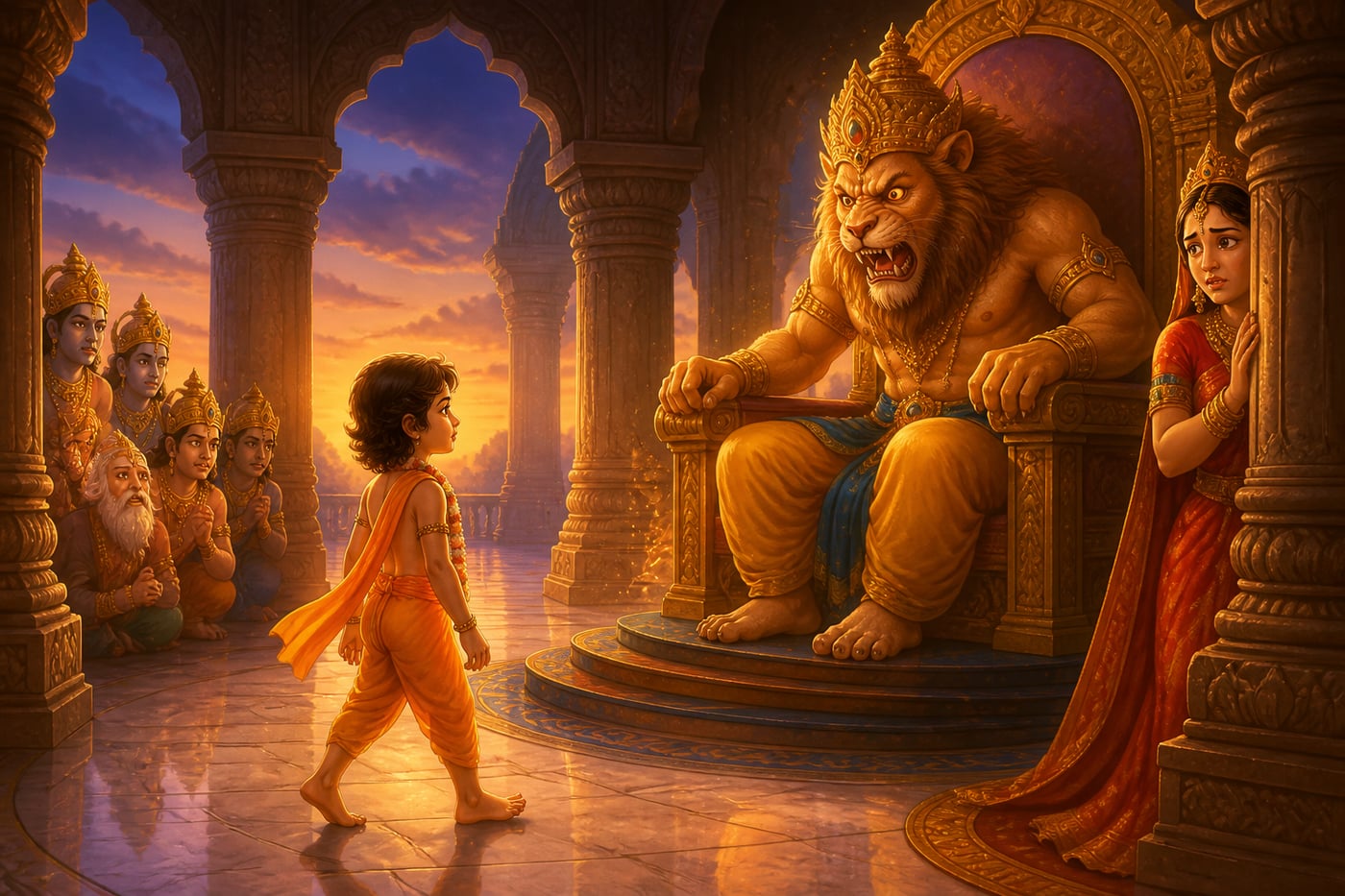
While gods and celestial beings trembled at the margins of the assembly hall, a small figure walked calmly toward the terrible form of Lord Narasimha. The child Prahlada, whose faith had called forth this manifestation, approached without fear.
Brahma, the creator, recognized what was happening:
"Let Prahlada go forward. He is dearer to the Lord than any of us. Perhaps his love can accomplish what our prayers could not."
As Prahlada approached, something remarkable began to happen. The Lord's roaring quieted. His blazing eyes focused on the child. The cosmic tension that had gripped the universe began to ease.
The Touch
Lord Narasimha extended His hand - that same hand whose claws had just torn apart Hiranyakashipu - and placed it gently on Prahlada's head. It was a gesture of blessing, of affection, of the tenderness that underlies even the fiercest divine form.
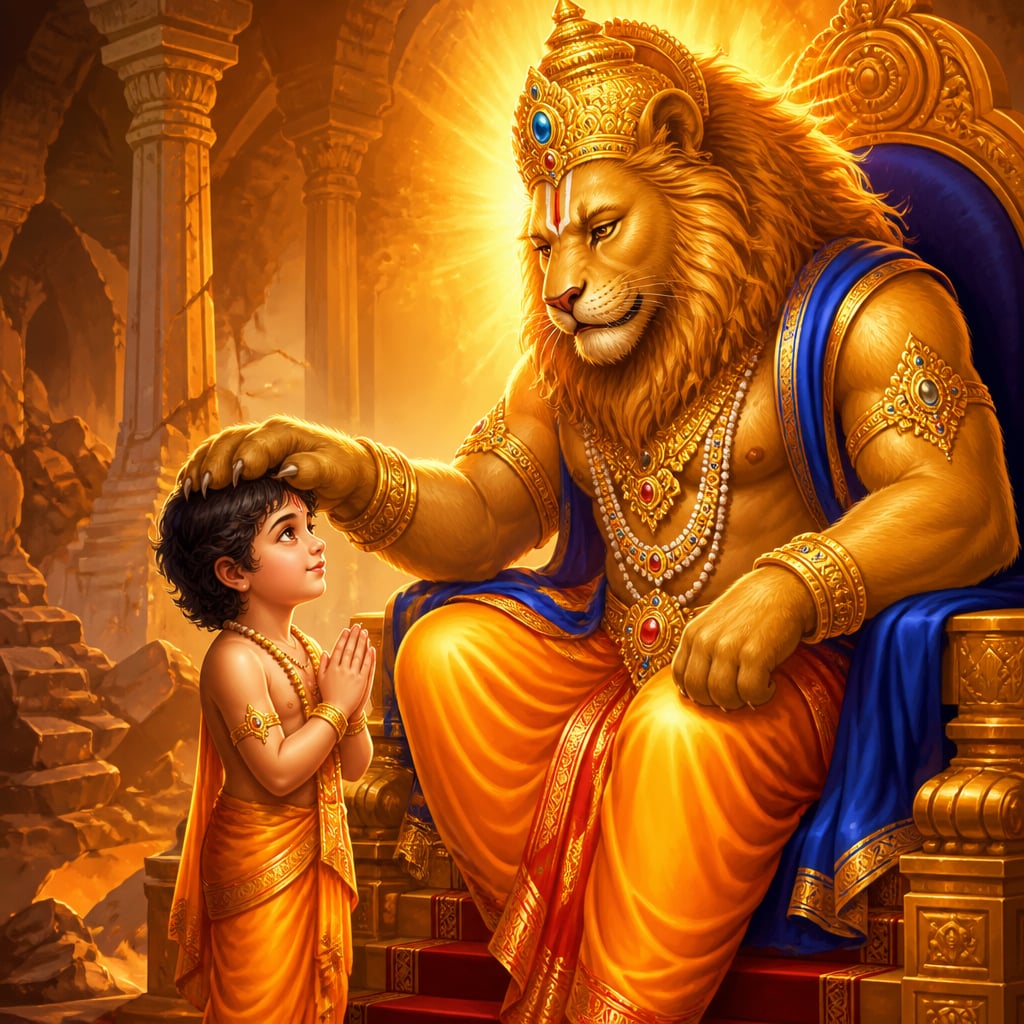
The Bhagavatam describes the moment:
When the Lord's hand touched Prahlada's head, all the child's fears dissolved - not that he had felt fear, but even the subtle anxiety of a devotee waiting to see his Lord face to face vanished. Divine knowledge flooded his consciousness.
With that touch, Prahlada was granted the ability to compose and speak prayers that would reveal the deepest truths of bhakti.
The Prahlada Stuti
What followed is one of the five great prayers (Pancha Stuti) of the Bhagavatam tradition - the Prahlada Stuti, a masterpiece of devotional poetry that has been recited, studied, and sung for millennia.
Opening: Humility
Prahlada began by acknowledging his unworthiness:
"Great souls like Brahma have praised You with profound hymns. How can I, a child born among demons, hope to add anything? My words are like the stammering of an infant compared to their eloquence."
Yet he continued:
"But You are not pleased by polished words or powerful speakers. A sincere heart is what moves You. Even imperfect offerings, when given with love, please You more than grand rituals without devotion."
The Nature of Divine Protection
"Parents cannot protect a child, O Lord. Medicine cannot cure disease. A boat cannot save one drowning in the ocean. All these work only by Your will. Without Your favor, no protection succeeds; with it, even the impossible becomes easy."
This verse (which we encountered earlier) encapsulates Prahlada's understanding gained through his trials: all worldly protection is ultimately dependent on divine grace.
Fearlessness in the Face of Suffering
"I am not afraid of this ocean of material suffering. My mind is drowned in the nectar of chanting Your glories. But I lament for the fools who, averse to You, carry the burden of material existence, seeking happiness in things that can never satisfy."
Remarkably, Prahlada expressed more concern for suffering humanity than for himself.
The True Liberation
"Those who seek liberation for themselves alone are selfish. I do not want liberation if it means leaving behind the suffering souls. Grant me the power to show them the path, O Lord. Let me remain in this world, serving as an instrument of Your compassion."
This extraordinary sentiment - preferring to stay in material existence to help others rather than seeking personal liberation - places Prahlada among the highest category of devotees.
The Request That Wasn't
The Lord, pleased beyond measure, offered Prahlada any boon:
"Ask anything, Prahlada. All the treasures of the universe are yours for the asking. Kingdoms, powers, pleasures, liberation itself - whatever you desire shall be granted."
Prahlada's response revealed the depths of his devotion:
"If You are pleased with me, grant me this boon: may I never desire anything from You. The moment I desire something, I become a merchant, not a devotee. May my love remain pure, seeking nothing in return."
The Lord was moved:
"This is the answer I hoped for. Ask again, knowing that your love is already pure."
The Boon for His Father
Then Prahlada made his one request:
"If You wish to give me something, then liberate my father. He was burned by the fire of enmity toward You, but that same fire has purified him. His opposition to You was constant meditation on You. Let him now attain liberation."
Consider the magnitude of this request: the son asking for liberation for the father who had tried to kill him repeatedly.
The Lord's response was both surprising and profound:
"Your father is already liberated. His constant thinking of Me - even in enmity - kept Me always in his consciousness. But because of your prayer, twenty-one generations of your ancestors have been purified and liberated."
The Coronation

With Hiranyakashipu dead, the demon kingdom needed a new ruler. Lord Narasimha Himself installed Prahlada as king:
"Rule this kingdom, Prahlada. Guide these demons not as their tyrant but as their teacher. Transform hatred into devotion, fear into love. This is your dharma now."
Brahma and the gods arrived to witness the coronation. The same demon court that had watched Prahlada's persecution now witnessed his coronation - with Lord Narasimha performing the ceremony Himself.
The Lord's Departure
With Prahlada pacified and installed as king, with all boons granted, Lord Narasimha prepared to withdraw. His purpose accomplished, the fierce form began to dissolve back into the transcendent.
Before departing, the Lord spoke final words to Prahlada:
"You have shown the universe what devotion truly is. Your faith called Me forth from the pillar. Your love pacified My wrath. Your forgiveness toward your father exceeded even divine justice. Wherever your story is told, I shall be present. Whoever remembers you shall find Me."
The Lessons of the Stuti
Prahlada's prayers teach several profound lessons:
1. Purity Over Polish The Lord is not impressed by sophisticated words but by genuine hearts. A child's simple love exceeded the gods' elaborate hymns.
2. Selfless Devotion True devotion seeks nothing - not even liberation. The moment we bargain with God, we reduce the relationship to commerce.
3. Compassion for Others The highest devotees are not concerned with personal liberation but with the suffering of others. Prahlada would rather stay in samsara helping souls than escape alone.
4. Forgiveness Prahlada's request for his father's liberation demonstrates that divine love extends even to one's persecutors. This is not weakness but spiritual strength.
5. The Power of Enmity-as-Meditation Hiranyakashipu's constant thinking of Vishnu - though in hatred - still connected him to the Divine. The Lord can liberate even those who oppose Him, if a devotee intercedes.
The Transformation of the Demons
Under Prahlada's rule, the demon kingdom underwent a transformation. The one who had learned devotion from Narada now taught it to the demons:
- The same soldiers who had tried to kill Prahlada now learned to worship Vishnu
- The court that had plotted his death now chanted the Lord's names
- The kingdom that had banned worship now became a center of devotion
Prahlada proved that no one is beyond redemption. If demons could become devotees, anyone could.
The Legacy
Prahlada's story does not end with Skanda 7. He appears again later in the Bhagavatam, still devoted, still teaching. His dynasty includes Bali Maharaja, another famous devotee whose story involves Lord Vamana.
The Prahlada Stuti remains one of the most recited prayers in the Vaishnava tradition. Its themes of selfless devotion, compassion for suffering souls, and fearless love of God continue to inspire seekers across centuries.
Through Prahlada, the Bhagavatam demonstrates that devotion is the highest path - higher than knowledge, higher than yoga, higher even than the elaborate rituals of the gods. A child's pure love accomplished what cosmic powers could not.
Living traditions
Prahlada's teaching on motiveless devotion (nishkama bhakti) has profoundly influenced Hindu spirituality. His willingness to remain in samsara to help others echoes the Bodhisattva ideal and has inspired countless teachers. ISKCON's philosophy particularly emphasizes Prahlada's example of pure devotion. His story continues to be taught to children as the premier example of faith, forgiveness, and fearless devotion.
- Prahlada Stuti Parayana: Regular recitation of Prahlada's prayers from Srimad Bhagavatam, especially during Narasimha worship
- Kshama Prarthana (Forgiveness Prayer): Inspired by Prahlada's forgiveness, some traditions include prayers for the welfare of enemies and those who have caused harm
- Prahlada Varada Narasimha Temple: The temple depicting Lord Narasimha blessing Prahlada after the killing of Hiranyakashipu. The deity shows the Lord in gentle form with hand on Prahlada's head.
- Malola Narasimha Temple: Temple featuring the gentle (Malola) form of Narasimha, sitting with Lakshmi on His lap after His wrath was pacified. This form is especially worshipped for marital blessings.
Reflection
- Prahlada refused boons because asking makes one a 'merchant, not a devotee.' Examine your own spiritual life: what do you ask God for? What would it mean to want nothing?
- Prahlada asked for his father's liberation - the father who had tried to kill him. Is there someone who has deeply wronged you? Could you genuinely pray for their welfare and liberation?
- Prahlada said he would rather remain in material existence to help others than attain liberation alone. Does your spiritual practice serve only yourself, or does it have a component of serving others?