Prahlada: The Child Devotee

Devotion from the womb

While in his mother Kayadu's womb, Prahlada receives teachings from Narada. Born as a devotee of Vishnu, he scandalizes his demon father by his unwavering bhakti. His father's attempts to educate him in demonic ways fail completely.

The Womb as Classroom

In the previous lesson, we saw how Narada Muni rescued Kayadu, Hiranyakashipu's pregnant wife, from Indra and brought her to his ashrama. What followed was one of the most remarkable teachings in spiritual history - a prenatal education that would shape the destiny of worlds.
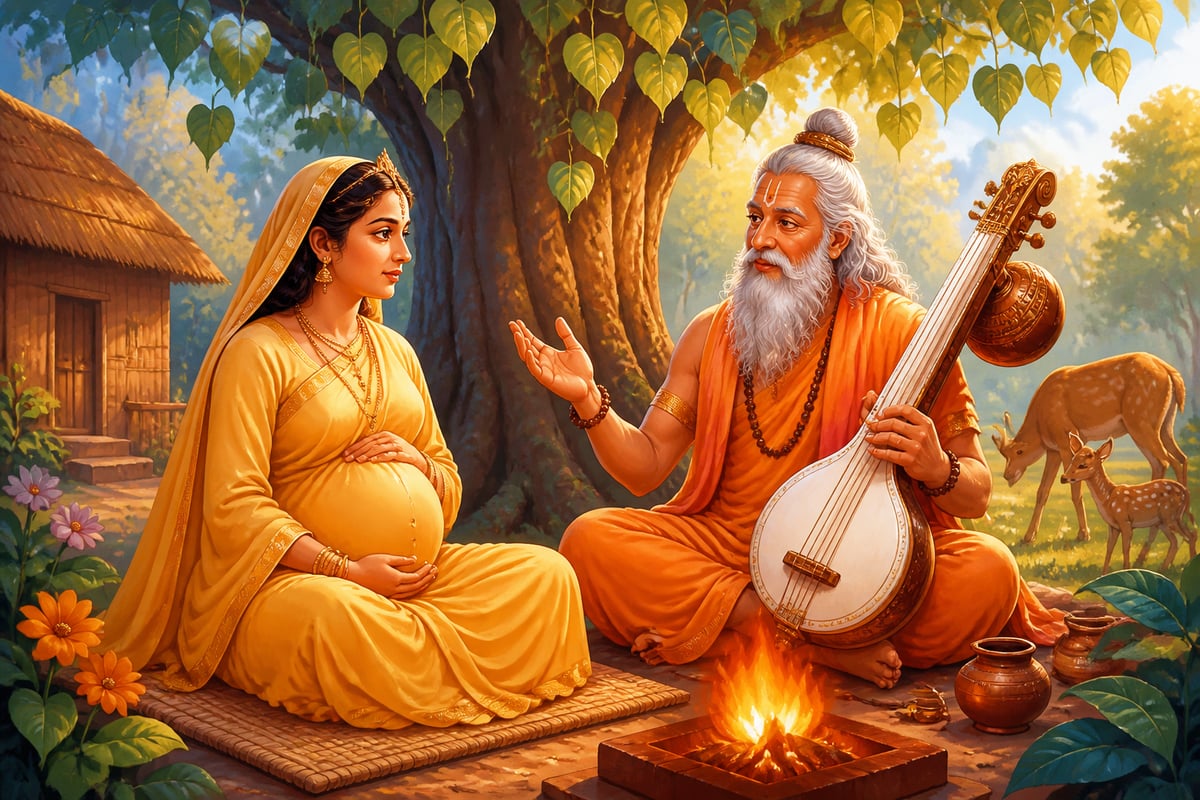
Kayadu listening to Narada at his ashram

As Kayadu lived in Narada's hermitage, waiting for her husband's return from his millennia-long penance, the sage began instructing her in the truths of bhakti - devotional service to Lord Vishnu. He spoke of the temporary nature of material existence, the eternal nature of the soul, and the supreme sweetness of loving God.

Kayadu listened, but she did not fully absorb the teachings. Her mind was distracted by worry for her husband and uncertainty about the future. But there was another listener - one who heard every word with perfect attention.

The child in her womb - Prahlada - absorbed Narada's teachings completely. In the mysterious way of divine grace, this unborn soul received bhakti at its source. The Bhagavatam tells us:

"Just as a fire is covered by smoke, Prahlada's spiritual knowledge was temporarily covered at birth. But like fire, it remained within him and would blaze forth at the appropriate time."

The Birth of a Devotee

When Hiranyakashipu finally completed his penance and received Brahma's boons, he returned to find his wife still in Narada's care. Kayadu returned to the demon capital, and soon after, Prahlada was born.

From the outside, the child appeared normal - healthy, beautiful, the crown prince of the demon empire. Hiranyakashipu looked upon his son with pride and ambition. Here was his heir, the one who would continue his dynasty and his war against Vishnu.

But something was different about this child.

While other demon children delighted in games of power and cruelty, Prahlada sat quietly, his eyes often closed in meditation. While others fought and boasted, Prahlada seemed to be listening to an inner music. The nursemaids noticed that whenever they sang demon war songs, the child turned away. But when they inadvertently hummed devotional melodies, the infant smiled with inexplicable joy.

Young Prahlada sits cross-legged in quiet meditation while demon-prince classmates wrestle and brandish wooden swords around him in the palace courtyard.

The Demon's Education

As Prahlada grew, Hiranyakashipu enrolled him in the finest demon school, under the tutelage of Shanda and Amarka, sons of the demon priest Shukracharya. Their curriculum was designed to produce the perfect demon prince:

Subject Purpose
Diplomacy (Sama) Deceive enemies through false friendship
Bribery (Dana) Control others through wealth
Dissension (Bheda) Create division among opponents
Force (Danda) Crush all resistance through power

These were the four upayas - the political strategies that demons used to maintain power. Additionally, they taught military tactics, the art of intimidation, and the proper way to terrorize lesser beings.

Prahlada attended these classes dutifully. He was never disrespectful to his teachers. He sat quietly and listened. But his heart remained untouched.

Inside, a different voice spoke - the voice of Narada's teachings, echoing from his time in the womb. While his teachers spoke of power, he heard hymns of devotion. While they described ways to dominate others, he contemplated the sweetness of surrender to the Lord.

The Father's Test

One day, Hiranyakashipu called for his son. The demon king wished to examine the progress of his heir's education. Prahlada, perhaps five years old, stood before his towering father with peaceful composure.

"My dear son," Hiranyakashipu said warmly, "tell me what you have learned. What is the best thing you have been taught?"

The court fell silent. Shanda and Amarka looked on nervously - they knew the child had shown little interest in their teachings. What would he say?

Prahlada answers in his father's court

Prahlada answered with simple directness:

"Hearing about Lord Vishnu, chanting His names, remembering Him always - this is the supreme education. I have learned that the intelligent person should abandon the material path and take shelter of the Lord."

A gasp went through the assembly. The demon courtiers looked at each other in disbelief. Had the crown prince just praised their sworn enemy?

Hiranyakashipu's face darkened. He glared at the teachers. "What have you taught my son? What is this nonsense about Vishnu?"

"My lord, we taught him no such thing!" Shanda protested. "We never mentioned that name. We don't know where he learned this!"

The Second Chance

Hiranyakashipu controlled his rising anger. Perhaps the child had been corrupted by some spy or traitor in the palace. The demon king ordered Shanda and Amarka to take Prahlada back and re-educate him properly, keeping him isolated from any possible bad influence.

For months, the teachers tried everything. They repeated the demon curriculum with greater intensity. They threatened. They offered rewards. They kept Prahlada confined to the classroom, watching his every interaction.

Nothing changed. The child remained serene, his devotion undiminished.

Worse still, Prahlada began to influence his classmates. During breaks, when the teachers were not watching, the other demon children gathered around Prahlada, drawn by something in his peaceful demeanor.

"What do you know that makes you so happy?" they asked. "Why aren't you afraid of anyone?" "Teach us what you've learned."

And Prahlada, gentle and generous, began to share the nectar of bhakti with his demon classmates.

A Child's Wisdom

What Prahlada shared with the other children reveals the depth of wisdom he had received in the womb. He spoke not as a child but as a sage:

"Friends, this human form of life is rare and valuable. Even the demigods desire it because in this form one can achieve the highest goal - love of God. From the very beginning of life, one should practice devotion to Lord Vishnu."

His friends objected: "But Prahlada, we are young! Let us enjoy now and think about spiritual matters when we are old."

Prahlada replied with startling insight:

"Life is short and uncertain. A hundred years sounds long, but half is spent in sleep. Youth is wasted in play, old age in regret and illness. The remaining time is consumed by attachment and anxiety. There is no time to waste. Begin now."

The demon children listened, fascinated. Here was someone their own age speaking truths that resonated in their hearts despite all they had been taught.

The Impossible Devotee

When Hiranyakashipu summoned Prahlada again, the result was the same. The child spoke only of Vishnu's glories. And now, reports reached the demon king that other children were being "infected" with this devotion.

The situation was unprecedented. Demons had defied the gods before, had fought Vishnu before, had even tried to usurp his position. But a demon child spontaneously loving Vishnu? Teaching other demon children to do the same? This had never happened.

Hiranyakashipu's confusion began to transform into rage. How could his own son, fruit of his own body, born in his own palace, educated by his own chosen teachers - how could this child become a devotee of his mortal enemy?

"Where did you learn this?" he demanded. "Who taught you to worship Vishnu?"

Prahlada's answer was both profound and provocative:

"My dear father, the same Lord who dwells in your heart also dwells in mine. He is the source of all knowledge. When one turns to Him with sincerity, He reveals Himself. No external teacher is needed - though in my case, Narada Muni blessed me while I was in my mother's womb."

The Lines Are Drawn

This revelation infuriated Hiranyakashipu further. Narada - that meddlesome sage who wandered the worlds causing trouble! He had corrupted the demon's own heir while the child was still unborn!

But what could be done? The teachings had taken root too deep. No amount of counter-education had worked. Threats meant nothing to a child who had no fear.

Hiranyakashipu now faced an impossible choice. His own son - the prince of demons, heir to the throne of the three worlds - was a devotee of Vishnu. He could not be educated out of it. He could not be threatened out of it. He would not grow out of it.

The demon king's mind turned to darker solutions. If his son would not live as a demon, perhaps he should not live at all.

And so began the terrible trials that would test not only Prahlada's faith but the very foundations of Hiranyakashipu's power. For in persecuting his own son, the demon would discover that the God he sought to destroy was closer than he ever imagined - protecting the child from within.

The Mystery of Prahlada

What made Prahlada different? Why did he receive what others could not?

The Bhagavatam offers several insights:

Prahlada represents the possibility of devotion arising in the most unlikely circumstances. His story teaches that no environment is so dark that divine light cannot enter, no family so opposed to God that a devotee cannot be born there.

Living traditions

Prahlada's teachings on the nine processes of bhakti form the foundation of Vaishnava practice worldwide. His verse on Navavidha Bhakti is one of the most quoted from the Bhagavatam. ISKCON's 'Hare Krishna' movement particularly emphasizes his teaching that anyone, regardless of background, can practice devotion. His story is used to teach children about standing up for their beliefs despite opposition.

Reflection

More in Skanda 7: Science of God

All lessons in Skanda 7: Science of God ยท Srimad Bhagavatham course