Narasimha: The Half-Man Half-Lion

The Lord's most fearsome form

The dramatic battle between Lord Narasimha and Hiranyakashipu. At twilight, on the threshold, on His lap - the Lord kills the demon who thought himself immortal, satisfying all conditions of Brahma's boon. His post-battle fury terrifies even the gods.

The Battle Begins

As Lord Narasimha emerged fully from the shattered pillar, Hiranyakashipu did what he had done all his life when faced with opposition - he attacked. The demon who had conquered heaven itself was not about to retreat before any creature, however strange.

With a battle cry that shook the palace walls, Hiranyakashipu raised his mace and charged at the half-man, half-lion form before him. The demon generals who had fled in terror watched from doorways as their master engaged this unprecedented adversary.

A Strange Combat

The battle that followed was unlike any the universe had witnessed. Hiranyakashipu was no ordinary warrior - he had conquered Indra, humiliated the gods, and terrorized creation. His weapons had never failed him.
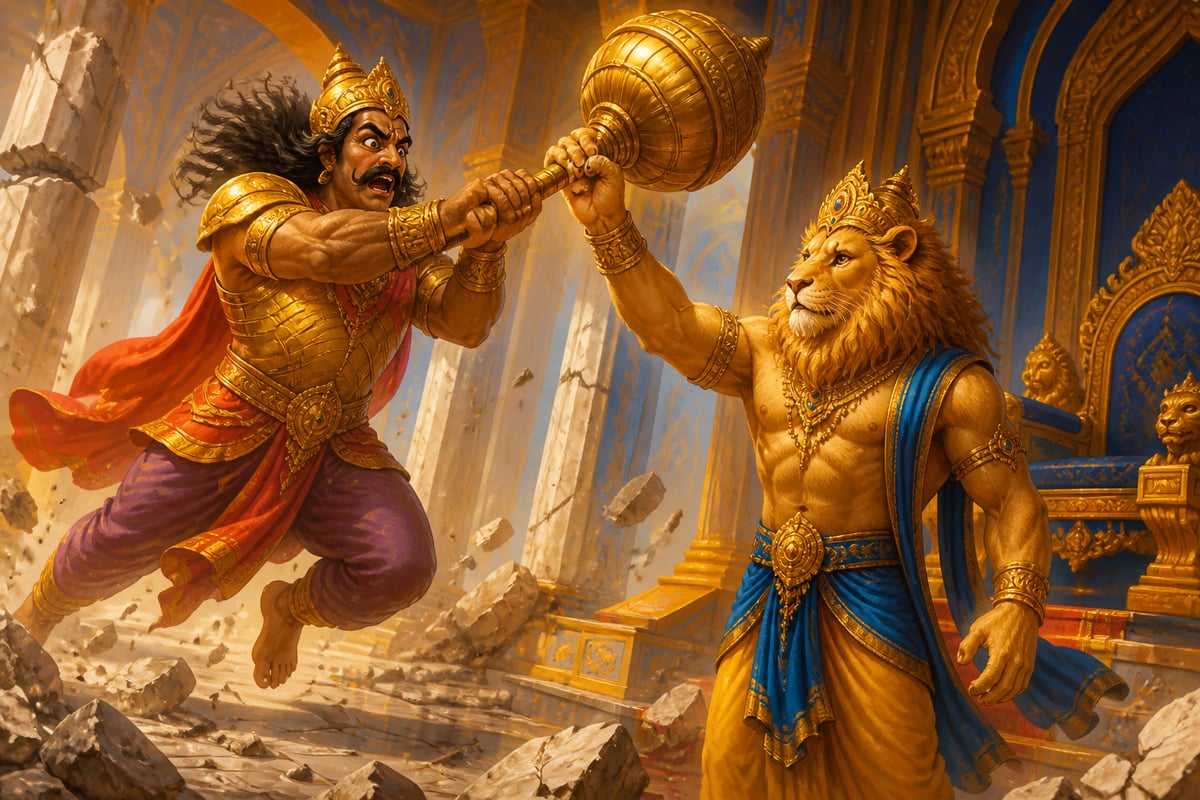
Narasimha catches Hiranyakashipu's mace

He struck at Narasimha with his mace, but the Lord caught it as if it were a child's toy. He launched astras - divine missiles - but they dissolved in the Lord's aura. He attacked with his bare hands, mighty enough to crack mountains, but could find no purchase on that leonine form.

The Lord, it seemed, was playing with him - allowing attacks, dodging effortlessly, demonstrating that all of Hiranyakashipu's power was nothing before the Creator of that power.

The Game of Cat and Mouse

At one point, Narasimha allowed Hiranyakashipu to seemingly escape, giving the demon false hope. The demon fled momentarily, then turned and attacked again with renewed fury. This happened several times, like a cat playing with a mouse before the final strike.

The Bhagavatam explains this delay: the Lord was waiting for the exact moment when all conditions of Brahma's boon would be satisfied:

The Final Moment

Narasimha kills the demon on the threshold

As the sun touched the horizon - that magical moment of sandhya when day and night meet - Narasimha seized Hiranyakashipu. The demon, exhausted from futile attacks, found himself in an unbreakable grip.

The Lord carried him to the doorway of the palace - the dehali, the threshold that belonged to neither inside nor outside. There, Lord Narasimha sat on the ground and placed Hiranyakashipu across His lap.

On the threshold (neither inside nor outside) At twilight (neither day nor night) On the Lord's lap (neither earth nor sky) Using claws (not weapons) The form of Narasimha (neither man nor beast) The Lord Himself (not a created being)

Every condition of Brahma's boon was satisfied while being circumvented.

The End of Hiranyakashipu

With His terrible claws - not weapons forged by any smith - Lord Narasimha tore open the demon's abdomen, just as a lion tears its prey. The demon who had terrorized three worlds, who had thought himself immortal, died in a moment.

But the Lord was not finished. He wore Hiranyakashipu's entrails as a garland. He sat on the demon's throne, the body before Him, His face still blazing with fury. The demon's death had not cooled His wrath - for this form had arisen not just to kill but to express the accumulated anger of the cosmos against one who had oppressed all creation.

Lord Narasimha sits wrathful on the demon king's vacated throne, His golden mane spreading wildly and a garland of demon entrails draped across His chest.

The Terror of the Gods

Word spread through the three worlds: Hiranyakashipu was dead. The gods emerged from hiding. The sages who had fled returned. All creation rejoiced.

But a new problem arose: Lord Narasimha's fury had not subsided.

The Lord sat on the throne, His mane spreading in all directions, His eyes still blazing like cosmic fires, His roar still shaking the foundations of reality. The very form that had liberated the universe now terrified it.

Brahma approached first, offering hymns of praise. The Lord did not respond.

Lakshmi, the Lord's eternal consort, came forward. Even She could not pacify Him - this form was beyond even Her gentle influence.

The gods sent their most eloquent members to offer prayers. The Lord remained unmoved.

The Bhagavatam describes the scene with striking imagery:

The Lord's anger was like a forest fire that, having consumed its original fuel (Hiranyakashipu), continued to rage, threatening to consume everything else. The heat of His fury disturbed even the celestial regions. The gods feared He might destroy creation itself in His wrath.

Why Such Fury?

Commentators offer several explanations for the Lord's prolonged anger:

1. Accumulated grievance Hiranyakashipu had not merely challenged the Lord personally - he had oppressed devotees, destroyed temples, banned worship, and terrorized innocent beings throughout creation. The Lord's anger represented the accumulated grievance of all these victims.

2. Protective instinct The form of Narasimha had arisen specifically to protect Prahlada. That protective instinct remained active even after the threat was eliminated.

3. Divine drama (lila) The Lord was setting the stage for Prahlada's glorification. Only the child devotee would be able to pacify what gods and goddesses could not.

4. Teaching moment The scene demonstrated that while the Lord is infinitely merciful, He is also capable of infinite wrath against those who harm His devotees.

Prahlada Steps Forward

As the gods retreated in fear, a small figure walked calmly toward the terrible form. It was Prahlada - the five-year-old whose faith had called forth this manifestation.

While others saw only terror, Prahlada saw his beloved Lord. While others heard only terrifying roars, Prahlada heard the voice that had protected him through every trial.

He approached without fear, for what he saw was not a monster but his protector, his guardian, his everything. The same Lord who had been in the fire, in the poison, in the elephants - was now before him in visible form.

Brahma, recognizing that conventional approaches had failed, asked Prahlada to attempt what no one else could do: pacify the Lord.

The child walked forward, and something remarkable happened. The Lord's expression began to soften. The roars quieted. The blazing eyes focused on the small devotee approaching.

In the next lesson, we will hear Prahlada's famous prayers - the Prahlada Stuti - one of the five great prayers (Pancha Stuti) of the Bhagavatam tradition. These prayers not only pacified the Lord but revealed the depths of Prahlada's wisdom and love.

The Theological Significance of Narasimha

The Narasimha avatar carries profound meaning:

1. Protection of devotees is paramount The Lord took an unprecedented form specifically to protect one child devotee. No form was too strange, no manifestation too dramatic, when a devotee needed help.

2. Divine intelligence exceeds all calculation Hiranyakashipu's elaborate boons seemed foolproof. The Lord's response demonstrated that divine intelligence can always find a way.

3. The Lord transcends categories Narasimha is neither man nor animal, appearing at neither day nor night, killing at neither inside nor outside. This form demonstrates that the Lord is beyond all material categories and classifications.

4. Fierce love Narasimha's terrifying appearance is the flip side of infinite love. The same Lord who nurtures can destroy - and does so precisely to protect what He loves.

Living traditions

Lord Narasimha remains one of the most worshipped forms of Vishnu, especially for those seeking protection. His image is common in Hindu homes as a protective presence. The Narasimha Kavacham has been set to music and is available in countless recordings. Modern Vaishnava organizations like ISKCON have spread His worship globally.

Reflection

More in Skanda 7: Science of God

All lessons in Skanda 7: Science of God ยท Srimad Bhagavatham course