Navavidha Bhakti: Nine Processes of Devotion
Teaching his classmates devotion
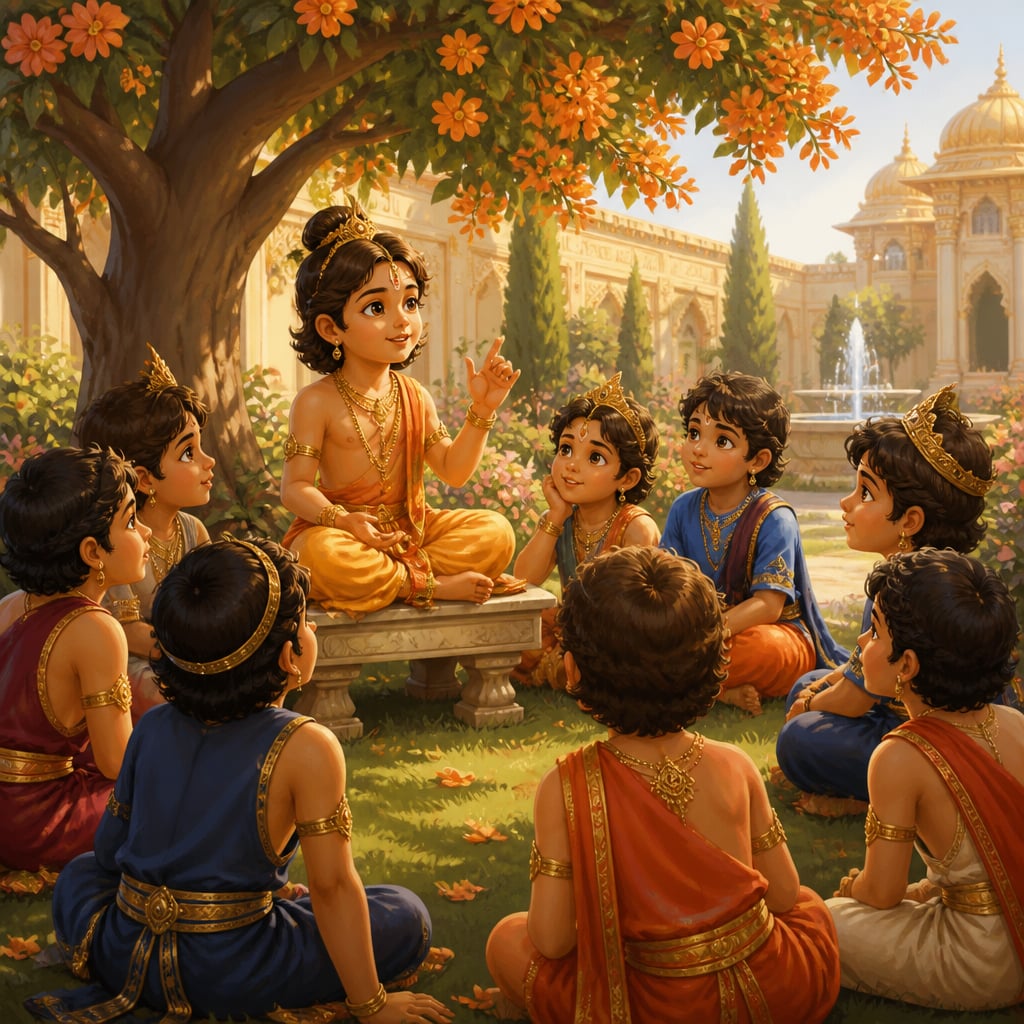
Prahlada teaches his demon classmates the nine processes of bhakti: hearing, chanting, remembering, serving, worshiping, praying, servitorship, friendship, and complete surrender. This becomes the definitive framework for devotional practice in the Bhagavatam tradition.
The Secret Classroom
While Shanda and Amarka taught their official curriculum of demon statecraft, a different kind of education was taking place in the corners of the schoolyard. During breaks, when the teachers retreated for their own rest, the demon children would gather around Prahlada, drawn by something inexplicable in his peaceful demeanor.
These were not ordinary children. They were the sons of demon lords, raised on stories of conquest and trained for violence. Yet something in Prahlada's presence touched a deeper chord within them.
"Prahlada," they would ask, "why are you so different? We are taught to fear our enemies and crush our rivals. But you fear no one. What do you know that we don't?"
And Prahlada, with the patience of an ancient sage in a child's body, would teach them the path of bhakti - devotion to Lord Vishnu.
The Foundation Teaching
Prahlada began with the essential truth that would frame everything else:
"Friends, this human form of life is rare and precious. The soul wanders through 8,400,000 species - from microbes to celestial beings. Only in the human form can one consciously seek liberation. Do not waste this opportunity."
The children objected: "But Prahlada, we are demons, not humans! And we are young. These matters are for old sages."
Prahlada's response was profound:
"The soul has no caste - demon or god, high or low. These are costumes worn by the eternal self. And as for age - life is uncertain. Many do not reach old age. And even those who do spend their final years in weakness and regret. The intelligent person begins now, in youth, when the body is strong and the mind is fresh."
The Nine Limbs of Bhakti
Then Prahlada taught what would become the most famous framework for devotional practice in all of Hindu tradition - the Navavidha Bhakti, the nine processes of devotion:
1. Shravanam - Hearing
"The first process is shravanam - hearing about the Lord. When we hear of His names, forms, qualities, and pastimes, the contamination of material attachment is washed away."
What to hear:
- The names of the Lord (Vishnu, Krishna, Narayana)
- His divine attributes (all-merciful, all-knowing, all-powerful)
- His transcendental pastimes (lilas)
- Stories of His devotees
How to hear:
- From authentic sources and realized souls
- With faith and attention
- Repeatedly, for the effect deepens with repetition
- Without mental speculation or skepticism
Prahlada explained: "Hearing is the foundation because it awakens all other processes. How can one chant without first hearing? How can one remember what one has never heard?"
2. Kirtanam - Chanting

"The second process is kirtanam - chanting the glories of the Lord. What enters through hearing should emerge through chanting. The tongue that speaks His names becomes purified, and that purification spreads throughout the body."
Forms of kirtanam:
- Singing devotional songs
- Repeating the Lord's names (japa)
- Reciting scriptures aloud
- Speaking about God to others
- Congregational chanting (sankirtan)
Prahlada noted: "Kirtanam is especially powerful in this age. While other processes require purity and qualification, chanting works even for the fallen. The holy name does not depend on the purity of the one who chants - it is powerful in itself."
3. Smaranam - Remembering
"The third process is smaranam - remembering the Lord at all times. The mind naturally dwells on what we love. When the heart is attached to God, the mind naturally thinks of Him."
Prahlada distinguished three levels:
| Level | Description | Example |
|---|---|---|
| General remembrance | Occasional thoughts of God | Remembering God during prayer times |
| Meditation (dhyana) | Focused contemplation | Sitting to meditate on the Lord's form |
| Constant remembrance (dhruva-anusmriti) | Unbroken awareness | The Lord's presence underlying all thoughts |
"The goal," Prahlada said, "is to reach a state where the Lord is never forgotten, even for a moment. This takes practice, but hearing and chanting lead naturally to remembering."
4. Pada-sevanam - Serving the Lotus Feet
"The fourth process is pada-sevanam - serving the Lord's lotus feet. This means engaging the body in acts of service - visiting temples, circumambulating sacred sites, performing physical seva."
Prahlada explained the symbolism: "The lotus feet represent the Lord's mercy. Just as the lotus grows from mud but remains unstained, the Lord's feet bring purity to all they touch. By serving those feet - physically or mentally - we receive that purifying mercy."
Practical forms:
- Walking to holy places (tirtha-yatra)
- Serving in temples
- Prostrating before the Lord
- Massaging the feet of the deity
- Any physical service offered with devotion
5. Arcanam - Deity Worship
"The fifth process is arcanam - worshiping the Lord in His deity form. The Lord, out of compassion, accepts a form made of wood, stone, or metal, allowing devotees to serve Him directly."
The children asked: "How can God be limited to a statue?"
Prahlada answered: "God is not limited - He is unlimited. It is His unlimitedness that allows Him to be present anywhere He is invited. The deity is not an idol representing God; the deity is God Himself, graciously making Himself visible and touchable."
Elements of arcana:
- Bathing the deity (abhisheka)
- Dressing and decorating
- Offering food, flowers, incense
- Waving lamps (arati)
- Offering prayers
6. Vandanam - Offering Prayers
"The sixth process is vandanam - offering prayers and obeisances. This is the heart crying out to the Lord, expressing love, need, gratitude, or surrender."
Prahlada distinguished prayer from mere petition: "Many pray only when they want something. True vandanam is conversation with the Beloved - sometimes asking, but more often praising, thanking, or simply expressing love."
Types of prayers:
- Stutis (hymns of praise)
- Prayers of gratitude
- Prayers of surrender
- Prayers of confession and seeking forgiveness
- Spontaneous prayers from the heart
7. Dasyam - Servitorship

"The seventh process is dasyam - the mood of being God's servant. This is not mere service, but an attitude: 'I am His, and all my abilities belong to Him.'"
This mood, Prahlada explained, involves:
- Feeling oneself to be the Lord's property
- Acting for His pleasure rather than one's own
- Accepting His will in all circumstances
- Using one's talents, wealth, and time in His service
"The servant-mood," he said, "is liberating, not binding. When we serve a material master, our service increases bondage. When we serve the Lord, every act of service brings freedom."
8. Sakhyam - Friendship
"The eighth process is sakhyam - friendship with the Lord. This is more intimate than servitorship. The friend speaks freely with God, shares secrets, and experiences mutual affection."
Prahlada noted that this mood requires maturity: "One cannot skip the servant-mood and jump to friendship. But for advanced devotees, the Lord reveals Himself as friend, companion, and confidant. Arjuna experienced this with Krishna."
9. Atma-nivedanam - Complete Surrender
"The ninth process is atma-nivedanam - offering one's entire self to the Lord. This is the culmination of all other processes. The devotee holds nothing back - body, mind, words, possessions, even one's individual identity is placed at God's feet."
This surrender, Prahlada emphasized, is not resignation but liberation:
"When a drop of water surrenders to the ocean, does it lose itself or find itself? It becomes oceanic. When the soul surrenders to God, it does not cease to exist - it becomes infinite."
The Teaching's Power
The demon children listened with increasing wonder. These were not abstract philosophies but practical paths they could walk. Some began quietly chanting. Others asked Prahlada to tell them more stories of Vishnu's pastimes.
Unaware that their teachers were watching from the shadows, the children were being transformed. The seeds of devotion, planted by Prahlada's words, began to sprout in soil that had been prepared only for hatred.
When Shanda and Amarka reported this to Hiranyakashipu, the demon king's fury knew no bounds. His own son was not merely a devotee himself - he was creating devotees among the demon children. The infection was spreading.
The Integration
Prahlada concluded his teaching by showing how the nine processes work together:
"These nine are not separate compartments but aspects of one devotion. When you hear (shravanam), you naturally want to chant (kirtanam). Chanting leads to remembering (smaranam). Remembering awakens the desire to serve (pada-sevanam) and worship (arcanam). Service and worship overflow into prayer (vandanam). Prayer deepens into the servant's mood (dasyam), which matures into friendship (sakhyam). And friendship culminates in total surrender (atma-nivedanam)."
He added a crucial point: "One need not practice all nine equally. Perfection in even one process leads to perfection. Parikshit achieved liberation through hearing alone. Shukadeva through chanting. Uddhava through remembering. Lakshmi through serving the Lord's feet. Akrura through prayer. Hanuman through service. Arjuna through friendship. Bali through surrender."
The Revolutionary Teaching
What made Prahlada's teaching revolutionary was its accessibility. He was not speaking to sages in a forest but to demon children in a hostile environment. His message was clear: bhakti is available to everyone, regardless of birth, qualification, or circumstances.
This teaching would echo through millennia. The same nine processes taught by a five-year-old demon prince would become the foundation of:
- The Bhagavata tradition
- The Alvar saints of South India
- The North Indian Bhakti movement
- The Gaudiya Vaishnava tradition (including ISKCON)
- Countless devotional lineages worldwide
All trace their essential practice back to these verses spoken by Prahlada to his demon classmates in the schoolyard of the tyrant's palace.
Living traditions
Prahlada's nine processes remain the framework for devotional practice across all Vaishnava traditions. ISKCON's worldwide movement is built on shravanam-kirtanam - hearing and chanting. The daily schedule of ISKCON temples directly implements Prahlada's teaching: morning hearing (Bhagavatam class), japa (personal chanting), arcanam (deity worship), and seva (service). The Hare Krishna mahamantra, chanted by millions, is a direct application of kirtanam.
- Daily Bhagavata Shravanam: The practice of hearing Srimad Bhagavatam recitation daily, especially the morning Bhagavatam class in ISKCON temples worldwide
- Japa Meditation: The practice of chanting the Lord's names on a mala (prayer beads), typically 16 rounds of the Hare Krishna mahamantra daily
- Temple Seva: Volunteer service in temples - cooking prasadam, cleaning, decorating, assisting with worship
- Mayapur: Birthplace of Chaitanya Mahaprabhu who particularly emphasized nama-sankirtan (congregational chanting) as the yuga-dharma for this age. Home to the Temple of the Vedic Planetarium.
- Sri Rangam Temple: One of the largest functioning Hindu temples, famous for elaborate deity worship (arcanam) following Pancharatra agama rules. The deity Sri Ranganatha is served with 24/7 rituals.
Reflection
- Of the nine processes of bhakti, which resonates most naturally with you? Why do you think this is? How might you deepen your practice of this process?
- Prahlada taught advanced spiritual truths as a five-year-old child. What does this suggest about the relationship between age, formal education, and genuine wisdom?
- The 'blind leading blind' metaphor suggests we often follow guides who are themselves lost. Who are your actual guides in life (not just declared teachers, but those whose opinions shape your choices)? Are they leading you toward truth or away from it?