Prahlada: "He is Everywhere"

The pillar confrontation

The final confrontation between father and son. 'Where is your Vishnu?' demands Hiranyakashipu. 'Everywhere - even in this pillar,' Prahlada replies. The demon strikes the pillar in mockery, and what emerges will shake creation to its foundations.

The Final Confrontation

The torture methods had failed. Prahlada had survived weapons, elephants, serpents, fire, poison, cliffs, storms, and starvation. Each failure had increased Hiranyakashipu's rage and confusion. How could the conqueror of the three worlds, holder of Brahma's boons, fail to kill a five-year-old child?

Finally, unable to contain his fury any longer, the demon king confronted his son directly. The Bhagavatam describes this scene with dramatic intensity - the massive demon towering over the small child, his eyes blazing with rage.

The Debate

"Prahlada, you worthless wretch! You dare to worship my enemy? I have conquered Indra! I have driven the gods from heaven! The sun and moon obey my command! Yet you, my own son, bow to Vishnu?"

Prahlada remained calm:

"Father, my devotion to the Lord is not foolishness but wisdom. The same Lord who gives you your power, who maintains the universe - how can worshiping Him be wrong? He is the supreme being, and you, like everyone else, are His part."

"Where is Your Vishnu?"

The demon king leaned close to his son:
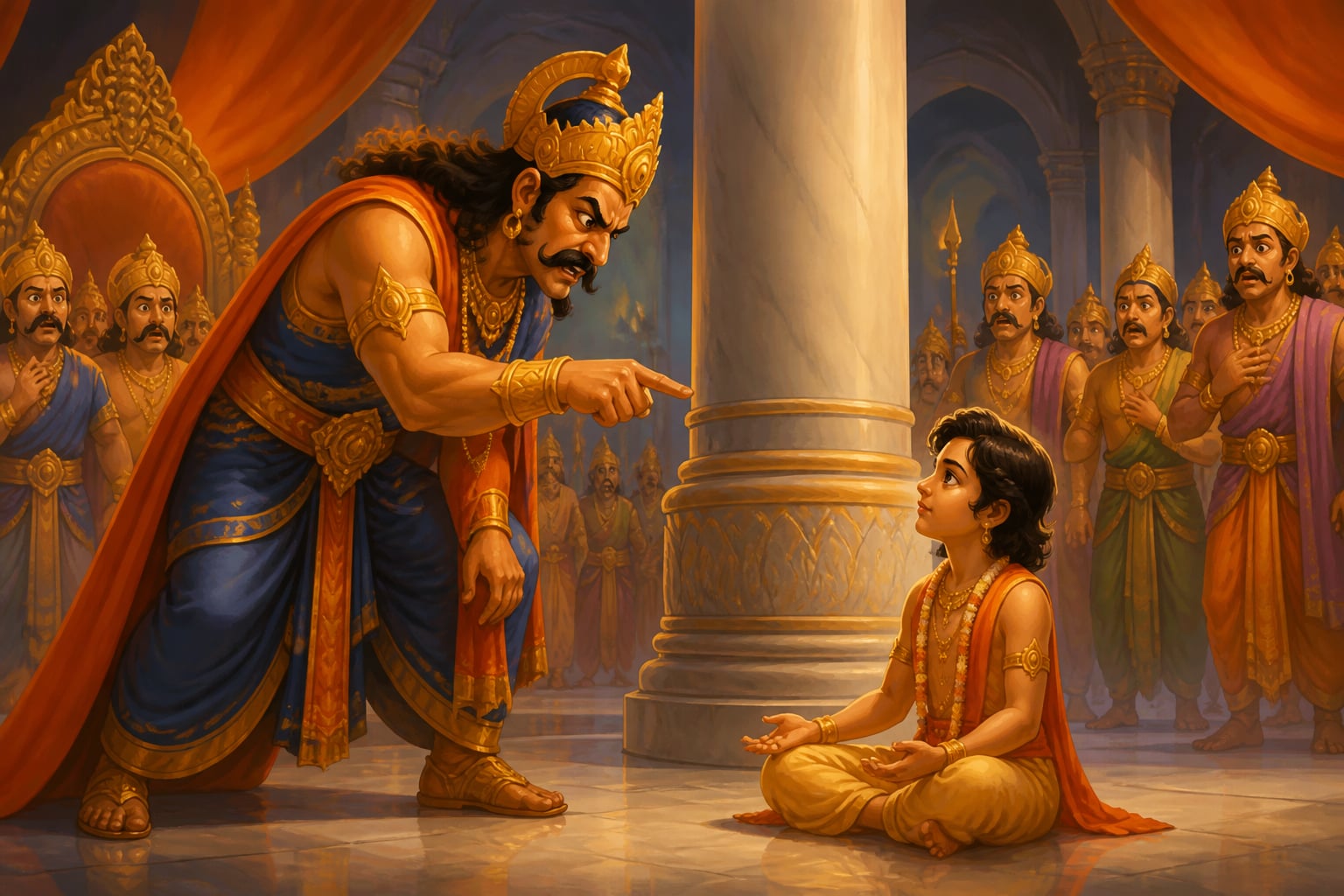
Hiranyakashipu demands where is your Vishnu

"Tell me, boy - if your Vishnu is so powerful, where is He? Why doesn't He come to save you? Why doesn't He face ME instead of hiding behind a child?"

Prahlada's answer changed everything:

"Father, the Lord is not hiding. He is everywhere. He is in the fire that could not burn me. He is in the elephants that would not trample me. He is in every atom of creation. You cannot escape Him because there is nowhere He is not."

Hiranyakashipu's eyes narrowed:

"Everywhere, is He? Is He in this pillar?" He gestured mockingly at a massive stone column in the assembly hall.

"Yes," Prahlada replied without hesitation. "He is in that pillar."

The Moment

With a roar of contemptuous fury, Hiranyakashipu raised his mace and struck the pillar with all his enormous strength.

Hiranyakashipu brings his heavy mace down with two-handed fury against a tall stone pillar while young Prahlada stands calmly nearby with folded hands.

"Then let Him come out and save you!"

What happened next shook the universe:

A tremendous sound filled the palace - so strange and terrible that even Hiranyakashipu stepped back. It seemed to come from everywhere and nowhere, as if the very fabric of reality was tearing apart.

The pillar began to crack. But what emerged was not stone fragments. A form began to manifest - unlike anything the three worlds had ever seen.

The Impossible Form

From the broken pillar emerged Lord Narasimha - the Man-Lion incarnation of Vishnu:

Feature Description
Head Ferocious lion with blazing eyes
Body Powerful man's torso and limbs
Arms Seemed to fill the sky
Claws Like thunderbolts
Mane Standing erect like flames
Expression Cosmic rage personified

The courtiers fled in terror. The guards dropped their weapons. The very walls seemed to shake in fear.

Only Prahlada remained peaceful, his eyes filled with tears of joy. His Lord had come.

Why This Form?

The form of Narasimha was divine intelligence responding to every condition of Hiranyakashipu's boons:

Boon Condition Narasimha's Answer
"Not killed by man" He is half-man
"Not killed by beast" He is half-lion
"Not killed by weapon" Killed by claws
"Not killed inside" On the threshold
"Not killed outside" On the threshold
"Not killed on earth" On His lap
"Not killed in sky" On His lap
"Not killed by day" At twilight
"Not killed by night" At twilight
"Not by created being" He is the Creator

Every loophole, every condition - the Lord found a way through all of them while technically violating none.

The Divine Logic

Hiranyakashipu had tried to achieve immortality through exhaustive negation - listing everything that could NOT kill him. But his list, however long, remained finite. Against the infinite intelligence of the Divine, finite protection must eventually fail.

Prahlada's Vision

While the court saw only terror, Prahlada saw something different. He saw his beloved Lord appearing in response to his faith. He understood that this terrifying form was as much an expression of divine grace as the gentle Vishnu. The same Lord who protects can also destroy - and He destroys precisely to protect.

The Significance of the Pillar

1. Answering the Challenge Hiranyakashipu mocked the idea that Vishnu could be in the pillar. The Lord responded by literally emerging from it.

2. The Stambha Symbolism The pillar (stambha) represents the cosmic axis - the support of the universe. By emerging from the pillar, the Lord showed Himself as the true support of existence.

3. Breaking the Illusion Hiranyakashipu's palace was built on pillars. When the Lord emerged from one, He symbolically demolished the foundation of demonic pride.

4. Manifest and Unmanifest The pillar appeared solid and material, but contained the Lord. Similarly, all material reality is sustained by divine presence. The Lord was always in the pillar; Hiranyakashipu's blow simply revealed Him.

The Pause Before Battle

For a moment, time seemed to stop. Lord Narasimha surveyed the assembly. Hiranyakashipu, for perhaps the first time in his existence, felt something he had made others feel countless times - fear.

But demons do not surrender easily. Recovering from his initial shock, Hiranyakashipu did what he had always done when confronted with opposition: he attacked.

What followed would be the most dramatic battle in all of the Puranas. But the outcome was never in doubt. Because when the devotee calls, the Lord answers. And when the Lord answers, nothing in all the three worlds can stand against Him.

Living traditions

The pillar scene has become one of the most depicted moments in Hindu art. It appears in countless temple carvings, calendar paintings, and children's books. The phrase 'He is in this pillar too' has become a popular expression of faith in God's omnipresence. Many Hindus keep images of Narasimha emerging from the pillar in their homes as a reminder of divine protection.

Reflection

More in Skanda 7: Science of God

All lessons in Skanda 7: Science of God ยท Srimad Bhagavatham course