Stuti: Kunti and Bhishma's Prayers
Two of the Pancha Stutis
Queen Kunti offers her famous prayers to Lord Krishna, revealing deep bhakti philosophy through her sufferings. Grandfather Bhishma, on his bed of arrows, delivers his final glorification of the Lord. These two prayers are among the five most celebrated hymns in the Bhagavatam.
The Five Great Prayers
Within the Srimad Bhagavatam, certain prayers stand out as gems of devotional literature. Tradition celebrates five prayers (Pancha Stuti) as the most exalted:
- Kunti Stuti - The prayers of Queen Kunti (First Skanda)
- Bhishma Stuti - The prayers of Grandfather Bhishma (First Skanda)
- Gajendra Stuti - The prayers of Gajendra the elephant (Eighth Skanda)
- Prahlada Stuti - The prayers of young Prahlada (Seventh Skanda)
- Gopis' Stuti - The prayers of the cowherd women (Tenth Skanda)
In this lesson, we explore the first two - prayers that emerge from very different circumstances yet reveal the same profound truth: suffering can become the gateway to grace.
The Context: Krishna Prepares to Leave
The Kurukshetra war had ended. The Pandavas were victorious but grieving. They had lost their sons, their teachers, and millions of warriors who had been their brothers-in-arms.
Through it all, Lord Krishna had been their guide, protector, and friend. He had served as Arjuna's charioteer, navigated impossible political situations, and ensured their survival against overwhelming odds.
Now Krishna was preparing to return to His kingdom of Dwaraka. The Pandavas and their mother Kunti faced the prospect of life without His immediate presence.
Queen Kunti's Prayers
Kunti, aunt of Krishna and mother of the Pandavas, stepped forward. This was not a young woman speaking - she was elderly, worn by decades of suffering, widowed, exiled, and hunted. Yet through all her trials, Krishna had been her refuge.
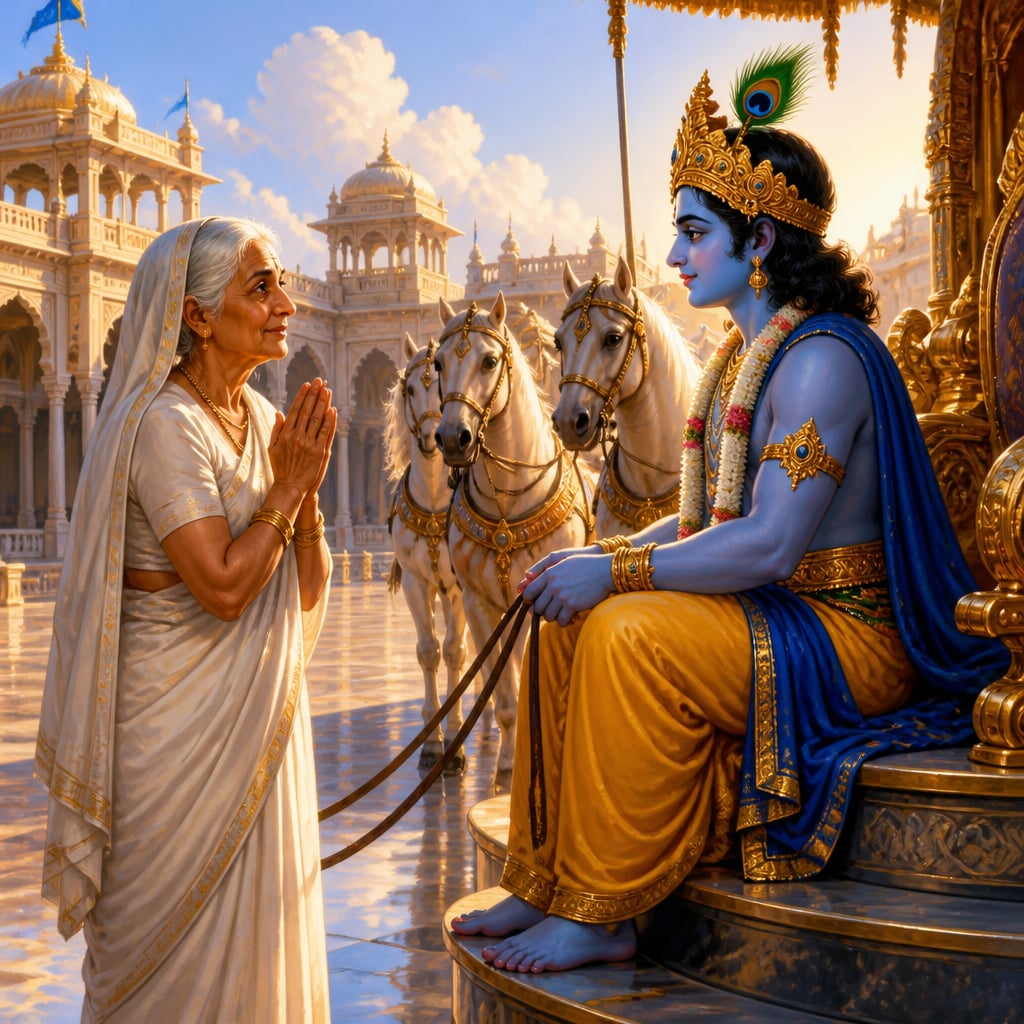
Her prayers are remarkable because she asks not for comfort but for continued difficulty:
Prayer for Continued Suffering
"विपदः सन्तु ताः शश्वत्तत्र तत्र जगद्गुरो। भवतो दर्शनं यत्स्यादपुनर्भवदर्शनम्॥"
"Let calamities come again and again, O Lord of the universe, for in those calamities You become visible to us. And seeing You means never being born again in this world."
This verse revolutionizes our understanding of difficulty. Most prayers ask for removal of problems. Kunti asks for their continuation - because problems brought Krishna closer.
In prosperity, she explains, people forget God. They become proud, self-sufficient, and blind to their dependence on the Divine. But in adversity, the ego shatters. In helplessness, we turn to the only true helper.
The Logic of Her Prayer
Kunti's reasoning was not masochistic but deeply practical:
- When the Pandavas were exiled, Krishna visited them in the forest
- When Draupadi was being disrobed, Krishna's protection manifested
- When the palace of lac was burning, Krishna guided their escape
- When enemies surrounded them, Krishna became their charioteer
Pattern: Difficulty brought Krishna; comfort made them forget Him.
Therefore, she concludes, difficulties are actually blessings disguised as problems. They accomplish what prosperity cannot: they draw the soul toward the Divine.
Birth and Detachment
Kunti also prayed for understanding of Krishna's transcendence:
"Though You appear to be born in the Yadu dynasty, You are the unborn Lord of creation. Though You seem to be a human being, You are beyond material nature. Let me always remember this truth."
This prayer addresses a fundamental challenge of devotion: Krishna appears so human - eating, sleeping, fighting, playing - that devotees can forget His divinity. Kunti asks for the vision that sees both: the approachable friend who is simultaneously the Supreme Lord.
Grandfather Bhishma's Prayers
Meanwhile, another great soul was preparing to depart this world.

Bhishma, the grandsire of both the Pandavas and Kauravas, lay on a bed of arrows. He had fallen in battle to Arjuna (with Krishna's help) and now awaited the auspicious moment to leave his body - for he had the boon of choosing his own death.
As he lay with hundreds of arrows piercing his body, he used his remaining time for the highest purpose: glorifying the Lord.
The Paradox of Bhishma's Position
Bhishma's situation was painfully ironic. He had been Krishna's devotee, yet he had fought against Krishna's side. He had protected the Pandavas as children, yet he had nearly killed them in battle. He knew dharma better than anyone, yet he had watched silently as Draupadi was insulted.
How does such a devotee face death?
Bhishma resolved the paradox through deeper understanding: he had played his role in the cosmic drama, but his heart had always belonged to Krishna. Even his opposition had been arranged by the Lord to glorify His devotees.
Vision of Krishna as Warrior

"At the moment of death, let my mind be fixed on Shri Krishna, His chariot flying His flag, dust on His face from the battlefield, His hair disheveled from the fighting, His body marked with wounds from my arrows."
This is remarkable: Bhishma wanted to remember Krishna not in His peaceful, beautiful form, but in His fierce warrior aspect - covered in dust, marked by battle wounds that Bhishma himself had caused.
Why this strange prayer?
Because this was the Krishna Bhishma knew best. This was the form that had charged toward him on the battlefield, making his heart swell with devotional joy even as they fought as enemies. Bhishma wanted to die remembering his most intimate experience of the Lord.
The Joy of Fighting God
Bhishma revealed that fighting against Krishna had actually been a form of devotion:
"When I saw Krishna rushing toward me, abandoning His vow not to take up weapons, just to protect His devotee Arjuna, my heart was filled with the greatest bliss."
Even in apparent opposition, the devotee finds joy. Bhishma was not Krishna's enemy - he was playing a role that allowed Krishna's glories to manifest. The battlefield became a temple; the combat became worship.
Final Instructions
Before leaving his body, Bhishma gave extensive teachings on dharma, politics, and spiritual life. But he concluded with the essence:
"For those who desire liberation, there is nothing better than to take shelter of Krishna. Those who do so will never be bewildered about their ultimate welfare."
With this final glorification, as the sun reached its auspicious northern course, Bhishma withdrew his mind, fixed it on Krishna, and departed this world.
The Philosophy of the Two Prayers
Suffering as Grace
Kunti's prayer establishes a revolutionary spiritual principle: adversity can be a form of divine grace. Not because suffering is good in itself, but because:
- It breaks the ego's illusion of self-sufficiency
- It forces us to seek help beyond our own resources
- It creates opportunities for divine intervention
- It reminds us of our true dependence on the Divine
This does not mean we should seek suffering or that all suffering is beneficial. But it does mean we should not resent difficulties that lead us toward God.
Remembrance at Death
Bhishma's prayer establishes another crucial principle: what we remember at death determines our destination.
The Bhagavad Gita states: "Whatever one remembers at the time of death, that state one attains without fail." Bhishma prepared for death by fixing his mind on the form of Krishna he loved most.
The Paradox Resolved
Both prayers share a deeper unity: apparent opposites can serve the same spiritual purpose.
- For Kunti: suffering and prosperity are both opportunities if rightly understood
- For Bhishma: fighting against Krishna and fighting for Krishna are both devotion if the heart is rightly oriented
This liberates us from thinking there is only one way to approach the Divine. Every life circumstance can become a pathway.
Living traditions
Kunti's prayer has become popular in modern devotional circles as a teaching on reframing adversity. Her verse 'vipadaḥ santu' is often quoted in discussions of theodicy (why God allows suffering). Bhishma's example of choosing his death moment has influenced Hindu perspectives on conscious dying.
- Kunti Stuti Patha: Recitation of Queen Kunti's prayers, especially during difficult times, as a means of transforming adversity into spiritual opportunity
- Bhishma Ashtami: Observance of the day Bhishma departed this world, with recitation of his prayers and teachings on dharma
- Bhishma Kund, Kurukshetra: Traditional site where Bhishma lay on his bed of arrows. A water tank (kund) marks the spot where Arjuna shot an arrow into the ground to provide water for the thirsty grandsire.
- Jyotisar, Kurukshetra: The traditional site where Krishna spoke the Bhagavad Gita to Arjuna. A ancient banyan tree marks the spot. Connected to Bhishma's prayers as the same battlefield context.
Reflection
- Kunti asked for continued difficulties because they brought Krishna closer. Looking back on your own life, have your most significant spiritual moments come from times of suffering or times of comfort?
- Kunti said those proud of birth, wealth, education, and beauty cannot approach Krishna. Which of these four might be creating distance between you and the Divine in your life?
- Bhishma chose to remember Krishna in warrior form at death - the form he knew most intimately. What form or aspect of the Divine do you know most intimately? What would you wish to remember at your final moment?