Relevance in 2026 and Beyond
Skanda 1 wisdom for today
How do the teachings of Skanda 1 apply to modern life? From asking the right questions to facing mortality with grace, from protecting dharma to seeking refuge in the Lord - discover timeless wisdom for navigating the challenges of Kali Yuga today.
Living in Kali Yuga: The Bhagavatam's Diagnosis and Prescription
The sages at Naimisharanya asked their questions 5,000 years ago, yet their concerns feel eerily contemporary. They worried about declining values, confusion about priorities, and the spiritual darkness of the coming age. If anything, their predictions have proven too accurate.
But the Bhagavatam does not merely diagnose; it prescribes. Skanda 1 offers specific wisdom for navigating exactly the challenges we face today.
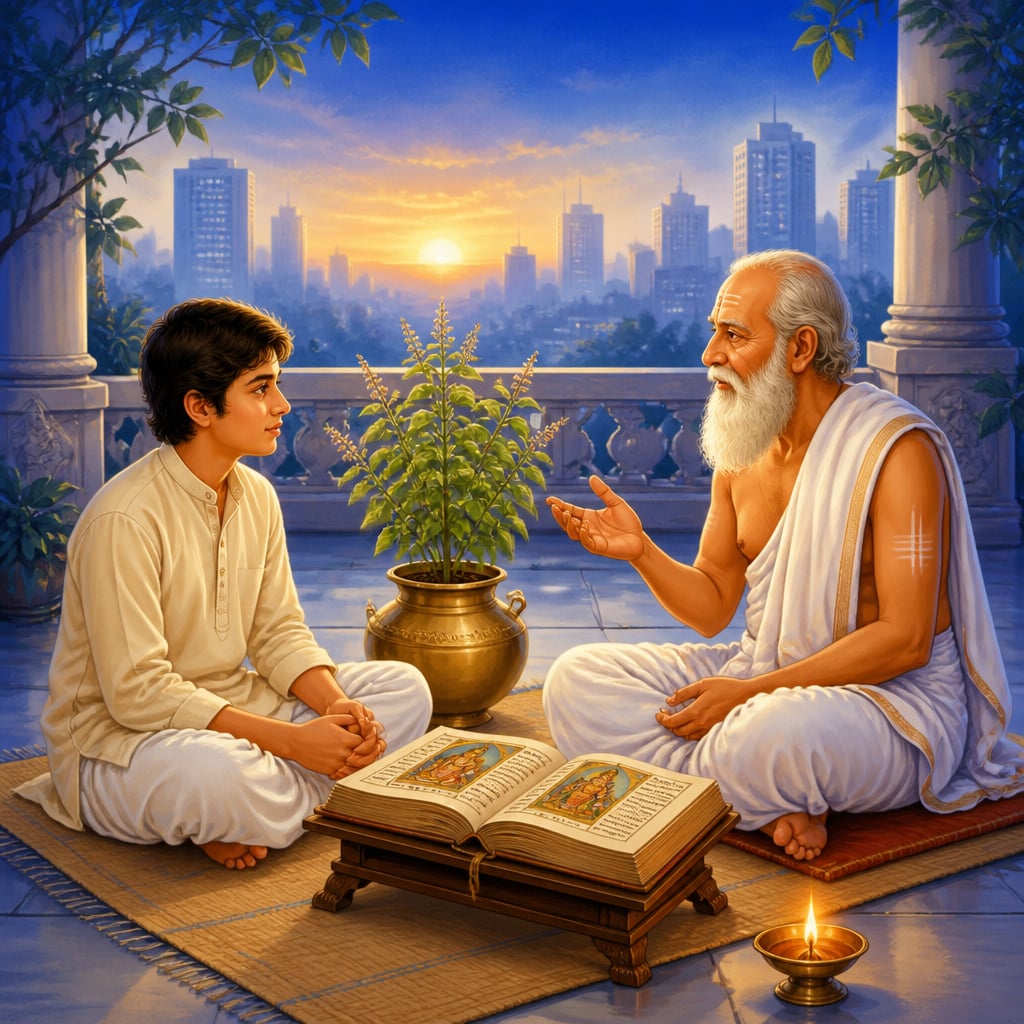
Lesson 1 Revisited: The Power of the Right Question
The sages did not ask: "How can we become wealthy?" or "How can we defeat our enemies?" They asked: "What is the supreme good for all beings, especially in this age of decline?"
Modern Application
In an age of information overload, the quality of our questions determines the quality of our answers. We have access to more information than any previous generation, yet we often feel more confused than enlightened.
Ask better questions:
- Instead of "What should I do for a career?" ask "What contribution can I make that serves both my nature and the world's need?"
- Instead of "How can I be happy?" ask "What kind of person do I need to become to experience genuine fulfillment?"
- Instead of "What's trending?" ask "What is timeless?"
The sages also demonstrated the power of satsanga - spiritual community. They gathered together, pooled their insights, and sought wisdom collectively. In our age of digital isolation, physical communities of genuine seekers become more precious, not less.
Lesson 2 Revisited: Recognizing Divine Manifestation
The Bhagavatam lists 22 incarnations of Vishnu, each appearing when dharma declined and adharma rose. The avatara principle teaches that the Divine intervenes purposefully - not randomly or whimsically.
Modern Application
Recognize divine purpose in unexpected places:
While we may not witness incarnations like Rama or Krishna, we can learn to see divine intelligence at work. Sometimes that intelligence manifests through:
- A teacher who appears at exactly the right moment
- A crisis that forces necessary change
- A seeming obstacle that redirects us toward our true path
Understand intervention as response:
The avataras came not to impose but to respond - to the prayers of devotees, to the cries of the oppressed, to the need of the age. This suggests that our sincere seeking itself draws divine response. The universe is not indifferent to genuine spiritual aspiration.
Lesson 3 Revisited: Protection Against Impossible Odds
Parikshit survived the Brahmastra - the most devastating weapon in existence - because Krishna personally entered the womb to protect him. From this we learn that divine protection is intimate and personal.
Modern Application
The principle of garbha sanskara:
Modern research increasingly confirms what tradition knew: prenatal experiences shape the child. Stress hormones cross the placenta; maternal emotions influence fetal development. The Bhagavatam takes this further: spiritual impressions can be imprinted before birth.
For parents and parents-to-be: the environment you create - physical, emotional, and spiritual - matters more than you might imagine.
Protection requires worthiness:
Krishna protected Parikshit not arbitrarily but because he was destined to play a crucial role. When we align ourselves with dharma, we become worthy of protection not as a reward but as a necessity - the universe needs us to fulfill our purpose.
Lesson 4 Revisited: Transforming Curses into Blessings
The curse of Shringi gave Parikshit only seven days to live. Instead of fighting or fleeing, he transformed this deadline into an opportunity for ultimate seeking. The result: the Bhagavatam itself.
Modern Application
The gift of limits:
Without the curse, Parikshit might have ruled for decades and been forgotten like countless other kings. The deadline created urgency that produced immortal wisdom.
We too have deadlines, though we forget them. Death is certain; the date is unknown. Those who remember this live differently from those who forget.
Shamika's wisdom: justice vs. wisdom:
Shamika asked his son: "Your curse may be just, but was it wise?" The removal of a dharmic king harmed more people than the original offense.
In an age of outrage culture, where punishment often exceeds crime, this teaching is vital. Being technically right is not enough. We must ask: "Will my response create more good than harm?"
Lesson 5 Revisited: Restricting Evil When You Cannot Destroy It
Parikshit could not kill Kali - the personification of the dark age. But he could restrict him to specific domains: gambling, intoxication, illicit relations, violence, and gold-greed.
Modern Application
Create Kali-free zones:
We cannot eliminate the influences of Kali Yuga from the world, but we can limit their access to our lives:
- Reduce exposure to gambling (including speculative investments that function like gambling)
- Limit intoxicants that cloud the mind
- Guard relationship boundaries
- Avoid unnecessary violence (including violent entertainment)
- Examine relationship with money - is it tool or master?
The hidden trap: gold:
Parikshit assigned Kali to dwell wherever there is gold (wealth). From gold comes falsehood, pride, lust, passion, and enmity. This is remarkably relevant in an age where net worth often equals self-worth.
The hidden advantage:

Kali Yuga has one supreme advantage: liberation comes easily through simple, sincere practices. What required elaborate sacrifices in other ages can be achieved through truthful chanting of divine names. This is the grace embedded within the difficulty.
Lesson 6 Revisited: Suffering as Grace and Conscious Death
Kunti's Revolutionary Prayer
Kunti asked for continued calamities because difficulties brought Krishna closer. This reverses our instinctive reaction to suffering.
Modern Application:
This does not mean we should seek suffering or that all suffering is beneficial. But it does offer a framework for reinterpreting difficulty:
- Instead of "Why is this happening to me?" ask "What is this teaching me?"
- Instead of "How can I escape this?" ask "How can I grow through this?"
- Instead of "When will this end?" ask "What would I miss if it ended too soon?"
Pride as obstacle:
Kunti identified pride in birth, wealth, education, and beauty as barriers to divine access. In modern terms:
- Professional credentials can become spiritual obstacles
- Financial success can create the illusion of self-sufficiency
- Physical appearance can become an identity trap
- Family background can generate entitlement
None of these are bad in themselves. They become obstacles only when they generate pride.
Bhishma's Conscious Death
Bhishma chose his moment of death and spent his final days remembering Krishna. He fixed his mind on the form he knew best - the warrior covered in battlefield dust.
Modern Application:
Most people die in hospitals, sedated, surrounded by machines. The art of conscious dying - which every traditional culture taught - has been lost.
Bhishma's example suggests:
- Death should be prepared for, not feared or denied
- What we remember at death matters
- We should practice now the remembrance we want at the end
- The form of the Divine we love most is the one we should cultivate
The Synthesis: A Kali Yuga Survival Guide
From Skanda 1, we can extract a practical framework for spiritual life in our age:
1. Ask the Right Questions In an age of infinite answers, cultivate the art of asking questions that matter. Seek wisdom, not just information. Find communities of genuine seekers.
2. Recognize Divine Presence Learn to see purposeful intelligence in life's events. Understand that sincere seeking draws divine response. The universe is not indifferent.
3. Create Worthy Containers Whether for children or for ourselves, create environments where spiritual impressions can form. Protect what is developing from destructive influences.
4. Transform Limitations Use deadlines, constraints, and difficulties as catalysts rather than obstacles. Remember that the curse created the Bhagavatam.
5. Restrict What You Cannot Destroy Create personal domains where Kali has no access. Limit exposure to his five abodes. Take advantage of the age's hidden gift: simple practices yield great results.
6. Reframe Suffering Without becoming masochistic, understand that difficulty can serve spiritual purposes. Pride blocks divine access; humility opens it.
7. Prepare for Death Remember regularly that life is finite. Cultivate now the remembrance you want at the end. Practice conscious living as preparation for conscious dying.
Conclusion: Why the Bhagavatam Matters Now
The sages at Naimisharanya were not naive. They knew exactly what Kali Yuga would bring - they had seen its beginning. Yet they did not despair. They sought and found what would sustain seekers through the darkness.
That is why the Bhagavatam was spoken. Not for entertainment or historical interest, but as medicine for the age.
The symptoms it addresses - confusion, distraction, declining values, spiritual forgetfulness - are our symptoms. The remedies it offers - proper questions, satsanga, remembrance of the Divine, acceptance of difficulty, simple practices done with sincerity - are remedies we can still apply.
The Bhagavatam promises that even in Kali Yuga, liberation remains possible. Perhaps more possible than ever, for those who sincerely seek.
This is the message of Skanda 1. The remaining eleven skandhas will elaborate, illustrate, and deepen these foundations. But the framework is now complete.
The question is: What will we do with it?
Living traditions
The Bhagavatam's influence on modern Hindu spirituality is incalculable. Gaudiya Vaishnavism (and its global extension through ISKCON) centers on the Bhagavatam as the 'ripened fruit' of Vedic literature. Its teachings on bhakti, avatar theory, and Kali Yuga dharma shape the practice of millions. The simple practice of nama-sankirtana that it prescribes for our age has spread across the globe.
- Srimad Bhagavatam Saptaha: Complete recitation of the Bhagavatam over seven days, recreating Shukadeva's narration to Parikshit. Listeners fast partially and absorb the entire scripture.
- Nama-sankirtana (Congregational Chanting): Group chanting of the divine names, especially the Hare Krishna maha-mantra, as the primary spiritual practice for Kali Yuga
- Naimisharanya (Nimsar): The sacred forest where 88,000 sages gathered and Suta Goswami narrated the Bhagavatam. Considered the most auspicious place for hearing the scripture.
- Sukratal (Shukdeva's Tal): Traditional site on the Ganga where Shukadeva narrated the Bhagavatam to Parikshit over seven days. Ancient banyan tree marks the spot.
- Chakra Tirtha, Naimisharanya: Sacred tank where Vishnu's chakra (discus) is said to have landed, marking the center of the forest. Bathing here is considered highly purifying.
Reflection
- The Bhagavatam describes Kali Yuga people as short-lived, lazy, misguided, unlucky, and disturbed. Without becoming self-condemning, do you recognize any of these tendencies in yourself? Which one is your primary challenge?
- Of Kali's five domains (gambling, intoxication, illicit relations, violence, gold-greed), which has the strongest presence in your life - even in subtle forms? What would reducing it by 50% look like practically?
- If you had only seven days to live, like Parikshit, what would you most regret not having done spiritually? What is stopping you from beginning that now?