Ashirwad: Parikshit's Blessed Birth
Krishna saves the unborn child
Ashwatthama launches the devastating Brahmastra at Uttara's womb. Lord Krishna enters to protect the unborn Parikshit, who is blessed to see the Lord before birth. The child grows to become the ideal king who will hear the entire Bhagavatam.
The Last Heir of the Pandavas
The great Kurukshetra war had ended. The battlefield, which for eighteen days had witnessed the destruction of millions of warriors, now lay silent. The Kauravas were annihilated. But victory had come at a terrible price - nearly all the male heirs of both dynasties had perished.
The Pandavas stood victorious but grieving. Their sons, the five Upapandavas, had been killed in a night raid by Ashwatthama, the son of Dronacharya. In that single act of cowardly treachery, the future of the Pandava line seemed extinguished forever.
But unknown to all, a single hope remained. Uttara, the young widow of Abhimanyu (Arjuna's heroic son who had died in the Chakravyuha), carried a child in her womb. This unborn baby was the last surviving heir of the Kuru dynasty - the final hope for the continuation of the Pandava lineage.
Ashwatthama's Terrible Weapon
Ashwatthama, son of the great Dronacharya, had committed the worst of crimes: killing the sleeping Upapandavas in the dead of night. When confronted by Arjuna, he faced certain death. In desperation, he invoked the Brahmastra - the most devastating weapon in the universe, capable of destroying entire armies.
But Ashwatthama, though he knew the mantra to invoke the weapon, did not know how to withdraw it. Once released, the Brahmastra could not be called back. In his fear and hatred, he directed this unstoppable force at the only remaining heir of his enemies - the unborn child in Uttara's womb.
"Let the entire line of the Pandavas be destroyed forever!" Ashwatthama cried as he released the weapon.
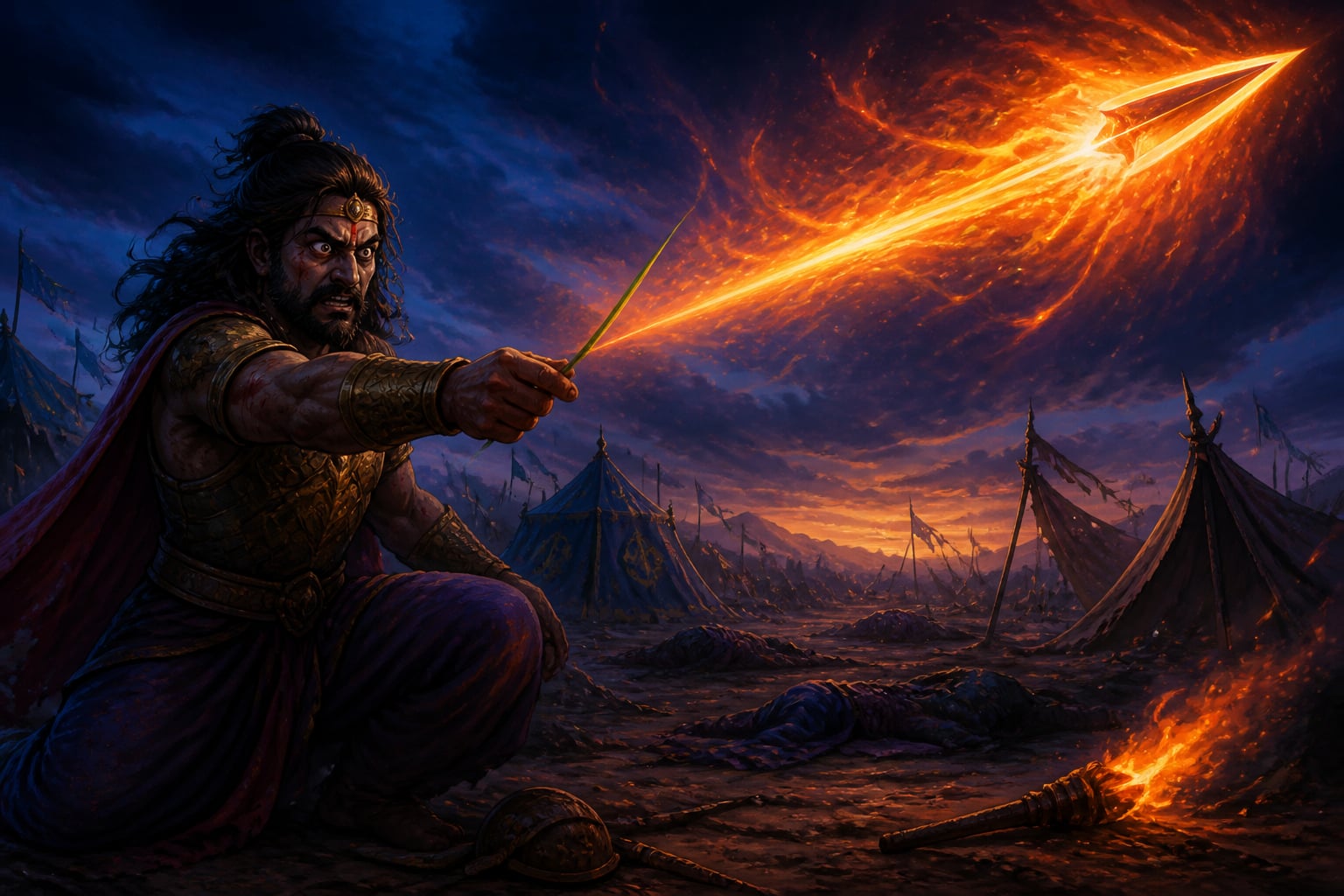
The blazing missile, carrying the destructive power of a cosmic fire, streaked toward the pregnant princess. All who witnessed it knew that nothing in the three worlds could stop a properly invoked Brahmastra.
Uttara's Desperate Plea
Uttara, feeling the scorching heat approaching her womb, ran to Lord Krishna for protection. Though she was just a young woman, facing a weapon that even the greatest warriors could not stop, her faith did not waver.
"O Lord of lords, O Protector of devotees! Only You can save my child. Please protect the last hope of the Pandava dynasty!"
Her prayer was simple but complete: she did not ask for explanations, negotiations, or alternatives. She simply surrendered to the one power greater than any cosmic weapon.
Krishna Enters the Womb
What happened next revealed the true nature of divine protection.
Lord Krishna, seeing His devotee's distress and the approaching destruction, did something unprecedented: He entered Uttara's womb to personally shield the child. Using His divine chakra, the sudarshana, He created a barrier of divine energy around the unborn baby.
The Brahmastra struck - its heat so intense that it could have destroyed planets. But inside the womb, the child felt only the cool, protective presence of the Lord Himself. While cosmic fire raged outside, divine peace reigned within.
This was not simply a case of a weapon being deflected. It was the Supreme Lord personally becoming the protector of an unborn child - entering into the most intimate space to ensure the continuation of a righteous lineage.

The Vision Before Birth
The child in the womb had an experience granted to virtually no other soul: he saw Lord Krishna before being born.
![]()
As the Brahmastra's fire was neutralized by divine energy, the baby perceived a magnificent being - about the height of a thumb (the size appropriate for the space), radiant as lightning, wearing golden garments, wielding the flaming chakra, with a beautiful crown adorned with gems.
This thumb-sized form is described in the Upanishads as the aṅguṣṭha-mātra puruṣa - the Paramatma dwelling within every heart. The child was seeing what yogis spend lifetimes trying to perceive: the Lord in His heart.
This vision would shape the child's entire existence. Though he could not yet think in words or concepts, the impression of divine protection was stamped indelibly on his consciousness.
The Birth of Parikshit
When the child was born, the Pandavas named him Parikshit, meaning "the examiner" or "one who tests." This name referred to the fact that throughout his life, he would constantly look for the same divine form he had seen in the womb.
"Wherever Parikshit went, whomever he met, he would examine them, as if asking: 'Are you the one I saw? Are you that radiant protector who saved me?'"
This constant seeking was not a sign of dissatisfaction but of devotion. The vision had awakened an unquenchable thirst for the Divine that would define his character.
Astrologers who examined the child at birth made remarkable predictions:
- He would be a great king, ruling with perfect dharma
- He would have the strength of a lion and the compassion of a sage
- He would protect the righteous and punish the wicked
- Most remarkably, he would be the catalyst for the speaking of the Bhagavatam itself
The Ideal King
As Parikshit grew, he fulfilled every prediction. Under the guidance of the elderly Pandavas and later his own wisdom, he became an exemplary ruler.
His governance was marked by three principles:
1. Dharma First Every decision was measured against righteousness. He did not allow personal benefit, political convenience, or popular opinion to override what was dharmic.
2. Protection of the Vulnerable Following the kshatriya code, he took special care of those who could not protect themselves - women, children, the elderly, animals, and brahmanas.
3. Preparation for Krishna's Departure As the last king of the dynasty that had Krishna's direct association, Parikshit understood that he ruled in a transition period. The Lord had departed; Kali Yuga had begun. His reign was about preserving dharma in the face of rising darkness.
We will later see how Parikshit confronted Kali directly, restricting the demon of the age to five specific places - an act of dharmic governance that still affects the world today.
The Thread of the Bhagavatam
The survival of Parikshit was essential not just for the Kuru dynasty but for all humanity. Without him:
- There would be no king cursed to die in seven days
- Therefore no desperate need for ultimate wisdom
- Therefore no occasion for Shukadeva to narrate the Bhagavatam
- Therefore no scripture reaching us today
Lord Krishna's protection of Parikshit in the womb was thus protection of the dharma that would sustain countless future generations. The small act of shielding one child became an act of preserving an entire tradition.
The Deeper Meaning
This episode teaches several profound truths:
The Lord Protects His Devotees Personally Krishna did not delegate the protection of Uttara's child to another agent. He entered the womb Himself. This demonstrates that for sincere devotees, the Lord's protection is not abstract but intimately personal.
Weapons Cannot Reach the Divinely Protected The Brahmastra was the most powerful weapon known to the Vedic world. Yet it could not harm one protected by divine grace. This applies to all threats we face: when we take shelter of the Divine, no material force can ultimately harm us.
Vision of God Transforms the Soul Parikshit's womb experience shaped his entire life. Similarly, even a momentary glimpse of divine grace can transform a person forever. The seeking that defined Parikshit's character came from that original vision.
The Lord Plans for Future Generations Krishna protected Parikshit not just for his sake but for ours. The Bhagavatam that we read today exists because of that protection. This reveals divine providence - the Lord working across centuries to ensure His message reaches those who need it.
Living traditions
The story of Parikshit's protection inspires contemporary Hindu families to maintain spiritual environments during pregnancy. Many mothers read the Bhagavatam aloud, play sacred music, and visit temples while pregnant, believing that these impressions benefit the unborn child. The story is frequently depicted in Amar Chitra Katha comics and dramatized in television serials.
- Garbha Sanskara: The practice of exposing unborn children to sacred sounds, mantras, and spiritual environments - inspired by stories like Parikshit's womb experience
- Sudarshana Homam: Fire ritual invoking Lord Vishnu's protective chakra, performed to remove obstacles and negative influences
- Hastinapura: The ancient capital of the Kuru kingdom where Parikshit ruled. Archaeological excavations have revealed settlements dating back to the Painted Grey Ware period (1100-800 BCE).
- Sudarshana Temples: Temples dedicated specifically to Lord Sudarshana, the divine chakra that protected Parikshit. Devotees worship for protection and removal of obstacles.
Reflection
- Uttara ran to Krishna when facing certain death for her child. When you face overwhelming challenges, where do you instinctively turn for help? What does that reveal about your faith?
- Parikshit spent his life seeking the face he had seen in the womb. Have you ever had a spiritual experience that shaped your subsequent seeking? What are you looking for?
- Ashwatthama had great knowledge (how to invoke the Brahmastra) but incomplete knowledge (how to withdraw it). Can you identify areas in your own life where partial knowledge has led to harm?