Shaapa: The Curse of Shringi
Seven days to live
King Parikshit, while hunting, unknowingly insults the meditating sage Shamika by placing a dead snake on him. His young son Shringi curses the king to die from a snake bite in seven days. This curse becomes the catalyst for the Bhagavatam's narration.
A Fateful Hunt
King Parikshit had ruled for many years with dharma as his guide. His kingdom flourished; the people were content. He had confronted Kali himself and restricted the demon to five places. By all measures, his reign was exemplary.
But even the greatest among us can fall to momentary weakness.
One day, the king went hunting in the forest. The chase was long and exhausting. By afternoon, Parikshit was hungry, thirsty, and fatigued - a dangerous combination that clouds judgment.
Wandering through the wilderness seeking water, he came upon a humble hermitage. Inside sat a sage named Shamika, deep in meditation. So absorbed was the sage in his practice that he had entered a state called samadhi - complete withdrawal from external awareness.
Parikshit approached and asked for water. Shamika, lost in meditation, did not respond. The king asked again. Still no response. Exhaustion and thirst transformed into irritation, and irritation into anger.
The Insult
In a moment he would regret for the rest of his (now shortened) life, Parikshit picked up a dead snake lying nearby and placed it around the sage's neck.
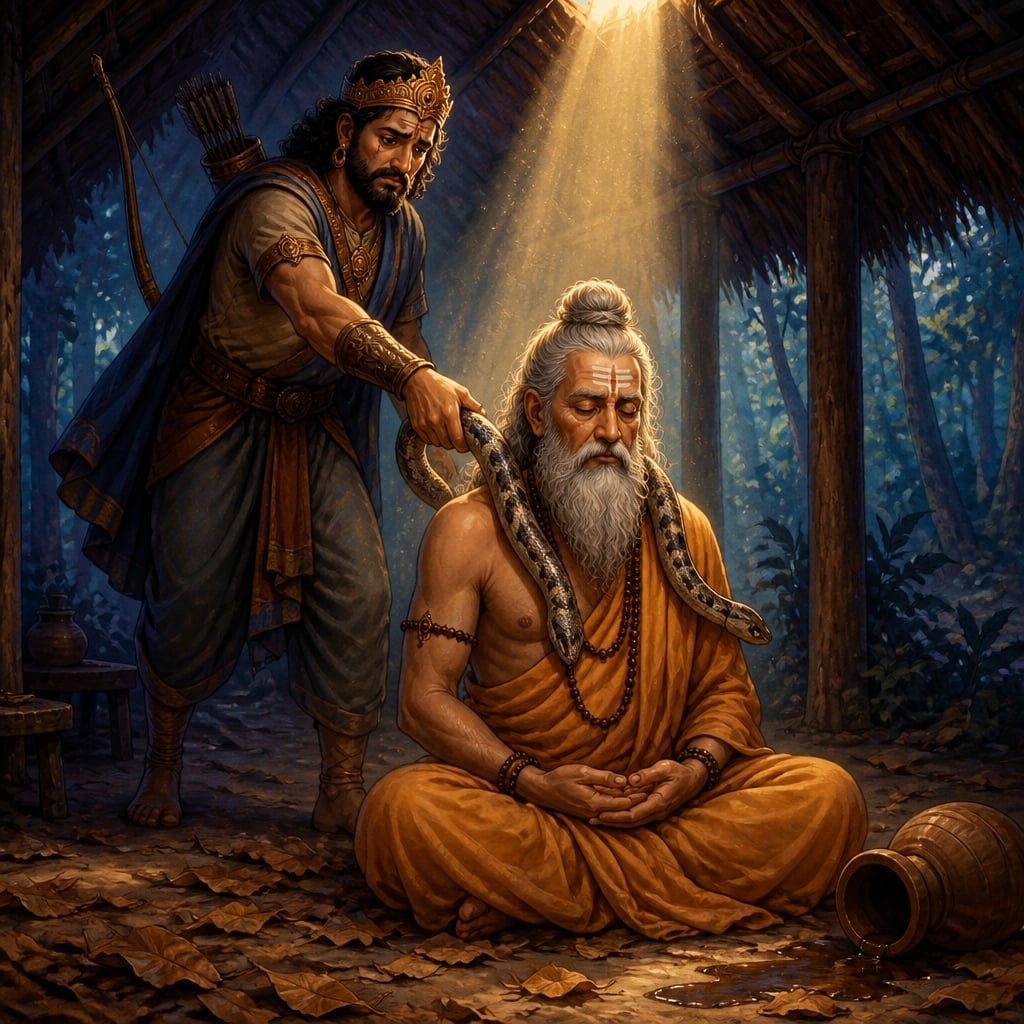
This was not merely rude - it was a profound violation. To touch a meditating Brahmin, let alone drape a dead animal on him, was a grave offense against dharma. The king, who had dedicated his life to protecting dharma, had in one impulsive moment violated it egregiously.
Having committed this act, Parikshit's anger subsided as quickly as it had arisen. Perhaps he felt immediate shame. He returned to his capital, but the memory of what he had done haunted him.
Shringi's Curse
Shamika's young son, Shringi, was playing with friends when he heard what the king had done. Unlike his father who was mature and forgiving, Shringi was a boy with immense power but little restraint.
His anger blazed. How dare a mere king, however righteous, insult his father - a sage absorbed in the highest meditation? Shringi did not pause to consider circumstances, did not wait for his father's guidance, did not temper justice with mercy.

Touching the sacred waters of the river, he pronounced a curse:
"Within seven days from today, the serpent-bird Takshaka shall bite this wicked king, and he shall die from that bite!"
The words left his mouth. The curse was irrevocable.
Shamika's Response
When Shamika emerged from his meditation and learned what had happened - both the king's insult and his son's curse - he was deeply distressed. But his distress was not for himself.
"My son, what have you done? The king may have erred, but he is the protector of dharma in this world. Without a righteous king, who will protect the sages? Who will maintain order? Your curse may be just, but was it wise?"
Shamika understood what Shringi did not: that justice without wisdom can cause greater harm than the original offense. The king's insult was terrible, but removing the kingdom's dharmic ruler would harm countless innocent people.
Showing remarkable grace, Shamika sent a messenger to warn the king of the coming curse. He bore no malice toward Parikshit - he wanted the king to have time to prepare.
Parikshit Receives the News
When Parikshit learned of the curse, his response revealed why he was considered a great king.
He did not rage against the injustice. He did not send armies to punish the boy-sage. He did not seek magical remedies or try to flee his fate. Instead, he accepted the curse as the consequence of his own action.
"This curse is actually a blessing in disguise. I have been living as though I had unlimited time. Now I know exactly how much time remains. Let me use these seven days to achieve what truly matters."
Parikshit immediately renounced his kingdom, handed power to his son Janamejaya, and went to the banks of the Ganga to prepare for death. He would spend his final days not in pleasure or panic, but in the pursuit of ultimate knowledge.
The Question That Changed Everything

As news spread that the king was fasting unto death on the Ganga's banks, sages from across the land gathered. Among them came Shukadeva Goswami, the liberated son of Vyasa, who normally wandered naked through the world, completely indifferent to social convention.
Parikshit, recognizing a realized soul when he saw one, posed the question that would unlock the entire Bhagavatam:
"O great sage, I have only seven days to live. Tell me: What should a person do who is about to die? What should one hear, what should one chant, what should one remember? What should one do, and what should one avoid?"
This question was not asked by an ordinary person facing death. It was asked by a king who had seen Krishna before birth, who had ruled with dharma, who had confronted Kali himself. His question came from genuine seeking, not fear.
Shukadeva's Response
Shukadeva recognized the perfection of the moment. Here was the ideal speaker (himself, liberated and free from bias), the ideal listener (Parikshit, facing death with equanimity), the ideal question (what truly matters at life's end), and the ideal setting (the sacred Ganga, surrounded by sages).
He agreed to speak for seven days without stopping, recounting the complete Bhagavatam - all twelve skandhas, all eighteen thousand verses, all the stories of the Lord's incarnations and devotees.
"O King, what you have asked is the most important question any human can ask. Now hear the answer from me, as I heard it from my father Vyasa."
Thus began the narration that Suta would later repeat to the sages at Naimisharanya, and that we receive today.
The Blessing in the Curse
Reflecting on this episode, we see how divine providence works through apparent calamity:
Without Parikshit's insult → No curse
Without the curse → No deadline
Without the deadline → No urgency to seek ultimate knowledge
Without the urgency → No question to Shukadeva
Without the question → No Bhagavatam narration
Without the narration → No scripture for us today
The snake placed on a sage's neck led to the nectar of divine knowledge being poured into humanity's ears forever. Parikshit's momentary lapse became the catalyst for eternal benefit.
Lessons from the Curse
This episode teaches several crucial truths:
Even the Righteous Can Fall Parikshit was not a sinful king. He had protected dharma, confronted Kali, and ruled justly. Yet in one moment of weakness - tired, hungry, frustrated - he committed a grave offense. This reminds us that vigilance must be constant.
Consequences Are Teaching Opportunities Rather than resenting the curse, Parikshit used it as motivation for ultimate seeking. Every consequence, no matter how severe, can become a doorway to growth if we approach it correctly.
Justice Without Wisdom Harms Shringi's curse was technically just - the king had committed an offense. But his father Shamika recognized that justice must be tempered with wisdom. Removing a dharmic king creates larger problems than the original offense.
Death Can Be the Greatest Teacher Facing a definite death date, Parikshit found a clarity that years of comfortable living had not provided. The awareness of mortality focused his mind on what truly mattered.
Living traditions
The Parikshit-Shukadeva dialogue format has influenced countless spiritual teachings. The idea of urgency in seeking - using limited time wisely - resonates in modern contexts. Steve Jobs famously said that remembering death is the best way to avoid thinking you have something to lose, echoing the transformation Parikshit underwent.
- Bhagavata Saptaha: Seven-day continuous recitation of the complete Bhagavatam, mirroring the seven days Shukadeva narrated to the dying Parikshit
- Marana-smrti (Death Contemplation): Spiritual practice of regularly contemplating one's mortality to maintain urgency in spiritual seeking
- Shukratal: Traditional site where Shukadeva narrated the Bhagavatam to Parikshit. Features an ancient banyan tree said to be present during the original narration.
- Shukadeva Ashram, Shukratal: Ashram at the traditional site of the Bhagavatam's narration. Pilgrims sit under the ancient banyan tree and hear Bhagavatam recitations, continuing the tradition started by Parikshit.
Reflection
- Parikshit was tired, hungry, and frustrated when he insulted the sage. Can you recall times when physical discomfort led you to act in ways you later regretted? What strategies might help in such moments?
- Shamika forgave the king and even warned him, while Shringi cursed him instantly. How do you typically respond when someone you love is wronged? What determines whether you lean toward mercy or justice?
- If you knew you had only seven days to live, what would you do? How does your answer differ from how you are currently living? What does this gap reveal?