Dharma: The Bull and Kali's Advent

Parikshit confronts Kali

King Parikshit encounters a bull standing on one leg - Dharma personified - being attacked by Kali, the personification of the dark age. The king restricts Kali to five places and protects dharma. This allegory reveals how righteousness declines through the yugas.

A Strange Sight on Patrol

King Parikshit, ever vigilant in protecting his kingdom, was traveling through his territories when he witnessed a disturbing scene.

A magnificent white bull, once powerful and proud, now stood trembling on a single leg. The poor creature was weeping, its body shaking with distress. Beside it stood a beautiful cow - equally distraught, tears streaming from her eyes.

Attacking them was a cruel man dressed as a king, wielding a stick and beating the helpless animals without mercy.
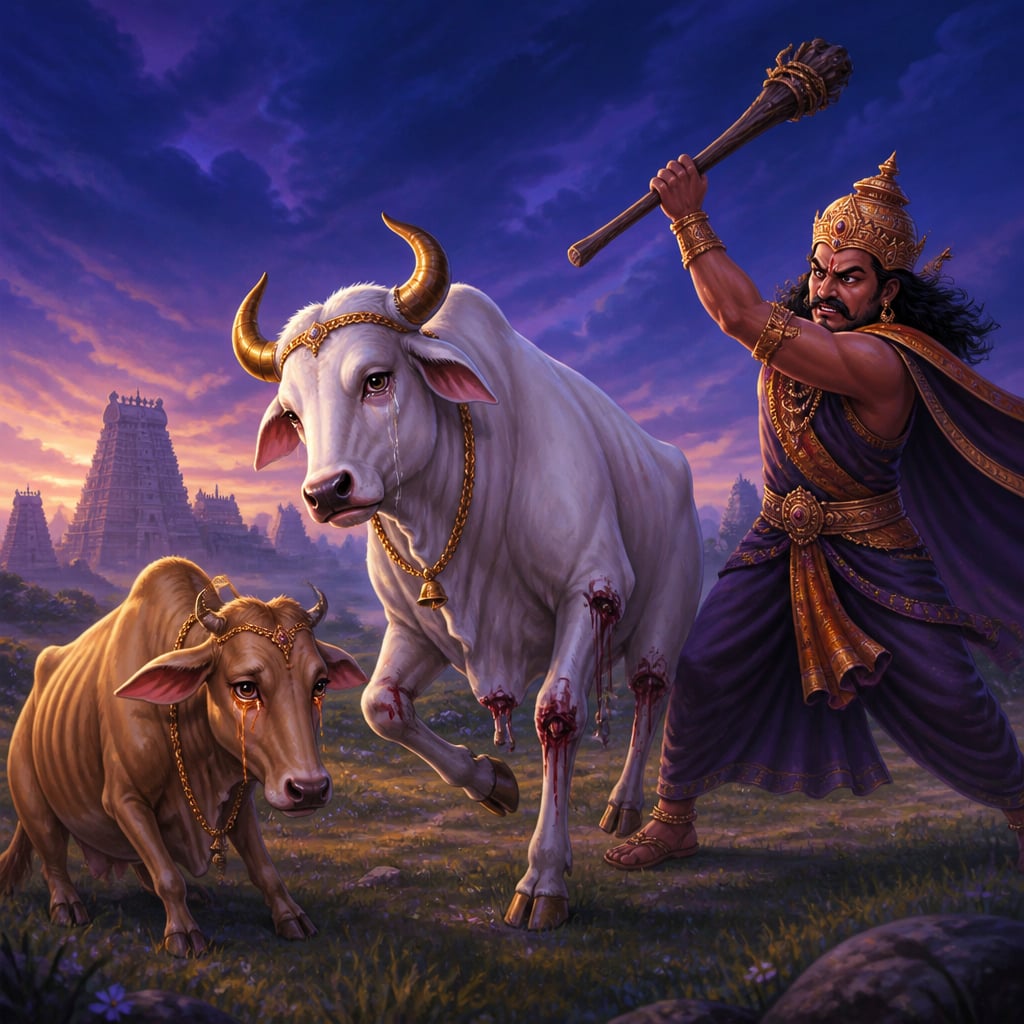
A magnificent white bull stands trembling on a single leg in a grassland at dusk beside a weeping cow Bhumi.

To most observers, this would appear to be simple animal cruelty - terrible, but perhaps not unusual. But Parikshit saw deeper. His vision, purified by having seen Krishna in the womb, recognized what was truly happening.

The Allegory Revealed

The bull was not an ordinary animal. It was Dharma itself - righteousness personified.

In the Satya Yuga (the Golden Age), Dharma stood on four legs, representing:

With each passing age, one leg was broken:

The cow was Bhumi - the Earth herself, who nourishes all creatures but is exploited by the unrighteous.

And the false king beating them? This was Kali personified - not the goddess Kali, but the demon of the dark age, the embodiment of irreligion, conflict, and degradation.

Parikshit's Righteous Anger
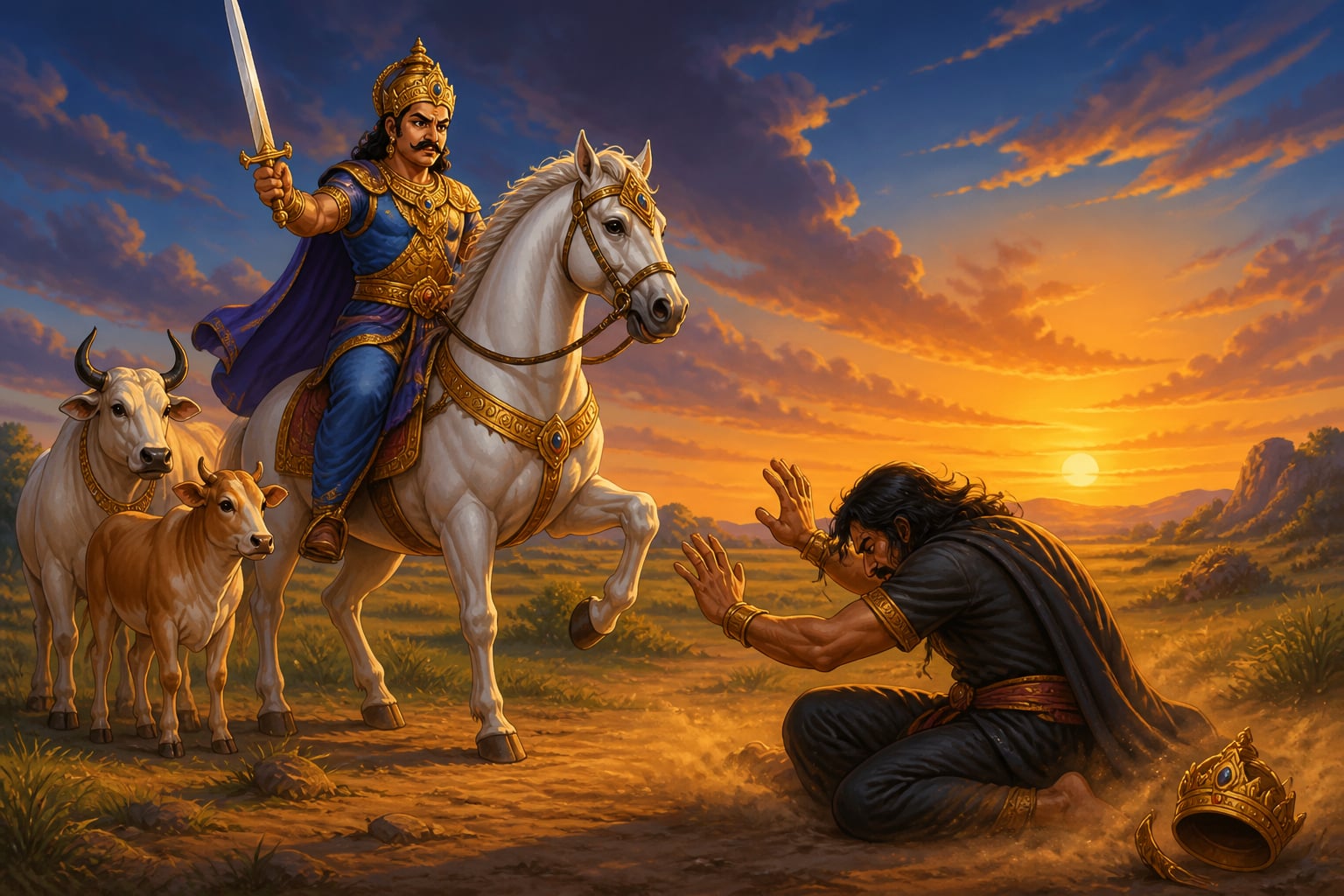
Parikshit confronts the disguised Kali

Seeing dharma being assaulted, Parikshit's kshatriya blood burned. He drew his sword and addressed the attacker:

"Who are you who dares to harm the helpless in my kingdom? You dress as a king but act as a criminal. In the realm of Parikshit, none may attack those who cannot defend themselves - whether Brahmins, cows, women, children, the elderly, or the sick."

"Reveal yourself! Are you some demon disguised as a royal? Know that for such crimes in my kingdom, the punishment is death!"

Kali, terrified by the king's power and determination, threw aside his royal disguise and revealed his true nature. He fell at Parikshit's feet, begging for mercy.

The Dilemma of the Dharmic King

Parikshit faced a profound choice:

Option 1: Kill Kali This would seem justified. Kali was attacking dharma itself. As a kshatriya, Parikshit's duty was to protect the righteous and punish evil. Killing Kali might even prevent the dark age from manifesting.

Option 2: Show Mercy But Kali had surrendered, falling at the king's feet. The dharmic codes held that one who surrenders should be given protection, not death. Even enemies, once they submit, are under the victor's care.

Moreover, Parikshit recognized a deeper truth: Kali was not simply an individual villain but a cosmic force. The Kali Yuga was destined to occur as part of the cosmic cycle. Killing this personification would not prevent the age from coming.

The Five Abodes of Kali

Choosing the path of wisdom over rage, Parikshit offered Kali a conditional pardon:

"You are an offense to dharma, and I should kill you. But since you have surrendered, I will spare your life. However, you may not roam freely in my kingdom. I will assign you specific places where you may dwell. Beyond these, if you are found, you will be executed."

Kali, relieved but still fearful, asked where he might live. Parikshit named five places where Kali would have dominion:

The five abodes of Kali

Place What It Represents
Gambling (dyuta) Where cheating, greed, and false hope flourish
Drinking (pana) Where intoxication clouds judgment and morality
Prostitution (striya) Where lust degrades sacred relationships
Animal Slaughter (suna) Where violence for pleasure corrupts compassion
Gold (hiranya) Where greed for wealth destroys contentment

In these five places alone could Kali exercise his influence. Everywhere else in Parikshit's kingdom, dharma would be protected.

But Kali cunningly asked for one more residence: wherever there is false pride and ego. Parikshit granted this as well.

The Deeper Teaching

This episode contains layers of meaning:

1. The Progressive Decline of Dharma The four legs represent the gradual loss of spiritual qualities through the ages. We now live in an age where only truth remains as the primary pillar of dharma. Protect truth, and you protect the last leg Dharma stands upon.

2. The Power of Human Choice Despite living in Kali Yuga, we can choose whether to invite Kali into our lives. By avoiding his five domains - gambling, intoxication, illicit relations, unnecessary violence, and greed for gold - we restrict his influence over us personally.

3. The Kshatriya's Duty Refined Parikshit's choice shows that dharmic protection is not merely about violence. It includes wise governance - restricting evil rather than merely destroying it when complete destruction is neither possible nor wise.

4. Surrender Transforms the Relationship Even a cosmic demon, when he surrenders, changes the dynamics. The Bhagavatam repeatedly teaches that sharanagati (surrender) is the key that opens doors otherwise locked.

Why Truth Remains

Why does Satya (truth) alone remain in Kali Yuga while the other three legs are broken?

The answer may lie in the essential nature of spiritual life. One can lack formal austerity yet advance through honesty. One can lack perfect external purity yet progress through truthful self-examination. One can even struggle with compassion yet grow through acknowledging one's shortcomings truthfully.

But without truth, no spiritual progress is possible. All self-deception blocks the path. This is why the Kali Yuga, despite its limitations, offers one supreme advantage: honesty is enough.

As the Bhagavatam later reveals, the simplest practice - truthful chanting of the divine name - is sufficient for liberation in this age. Where other ages required elaborate sacrifices, this age needs only sincere utterance of truth.

The Earth's Tears

Before leaving this scene, we should note the cow Bhumi's tears. Why was the Earth weeping?

The Bhagavatam explains that the Earth grieves when:

These tears continue today. Every environmental crisis, every exploitation of resources, every species driven to extinction - these are the ongoing tears of Bhumi.

Living traditions

The environmental movement finds an ancient ally in the weeping Bhumi. The concept of Kali's five domains has been used to explain addiction, consumerism, and social degradation. ISKCON and other movements emphasize that the 'yuga-dharma' (practice suited to the age) of chanting makes Kali Yuga uniquely conducive to spiritual advancement despite its challenges.

Reflection

More in Skanda 1: Creation

All lessons in Skanda 1: Creation ยท Srimad Bhagavatham course