Avatara: The Incarnations Enumerated
Twenty-two divine descents
Suta describes Vyasa's dissatisfaction despite composing the Vedas and Mahabharata. Narada advises him to glorify the Lord's pastimes. The famous list of twenty-two incarnations is revealed, with Krishna declared as the source of all avataras.
Vyasa's Mysterious Dissatisfaction
Before narrating the main stories of the Bhagavatam, Suta Goswami revealed to the sages at Naimisharanya a mystery that had puzzled even the celestial beings: Why was Vyasadeva, the greatest literary genius in cosmic history, depressed?
Consider Vyasa's accomplishments. He had divided the one Veda into four parts for easier study. He had composed the eighteen major Puranas. He had written the Brahma Sutras, the philosophical foundation of Vedanta. Most remarkably, he had authored the Mahabharata - one hundred thousand verses containing the complete wisdom of dharma, artha, kama, and moksha. Within that epic, he had embedded the Bhagavad Gita, spoken by the Lord Himself.
Yet after all this, Vyasa sat by the banks of the Saraswati River feeling empty and incomplete. The man who had given humanity its most comprehensive scriptures felt that something essential was missing.
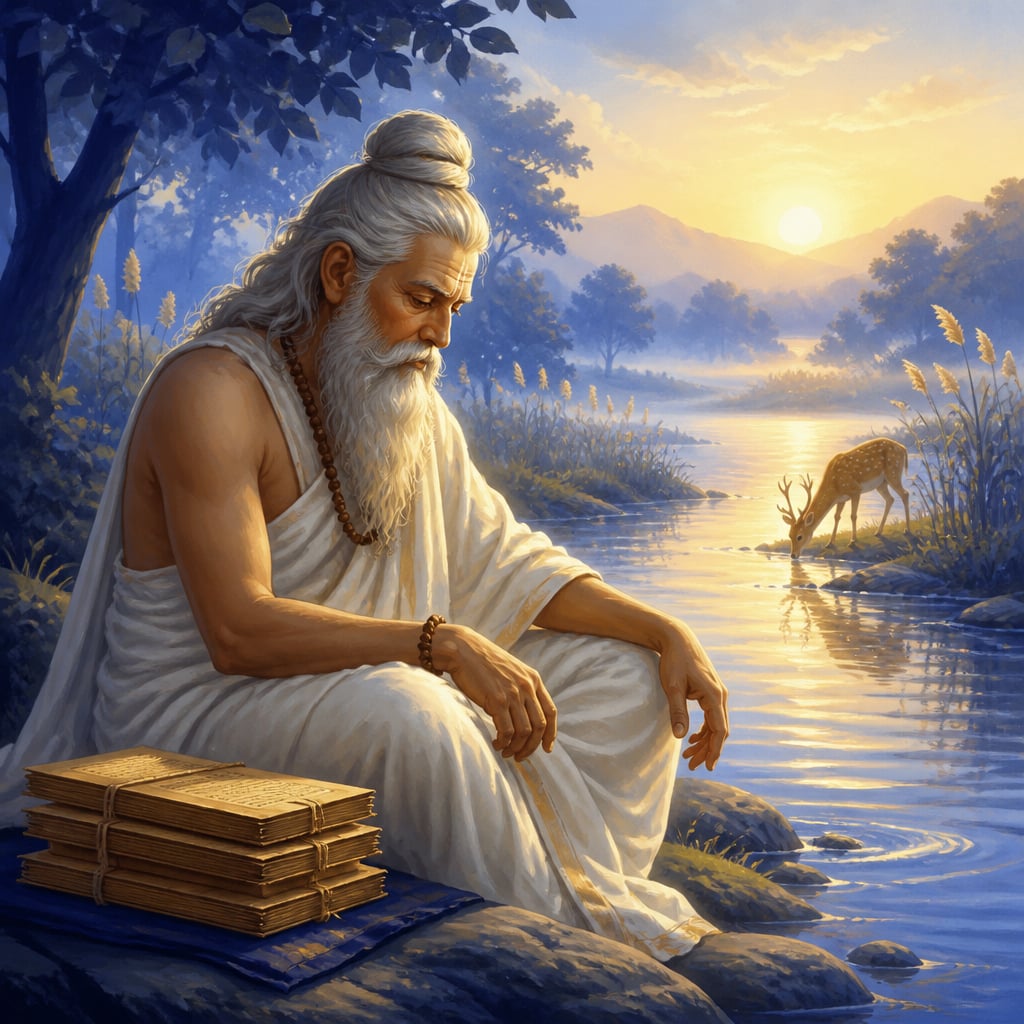
"Even after accomplishing all this," Vyasa reflected, "why does my heart feel unsatisfied? I have described dharma in full detail. I have explained the nature of the soul, the paths of liberation, and the workings of the material world. Yet I feel as though I have neglected something crucial."
Narada's Timely Arrival
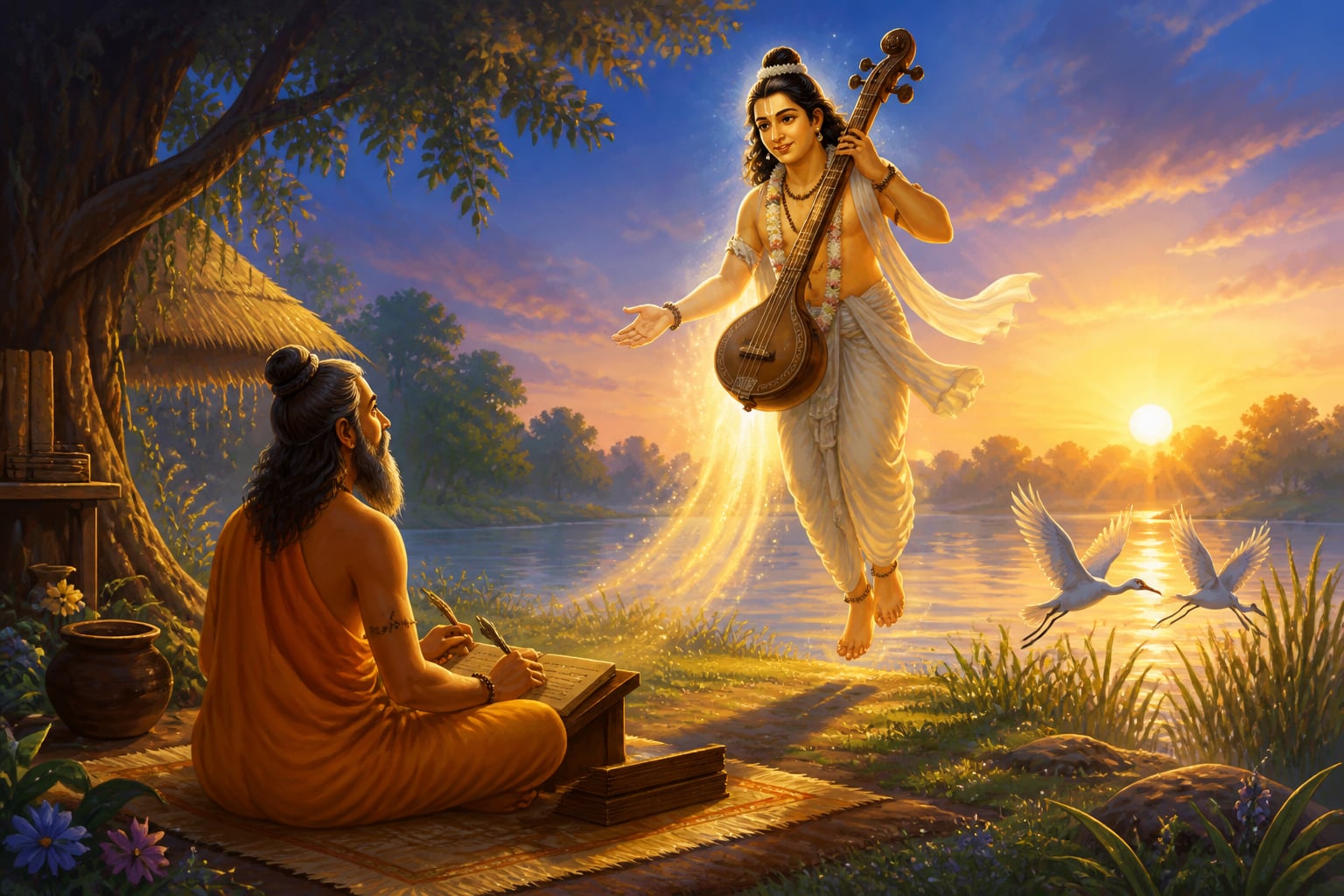
At this critical moment, as if summoned by Vyasa's inner crisis, the celestial sage Narada Muni appeared. He arrived as he always did - his veena singing its eternal notes, his lips murmuring "Narayana, Narayana."
Narada understood immediately what troubled his disciple. With gentle directness, he diagnosed the problem:
"O Vyasa, you have described dharma and the paths to liberation, but you have not sufficiently glorified the Supreme Lord's transcendental pastimes. You have presented the Lord's instructions, but not His personal activities. You have given people the means to approach the Absolute Truth, but not the nectar of the Absolute Truth's own loving deeds."
Narada explained a profound principle: knowledge alone does not satisfy the soul. The jiva (individual soul) is constitutionally a servant and lover of the Supreme. Until the soul connects with the Lord through hearing of His pastimes, no amount of philosophical knowledge can bring complete fulfillment.
"Therefore," Narada counseled, "compose a work that directly describes the glories, names, and pastimes of the Supreme Personality of Godhead. This alone will bring you peace, and this alone will truly benefit the world."
Vyasa Composes the Bhagavatam
Inspired by his guru's words, Vyasa entered deep meditation at his ashram in Badarikashrama (modern-day Badrinath). In that absorbed state, he perceived the entire panorama of the Lord's activities - from the cosmic creation to the intimate pastimes in Vrindavan.
What emerged was the Srimad Bhagavatam - the "beautiful story of the Lord" - the crown jewel of all Puranas. Unlike his previous works that presented dharma through rules and philosophy, this work would present dharma through rasa - through the taste of divine love.
To transmit this treasure, Vyasa taught it to his son Shukadeva Goswami, who was already liberated from birth. The fact that a born-liberated soul became so attached to the Bhagavatam proved Narada's point: bhakti transcends even liberation.
The Source of All Avataras
In the Bhagavatam, Suta now revealed to the sages at Naimisharanya the source from which all divine descents spring.
![]()
Before listing the individual incarnations, he established a fundamental teaching: The Supreme Lord is like an inexhaustible ocean. Just as countless rivers flow from a single ocean and return to it, innumerable avataras (incarnations) descend from the Lord and are never separate from Him.
Suta then enumerated twenty-two principal incarnations:
| # | Avatara | Purpose |
|---|---|---|
| 1 | Kumaras | Four sages who taught celibacy and self-realization |
| 2 | Varaha (Boar) | Lifted the Earth from the cosmic waters |
| 3 | Narada | Spread devotion through the three worlds |
| 4 | Nara-Narayana | Established severe austerity for dharma |
| 5 | Kapila | Taught Sankhya philosophy to His mother Devahuti |
| 6 | Dattatreya | The triple deity who taught spiritual knowledge |
| 7 | Yajna | The Lord of Sacrifice who performed sacred rituals |
| 8 | Rishabhadeva | Renounced emperor who taught supreme detachment |
| 9 | Prithu | First king to milk the Earth for abundance |
| 10 | Matsya (Fish) | Saved the Vedas from Pralaya (dissolution) |
| 11 | Kurma (Tortoise) | Supported Mount Mandara during ocean churning |
| 12 | Dhanvantari | Brought the nectar of immortality |
| 13 | Mohini | Enchanting form that distributed the nectar |
| 14 | Narasimha | Half-lion who protected Prahlada |
| 15 | Vamana | Dwarf who reclaimed the universe from Bali |
| 16 | Parashurama | Warrior sage who destroyed corrupt kshatriyas |
| 17 | Vyasa | Compiler of the Vedas (Vyasa himself is an avatara!) |
| 18 | Rama | Prince of Ayodhya, embodiment of dharma |
| 19 | Balarama | Krishna's elder brother, embodiment of strength |
| 20 | Krishna | The complete manifestation in Vrindavan and Dwaraka |
| 21 | Buddha | Teacher who led the misguided away from violence |
| 22 | Kalki | Future incarnation to end Kali Yuga |
Krishna: The Source, Not Just an Avatara
After listing these twenty-two incarnations, Suta made an astonishing declaration - one of the most important verses in the entire scripture:
"ete cāṁśa-kalāḥ puṁsaḥ kṛṣṇas tu bhagavān svayam" "All these incarnations are either plenary portions or portions of plenary portions of the Lord. But Krishna is the Supreme Personality of Godhead Himself."
This verse revolutionized understanding of the divine descents. While most traditions view Krishna as one among many avataras - perhaps tenth in a list of ten - the Bhagavatam declares the opposite: Krishna is the original, and all other avataras emanate from Him.
The reasoning is subtle but profound:
- Other avataras appear for specific purposes (protecting dharma, killing demons, teaching philosophy) and then return to the spiritual realm
- Krishna's appearance includes all purposes of all other avataras, plus something more: He reveals intimate loving relationships with His devotees that are never displayed by any other form
- Krishna alone manifests the full range of rasas (devotional moods) - from awe and reverence to parental affection to conjugal love
Why Avataras Descend
The Bhagavatam gives multiple reasons for divine incarnation:
1. Protection of Dharma Whenever righteousness declines and evil rises, the Lord descends to restore balance. This echoes His own statement in the Bhagavad Gita.
2. Deliverance of Devotees The Lord comes not just to punish the wicked but to personally associate with His beloved devotees. Prahlada, Dhruva, and the Gopis all received direct audience with the Lord.
3. Establishment of Scripture Several avataras left behind teachings that would guide future generations - Kapila's Sankhya, Vyasa's Puranas, Buddha's doctrines.
4. Revelation of Divine Pastimes Perhaps most importantly, the Lord descends to create katha - sacred narratives that give pleasure to devotees across all time. These stories are not mere entertainment but active spiritual medicine.
The Inexhaustible Spring
Suta concluded this section with a beautiful metaphor: Just as countless rivers emerge from the ocean yet the ocean is never depleted, innumerable avataras descend from the Lord yet the Lord remains complete. Unlike material entities that diminish when they give, the Supreme is purna - complete and ever-full.
This completeness extends to the Bhagavatam itself. Though it is spoken in time, its contents are eternal. Though it is composed of verses, each verse contains infinite depths. And though it describes particular events, it illuminates universal truths.
With the source of all incarnations now revealed, Suta would proceed to tell the sages what led to the Bhagavatam being spoken in the first place - the dramatic story of King Parikshit, protected by Krishna even in the womb.
Living traditions
The Dashavatara concept has inspired countless artistic representations - from Puri's Jagannath paintings to Amar Chitra Katha comics to Bollywood films. The idea of divine incarnation for cosmic balance has influenced popular culture worldwide. ISKCON has particularly emphasized the 'Krishna as source' teaching, translating Srila Prabhupada's Bhagavatam purports into over 80 languages.
- Avatara Katha: Specialized recitations focusing on the pastimes of specific incarnations like Narasimha, Vamana, or Rama - often performed on their appearance days
- Vyasa Puja: Annual celebration honoring Vyasadeva as the literary incarnation who compiled the scriptures and gave humanity the Bhagavatam
- Badrinath Temple (Vyasa Cave): One of the Char Dhams, near Vyasa's cave (Vyasa Gufa) where the Bhagavatam was composed. Pilgrims visit both the temple and the meditation cave.
- Dashavatar Temple, Deogarh: One of the earliest temples (5th century) depicting the ten avataras in stone, showing how the avatara concept was central to early Hindu worship
Reflection
- Vyasa had accomplished more than any other author in history, yet felt unfulfilled. Have you ever achieved something significant but still felt incomplete afterward? What was missing?
- The Bhagavatam declares Krishna as the source of all avataras, not just one among them. How does this change your understanding of the relationship between different divine incarnations?
- Narada said that even imperfectly composed verses glorifying the Lord are more valuable than perfect poetry about worldly subjects. What does this tell us about what makes art or literature truly valuable?