Rudra to Shankara: The Names That Shift
One god, many moods across the ages
In the Vedas he is Rudra, the storm archer you approach with lowered eyes. In the Puranas the same god is Shankara, the auspicious householder of Kailasa. This lesson follows the names across three thousand years and asks why one truth needed two faces.
The Chant in the Forest Clearing
Picture a forest clearing in the Sapta Sindhu region, sometime in the late Vedic age, perhaps a thousand years before the Buddha. The air is cold before dawn. A small fire crackles in a square pit. Around it sit a handful of householders and their priest, a Vedic ritualist of the Krishna Yajurveda lineage. Cattle move somewhere in the dark. The hills are full of leopards, of fevers, of cobras the colour of ash. The harvest is in. The sickness in the village is not.
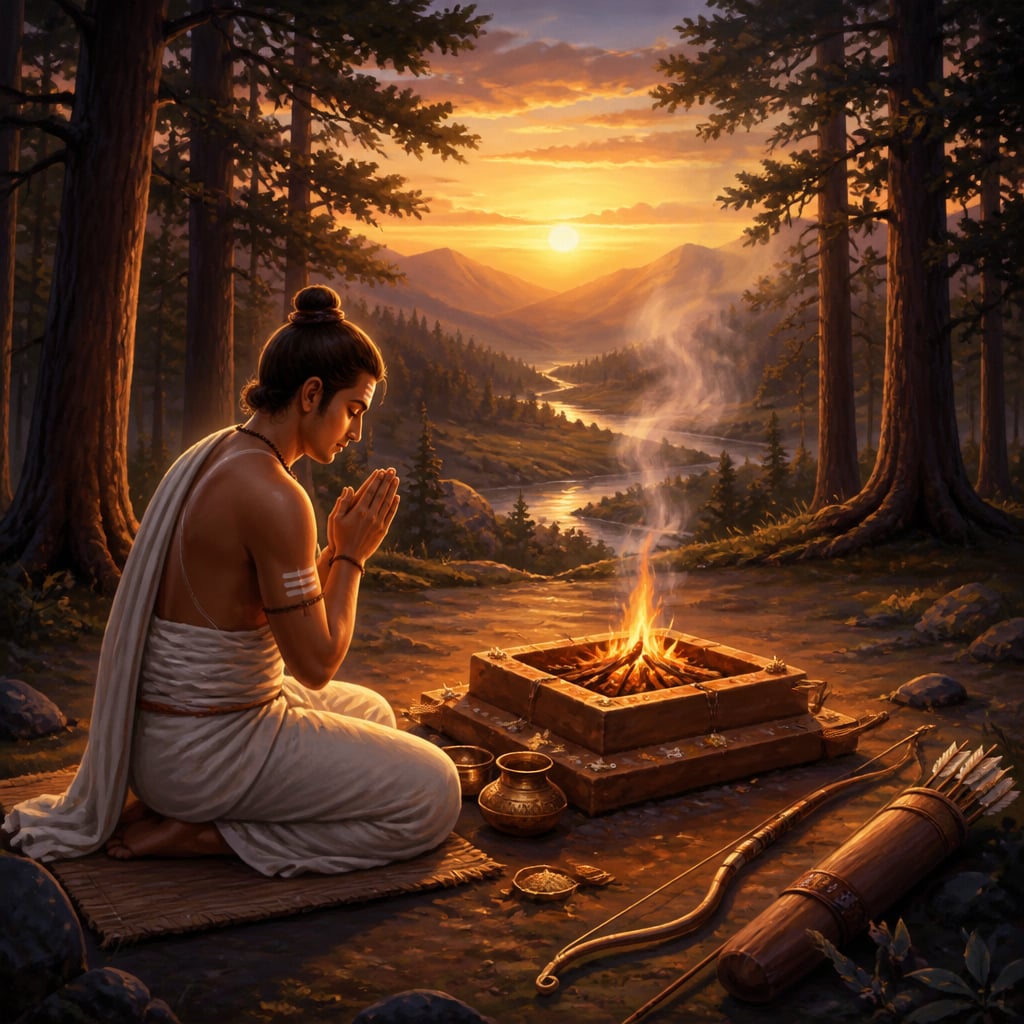
The priest does not begin with a god of comfort. He begins with the Shri Rudram, the oldest hymn to Shiva still chanted today. His voice is steady, but the words are not. They are afraid.
नमस्ते रुद्र मन्यव उतो त इषवे नमः। नमस्ते अस्तु धन्वने बाहुभ्यामुत ते नमः॥
namaste rudra manyava utota iṣave namaḥ namaste astu dhanvane bāhubhyām-uta te namaḥ
Salutations, Rudra, to your anger. Salutations to your arrow. Salutations to your bow, and to your two arms.
Krishna Yajurveda, Taittiriya Samhita 4.5.1
The priest is not asking Rudra for a boon. He is bowing to the parts of Rudra that could destroy the village before sunrise. The fever. The arrow. The anger. He says namaste, I bow, to each of them by name.
Why The Vedic God Was Fierce
The Vedic world was a thin candle inside a wide dark. Childbirth killed mothers. Cattle died of plague. A bad season ended a clan. The gods of that world had to be honest about this. Rudra is the howler. The name comes from the root rud, to weep or to roar. He is the storm that breaks the roof. He is the cobra in the woodpile. He is the disease that walks into the hut without knocking.
The Vedas do not pretend Rudra is safe. They pray to him to keep his arrows pointed away. Look at the verses around the namaste rudra line. They ask him not to harm cattle, not to harm children, not to harm the priest himself. The whole hymn is the prayer of a frightened, honest people.
And yet, even here, the second face is already showing. In the same Rudram, a few verses later, the priest sings:
या ते रुद्र शिवा तनूरघोराऽपापकाशिनी।
yā te rudra śivā tanūr-aghorā'pāpa-kāśinī
O Rudra, that form of yours which is auspicious, not terrible, not sin-revealing.
Krishna Yajurveda, Taittiriya Samhita 4.5.8
Notice the word shiva in that line. It is not yet the proper name of a god. It is an adjective. It means auspicious, kindly, the form that does not harm. The priest is saying: Rudra, please show me your shiva face, not your ugra face.
A thousand years of chanting will turn that adjective into a name.
The Slow Renaming
A name does not shift overnight. It shifts because people keep needing it to.
As the Vedic age gave way to the age of the Mahabharata and the early Puranas, life in Bharat changed. Cities grew. Trade routes opened. The fear of the forest faded a little. People still died, but they died inside walled towns now, and the gods who lived in their hearts were less the gods of the open field and more the gods of the household.
The Puranas, written and revised across many centuries, did something quiet and brilliant. They took the same Rudra and let him walk into the household. They let him marry. They let him have sons. They sat him on Kailasa with a wife who could argue with him, with two boys at his feet, with a bull at his door.
And they began to call him by the name he himself had hinted at in the Rudram. Shankara. Sham karoti iti shankaraha. The one who makes (karoti) auspiciousness (sham). The bringer of welfare. The kindly one.
It is the same god. The Puranas are clear about this. The Shiva Purana, the Linga Purana, the Vayu Purana, all open by saying that Rudra and Shankara and Mahadeva and Bhairava and Pashupati are one. Not five gods. One god, with names for his many moods.
The Tradition Of A Thousand Names
The Puranic tradition takes this idea and runs with it. It compiles a famous list called the Shiva Sahasranama, the thousand and eight names of Shiva. The list appears in the Mahabharata, in the Linga Purana, and in the Shiva Purana itself, with small variations.
A single god, named in a thousand and eight ways. Some of the names are gentle:
- Shankara, the auspicious one
- Mahadeva, the great god
- Pashupati, the lord of all beings
- Sadashiva, the eternally auspicious
Some are fierce:
- Rudra, the howler
- Bhairava, the terrifying
- Ugra, the formidable
- Aghora, the not-terrible (a name that flips fear back on itself)
The tradition is saying something deep here. A real god, like a real person, is not one mood. He is calm at the morning fire and fierce when a thief comes through the door. He is the kind father at the family meal and the angry one at his daughter's funeral. To know him by only one name is to know him only on his good days.
A Son Of The Eighth Century
If one human being can be picked to embody this whole shift, it is Adi Shankaracharya. Born in Kalady, a small village in present-day Kerala, around 788 CE, he was named after the god he would later teach. Shankara. The auspicious one.

In an age when many small sects were splitting India into competing schools, the young monk walked the length of the country. He wrote commentaries on the Brahma Sutras, the Upanishads, and the Bhagavad Gita. He composed hymns, including the Shivananda Lahari and the Dakshinamurti Stotram. He set up four mathas, one in each direction. And he taught, again and again, that the fierce Rudra of the Vedas and the gentle Shankara of the Puranas are one consciousness. Brahman. The same.
The name his parents gave him became the proof of his life's argument. A god who held both faces. A teacher who held both faces. One.
Why The Two Faces Belong Together
Look at your own life for a moment.
The parent who is gentle with the child at bath time is also the parent who shouts when the child runs into the road. The boss who is patient at the morning meeting is also the one who fires the cheating supplier. The friend who listens to your grief is also the friend who tells you, plainly, that you are wrong. Kindness without firmness is sentimental. Firmness without kindness is cruelty. A whole human being holds both.
The tradition is saying that a whole god holds both, too. Rudra is not a problem that the Puranas solve by hiding him under a kinder name. The Puranas keep Rudra. They keep the Rudram. They chant it every morning in the temple, three thousand years after the forest priest first sang it. They simply add Shankara on top, so the worshipper can see what Rudra is for.

Rudra is the fierce face that burns away the harm. Shankara is the kind face that blesses what is left.
| The Vedic Rudra | The Puranic Shankara |
|---|---|
| Howler in the storm | Householder on Kailasa |
| Archer in the forest | Father of Ganesha and Kartikeya |
| Approached with fear | Approached with love |
| Lord of disease and death | Lord of welfare and peace |
| Worshipped to ward off harm | Worshipped to invite blessing |
Both columns. One god.
The Five Syllables That Hold Both
In the Puranic age, the worshipper's central mantra became the Panchakshara, the five-syllable formula:
ॐ नमः शिवाय।
Om Namaḥ Śivāya
Om. Salutations to Shiva, the auspicious one.
It is the same grammar as the Vedic namaste rudra. The same namaste. The same bow. But the object of the bow has changed. Where the Vedic priest bowed to Rudra's anger and arrow, the Puranic devotee bows to Shiva himself, the auspicious one. Same gesture, calmer mood. Same god, gentler name.
This is what three thousand years of devotion did. It did not abolish fear. It folded fear into love.
Modern Echoes
The Swiss psychiatrist Carl Jung, in the 1930s, gave the modern world a phrase for this. He called it shadow integration. He had watched patient after patient try to be only their bright side, only their kind, only their calm. He watched their rejected anger and rejected fear leak out anyway, in symptoms, in dreams, in cruelty they did not mean to do. The cure, he said, was to face the shadow, to name it, to bring it home, to make it part of the whole. Wholeness is not the absence of darkness. Wholeness is the integration of it.
The Vedic priests had reached the same place by a different road, three millennia earlier. They had named Rudra. They had bowed to his anger by name, namaste manyave. They had not pretended he was not there. The Puranic poets then sat the same god by the household fire and called him auspicious. They did not delete the howler. They renamed him so the family could live with him.
In 2026, when a young manager in Bengaluru learns that her firmness is not the opposite of her warmth, she is meeting Rudra and Shankara in herself. When a parent learns to set a hard boundary without losing tenderness, that is the same lesson. The gods named it first.
Back in the forest clearing, the priest finishes the Rudram. The fire is low. The eastern sky is turning grey. The villagers walk home. The leopards are still in the hills. The fever is still in the hut. But something has changed in the air. They have looked the fierce thing in the face, called it by name, and bowed. And in the bowing, they have made room for the kind face to come.
In the next lesson, we will meet that whole god in his five faces, the Panchanana, and see the inner geometry of one consciousness wearing many masks at once.
Key figures
Rudra
The fierce Vedic form of Shiva, the howler in the storm, the archer of the forests
Shankara
The auspicious Puranic form of the same god, the householder of Kailasa, the bringer of welfare
Adi Shankaracharya
The 8th century CE Advaita teacher from Kalady, Kerala, named after Shiva-as-Shankara
Historical context
Late Vedic period (c. 1500-1000 BCE) through the Puranic age (c. 300-1400 CE)
Across two and a half millennia, Bharat moved from a forest and pastoral civilisation along the Sapta Sindhu and Saraswati rivers, to an urban age of mahajanapadas, to the great Hindu kingdoms of the Guptas, the Cholas, the Rashtrakutas, and the Vijayanagaras. The god the Vedic priest had bowed to as Rudra at the village fire became the Shankara of the temple cities, the Mahadeva of the imperial capitals, and the Nataraja of the bronze workshops at Tanjore. The renaming was not an abandonment of the Vedic god. It was the Vedic god finding new homes as the civilisation that worshipped him grew up.
Living traditions
The Shri Rudram is chanted daily in tens of thousands of Shiva temples in Bharat and the diaspora, making it the longest continuously performed religious hymn in the world. The Mahamrityunjaya mantra has crossed sectarian lines into the modern Indian wellness movement, recommended in clinical yoga therapy programmes and chanted by patients at hospitals like the Sri Sri Ayurveda Hospital in Bengaluru and the Arsha Vidya Gurukulam centres in the United States. The 2024 reopening of the Kashi Vishwanath corridor and the 2024 Pran Pratishtha at Ayodhya have brought millions of new worshippers into daily contact with the names this lesson traces.
- Shri Rudram Parayana: Daily or weekly recitation of the Namakam and Chamakam portions of the Shri Rudram, traditionally chanted as part of Rudrabhisheka, the bathing of the Linga with water, milk, honey, curd, and ghee. The whole hymn takes about 35 to 45 minutes to chant in full.
- Mahamrityunjaya Japa: Repeating the tryambakam mantra from Rig Veda 7.59.12, traditionally 108 times on a rudraksha mala. Done at sunrise, on Mondays, and during illness or difficult life passages. Many practitioners undertake a Purascharana of 1,25,000 repetitions over weeks or months.
- Panchakshara Japa: Repetition of Om Namah Shivaya, the five syllable mantra of Puranic Shiva worship. Counted on a rudraksha mala in cycles of 108. Beginners often do one mala a day. Advanced practitioners do five or more.
- Kashi Vishwanath Temple: One of the twelve Jyotirlingas and the spiritual heart of Shaiva Bharat. The Rudrabhisheka is performed daily at the inner sanctum, with the Shri Rudram chanted by trained Vedic priests. The newly redeveloped Vishwanath Dham corridor connects the temple to the Ganga ghats.
- Trimbakeshwar Jyotirlinga: The source of the Godavari river and the Jyotirlinga most closely associated with the Tryambakam mantra of Rig Veda 7.59.12. The unique three faced Linga represents Shiva, Vishnu, and Brahma. The temple performs the Mahamrityunjaya homa daily and is a major destination for healing and longevity prayers.
- Brihadeeswara Temple: The eleventh century Chola masterpiece built by Rajaraja Chola I, dedicated to Shiva as the great Lord. The temple still performs the daily Rudrabhisheka with full Shri Rudram recitation by a Vedic college of priests, exactly as inscribed on its walls a thousand years ago. The continuity of practice is itself the lesson.
Reflection
- Where in your present life have you been worshipping only the gentle face and refusing to name the fierce one, and what has that costing you?
- Why do you think the Vedic priests, who knew Rudra was dangerous, chose to bow to his anger by name rather than pretend it was not there?
- If the same god is named Rudra in the Vedas and Shankara in the Puranas, what does that say about the Dharmic view of identity itself, divine or human?