Panchanana: The Five Faces of Consciousness
Five directions, five ways of knowing
The five-faced Shiva is not iconography. It is a map of consciousness. Sadyojata creates, Vamadeva sustains, Aghora dissolves, Tatpurusha conceals, and Ishana frees. Walk the five faces in five directions, and you have walked the whole life of awareness, in yourself and in the cosmos.
The Priest at Pashupatinath
It is just past four in the morning at the Pashupatinath temple in Kathmandu, and the chief priest is unlocking the inner sanctum.
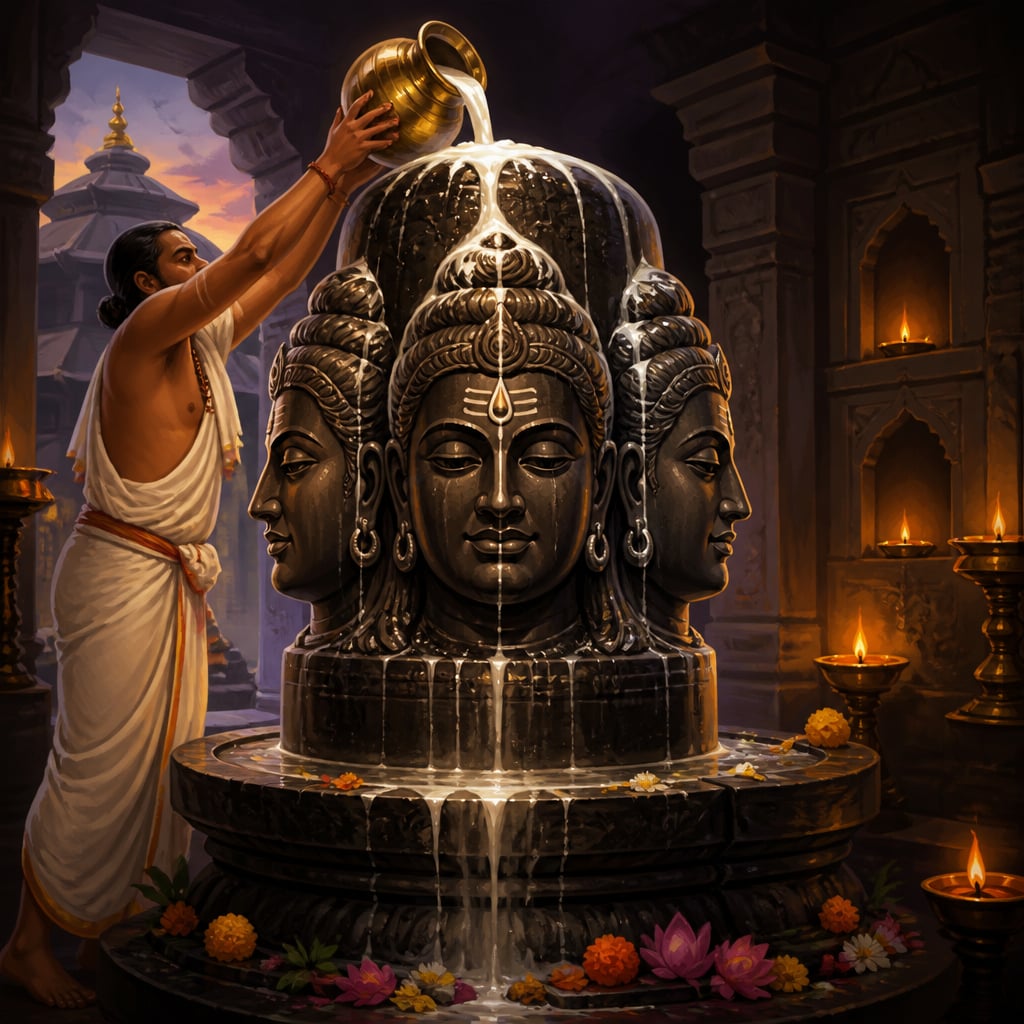
The Bagmati river runs cold outside. A line of devotees has already formed in the dark. Inside, the air smells of sandal paste, ghee lamps, and the bilva leaves placed the night before. The priest steps in barefoot. Before him stands the central murti of the temple: a stone linga with four faces carved into its sides, looking out toward the four directions, and a fifth face understood to be looking upward, into the ceiling, into the sky beyond.
Five faces. The priest will bathe each one. He will dress each one. He will offer flowers to each one. The whole pre-dawn ritual depends on knowing which face is which, and what each face holds.
This is the Panchanana, the five-faced form of Shiva. The same form is in the Kachabeshwarar temple at Kanchipuram. The same form is on the Sadashiva-murti at Elephanta near Mumbai, carved into a basalt cave wall around the seventh century, the head so vast that a grown person standing before it reaches only to the chin. Wherever you find Shiva, you will eventually find him with five faces.
The question this lesson asks is the question the priest already knows the answer to. Why five?
A Map, Not a Decoration
The Shaiva Agamas, the manuals that govern temple worship, are clear that the five faces are not artistic flourish. They are a map. Each face is a mode of consciousness, a way the one Shiva acts in the world and inside the human being. Each face is paired with one direction and one element. Together, the five describe the full life of awareness: how it arises, how it sustains, how it dissolves, how it conceals itself, and how it sets you free.
The tradition lists them in a fixed order, and we will walk through them in that order.
| Face | Direction | Element | Inner Mode |
|---|---|---|---|
| Sadyojata | West | Earth | Creation |
| Vamadeva | North | Water | Preservation |
| Aghora | South | Fire | Dissolution |
| Tatpurusha | East | Air | Concealment |
| Ishana | Upward | Ether | Grace |
Walk this table slowly. It is the whole lesson in compressed form.
The Face That Creates: Sadyojata
The west-facing face is called Sadyojata, "the suddenly born". It holds the element of earth. This is the face of beginnings.
Every morning when you wake, something happens before any thought arrives. A new world appears. The room is there. The body is there. The day is there, unstained, unwritten. That fresh appearing, before you have decided anything about it, is the Sadyojata mode.
In creation stories, this is the function the tradition calls Srishti. In the cosmic round, it is what brings universes into being. In your life, it is what brings each Tuesday morning into being. The same power, on different scales.
The teaching is gentle and practical. Whatever begins in your life today is Shiva's Sadyojata face turned in your direction. A new job. A new relationship. A first attempt at something. Honour beginnings. Do not crush them with old conclusions.
The Face That Holds: Vamadeva
The north-facing face is called Vamadeva, "the lovely lord". It holds the element of water. This is the face of grace and continuance.
What creation begins, Vamadeva sustains. The infant who is born today must be fed tomorrow. The friendship that started last spring must be tended through the winter. Anything alive needs holding.
The tradition associates Vamadeva with the feminine, the gentle, the nourishing. This is the Shiva who is also Shakti. The Shiva from whose matted hair the Ganga flows down to feed the plains. In cosmology, this mode is Sthiti, preservation, the function the tradition usually assigns to Vishnu but which the Agamas locate inside Shiva himself, in his second face.
In your inner life, Vamadeva is the patience to keep showing up. The capacity to feed what you have begun, day after day, even when the first excitement has faded. If Sadyojata is the spark, Vamadeva is the slow flame that does not go out.
The Face That Dissolves: Aghora
The south-facing face is called Aghora, "the not-terrifying". The name is a softening. The face is in fact the fierce one. It holds the element of fire.
Aghora is the Shiva of the cremation ground. The Shiva who smears his body with ash, who wears the serpent, who dances on what is finished. This is the function the tradition calls Samhara, dissolution. Most readers learn it as "destruction" and recoil. The Shaiva tradition insists on the gentler word. Aghora dissolves what is no longer serving life. He removes, so that the next round of creation has space.
Inside you, Aghora is the breath that lets a grudge go. The clarity that ends a relationship that has become poison. The honesty that admits a project should be closed. The south, in Indian geography, is the direction of Yama, the lord of endings. The Aghora face looks south because it has befriended what everyone else flees.
The chapter you have just walked through has been pointing here all along. Shiva is the god of right destruction. Not cruelty. Clearing. Aghora is the face that does the clearing.
The Face That Conceals: Tatpurusha
The east-facing face is called Tatpurusha, "that supreme person". It holds the element of air. This is the face of mystery.
The cosmic function here is the most subtle one in the entire system. The tradition calls it Tirobhava, concealment. Why would Shiva conceal anything? Because awareness, when it stays hidden inside a human being, is the very engine that makes the journey of life possible. If every soul knew immediately, on day one, that it was Shiva, the play would be over before it began. The concealment is what makes the seeking real.
Tatpurusha is the face of the question you cannot quite answer. The intuition that something deeper is going on but you cannot name it yet. The night sky that holds you for a moment longer than you expected. The air you breathe and never see.
This face teaches that mystery is not the absence of meaning. Mystery is one of the five things consciousness does. Some things in your life are concealed for now. They are in the Tatpurusha mode. Your task is not to force them open. Your task is to keep walking, breathing the air of the question.
The Face That Frees: Ishana
The fifth face is called Ishana, "the ruler". It does not look toward any direction on the compass. It looks upward. It holds the fifth element, Akasha, ether or space, the subtlest of the five.
In the Pashupatinath murti, this face is hidden inside the stone, understood to be facing the sky. In sculptural representations like the Sadashiva at Elephanta, Ishana is sometimes left unshown, suggested by the upward gaze of the whole work. The fifth face is the one you do not quite see, because it is the one looking out from behind your own eyes.
The cosmic function of Ishana is Anugraha, grace. This is the act that releases the soul from the play. Concealment, eventually, is undone. The seeker, eventually, finds. The veil over the Tatpurusha face slips, and Ishana looks down at you with recognition.
In Shaiva theology, all the other four functions are actually in service of this one. Creation, preservation, dissolution, and concealment exist so that grace, in its own time, can do its work. Ishana is the fifth face, but it is the first cause. The whole universe runs on Anugraha.
The Sound of the Five
The Panchanana is not only stone. It is sound.

The most-recited Shaiva mantra in the world is Om Namah Shivaya, the Panchakshari, the five-syllable mantra. Each of its five syllables, the tradition says, corresponds to one of the five faces and one of the five elements:
Na (earth, Sadyojata, creation) Ma (water, Vamadeva, preservation) Shi (fire, Aghora, dissolution) Va (air, Tatpurusha, concealment) Ya (ether, Ishana, grace)
When a devotee at Pashupatinath chants Om Namah Shivaya, she is not just calling Shiva by name. She is walking the five faces in five syllables. She is reciting the map of her own consciousness.
This is why the mantra is given to children, to monks, to the dying. It is small enough for a child and complete enough for a final breath. We will return to the Panchakshari in much greater depth in the practice chapter. Mark the connection now.
Modern Echoes
In the late twentieth century, the American mythologist Joseph Campbell, who spent years studying Hindu temple iconography, wrote that the five-faced Shiva at Elephanta was one of the great works of art of the world, comparable to the cathedral of Chartres. He understood that the carving was not a portrait but a psychology. Five doors into one mind.
The historian Stella Kramrisch, in her 1981 book The Presence of Shiva, made the same point in academic language. The five-faced form, she wrote, is the entire activity of god condensed into a single icon. Western scholarship took a century to arrive at what the Shaiva Agamas had said in plain Sanskrit a thousand years earlier.
Closer to home, the cognitive scientist Anil Seth at the University of Sussex has argued, in the language of neuroscience, that consciousness is not a single thing but a cluster of processes: perception, prediction, memory, agency, selfhood. He counts roughly five. The Panchanana counted five too, in a different vocabulary, before any of us had a word for cognition.
Back to the Sanctum
Back at Pashupatinath, the priest finishes the abhisheka. Milk has been poured over the western face. Curd over the northern. Ghee over the southern. Honey over the eastern. Pure water, finally, over the upward-facing fifth, the one that no devotee can see directly.
He rings the bell. The doors open. The line of devotees begins to move in.
You have now met the god you came to meet. He has five faces because you have five faces. He is the one who creates your morning, sustains your effort, dissolves what is finished, conceals what is not yet ready, and grants the recognition that ends the journey. Everything in the chapters that follow, the stories of Shakti, of Daksha, of Nataraja, of the Jyotirlingas, of every devotee who ever found him, is a way of meeting one of these five faces in a particular costume.
The priest has finished. The chapter has finished. The course is just beginning.
Historical context
Vedic to Early Medieval India (roughly 1000 BCE to 1000 CE)
The Panchanana concept developed across two thousand years and three textual layers. The Vedic root is the Pancha Brahma Mantras of the Krishna Yajur Veda (Taittiriya Aranyaka 10.43 to 10.47), composed roughly between 1000 and 800 BCE. The iconographic and ritual system was codified in the Shaiva Agamas between 500 and 1000 CE. The Linga Purana, Vayu Purana, and Shiva Purana gave it Puranic narrative form during the same window. By the seventh century, monumental sculptural expressions had emerged across India: the Sadashiva at Elephanta in the west, Pashupatinath in Nepal in the north, and Pancha Brahma sub-shrines in the early Pallava temples of the south. The Agamic period coincided with the great wave of cave-temple sculpture across Asia, including Ajanta, Ellora, and the Mogao caves in Tang China. Adi Shankara in the eighth century systematised the theology in the form that still governs Shaiva temple worship today.
Living traditions
The American mythologist Joseph Campbell devoted significant writing to the Sadashiva at Elephanta in his Mythos lectures (1987). The art historian Stella Kramrisch made the Panchanana central to her landmark 1981 book *The Presence of Shiva*, still the standard academic reference. The five-faced form appears on the official seal of the Pashupati Area Development Trust in Nepal, the body that has administered the temple since 1969. Pashupatinath remains a continuously active worship site with daily Pancha Brahma rituals performed exactly as the Shaiva Agamas prescribed over a millennium ago, making it one of the longest-running unbroken liturgical traditions in the world.
- Pashupatinath Temple: The most famous Panchamukha Shiva shrine in the Hindu world. The central murti is a Mukhalinga with four faces carved on the sides and a fifth face understood to look upward. Daily abhisheka is performed face by face by the chief priest before dawn. Located on the bank of the Bagmati river. The temple complex includes ghats, smaller shrines, and Aryaghat, a major cremation site, which makes the Aghora face's lesson on dissolution viscerally present.
- Elephanta Caves (Gharapuri): Home to the famous Sadashiva (also called Trimurti or Maheshamurti) carved into the basalt cave wall in the mid-6th to 7th century CE. The sculpture is approximately 20 feet tall and shows three of the five faces (Aghora on the left, Tatpurusha in the centre, Vamadeva on the right). The fourth and fifth faces are implied. UNESCO World Heritage Site since 1987. Joseph Campbell called it one of the great works of art of the world.
- Ekambareshwarar Temple: One of the Pancha Bhuta Lingas, representing the earth element. The temple complex contains multiple Sadashiva and Panchamukha shrines, where devotees can circumambulate and offer prayers to each of the five faces in sequence. Built primarily under the Pallavas (7th to 9th century CE) and expanded under the Vijayanagara empire. The 1,000-pillar mandapam is a key feature.
Reflection
- Of the five modes (creating, sustaining, dissolving, concealing, freeing), which one is most active in your life right now? Which one are you avoiding?
- Aghora dissolves what is no longer serving life. What in your life is asking to be dissolved? What are you holding onto past its time?
- Tatpurusha says concealment is one of the five legitimate acts of consciousness, not an absence. How does this change the way you relate to questions you cannot yet answer?