Lingodbhava: The Pillar of Fire
Brahma and Vishnu seek the end of Shiva
Brahma and Vishnu argue over who is supreme. A blazing pillar of fire appears between them, with no top and no bottom. Their search for its limits becomes the defining story of who Shiva really is, and a quiet lesson on what honesty does to ego.
Two Gods, One Argument
A quiet evening at the edge of creation. Brahma, the four-faced creator, and Vishnu, the dark-blue preserver, are sitting in the open. The cosmos has just been made. The three worlds are still warm from their work. They begin to talk, and slowly the talk turns into something else.
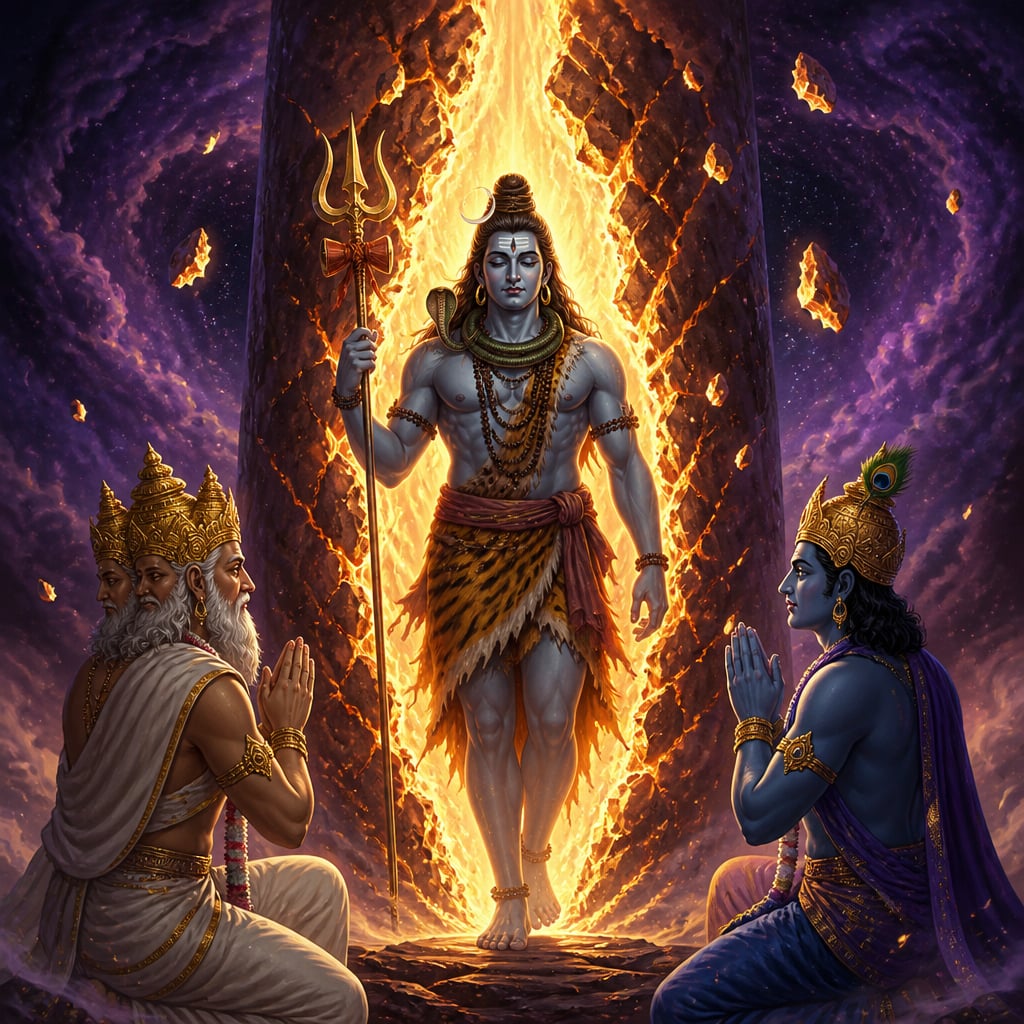
'I am the source,' Brahma says. 'From me come all the worlds. Without my creation, there is nothing for you to preserve.'
'And without my preservation,' Vishnu replies, 'your creation would dissolve in a single breath. I hold what you make. The greater of us is the one who holds.'
They argue. Each is honest about his own work and quietly unfair about the other's. Neither will yield. The argument has nowhere left to go. And then, between them, the air begins to burn.
A Pillar Without End
A column of light bursts up from the ground. It is wider than a mountain and thinner than a thought. It is so bright that the two gods shield their eyes. It rises through the sky and keeps rising. It sinks into the earth and keeps sinking. Its top is not visible. Its bottom is not visible. It just is, and it burns.
This is the Jyotirlinga, the linga of fire. The word linga means a sign, a mark. The pillar is a sign of something that has no shape of its own. A mark left by the formless. Brahma and Vishnu have never seen anything like it. Their argument is forgotten. A new question is in the room.
'What is this?' Vishnu asks.
'I do not know,' Brahma admits. 'But whoever finds its end is the greater of us.'
Vishnu agrees. The contest is set. One will go down, one will go up. Whoever first reaches a limit wins.
The Boar Goes Down
Vishnu takes the form of Varaha, the great boar. His tusks gleam. His snout is built to burrow. He plunges into the earth at the base of the pillar and begins to dig.

He digs through stone and through fire. He digs through worlds below worlds. He digs for what feels like an age. The pillar keeps going. Every layer of earth he passes, the pillar passes too. There is no base. There is no floor. There is only the burning column going further down than down can go.
Vishnu is honest with himself. The pillar has no bottom that he can find. He turns around and climbs back to the surface. His face is dusty. His eyes are wide. He has just met something larger than his own ability to measure.
The Swan Goes Up
Brahma takes the form of Hamsa, the white swan. His wings are wide. His neck is long. He flies up the side of the pillar, faster and faster.

He flies past the clouds. He flies past the moon. He flies past the stars and into regions where light itself begins to thin out. The pillar keeps going. There is no top. There is no peak. After what feels like an age, Brahma is tired and far from home, and the pillar still has not ended.
And then he sees something falling. A small white ketaki flower, the screw-pine bloom that ascetics offer to the gods. It is drifting down from somewhere even higher than where Brahma has reached.
Brahma's heart races. Here is a chance.
'Flower,' he says, catching it, 'how long have you been falling?'
'For a very long time,' the ketaki replies. 'I was offered at the top of this pillar by a worshipper, ages ago. I have been falling ever since.'
Brahma has not reached the top. But the ketaki has touched it. And the ketaki is now in his hand.
A Lie In The Sky
A small temptation. A small adjustment of the truth. Brahma tells the flower: 'Tell Vishnu you saw me at the summit. Say I plucked you there myself. Be my witness.'
The ketaki hesitates. But Brahma is the creator. The flower is small. It agrees.
They return to the foot of the pillar. Vishnu is already there, dusty and quiet, ready to admit what he found. Brahma arrives with the ketaki in his beak and a careful smile.
'I have done it,' Brahma announces. 'I reached the top. This flower is my witness. It was offered there at the summit, and I plucked it myself.'
Vishnu looks at his old friend. He does not know what to say. He had been ready to bow. He had been ready to acknowledge that Brahma was the greater. But something feels wrong.
And then the pillar splits open.
The God In The Pillar
From the burning column, Shiva steps out. Matted hair, ash-smeared body, calm eyes, a small smile that is not quite kind and not quite cruel. He looks at both of them and the contest is over before anyone speaks.
Vishnu folds his hands at once. 'I could not find the bottom,' he says simply. 'You are beyond my measure.'
Shiva nods. 'You spoke the truth. You will be worshipped in every age, in every land, in every form. The truth is what makes a god worthy of worship.'
Then he turns to Brahma. The smile fades.
'You did not reach the top. You sent a flower to lie for you. You used your power to manufacture a witness. For this, your worship will end. Across the whole earth, you will have almost no temple, no festival, no daily prayer. The creator who lied at the top of a pillar is not the creator the world will remember.'
Then he turns to the ketaki, trembling in Brahma's hand.
'And you,' Shiva says, gently but firmly, 'will never again be offered to me. Other flowers will sit at my feet. Not you.'
The sentence is light. The lesson is heavy. The pillar dims. The two gods go home. The story is over.
What The Pillar Was Saying
The pillar was never a riddle to be solved. It was a sign. A linga. A mark of something the two arguing gods could not contain. Vishnu went as far as he could and admitted his limit. Brahma went as far as he could and lied about his limit. The pillar did not test their power. It tested their honesty in front of the infinite.
This is what Shiva is in the Shaiva tradition. Not a god with a face you can describe. Not a king on a throne you can locate. Something that has no top and no bottom, and that the honest mind learns to bow to and the dishonest mind tries to claim. The linga in every Shiva temple, that simple stone column on a square base, is a small echo of that infinite pillar. It is not a body. It is a sign that no body is enough.
Modern Echoes
The psychologist Carol Dweck spent decades studying what she called the fixed mindset and the growth mindset. The fixed mindset, she found, treats every test as a verdict. To say I do not know feels like a defeat. So the fixed-mindset student bluffs, hides, and makes up answers. The growth-mindset student says I do not know and gets stronger. Brahma had a fixed mindset on a cosmic scale. Vishnu had a growth mindset. The one who said I could not find the bottom is the one the world worships in a thousand temples today.
More quietly, the writer Adam Grant has argued that confident humility, holding strong views while staying willing to revise them, is the rarest and most useful trait in a leader. Vishnu's I could not find the bottom is confident humility. He is sure of what he saw, and sure that what he saw was bigger than him. That is the posture the Lingodbhava story rewards.
There is a reason Indian temples carved this story onto the west wall of nearly every Shiva sanctum from the sixth century onward. The pillar is a daily reminder, in stone, that the honest I do not know is more sacred than the proud I have arrived.
Closing The Loop
The two gods who once argued at the edge of creation now sit together quietly. The pillar is gone. The lesson has stayed. Whenever you find yourself at the edge of something larger than you, the story whispers, you have two choices. You can be the swan who lies. You can be the boar who bows. The pillar is still there, in every life. So is the choice.
Next, we will meet a different test of friendship between Vishnu and Shiva, the moment Vishnu offered a thousand lotuses, came up one short, and reached for his own eye.
Historical context
Puranic compilation period (c. 8th to 11th century CE), with iconographic flowering from the 6th century onward.
The first millennium CE saw an extended Shaiva-Vaishnava negotiation across Indian temple culture. The Lingodbhava story is one of the great unifying myths of that period: Vishnu is not a rival to be defeated, but the honest devotee whose admission of limit is itself rewarded. Pallava and early Chola patronage of Shiva temples in Tamil Nadu fixed the iconography on the west wall of every major sanctum, while northern Puranic traditions consolidated the narrative in textual form. The result is a story that simultaneously asserts Shiva's supremacy and protects Vishnu's dignity, allowing Shaiva and Vaishnava devotees to share the same temple space without theological collision.
Every stone linga a contemporary visitor sees in a Shiva temple, from a small village shrine to a great Jyotirlinga, is iconographically the descendant of the pillar in this story. Without the Lingodbhava narrative, the linga is a mystery; with it, the linga is a sign that no body is enough.
Living traditions
The Lingodbhava story underwrites three of India's most living religious surfaces: Mahashivaratri (treated by the 2011 Indian census as one of the most widely observed religious nights in the country), the Jyotirlinga circuit (now bookable as a single yatra package by Indian Railways' IRCTC Bharat Gaurav trains), and Arunachala's Karthigai Deepam (drawing crowds estimated above one million each year by the Tamil Nadu HR&CE department). The story is also the explanation Indians give for the most striking feature of their own temple geography: that Brahma, the creator of the worlds, has only a single major temple at Pushkar, while Shiva has hundreds of thousands. The myth and the map agree.
- Lingodbhava Darshan At Midnight On Mahashivaratri: On Mahashivaratri, the great night of Shiva, South Indian Shiva temples reveal the Lingodbhava murti carved on the west wall of the sanctum at the midnight hour. Devotees stand in line through the night for this single darshan, in which Shiva is seen stepping out of the pillar with Brahma as the swan above and Vishnu as the boar below. Many temples chant the Rudram and the Shiva Tandava Stotram during the four prahara pujas of the night.
- Karthigai Deepam At Arunachaleshvara: On the night of Karthigai Deepam (the full moon of the Tamil month Karthigai, November or December), a giant cauldron of ghee is lit on the summit of Arunachala hill. The flame burns for several days and is visible for many kilometres. Tradition treats Arunachala itself as the Lingodbhava pillar made local: a hill of fire on the plain. Devotees walk the fourteen kilometre Girivalam path around the hill barefoot through the night.
- The Twelve Jyotirlinga Yatra: Tradition names twelve great Jyotirlingas across India, each treated as a place where the original pillar broke through and remained. The classical list runs from Somnath in Gujarat and Mahakaleshvar in Ujjain to Kashi Vishvanath in Varanasi and Rameshvaram in Tamil Nadu. Many devotees undertake the full circuit over a lifetime; others visit one or two as the centre of a regional pilgrimage.
- Arunachaleshvara Temple, Tiruvannamalai: One of the five Pancha Bhuta Sthalas of Shiva, dedicated to Shiva as Agni, the fire element. The temple sits at the base of Arunachala hill, which tradition treats as the Lingodbhava pillar made physical. The Girivalam path of fourteen kilometres around the hill is walked barefoot by pilgrims, especially on full moon nights. Ramana Maharshi made his ashram here in the twentieth century, drawing the hill into modern spiritual memory.
- Brihadishvara Temple, Thanjavur: The Chola masterpiece of Rajaraja I, completed in 1010 CE, with one of the largest stone Shiva lingas in any working temple. The west wall of the sanctum carries a classical Lingodbhava murti showing Shiva inside the pillar with Hamsa-Brahma above and Varaha-Vishnu below, the iconography this lesson describes. UNESCO World Heritage Site.
- Brahma Temple, Pushkar: Among the rarest of Indian temples: a working temple to Brahma, on the shore of Pushkar lake. Tradition treats Pushkar as one of the very few sites where the curse of the Lingodbhava is partly lifted. The temple is small, the architecture modest, and the rarity itself is the lesson; standing here, a pilgrim feels the absence of Brahma temples across the rest of the country.
Reflection
- Where in your life this week have you claimed knowledge or credit you did not fully have, in order to win a small argument or impress someone?
- Why does Shiva reward Vishnu for failing to reach the bottom, and curse Brahma not for failing to reach the top, but for lying about it?
- If Shiva is what has no top and no bottom, what does it mean to worship him? What is the difference between worship and possession?