Bahishkrita: The Outsider God

Why Shiva lives far from the court

Shukracharya climbs alone to Kailasa after his side has lost a long war. He asks the one god who lives outside the cosmic court for a vidya the devas will never share. Shiva listens and grants the Mrita Sanjivani, the science that revives the dead. A lesson about the freedom that comes from having nothing left to protect.

The Long Climb

The path up Mount Kailasa is not a path. It is a memory of a path, broken open every winter by ice and patched every summer by the boots of those who still come. Sometime after a long war between the devas (gods of the cosmic court) and the asuras (the gods who live outside it), a single climber is moving up this path. He is alone. His robe is the colour of bone. His hair is white at the temples. His feet are wrapped in cloth. He has been walking for many days.
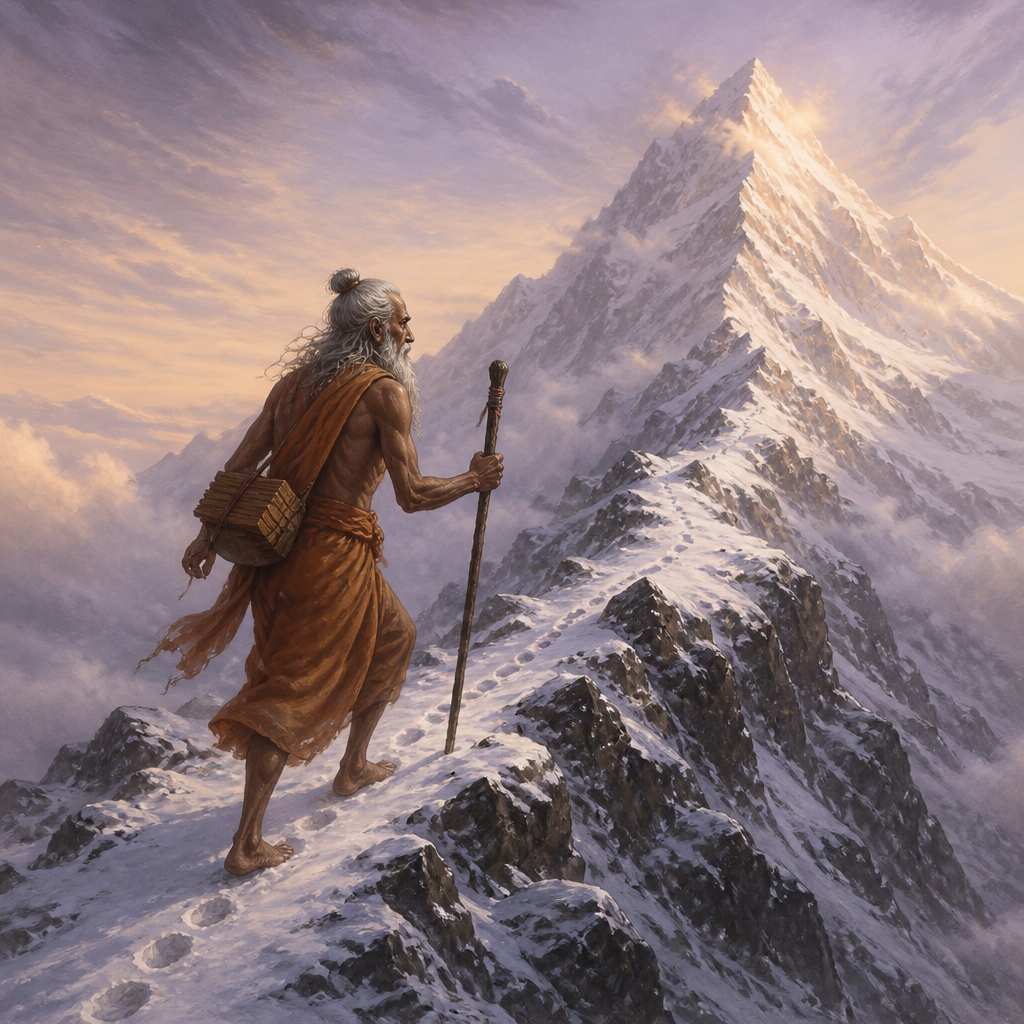
Shukracharya climbing alone along a snow-blown ridge of Kailasa

His name is Shukracharya. He is the guru of the asuras. His side has just lost the war. The deva court has celebrated. Indra is back on his throne. Brihaspati, the guru of the devas, has been showered with honours. And Shukracharya, on the losing side, has been left with the dead bodies of his students.

He is not climbing Kailasa to mourn. He is climbing to ask. There is a teaching that can revive the dead. It is called the Mrita Sanjivani Vidya, the science of life that returns. The devas will not give it to him. Brihaspati will not teach it to a rival. The cosmic court will not lend it to its losing party. Only one god might.

That god does not live in the court. He lives at the top of this mountain, far from Indra's palace, far from the politics, far from the celebrations. He sits in ash on a tiger skin, with snakes in his hair and a small drum in one hand. The asuras call him a friend. The devas call him a friend. Neither is wrong. He is the Bahishkrita, the outsider, and the science Shukracharya needs is in his keeping.

Why Outside

The Shiva Purana spends many chapters explaining why this god does not live in the court. The simplest answer is that the court is a place of trades. To live in it, you must owe someone something. Indra owes the devas his throne. The devas owe Indra their order. Brihaspati owes the devas his prestige. Each protects the others, and each is owned, in some small way, by the others.

Shiva does not enter that economy. He owns nothing the court can take. He wants nothing the court can give. His clothes are ash. His ornaments are snakes. His seat is a tiger skin. His drum is a piece of wood and two stones. His house is a mountain that cannot be deeded to anyone. There is nothing the cosmic court can offer him, and nothing it can threaten him with.

This is the meaning of Bahishkrita. The word is a compound of bahis (outside) and kṛta (placed). Placed outside. The tradition does not say Shiva was kicked out. It says he placed himself there, deliberately, so that he could remain free to do the work the court itself would not allow.

The work he does is care without political colour. A devotee asks. He answers. The devotee is a deva, an asura, a sage, a hunter, a queen, a tribal woman bringing him tasted berries. He receives them all. The Shiva Purana keeps insisting on this. The court cannot do this. The court is a system of preferences. The outsider is not.

What He Wears, And Why

Shiva at the cremation ground in ash and skulls

Most people meet Shiva first as an image. Before they read a word of the Purana, they have seen a poster, a temple statue, a painted door. The image is consistent across South India and North India, across Nepal and Bali, across two thousand years of art. He sits in deep stillness. He wears almost nothing. The few things he wears tell the whole story of why he is outside.

What He Wears What It Says
Bhasma (sacred ash) The body is on its way to ash. So is the office, the title, the salary, the reputation. Wearing ash is a daily reminder.
Jaṭā (matted hair) Hair untouched by a barber's politics. The river Ganga is held in it because, for a god outside the court, even the river finds a private home.
Snakes The animal the court fears most. He wears them as ornaments. What the court fears, the outsider has befriended.
Triśūla (the three-pointed spear) The three powers of will, knowledge, and action. He carries them himself. He does not borrow them from any institution.
Ḍamaru (the small drum) A piece of wood and two stones. The simplest instrument that exists. The pulse of every cycle is enough music.
Tiger skin The seat of someone who has met fear and is sitting on it.

None of this is poverty. The outsider is not poor. He has chosen to wear what cannot be taken from him. A salary can be cut. A title can be stripped. A house can be lost. Ash, hair, snakes, and a small drum are nobody's to take. This is what the icon is teaching, the moment a child sees it on a calendar at her grandmother's house. Wear what cannot be removed. Then you cannot be controlled.

The Vidya Travels Both Ways

Shukracharya reaches the top of the climb. Shiva is sitting on the tiger skin, looking out over the snow. Parvati, the mountain's daughter, is beside him. Shukracharya touches the ground with his forehead. He does not introduce himself. The outsider already knows him.

Shukracharya asks. He explains the war, the dead, the closed door at the deva court. He asks for the Mrita Sanjivani Vidya.

The Shiva Purana says Shiva considers, in silence, for a long time. He sees what the gift will do. The asuras, with their dead revived, will challenge the devas again. The cosmic balance will tip. The court will be furious. Indra himself will come, later, to complain.

Shiva granting the vidya to bowed Shukracharya

And Shiva grants it.

The reason the Shiva Purana takes its time on this scene is that it is the cleanest test of what an outsider god is. A god of the deva court could not have given this teaching. He would have asked, first, whose side the seeker is on. The teaching, in his hands, is a political asset. Only a god who has placed himself outside the court can give the teaching as a teaching, to whoever has earned it, on whichever side they happen to stand.

This is the Shaiva claim about real compassion. It is not the warm feeling you get for the people who already belong to your camp. It is the willingness to give the medicine to the patient who is bleeding, even when the patient is wearing the other team's colours. Shiva does this. He has been doing it for as long as the tradition can remember. Karna will receive his blessings. Banasura, an asura king, will be his closest friend. Ravana, the rakshasa of Lanka, will compose a hymn to him that is still chanted at temples today. The court keeps a sectarian register. The outsider does not.

The Court Inside You

The danger of reading this lesson too fast is that it will sound like an old story about gods and demons. It is not. It is a description of the way most lives in 2026 are organized.

Notice the courts you live inside. There is the corporate court, the room you walk into every Monday morning where promotions are decided and reputations are made and the dress code is a quiet form of allegiance. There is the family court, the WhatsApp group where approval is granted in emoji and withdrawn in silence. There is the social media court, the ambient panel of judges to whom every meal, every trip, every opinion is submitted for review. There is the identity court, the harshest of the four, the inner panel that you yourself appointed long ago to decide whether the day was a success or a failure, whether you were enough or not.

Each of these courts, like Indra's, is a system of trades. They give you something. You give them something in return. They give you status, belonging, a feeling of being okay. You give them your hours, your honesty, sometimes your shape. The trade is so quiet that it can run for decades without anyone naming it.

The philosopher and writer David Whyte, in his 2009 book The Three Marriages, argues that a person's freedom begins at the moment she names the third marriage, the marriage to the self, alongside the marriages to other and to work. Without that third marriage, the other two slowly own her. The same observation, in plainer dharmic words, is what the Shiva Purana is making. The outsider stance is not anti-court. The outsider stance is the third seat, the one where you can still see the courts clearly because you have not signed every paper they put in front of you.

Vairāgya Is Not Coldness

The Sanskrit word for what Shiva is teaching here is vairāgya. Most translations render it as detachment, which is a half-translation. The literal meaning is the colourlessness of someone whom the courts can no longer dye. Rāga is colour, dye, attachment. Vai-rāgya is what is left when the dye does not take.

A cold person is not vairagya. A cold person has cut all wires. They are not free, only numb. Shiva is the warmest god in the Indian tradition. He weeps for Sati. He weds Parvati. He raises Ganesha. He gives his most precious teaching to the asura who lost a war. The vairagya he models is not a refusal to feel. It is a refusal to be owned by what he feels. The wires are intact. The current is on. But the dye, the moment by moment colour change of someone whose mood is decided by what the court did or did not say today, is gone.

This is why the bhasma on his forehead is not a sad symbol. It is a free symbol. The man who has already remembered that he will return to ash is the man whose Monday morning cannot be ruined by an email. The court can write the email. It cannot pick the colour.

Modern Echoes

The outsider stance is not a museum piece. It is the working principle of every contemporary teacher who has been useful to a person in 2026. Ramana Maharshi, the sage who lived for fifty-three years on the slopes of the southern mountain Arunachala, said almost nothing about politics, accepted no salary, owned no property, and is still consulted, through his recorded conversations, by leaders, householders, and students all over the world. Arunachala itself is a Shiva mountain, and the silence Ramana kept in front of it is the silence this lesson is describing. Sadhguru's 112-foot Adiyogi statue, dedicated at the Isha Yoga Center in Coimbatore in 2017, was sculpted with the matted hair, the half-closed eyes, and the almost-smile of the outsider. Tens of millions of people have visited it in the years since. None of them came because the statue was endorsed by a court. They came because it was not.

The research literature is catching up to the same observation. The economist and risk theorist Nassim Nicholas Taleb, in his 2018 book Skin in the Game, argues that the people who have something to lose are the only ones whose advice is worth following on questions of risk. The Shaiva tradition adds a second move that Taleb does not: the people with the cleanest perception of risk are the ones who have stepped outside the games whose rules cannot be questioned from inside. The outsider is the Indian version of skin in the game, with one more turn of the dial. Skin, but not in someone else's game.

Back at Kailasa

The Shiva Purana closes the Shukracharya episode in a few quiet lines. Shukracharya descends the mountain with the vidya. The asuras revive. The devas complain. Shiva, on his tiger skin, does not move. The court is welcome to disagree with him. He does not live in it.

The long climb Shukracharya made was the climb out of the court itself. The vidya he was given was not only a teaching about reviving the dead. It was a demonstration that there exists, in this cosmos, a place where the rules of court do not apply, and a god who keeps that place open for whoever is willing to walk to it.

Somewhere this week, you will sit in a meeting that is also a court, or scroll a feed that is also a court, or replay a sentence in your head that is the inner court still in session. The Shiva Purana would have you notice it. You do not have to leave the meeting. You do not have to delete the app. You only have to remember that you are not from there. You are from a mountain the court does not own. Your real address is Kailasa. Everything else is a long visit.

Living traditions

The outsider Shiva is alive in many of the most visited spiritual landscapes of the present. The Naga sannyasis of the Mahanirvani, Juna, and Niranjani Akharas continue to gather at Prayagraj, Haridwar, Nashik, and Ujjain in the twelve-year Kumbh rotation, with the 2025 Maha Kumbh at Prayagraj drawing record crowds. Sri Ramanasramam at Tiruvannamalai, founded around the silent presence of Ramana Maharshi, is now a year-round destination for seekers from India and abroad. Sadhguru's 112-foot Adiyogi statue at the Isha Yoga Center near Coimbatore, dedicated in 2017 by Prime Minister Narendra Modi, has become the most visited modern monument to the outsider god. The twelfth-century vachanas of Akka Mahadevi, the Lingayat saint who walked away from a royal marriage to follow Shiva alone, are still printed and sung in Karnataka schools and homes today, a thousand-year-old voice of vairagya kept on the lips of children.

Reflection

More in Who Is Shiva Really?

All lessons in Who Is Shiva Really? · Shiva Purana course