Mahadeva: The God We Still Need
Why a god of destruction matters
The Shiva Purana opens at Naimisharanya, where the storyteller Suta meets the gathered sages and is asked one direct question: in this dark age, who can a person hold on to? His answer is Shiva, the Mahadeva. Not a god of polite blessings, but the one whose work is to destroy what no longer serves. This lesson welcomes you into the course by showing why a god of destruction is exactly the god a 2026 life needs.
The Forest That Listens
In the forest of Naimisharanya, on the banks of the Gomati, sometime at the start of Kali Yuga, eighty-eight thousand sages have gathered for a long sacrifice. The fires are low. The air smells of wet grass and ash. The morning chants have ended, and the sages are quiet.
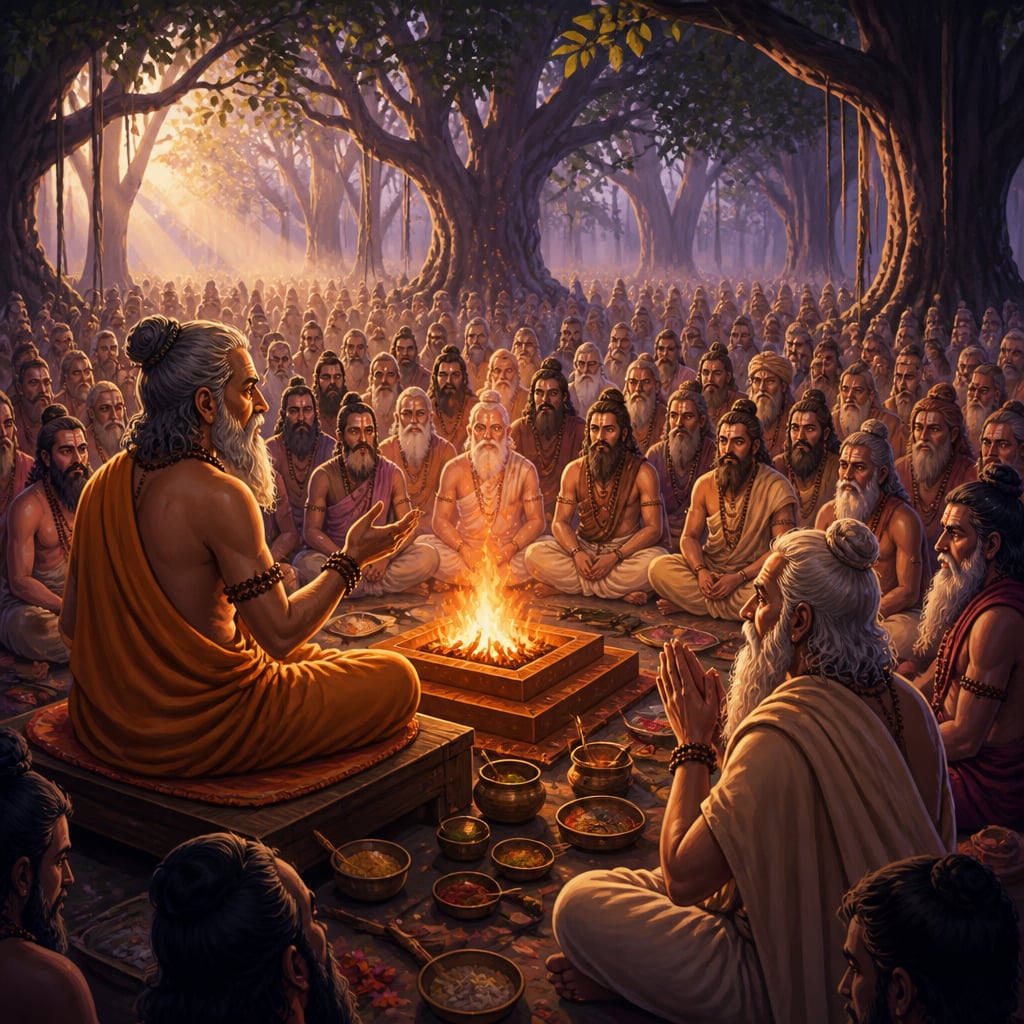
A traveller arrives. His name is Suta Goswami. He is the son of Romaharshana and a disciple of Vyasa, and he has heard, in his own life, the eighteen Puranas from the lips of his teacher. The sages rise to receive him. They wash his feet. They seat him on a deer skin. Then Shaunaka, the eldest among them, asks the question that opens this entire course.
"The age has turned dark. Lifespans are short. The mind is restless. People run after small pleasures and forget the great ones. Tell us, O Suta, in this Kali Yuga, who can a person hold on to? Whose name, whose form, whose story will not break under the weight of these times?"
Suta closes his eyes. When he opens them, he begins where every Shaiva storyteller begins. He tells them about Shiva, the Mahadeva, the great god. The lesson you are about to read is a part of his answer.
Why "Mahadeva"
The word Mahadeva is two words pressed together. Maha means "great". Deva means "shining one", a god. So Mahadeva is, plainly, "the great god". The Shiva Purana uses this title more than any other.
The title is not boastful. It is descriptive. The Shaiva tradition is not saying Shiva is greater than other gods so other gods are less. It is saying that Shiva does the one work the cosmos cannot do without, and yet the one work most of us spend our lives running from.
Shiva's work is to destroy what no longer serves.
Not to punish. Not to take revenge. Not to crush. To clear. The way a forest fire clears dead wood so the next season can grow. The way a surgeon cuts away the tumour so the body can live. The way a sleep clears the day so the next day is possible. Shiva is the god of that clearing.
The Word You Already Know
The name Shiva itself means auspicious. "That which is good for you". The Vedas, much older than this Purana, knew this god first as Rudra, the howler, the storm. He was feared. He was kept at the edge of the village. He was the god who killed and the god who healed, both, and the village did not know how to hold both in one name.
Over time, the tradition gave him a new name to soothe him. They called him Shiva, the auspicious one. The word was almost a prayer. Be good to us. Be Shiva, not Rudra. And he answered. The howler became the great god. The storm at the edge of the village walked into the village and became the god the village could not live without.
This is the first thing to understand about Mahadeva. He is not nice, but he is good. There is a difference. Nice does not break what needs to be broken. Good does, when it must, and only because it loves you.
A Day in 2026
Sit with a normal day. The phone is loud before you are awake. There is a feed to scroll, a message to answer, a face to put on. There is a job that demands you perform a version of yourself that may or may not be true. There is a relationship that may have started somewhere honest and is now held together by habit and small lies. There is an old story you tell yourself about who you are. You have outgrown it, but you have not been brave enough to put it down.
This is most lives in 2026. The trouble is not that anything is wildly wrong. The trouble is that too many things are quietly wrong, and they have crowded out the room where the true thing might still grow.
Which god do you call?
A god of polite blessings will not help. He will only add another layer of niceness on top of the pile. A god of moral lectures will not help. The pile is not a problem of information. A god of comfort will not help. Comfort is what built the pile.
You need a god who will clear.
That god is Mahadeva.
Destruction Is Not Cruelty
Most people read the word destruction and flinch. They picture damage. They picture a god who is angry, who breaks for the joy of breaking. The Shiva Purana spends much of its length undoing that picture.

Shiva's destruction is the destruction a gardener does when she prunes a tree so the tree can fruit. Destruction the river does when it cuts a new channel because the old one is silted. Destruction a parent does when she takes a knife from a small child's hand. The act looks fierce from outside. From inside, it is care.
| What people fear destruction is | What Shiva's destruction actually is |
|---|---|
| Anger acting out | Compassion acting in |
| Loss of what you had | Room for what wants to come |
| Punishment for being wrong | Clearing for being more true |
| The end | The threshold |
This is the central reframe of the Shiva Purana. Until it lands in you, the rest of the course will feel strange. Once it lands, every story in the next 79 lessons will read differently. The wrath at Daksha's yajna, the burning of Kamadeva, the destruction of the three cities of Tripura, the dance at the cremation ground. None of these are anger. All of them are care, in a form most of us are not ready to receive.
The Outsider Who Holds the Centre
Shiva does not live in a palace. He lives on Mount Kailasa, far from the cosmic court. He smears his body with bhasma (sacred ash). He wears a snake. He carries a trishula (a three-pointed spear). His matted hair holds the river Ganga and a crescent moon. His throat is dark blue from the poison he once drank to save the world. He is the god you would not invite to a polite dinner.

And yet, when the gods are in trouble, when the demons cannot be contained, when grief is too heavy for the safe gods, everyone, including the gods, walks to Kailasa. The outsider holds the centre.
This is what 2026 needs. Not another polished icon. A god who is not afraid of the parts of life that are not polished. A god who is at home with grief, with anger, with silence, with the cremation ground, with the things you usually push out of frame. The Shiva Purana keeps insisting, story after story, that the things you push out of frame are exactly where Shiva is waiting.
The Same Question Now
In 1925, Carl Jung gave a series of lectures at Zurich on what he called the shadow, the parts of the self a person disowns. He said the work of a real life is not to deny the shadow but to integrate it. "One does not become enlightened by imagining figures of light, but by making the darkness conscious." That sentence, written in German almost a hundred years ago, is a footnote on a god the Vedas already knew three thousand years earlier.
The research caught up later. Brené Brown's two decades of work on shame and vulnerability at the University of Houston shows the same thing, in plainer words. The parts of you that you hide are the parts that, brought to light, set you free. Pema Chödrön, the Buddhist teacher, calls it "the wisdom of no escape". Modern psychology has spent a century building back to a teaching the Shaiva tradition has carried forward, unbroken, since the Rudra hymns of the Rig Veda.
Mahadeva is the Indian name for that work. Not the work of becoming nicer. The work of becoming true, even when becoming true means letting some part of the old self burn.
Back in the forest at Naimisharanya, Suta has not yet finished his answer to Shaunaka. He has only opened the door. Through this door, in the lessons that follow, will walk Sati and Parvati, Ganesha and Kartikeya, the demons of the inner mind, the twelve Jyotirlingas, and the devotees who walked through fire. But before any of that, you needed to know who you were going to meet.
You were going to meet the great god. Not because he is the greatest in some ranking. Because he is the one whose hand you can hold when the work is to let something go.
Mahadeva is not a story from the past. Mahadeva is the part of life that clears the room so something true can finally arrive. The rest of this course is about how to recognise him, how to receive him, and how to stop running.
Living traditions
Mahadeva is now a global cultural reference, not only an Indian religious one. The Nataraja statue gifted by India to CERN in 2004 stands beside the world's largest particle accelerator as a metaphor for cosmic creation and destruction. The Mahashivaratri broadcast from Isha Yoga Center reaches over a hundred million viewers worldwide each year. Sadhguru, Ram Dass, Robert Svoboda, and David Frawley have written widely-read English works that introduced Shaiva ideas of clearing and shadow integration to a Western readership. The Indian Supreme Court's 2018 Sabarimala judgement and the 2019 Ayodhya verdict both engaged seriously with the Shaiva and Vaishnava traditions as living, not merely historical, frameworks of meaning.
- Mahashivaratri Night Vigil: The single most important Shaiva festival of the year, observed on the fourteenth night of the dark fortnight in Phalguna (February-March). Devotees fast through the day, stay awake through the night, and chant Om Namah Shivaya in four three-hour watches called praharas. Each prahara has its own abhisheka (ritual bath) of the Shivalinga: with milk, curd, ghee, and honey, in turn. The vigil is the year's most direct way to enact what this lesson teaches: a willingness to stay present while what no longer serves you is cleared.
- Pradosham: A twice-monthly Shiva observance held on the thirteenth day of each lunar fortnight, between roughly 4:30 PM and 6:00 PM. Devotees visit the Shiva temple, offer abhisheka, and sit silently in front of the linga during this window. Tradition says Shiva dances his dance of clearing during pradosham, and a sincere devotee who is present at the temple receives a portion of that clearing.
- Naimisharanya (Neemsar): The canonical site where the Shiva Purana was first transmitted by Suta to Shaunaka and the eighty-eight thousand sages, on the banks of the Gomati River. Key spots within the kshetra: Chakra Tirtha (the pond where the rim of the dharmachakra is said to have fallen, giving the forest its name), Lalita Devi temple (one of the 51 Shakti Peethas), Vyasa Gaddi (the seat where Vyasa is said to have organised the Puranas), and Hanuman Garhi. Walking the parikrama path of about five kilometres takes the pilgrim through the heart of where the Puranas were born.
- Kashi Vishwanath Temple: One of the twelve Jyotirlingas and the foremost Shiva site in India. The temple's prefix Vishwanath means lord of the universe, a direct echo of the title Mahadeva that this lesson centres on. The 2021 Kashi Vishwanath Corridor reopened the temple's connection to the Ganga, recovering a sacred geography that had been built over for centuries. A first encounter with Mahadeva is incomplete without a darshan here, even if the visit comes later in the course.
Reflection
- What is one thing in your life right now that you have been calling stable but is actually just stuck? What would it cost you to let Shiva clear it?
- Why do you think the tradition that first knew this god as Rudra the howler chose to keep that name even after adding the softer name Shiva, the auspicious?
- If destruction is a form of compassion, what does that say about the dharmic relationship between change and love?