Kamalalochana: The Lotus, the Eye, and the Sudarshan Gift

A thousand lotuses, one missing flower

Vishnu, the lotus-eyed preserver, worships Shiva each dawn with a thousand lotuses and a thousand names. One morning a flower is missing. What he does next becomes the founding story of the deep friendship between Vishnu and Shiva, and the origin of the Sudarshan Chakra, the discus that protects the worlds.

A Thousand Names, A Thousand Lotuses

A cold Himalayan dawn at the edge of Manasarovar lake. Vishnu, the dark-blue preserver of the worlds, sits on the bank in silence. In front of him is a small heap of fresh lotuses, freshly picked in the early light, still wet from the lake. His eyes are large and quiet. They are the reason one of his oldest names is Kamalalochana, the lotus-eyed.
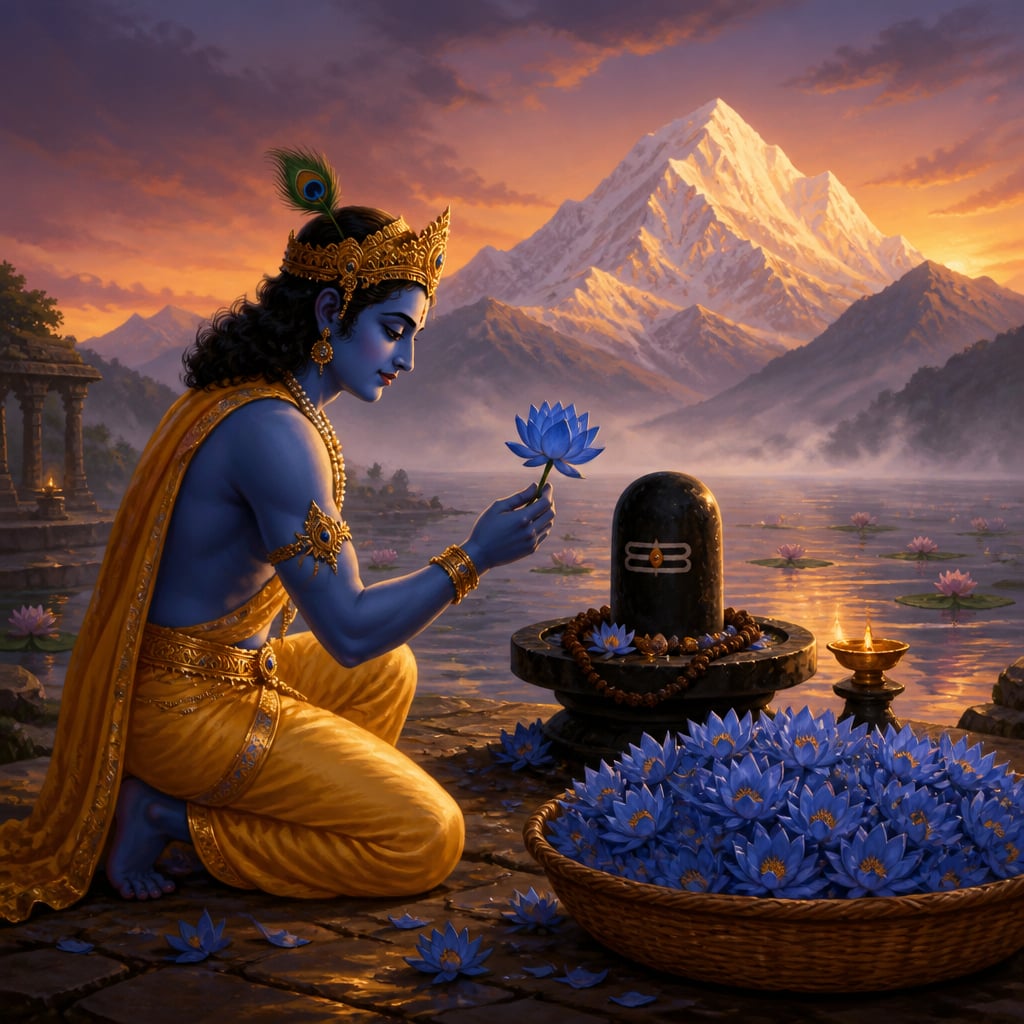
Vishnu offering lotuses to a Shiva linga at dawn beside Manasarovar

For a long time now, Vishnu has been worshipping Shiva in a precise way. Each morning, before the world wakes, he chants one thousand names of Shiva. With each name, he places one fresh lotus at the linga in front of him. One name, one flower. One thousand names, one thousand flowers. He has done this for many days. The world is in trouble. Asuras are growing stronger. The preserver needs a weapon that cannot be matched, and he has decided that only Shiva can give it to him.

This morning, Shiva is watching. Quietly, from somewhere just out of sight, he decides to test his old friend.

The Missing Flower

Vishnu begins. Om Sthanave namah. A flower. Om Hiranya-bahave namah. A flower. Om Sarvajnaaya namah. A flower. The names roll out steadily. The pile of lotuses shrinks. The pile in front of the linga grows. The early sun starts to climb.

Nine hundred and ninety-nine names. Nine hundred and ninety-nine flowers. Vishnu reaches for the last one.

There is no last one.

He pauses. He counts. He counts again. He looks around the bank. He checks under his asana. The pile is empty. One lotus is missing. Without the thousandth flower, the worship is incomplete. Without the thousandth flower, the discipline of many days breaks on the very last morning.

Most worshippers in this moment would do one of two things. They would stop and start again tomorrow. Or they would offer a small substitute, a leaf, a petal, a handful of water, and tell themselves it was close enough. Vishnu does neither.

The Lotus In His Face

He sits very still. His mind moves quickly. I have one lotus, he thinks, that I have not yet offered. The lotus that men have always seen in my face. The lotus that gave me my name.

Vishnu offering his own lotus-eye to Shiva

His eye.

He does not announce the decision. He does not pray for permission. He simply lifts a hand. The thousandth name is already on his tongue. Om Kamalochana-rakshakaaya namah. He plucks his own right eye out of its socket and places it, calmly, on the heap of flowers at the linga. The blood is real. The pain is real. The discipline is complete.

Shiva Steps Out

The linga begins to glow. The light is soft, then strong, then warm enough to dry the morning dew on the grass. Shiva steps out, ash on his skin, matted hair falling, a small surprised smile on his face. He has tested many devotees over the ages. He has never seen this.

'Stop,' he says. 'Hari, stop. The thousandth flower was never missing. I hid it. I wanted to see what you would do. I did not expect this.'

Vishnu opens his remaining eye. He folds his hands. He says nothing. There is nothing to add.

Shiva gifting the spinning Sudarshan Chakra

Shiva places his palm on Vishnu's face. The eye returns. Then he lifts his other hand and a wheel of light spins out of his palm, edged with flame, faster than the eye can follow. He places it in Vishnu's hand.

'This is Sudarshana,' he says. 'The good vision. It will turn at your thought. It will protect every world you choose to protect. The asuras you came to me about will not stand against it. Take it. It is yours because you held nothing back.'

Why The Story Matters

The Sudarshan Chakra is the most famous weapon in Indian sacred memory. Krishna spins it on his finger in the Mahabharata. It cuts down Shishupala. It hides the sun in the Jayadratha episode. Every Vishnu temple from Tirupati to Badrinath shows it on his upper right hand. Most worshippers know the chakra. Far fewer know how he received it.

He received it from Shiva. And he received it because he was willing to give the thing he most wanted to keep. The story sits at the founding root of the Hari-Hara tradition, the long Indian conviction that Vishnu and Shiva are not rivals to be chosen between but two faces of one truth. Vishnu worships Shiva at this lake. Shiva will, in another story, worship Vishnu at Kashi on the night of Vaikuntha Chaturdashi. Each bows to the other. Each gives the other something the other cannot make alone.

The Shiva Purana puts the moral plainly. Devotion that holds back its best part is not yet devotion. The thousandth lotus is the test. Anyone can offer the first nine hundred and ninety-nine. The last one is the question.

Modern Echoes

The writer Nassim Nicholas Taleb has spent two decades arguing for what he calls skin in the game. A doctor whose own life is at stake on her diagnosis listens differently. A leader whose own money is in the venture decides differently. A teacher whose own children sit in the class teaches differently. Without something of yourself on the line, Taleb argues, your judgment is incomplete and your standing is borrowed. Vishnu's eye on the heap of flowers is the oldest case study in this principle. He does not ask Shiva for the chakra with words alone. He puts skin, and bone, and sight, on the table.

The psychologist Angela Duckworth has shown in her research on grit that what predicts long-term success is not talent or even effort but the willingness to keep going at the very last percent, the part of the journey when most people quietly stop. Nine hundred and ninety-nine lotuses are effort. The thousandth is grit. Vishnu's gesture is the dharmic image of that last percent made visible.

In the corporate world, the founders that investors trust most are the ones who have put their own savings into the company before asking outsiders to invest. The pattern is the same. The world responds to the person who has already given up something that costs them. Shiva responds to Vishnu for the same reason.

The Pillar And The Eye

In the last lesson, Vishnu honoured the infinite by saying I could not find the bottom. In this one, he honours the infinite by giving the part of himself that finds anything at all. The pillar tested his honesty. The lotus tested his completeness. He passed both, and the temples of India remember him for it in two different ways: in the Lingodbhava panel on the west wall, and in the chakra spinning on his upper right hand.

Next, we will move from Shiva's stories to Shiva's many names. The same god who is Bhairava in one moment is Shankara the auspicious in the next. How one god holds so many moods is the question of the next lesson.

Historical context

Puranic compilation period (c. 8th to 12th century CE), with Hari-Hara iconography flowering between the 6th and 14th centuries CE under successive South Indian dynasties.

The first millennium CE was the great period of Shaiva-Vaishnava negotiation in Indian temple culture. Pallava, Chalukya, Rashtrakuta, Chola, Hoysala, and Vijayanagara dynasties all patronised both traditions, often in the same complex. The Kamalalochana story is one of the unifying myths of that period: it asserts Shiva's supremacy in the Shaiva text but simultaneously honours Vishnu as the model devotee. Vaishnava texts return the favour by having Shiva worship Vishnu at Kashi. The result is a settled theological agreement that allowed Shaiva and Vaishnava devotees to share temples, towns, and royal courts without civil conflict. The Vijayanagara emperors, naming themselves Harihara, made the doctrine the founding charter of their state.

The Sudarshan Chakra, the most iconic weapon in Indian sacred imagination, the discus that Krishna spins on his finger, that ends Shishupala, that hides the sun for Arjuna, originates in this story. Without the Kamalalochana narrative, the chakra is a Vaishnava weapon. With it, the chakra is a gift from Shiva to Vishnu, and a permanent reminder that the two great gods stand on the same side.

Living traditions

The Kamalalochana story underwrites three of contemporary India's most living religious surfaces. The Vishnu Sahasranama, the very thousand names Vishnu chants in this lesson, is recited daily in millions of households and is one of the most widely sold religious audio recordings in the country, with TM Krishna and MS Subbulakshmi versions running into hundreds of millions of plays. The Sudarshan Chakra, granted to Vishnu in this story, is the symbol on the left arm of every Vishnu and Krishna murti in India and the iconographic anchor of the Sudarshana Yantra worshipped in Pancharatra and Sri Vaishnava traditions. And Vaikuntha Chaturdashi at Kashi is treated by the Uttar Pradesh tourism department as one of the city's three peak nights of the year, with pilgrim footfall estimated above three lakh on the recent festival nights. The Hari-Hara doctrine the story founds is also the deepest answer Indian theology offers to the question of which is the highest god. The answer the temples give, in stone and in lamp-flame, is both.

Reflection

More in Who Is Shiva Really?

All lessons in Who Is Shiva Really? ยท Shiva Purana course