Vairagya: Detachment Without Coldness
The cremation-ground dweller who is also the doting father
Vairagya is usually translated as detachment, and usually misread as coldness. The Shiva Purana's teaching is more precise: detachment from outcomes, not from people. This lesson traces the word through the Bhagavata and the Yoga Sutras, shows what full engagement without clinging actually looks like, and ends with the householder's question: how do I love without holding on?
Ash on the Cheek
The summit of Kailasa, just before dawn. The snow on the upper slopes was holding the last of the night, and the sky over the eastern ranges had begun to whiten. Parvati was awake. She had been awake for some time. Her younger son Ganesha was asleep against her shoulder, his small elephant head heavy and warm. The lamp in the hall had burned down. She was waiting for her husband.
Shiva had been at the cremation ground all night. Manikarnika, on the western bank of the Ganga at Kashi, where the dead are burned without pause, where the priests of his order keep the fires lit through every season. He had walked among the pyres. He had spoken with the dead, the way she had seen him speak with them many times. He had returned now along the high passes, alone, on foot.
He came in through the door without speaking. There was a smear of grey ash across his right cheek. His skin smelled of woodsmoke and of something colder. He sat down on the stone bench beside her. He looked at the sleeping child. He smiled.
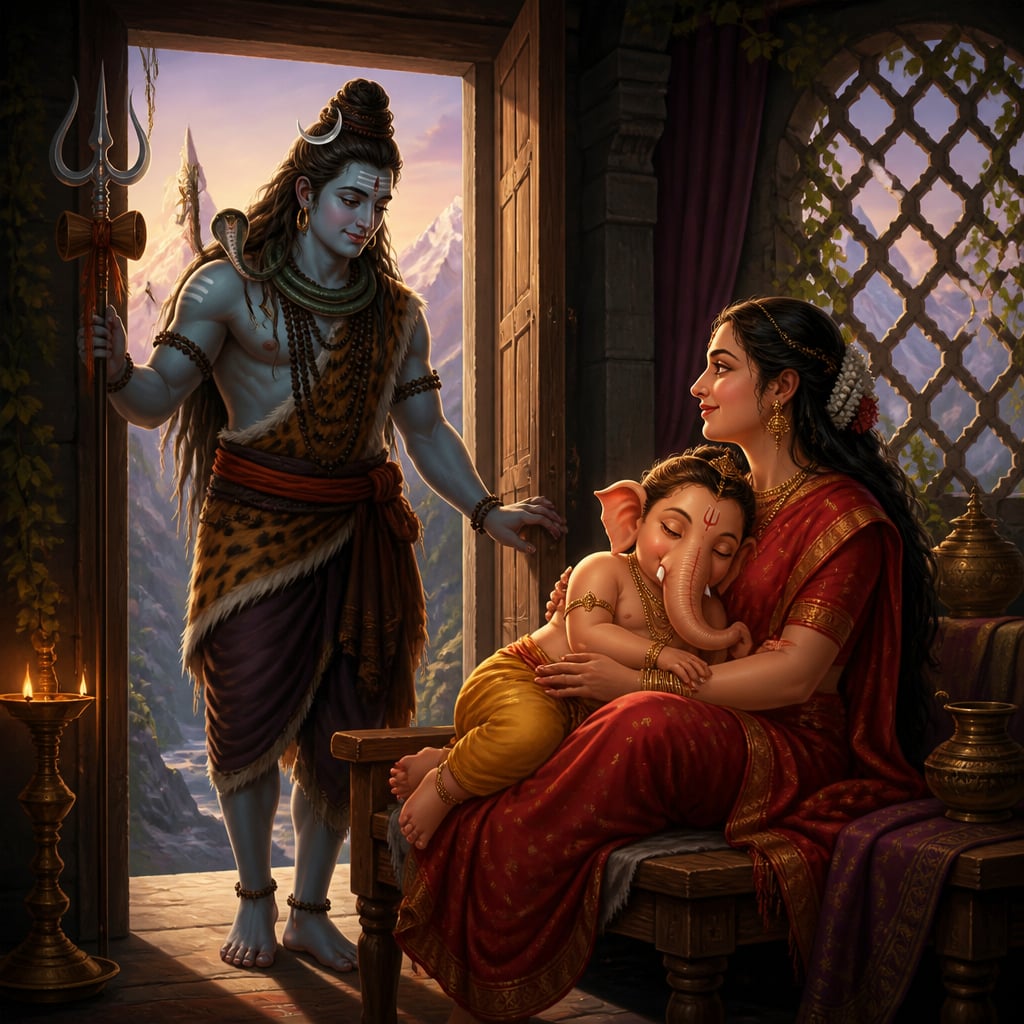
Parvati had been the wife of this man for what felt to her a very long time. She had asked him many questions over those years, and he had answered each one. There was one question she had never quite asked him directly. She asked it now, in the half-light, with the ash still on his cheek and the son still asleep on her shoulder. How are you both at once? How is it that the man who walks among the dead is the same man who is now smiling at this child?
What follows is the dharmic answer to that question. The answer is the Shaiva teaching of vairagya, detachment without coldness, and it is the most often misread teaching in the entire dharmic canon.
What Vairagya Is Not
Most modern readers, when they meet the word vairagya, hear it as some version of cold withdrawal. The detached person, in this misreading, is the one who has stopped feeling, the one who has put up walls, the one who attends a parent's funeral with dry eyes and calls it spiritual progress. The Shaiva tradition is unambiguous. This is not vairagya.
The Sanskrit word for that posture is nirveda, revulsion, the recoil from life. Nirveda is the temptation that arises when life has hurt the seeker badly enough that withdrawal feels like freedom. The Shiva Purana names nirveda as a wrong turn. The cold person is not a free person. The cold person is a wounded person who has confused the absence of feeling with the absence of attachment.
Vairagya is something else. The word breaks open into two parts. Vi is without. Rāga is colour, in the technical sense of the colouring of the mind by an external object. Vairagya is therefore the mind without external colouring, the mind that perceives the object as it is, without being tinted by it. The chanter of the verse sees the sunset clearly. The chanter of the verse is also not made into a different person by it.
A short comparison clarifies the distinction.
| Nirveda (false detachment) | Vairagya (true detachment) |
|---|---|
| The mind has shut down. | The mind is fully open. |
| Feelings are suppressed or absent. | Feelings arise freely and pass through. |
| The cause is a wound or fear. | The cause is steady inner ground. |
| Withdrawal from life. | Engagement with life. |
| Cold to others. | Warm to others, unshaken inside. |
The lord at Manikarnika is not in nirveda. The lord is in vairagya. The pyres do not shake him. The grief of the families at the ghat does not shake him. He is fully present with each cremation. He is also, simultaneously, the father walking home to a sleeping son.

The Cremation-Ground Dweller
The Shiva Purana names the lord with the title smaśāna-vāsin, the dweller of the cremation ground. The Vidyeshwara Samhita opens with the verse:
श्मशानवासिनं शान्तं भूतिभूषितविग्रहम्। भस्मोद्धूलितसर्वाङ्गं प्रणमामि महेश्वरम्॥
śmaśāna-vāsinaṃ śāntaṃ bhūti-bhūṣita-vigraham bhasmoddhūlita-sarvāṅgaṃ praṇamāmi maheśvaram
I bow to the great lord, the dweller of the cremation ground, the peaceful one, his form adorned with sacred ash, his entire body powdered with ash.
Shiva Purana, Vidyeshwara Samhita
The verse is precise about the lord's twin attributes. He lives at the cremation ground, and he is śānta, peaceful. He is covered in ash, and he is the great lord. The two halves are joined by the small Sanskrit conjunction the verse barely needs to mark, because in the Shaiva reading the two halves are not in tension. They are the same posture seen from two sides.
Why ash. The Shaiva tradition is direct. Bhasma, the ash that the lord wears, is what remains when everything else has been burned away. The ash is the residue of every form. It is what is left when the body has finished its arc. To wear the ash is to wear the truth of the body's destination on the body itself, all day, every day. The wearer of the ash does not need to fear death, because the wearer of the ash has already, iconographically, accepted it. The fear has nothing left to grip.
This is the inner posture vairagya describes. Not a refusal to live. A refusal to be shaken by what living involves.
The Same Lord, Two Forms
The Shiva Purana is unusually careful to keep both halves of the lord visible at once. The same chapter that describes Shiva at Manikarnika describes him on Kailasa with Parvati. The same verses that name him Bhairava, the terrible one of the cremation ground, name him Pita, the father, watching Ganesha learn to write. The tradition does not soften one half to make room for the other. The tradition holds both at full intensity.
This is the dharmic image of the integrated person. The integrated person is not the one who has chosen the ascetic pole and renounced the householder pole, or chosen the householder pole and forgotten the ascetic. The integrated person is the one who can walk the cremation ground at three in the morning and also be at the dinner table at eight in the evening, without either side feeling false.
The Bhagavad Gita, in the sixth chapter, gives the technical name for this inner posture. The yogi seated firm in himself is described in verse 8 as kūṭastho vijitendriyaḥ, immovable, with the senses conquered. The verse continues:
ज्ञानविज्ञानतृप्तात्मा कूटस्थो विजितेन्द्रियः। युक्त इत्युच्यते योगी समलोष्टाश्मकाञ्चनः॥
jñāna-vijñāna-tṛptātmā kūṭastho vijitendriyaḥ yukta ity ucyate yogī sama-loṣṭāśma-kāñcanaḥ
The yogi whose self is satisfied with knowledge and discernment, who is immovable, whose senses are conquered, who sees a clod of earth, a stone, and a piece of gold as the same, is called yoked.
Bhagavad Gita 6.8
The yogi is not unable to tell gold from stone. The yogi is unable to be made into a different person by which one is in front of him. The Sanskrit word for this is samatva, equanimity, the same-sightedness that does not flatten the world but that refuses to be flattened by it.
A dirt-clod, a stone, and a piece of gold are still, of course, different. The yogi can still pick the gold to pay the temple priest. The yogi simply does not become a smaller person when the gold appears, or a larger person when it does not.
The Sthitaprajna
Krishna's most-quoted description of the integrated person comes earlier in the same Gita, in the second chapter. Arjuna asks how to recognise such a person. Krishna gives the answer in verses 55 to 72. The opening verse names the sthitaprajña, the one of steady wisdom.
प्रजहाति यदा कामान् सर्वान् पार्थ मनोगतान्। आत्मन्येवात्मना तुष्टः स्थितप्रज्ञस्तदोच्यते॥
prajahāti yadā kāmān sarvān pārtha mano-gatān ātmany evātmanā tuṣṭaḥ sthita-prajñas tadocyate
When one gives up all desires that have entered the mind, satisfied in the self by the self, that one is called the sthitaprajña, the one of steady wisdom.
Bhagavad Gita 2.55
Notice what the verse does and does not say. It does not say, one in whom no desires arise. It says, one who gives up all desires that have entered the mind. Desires still arrive. The sthitaprajña does not pretend they do not. The sthitaprajña simply does not let them set up residence. The mind is the courtyard. Visitors come and go. The owner of the courtyard is the steadiness underneath, not the visitors.
This is the same image the Shiva Purana paints with the cremation ash. Things will burn. Forms will end. Desires will rise and fall. The ash is what remains. The ash is the chanter, underneath all the colourings the day brings.
What Parvati Saw
Return to Kailasa, just before dawn. Parvati has asked her question. Shiva does not answer in words. He does not need to. She is the goddess. She can see the answer in his face.
The man who has just walked through the cremation ground all night is the same man who is now smiling at her sleeping son. The presence has not been bought by the absence of feeling. The presence has been bought by the steadiness underneath the feeling. The grief at the pyre was real. The smile at the boy is real. They are not in conflict. They are produced by the same ground.
Parvati realises, watching him, that this is what vairagya actually looks like in a real human life. It is not the cold person at the funeral. It is the warm person at the funeral, who weeps with the bereaved, who holds them, who sits with them through the long night, and who, at three in the morning, is still the same person he was at three in the afternoon, because the ground beneath the feeling has not moved.
Modern Echoes
The psychiatrist John Bowlby, working at the Tavistock Clinic in London across the 1960s and 1970s, gave the modern world the language of attachment theory. Bowlby's central observation, after thirty years with children separated from their primary caregivers, was that the human capacity for love is not destroyed by detachment from outcome. The opposite. Secure attachment, in Bowlby's clinical work, is the inner state from which love can be most fully given. The insecurely attached child clings, controls, withdraws, fears. The securely attached child is the one who can leave the room and come back, who can love the parent and also play independently, who is shaken by separation and not destroyed by it. Bowlby's secure attachment is, almost word for word, the dharmic vairagya. The ground beneath the feeling. The capacity to love without clinging.
The psychologist Tara Brach, founder of the Insight Meditation Community of Washington, gave the modern world a deployable form of the same teaching in her 2003 book Radical Acceptance. Brach's protocol, RAIN, asks the practitioner to Recognise the difficult emotion that has arisen, Allow it to be present, Investigate it without trying to fix it, and Nurture it with the same warmth one would offer a friend. The protocol is, in Shaiva vocabulary, the inner cremation ground. The practitioner sits with the feeling the way Shiva sits with the pyres. Not refusing it. Not refusing to be moved by it. Not being unmade by it.
The neuroscientist Richard Davidson, at the University of Wisconsin's Center for Healthy Minds, has measured the brains of long-term contemplative practitioners since the early 2000s. His finding, published in the Annals of the New York Academy of Sciences in 2008, is that experienced practitioners show stronger emotional responses to suffering than non-practitioners, and recover from those responses faster. Davidson called this equanimous responsivity. The Shaiva tradition called it vairagya, two thousand years earlier. The practitioner is not less moved. The practitioner is more moved, and not destroyed by the movement.
Back on Kailasa, the dawn was just breaking over the eastern ranges. The ash on Shiva's cheek caught the first light. Ganesha stirred against his mother's shoulder. The man who had walked among the pyres reached out, gently, and brushed the ash from his own face onto the sleeping boy's forehead. This too, the gesture said. This too is what protects us.
Living traditions
The Aghori sampradaya, the most direct living inheritors of the Shaiva smashana tradition, continues at Krim Kund in Varanasi and at smaller centres at Tarapith and Tryambakeshwar. Baba Kinaram, the seventeenth-century saint who founded the principal modern Aghori lineage, remains the central figure of the tradition. His ashram receives serious practitioners under guidance. In modern psychology, the work of John Bowlby on secure attachment, Tara Brach on the RAIN protocol, and Richard Davidson on equanimous responsivity at the University of Wisconsin's Center for Healthy Minds all arrive, in different vocabularies, at the dharmic teaching this lesson holds. The cardiologist Atul Gawande's 2014 book Being Mortal, and the modern hospice and palliative-care movement that the book accelerated, takes as its central thesis that the avoidance of the truth of the body's destination is itself the source of much modern suffering, and that direct contact with that truth, supported by community, produces a different relationship to daily life. The Manikarnika Ghat in Varanasi, the site that has been performing this teaching continuously for at least two and a half thousand years, has become, in the last two decades, an unexpected pilgrimage site for hospice workers, palliative-care physicians, and end-of-life educators from across the world.
- Smashana Sadhana: The Shaiva and Tantric practice of meditation at cremation grounds, performed at intervals across a practitioner's life rather than continuously. The traditional practice is a single all-night vigil at a working cremation ground, undertaken under the guidance of a teacher, on a Mahashivaratri or Bhairav Ashtami night. The practitioner sits at a respectful distance from active pyres, recites the Mahamrityunjaya or the Bhairav mantra, and observes the work of the smashana without participating in it. The intent is not morbid contemplation. The intent is the dharmic reset that comes from sitting with the truth of the body's destination, in the presence of the lord who is identified, in this iconography, with that ground itself.
- Bhasma Application: The Shaiva ritual application of vibhuti, sacred ash, in three horizontal lines across the forehead each morning after bathing, with the recitation of the Tryambakam mantra. The ash is traditionally prepared from the burning of cow dung cakes and the leftover ash of the Pradosham homa, gathered and stored in a small container at the home shrine. The morning application takes thirty seconds. The practitioner who wears it carries the iconographic memory of impermanence into the day, in continuous physical contact with the skin.
- Manikarnika Ghat: The principal cremation ground of Varanasi, on the western bank of the Ganga, between Dashashwamedh Ghat and Scindia Ghat. The site has held continuous open-air cremations for at least 2,500 years by archaeological dating, and possibly far longer by traditional reckoning. The fires at the central platform have not been allowed to go out across that span. The Manikarnika Kund, the small reservoir adjoining the ghat, is identified by tradition as the spot where Parvati's earring fell, giving the ghat its name. Devotees visit at any hour, observe the cremations from a respectful distance along the upper steps, and offer prayers at the small Tarakeshwara temple at the head of the ghat. The Doms, the hereditary fire-keepers, can be approached respectfully but never photographed. The ghat is the longest-running funeral site in continuous human use anywhere on the planet.
- Tarapith: The principal Tantric pilgrimage site of Bengal, holding the working cremation ground and the temple of Tara, one of the ten Mahavidyas. The site is the geographical anchor of the Tantric tradition that holds the smashana as the principal sadhana ground. The temple was the home of the saint Bama Khepa (1837-1911), whose samadhi is in the temple compound and whose practice was based explicitly on the smashana. The cremation ground adjoins the temple. Practitioners undertake the once-yearly all-night vigil here on Bhairav Ashtami and on the new-moon nights of the year. The site is unusual in that the temple, the cremation ground, and the saint's samadhi are within fifty metres of each other, allowing the practitioner to move between worship, contemplation, and direct study of impermanence within a single hour.
Reflection
- Where in your own life have you been performing distance and calling it detachment, and what would it look like to replace the distance with the equanimous presence the Shaiva tradition actually names as vairagya?
- Why does the Shiva Purana keep Shiva on the cremation ground and Shiva on Kailasa with his family in the same chapter, instead of choosing one image and developing it cleanly?
- What is the dharmic distinction between vairagya and nirveda, and how does this distinction reframe the modern reader's assumption that detachment is the same as withdrawal?