Mrityu Bodha: Facing Fear and Death

Befriending what everyone flees

On the morning his life is supposed to end, the sixteen-year-old Markandeya wraps his arms around a Shivalinga and refuses to let go. Yama's noose falls around the Linga too, and Shiva rises. The lesson reads this not only as a story of rescue but as the Shiva Purana's direct teaching on how to meet the fear of death.

The Boy Who Hugged the Stone

In the small hermitage of the sage Mrikandu, on the bank of a forest stream somewhere in central India, sometime in the long mythic time the Puranas use, a boy named Markandeya is sitting at the family Shivalinga. He is sixteen years old. The stone is dark, slightly damp from the morning's abhisheka, and small enough that his arms can reach all the way around it. He is reciting Om Namah Shivaya with his eyes closed.
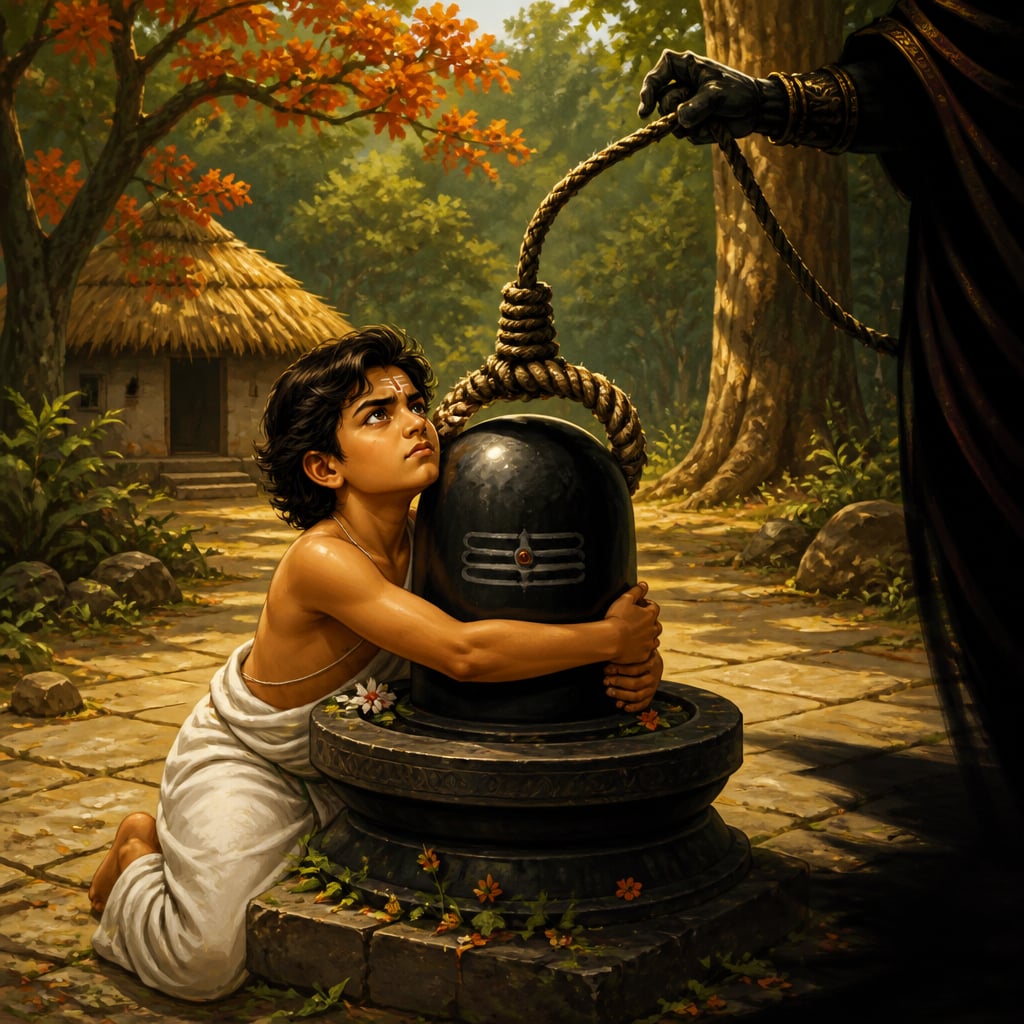
Sixteen-year-old Markandeya wrapping both arms around the small dark Shivalinga, eyes closed, chanting Om Namah Shivaya.

It is the day the boy was told, since his birth, that he would die. Mrikandu and his wife Marudvati had asked Shiva for a son and had been given a choice: a brilliant son who would live only sixteen years, or a dull son who would live a hundred. They chose the brilliant son. Today, the sixteen years end.

The boy knows this. He has been told. He is, this morning, doing the only thing the family tradition has ever asked him to do. He is sitting at the linga and chanting the five-syllable mantra his father taught him.

A shadow falls across the courtyard. Yama, the god of death, is standing at the gate. He is dark-skinned, holds a small noose in one hand, and rides a black buffalo that snorts quietly behind him. He is patient. He is doing his job.

Markandeya does not look up. He tightens his arms around the stone. He keeps chanting.

Yama steps forward. He raises his noose. He throws.

The noose lands not on the boy but on the linga he is hugging. The stone, the boy, and the noose are now wrapped together. And then, in the most famous moment in the entire Shaiva canon of stories about death, the linga splits open.

The God Who Stops Death

Shiva bursts from the linga to halt Yama

Shiva bursts from the stone. He is fierce. He is Mrityunjaya, the conqueror of death. The boy is still wrapped around his lower body. Yama is standing in the courtyard with a noose in his hand and a god he was not expecting in front of him.

The Shiva Purana describes the next moment with restraint. Shiva does not destroy Yama. He does not abolish death. He kicks Yama in the chest, hard enough to send the god of death staggering backwards. Then he turns to the boy and grants him the boon that Markandeya will be sixteen years old forever. Not immortal. Sixteen. Frozen at the age the boy had reached when he chose to keep chanting through the arrival of his own death.

The Shaiva tradition has read this moment in only one way for two thousand years. Death is not abolished. Death is not destroyed. Death is, in this one boy's case, simply outweighed by an act of unbroken devotion. The boy did not flinch. He did not run. He did not bargain. He kept his arms around the stone and his voice on the mantra. And the universe, in the form of Shiva, met him there.

The verse that emerged from this scene became the Mahamrityunjaya Mantra, the great mantra of conquering death. Chapter 10 of this course walked through it as a daily practice. This chapter returns to it as a teaching about the inner work the boy was doing. The mantra is not a magic spell. It is a description of the posture in which Markandeya met his death.

The Cremation Ground as Teacher

The Shaiva tradition draws the most consequential lesson of Markandeya's story not from the boy's escape but from where Shiva himself chooses to live. He does not live in a palace. He does not live in a flower-filled forest. He lives in the shmashana, the cremation ground.

The choice is not aesthetic. It is doctrinal. The Shiva Purana says, plainly, that Shiva chose the cremation ground because that is where the truth about a human life is most visible. Bodies arrive on bamboo stretchers. Wood is stacked. Fire is lit. Within four hours the body is gone. Within four hours, the world the body called "my life" is also gone. Shiva sits at the edge of this and watches. He is smeared in the grey ash from the pyres. He wears a rudraksha mala that is, in some traditions, made from the bones of the dead. He does not turn away.

This is the Shmashana Vairagya of the Shaiva tradition: the dispassion that arrives only at the cremation ground and is, the tradition says, the only dispassion that holds when it leaves. Most calm in life is dependent on the world cooperating. The calm of Shmashana Vairagya is the calm that knows the worst the world can do, has watched it happen, and has chosen, anyway, to remain present.

The central image is Bhairava, the fierce form of Shiva who guards the cremation grounds across India. He carries a skull-cup, a trident, and a small drum. His face is dark. His expression is not angry; it is undistracted. The point of the iconography is precise. Bhairava is what the calm of a person who has befriended death looks like. He is not enjoying the cremation ground. He is just not afraid of it.

Dom community tending fires at Manikarnika

Manikarnika and the Doms

The story is not only mythological. It is geographic. At Manikarnika Ghat in Kashi, on the western bank of the Ganga in the heart of Varanasi, between two and three hundred bodies are cremated every single day. The fires have not gone out, by tradition, for over three thousand years. The smell of woodsmoke and something else hangs in the air at all hours. Bodies arrive in processions, wrapped in white or saffron cloth, carried on bamboo stretchers by family members chanting "Ram Naam Satya Hai," the name of Ram is the only truth.

The community that has tended these fires across forty generations is the Dom community, traditionally treated as outcastes by the formal varna system, and treated, on the ghat itself, as the keepers of the most sacred fire in Hinduism. The eldest Dom of the Manikarnika lineage holds the lit torch that lights every pyre on the ghat. No fire is started without his sanction. His title is Dom Raja, the king of the Dom. The current Dom Raja's family has held the position, by oral tradition, for more than four hundred years.

The Shaiva tradition's reading of Manikarnika is that the ghat is not a tragic place. The ghat is where the highest Shaiva teaching is being taught every hour of every day. Bodies that thought they were permanent are being shown, four hours at a time, that they were not. The mourners walking down the steps are being shown what their own family will look like at the same steps in twenty years, or fifty, or eighty. There is grief, but there is also a strange clarity. The Shaiva tradition asks the practitioner to spend time at the ghat for one specific reason. Most spiritual practice happens at a remove from the fact of death. Practice at Manikarnika does not.

The Aghori and the Difficult Practice

The most difficult practice in the Shaiva tradition is the Aghori path. Aghori sadhus, mostly concentrated around Kashi and the Tarapith cremation ground in West Bengal, take meditation seats at the cremation ground at night. They eat from skull-cups. They wear ash from the pyres. They engage in practices that are, by every conventional standard, taboo. The point is not transgression for its own sake. The point is precise. The Aghori claims that fear has the practitioner trapped inside a series of "never agains", and that the only way to step outside the cage is to do the things the cage was built to prevent.

The Aghori path is not recommended for the ordinary householder. The Shaiva tradition is explicit about this. It is mentioned in this lesson because its existence makes a doctrinal point that the householder needs to hear from a safe distance. The cremation ground is a real teacher. The fear of death is a real obstacle. The most extreme practice in the tradition treats the fear of death as the single thing standing between the practitioner and the inner stillness of Shiva. Most of us will never become Aghoris. All of us are asked, by the existence of the path, to take seriously what the fear of death has been doing in our lives.

The ordinary householder's version of the practice is gentler. It is the Mrityu Bodha practice, the contemplation of death, performed for a few minutes a day. It is the visit to a cremation ground once in a life. It is the willingness to sit with an elderly parent who is dying and not flinch. It is, in the tradition's language, the choice to stop running.

The Same Question Now

The Shaiva teaching on death has had a quietly enormous modern reception. The American philosopher Sam Harris, in his 2014 book Waking Up, devotes an entire chapter to the contemplation of death and cites the South Asian cremation-ground traditions as the deepest and most honest treatment of mortality he has read. The Stanford psychologist Laura Carstensen, in her socioemotional selectivity theory developed across the 1990s and 2000s, demonstrated that older adults whose time horizons have shrunk are measurably happier, more present, and more focused on meaningful relationships than younger adults with long horizons. The Shaiva tradition has been claiming this for two thousand years. The cremation ground does not produce despair. It produces clarity.

The palliative-care physician Atul Gawande, in his 2014 book Being Mortal, argues that the modern Western unwillingness to face death has produced a medical system that hurts people in their final months for the sake of avoiding a conversation everyone knew was coming. The book has sold over four million copies and has changed end-of-life care policy in several countries. Bhante Sujato, the Australian Theravada monk, has cited Markandeya's story in talks at the Ehipassiko monastery as the Hindu cousin of the Buddha's instructions to walk through the charnel ground. The 2024 Yale study on "awe and mortality" by David Yaden and colleagues, published in the journal Emotion, found that brief contemplation of one's own death produces measurable increases in present-moment focus and prosocial behaviour for up to seventy-two hours afterwards. The cremation ground, it turns out, is producing in the laboratory exactly what Bhairava produces in the iconography.

Back in the courtyard at Mrikandu's hermitage, Markandeya is still hugging the linga. Yama has stepped back. Shiva has stopped time. The boy will be sixteen forever, not because death was abolished, but because he did not run from it. The rest of us will not be granted that boon. We will, all of us, age and die. The story is not asking us to escape that. It is asking us to keep our arms around what we love and our voices on the mantra when death finally arrives. That posture, the tradition says, is the only one death cannot take.

Living traditions

The Shaiva teaching on death has had a quietly enormous modern presence. The American philosopher Sam Harris's 2014 book Waking Up devotes a full chapter to the contemplation of death and cites the South Asian cremation-ground traditions as the most honest treatment of mortality he has read. The palliative-care physician Atul Gawande's 2014 book Being Mortal, which has sold over four million copies, makes a sustained case that the modern Western avoidance of death has produced a medical system that hurts people in their final months, and the book has changed end-of-life care policy in several countries including the United Kingdom and Canada. The Stanford psychologist Laura Carstensen's socioemotional selectivity theory and the 2024 Yale study by David Yaden on awe and mortality, published in the journal Emotion, both converge on findings the Shaiva tradition has been making for two thousand years: that direct contact with mortality produces, rather than diminishes, present-moment focus and prosocial behaviour. The Mahamrityunjaya Mantra is now widely chanted in oncology wards and palliative-care units in major Indian hospitals including AIIMS Delhi, the Tata Memorial Hospital in Mumbai, and the Christian Medical College in Vellore, with formal patient-care protocols that recognise its calming effect on patient and family. The Isha Foundation's annual Mahashivaratri program at Coimbatore, attended by several million viewers each year, devotes substantial time to the cremation-ground teaching of the Shaiva tradition. The Indian-American writer Pico Iyer, in his 2023 book The Half Known Life, cites Manikarnika Ghat as the single place that taught him most about how to live, ahead of Jerusalem, Iran, and the war zones he had reported from. Eight hundred years after Markandeya hugged the linga, the lesson is still being taught, in the cremation ground itself, in the hospital ward, in the laboratory, and in the practitioner's two-minute Mrityu Bodha at sunset. The arms are still around what is loved. The voice is still on the mantra.

Reflection

More in The Inner Transformation Model

All lessons in The Inner Transformation Model ยท Shiva Purana course