Maunam: Stillness as Power
The mountain does not explain itself
In 1907 in Tiruvannamalai, a young man who would become Ramana Maharshi has been sitting in silence for over a decade. Visitors ask for an explanation. He does not speak. This lesson reads the Shiva Purana's teaching on maunam, stillness as active power, and traces it from the Dakshinamurti through the Tamil saint and into a daily practice.
The Young Man Who Stopped Speaking
In the small temple of Arunachaleshwara at the base of the holy hill Arunachala in Tiruvannamalai, sometime in the early months of 1907, a thin barefoot young man sat against a stone pillar, eyes half closed, his body so motionless that ants had begun to crawl over his feet without him brushing them away. He was twenty-seven years old. His birth name was Venkataraman Iyer. He had walked away from school in 1896, at the age of sixteen, after a sudden and complete experience of the Self. He had not spoken much since.
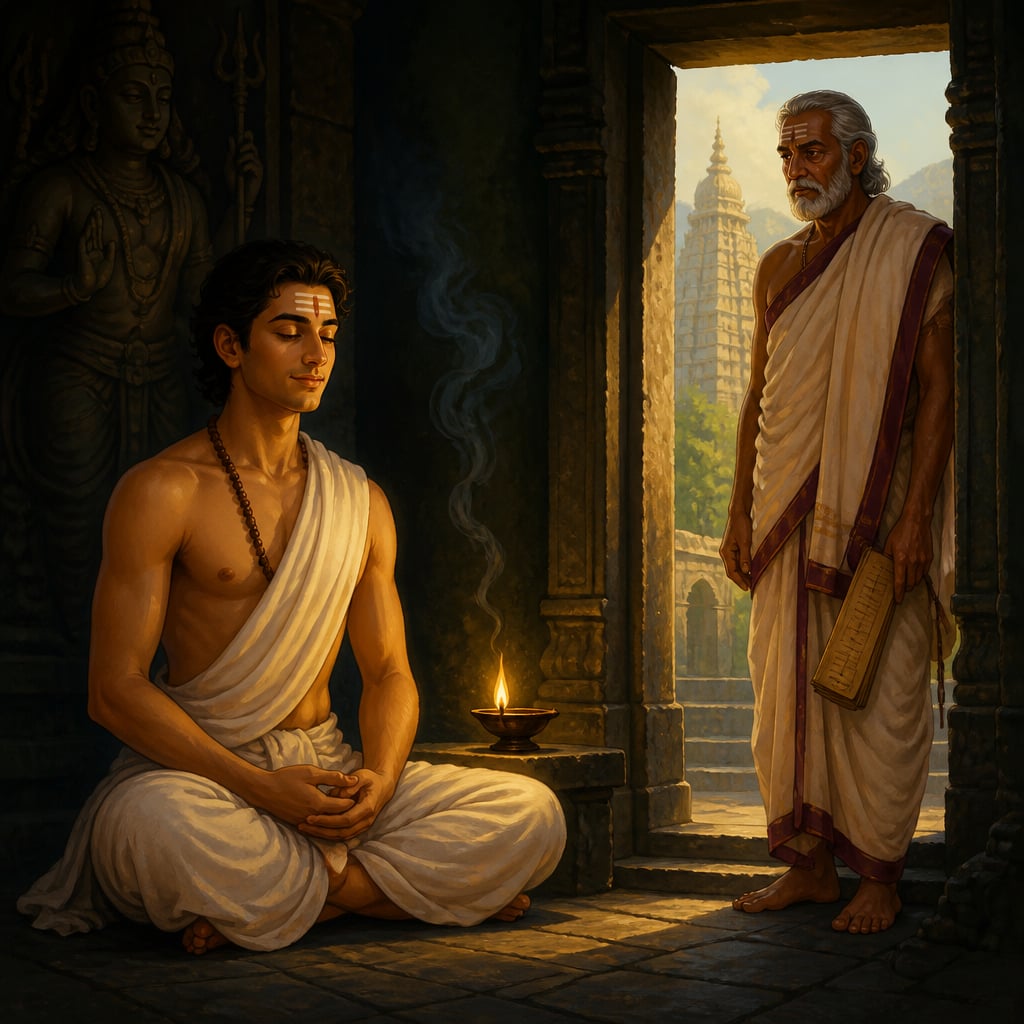
A visitor, a respected Sanskrit scholar from Madurai, had walked in that morning with a list of questions about the Brahma Sutras. The scholar had practised his questions on the train. He had imagined the conversation. He had a particular line he wanted answered.
The young man did not answer. He did not even open his eyes fully. The scholar waited. Five minutes passed. Then ten. Then thirty.
At some point, the scholar later recorded in writing, he forgot what he had come to ask. He began to feel the question dissolve in his own chest, as though the silence in front of him had quietly absorbed it. When he eventually walked out of the temple, he did not feel the disappointment of an unanswered visit. He felt, instead, that he had been answered with a thoroughness no spoken reply could have managed.
The young man would later be called Sri Ramana Maharshi. He would teach for fifty more years at the foot of Arunachala. The bulk of his teaching, by his own preference and the records of every contemporary, was given in silence.
This is what the Shaiva tradition calls maunam.

The Mountain Does Not Explain Itself
The central image of Shaiva stillness is not a hermit. It is a mountain. Mount Kailasa, the Shiva Purana says, holds the deity in unmoving meditation while the cosmos churns around it. Asuras attack. Gods plead. Wars break out. Sons are born and beheaded and restored. Through all of it, the mountain does not move. The yogi seated on it does not justify himself.
The Shiva Purana shows this in four canonical scenes that every reader carries.
The Insult. When Sati's father Daksha publicly insults Shiva at his great yajna, Shiva does not retort. He sends no messenger. He writes no rebuttal. He waits. The insult unfolds its own consequence, which is Sati's self-immolation, and even then his response is not a counter-argument. It is the dispatch of Virabhadra, after the fact, when the insult has already produced its result.
The Devotee. When Parvati performs years of severe tapas to win Shiva's hand, he does not rush. He does not appear quickly to comfort her. He arrives in disguise to test her, and only when she has stood firm against every doubt does he reveal himself. The waiting is the relationship.
The Boy at the Linga. When Markandeya, at sixteen, hugs the Shivalinga as Yama comes for him with the noose, Shiva does not appear at the first cry. He waits until the noose is in motion, until the boy has actually committed his life to the linga, and only then bursts forth. Premature rescue is not the Shaiva style.
The Tripura War. In the story this course's seventh chapter has already named, Shiva mounts the chariot of the gods, draws the bow, and waits for the three flying cities of Tripurasura to align. The cosmos has begged him to act. The gods have begged him to act. He does not move. When the alignment finally comes, a single arrow ends the cities at once.
In each scene, the same architecture. The yogi is seated. The world is in motion. The yogi waits. The waiting itself is the action.
मौनव्याख्या प्रकटितपरब्रह्मतत्त्वं युवानं वर्षिष्ठान्तेवसदृषिगणैरावृतं ब्रह्मनिष्ठैः।
mauna-vyākhyā prakaṭita parabrahma-tattvaṃ yuvānaṃ varṣiṣṭhāntevasad-ṛṣi-gaṇair āvṛtaṃ brahma-niṣṭhaiḥ
Through the silent exposition the supreme Brahman is revealed; the youthful one, surrounded by elderly disciple-sages who are firmly fixed in Brahman.
Dakshinamurti Stotram, attributed to Adi Shankaracharya
The Word Maunam
The Sanskrit word maunam is not just the absence of speech. It comes from the same root as muni, the Vedic title for one who holds the truth in silence rather than scattering it through speech. The Brihadaranyaka Upanishad uses the word for the sage Yajnavalkya, who, after producing the longest philosophical dialogue in the Upanishadic corpus, finally tells his wife Maitreyi that the deepest knowing of the Self can be pointed at, but not said.
The Vedic position is precise. Speech is shaped through more speech. But the highest knowing is the tushnim-vak, the silent speech, the knowing that arrives in the practitioner without traveling through the throat at all.
This is also why the Buddha, in the Pali canon, is recorded as keeping a Noble Silence about certain metaphysical questions. The Sanskrit and Pali traditions agree on this. Some things can be said. Other things must be sat with.
Why Modern Professional Life Cannot Hold Stillness
The contemporary professional condition is structurally allergic to maunam. The reasons are visible.
- Constant input. Phone notifications average dozens per hour for the typical white-collar worker. The brain never reaches a quiet baseline.
- Performative speech. Professional environments reward visible activity, including verbal activity, even when the speech is empty.
- Loss aversion. Saying nothing in a meeting feels, to most people, like a small failure of presence. Saying something, even something incomplete, registers as participation.
- Algorithmic feedback. Social media platforms reward responses, not silences. Quiet posters are deprioritised in feeds.
The result is a generation of capable people who cannot be still. The cost is paid in the quality of their decisions. Cal Newport, the Georgetown computer scientist who wrote Deep Work in 2016, observed that the most consequential modern professional output, the kind that compounds across years, almost always emerges from extended periods of quiet uninterrupted attention. His finding is a small modern echo of the Shaiva claim. The mountain that does not move is the mountain that holds the river in its place.
The Modern Echoes
In 2013, the German neuroscientist Imke Kirste published a study in Brain Structure and Function showing that mice exposed to two hours of complete silence per day developed new neurons in the hippocampus. The hippocampus is the brain region most strongly associated with memory and learning. The silence, not the music, not the white noise, was what produced the cell growth. The brain rewires itself in the absence of input. The Vedic tradition that named the muni had reached the same finding without a microscope.
The American neuroscientist Marcus Raichle, who first identified the brain's default mode network in 2001, found that this network is most active not during focused tasks but during periods of internal rest, daydreaming, and silence. The default mode network is what consolidates memory, integrates experience, and surfaces the kind of insight that does not arrive through effort. Modern professionals, by hammering their attention through meetings and notifications, are largely silencing the default mode network. The Shaiva tradition would call this a mistake of architecture.
In the contemporary contemplative world, the Indian teacher S. N. Goenka, who died in 2013, built one of the largest silent-retreat networks on the planet around the Vipassana tradition, with the flagship centre at Igatpuri in Maharashtra. Each retreat enforces ten full days of complete silence, an inheritance directly from the muni tradition the Shaiva yogi has been keeping for three millennia. Tens of thousands of professionals each year, many of them software engineers, doctors, and senior executives, walk into these retreats, sit, and for the first time in their adult lives encounter the mind that the noise had been hiding.
A Quiet Closing
Back at the temple at Tiruvannamalai, the scholar from Madurai walked out of the inner chamber into the evening sun. The young man at the pillar had not spoken a word. The scholar would return many times over the next decade. He would come, eventually, to call Ramana his guru. By his own account he learned more in those silences than in any of the books he had spent his life reading.
The mountain does not explain itself. It does not need to. Whoever has the stillness to sit before it will hear, in time, what it has always been saying.
The next lesson moves from stillness to its most direct iconographic form, the Dakshinamurti, the south-facing Shiva who teaches the four eternal Kumaras through silence alone.
Living traditions
The Shaiva mauna teaching has had a remarkable modern afterlife. Sri Ramana Maharshi's silent transmission at Arunachala from 1907 to 1950 was witnessed and recorded by visitors including Carl Jung, Paul Brunton, Somerset Maugham (whose 1944 The Razor's Edge fictionalises the encounter), Mercedes de Acosta, and Major Chadwick. S. N. Goenka's Vipassana network, scaled from his original Igatpuri centre in 1976 to over 200 centres worldwide, brings the muni tradition to tens of thousands of contemporary professionals each year, in a ten-day silent format that is structurally identical to the classical Mauna Vrata. The 2013 study by Imke Kirste in Brain Structure and Function provided the first peer-reviewed neurological confirmation that silence physically grows new brain cells. Marcus Raichle's 2001 default mode network research established that the brain's most powerful integrative work happens in silence rather than in focused activity. The American computer scientist Cal Newport's 2016 book Deep Work translated the maunam architecture into the contemporary professional vocabulary, arguing that the most consequential modern work emerges from extended periods of unbroken quiet attention. Across all of it, the Shaiva claim that stillness is power, not its absence, has been independently rediscovered in fields the original yogis would not have recognised. The mountain has not moved. The world has come to it.
- Mauna Vrata: The traditional vow of silence, observed for a fixed period that may be a single day, a week, a month, or longer. The practitioner takes a sankalpa (formal resolve) at the start, refrains from all speech for the duration, communicates by writing only when essential, and breaks the vrata at a fixed moment with a closing prayer. Many Shaiva sannyasis observe an annual mauna vrata of one full month, often during the rainy season or during a temple festival. Householder devotees often begin with a single Sunday or full-moon day and extend the practice gradually as their lives allow.
- Vipassana Ten-Day Silent Retreat: A modern adaptation of the muni tradition into a structured ten-day retreat in which participants observe complete silence (Noble Silence in the Goenka terminology), abstain from all forms of communication including eye contact and gesture, follow a fixed schedule of meditation from 4 AM to 9 PM, and conclude with a single half-day of carefully resumed speech. The retreat is offered free of charge worldwide, funded entirely by donations from prior students. Participants often describe the tenth day as the most quietly powerful experience of their lives.
- Sri Ramanasramam: The ashram established at the foot of Arunachala hill by Sri Ramana Maharshi, which remains one of the most active centres of the silent-teaching tradition in India. The Old Hall where Ramana sat for decades is open to visitors, who are asked to sit quietly without speaking. The ashram offers free accommodation to genuine seekers, and the daily routine remains exactly as it was during Ramana's lifetime: Vedic chanting at dawn, group meditation, silent darshan at the samadhi shrine, and the inner Pradakshina (circumambulation) of Arunachala on full moon nights. Tens of thousands of pilgrims walk the 14-kilometre Arunachala girivalam (mountain-circumambulation) each full moon, many in mauna.
- Mount Kailasa: The 6,638 metre granite peak in western Tibet that the Shaiva, Buddhist, Bon, and Jain traditions all identify as the abode of Shiva (Hindu), Demchok (Buddhist), Sipaimen (Bon), and Rishabhadeva (Jain). The mountain has never been climbed by any human in recorded history, by deliberate human agreement across all four traditions and the Chinese authorities. Pilgrims walk the 52-kilometre kora (parikrama) around the mountain, traditionally in three days, traversing the 5,630 metre Drolma La pass. Many do the kora in mauna. Lake Manasarovar, the sacred lake adjacent, is the source of four major rivers (Indus, Sutlej, Brahmaputra, Karnali) and is itself one of the most revered pilgrimage destinations in the Indian tradition.
Reflection
- When was the last time you stayed silent in a moment when speech was expected? What did the silence reveal that speech would have hidden?
- Why does the Shaiva tradition place the deity on a mountain rather than in motion through the worlds?
- Is silence the absence of speech, or is silence its own positive content?