Aham Nirasa: Destroying the Ego
Witnessing, not suppressing
The Shaiva method for the ego is a third way: not suppression, which makes it stronger, and not indulgence, which feeds it. The method is witnessing from a place that is not the ego itself. This lesson opens with the Dakshinamurti image, four great sages sitting in silence at Shiva's feet, and walks the practice from there.
A Boy on the Floor at Madurai
It is the afternoon of 17 July 1896, on the upper floor of a house at Chokkappa Naicken Street in Madurai, Tamil Nadu. The room is small. A wooden cot stands in one corner. A boy of sixteen, named Venkataraman Iyer, has just sat down on the floor. He is alone. The day is hot. A faint sound of voices from the street comes through the latticed window.
Without warning, a violent fear of death takes hold of him.
There is no medical reason for it. He is healthy. There is no news of an illness in the family. The fear simply arrives, the way a thunderstorm arrives in a clear afternoon. The boy's body begins to feel cold. His heart pounds. He thinks, very clearly, that he is going to die in the next few minutes.
What he does next is the entire content of this lesson.
He does not run downstairs to call for help. He does not try to push the fear away. He does not try to pray it off. He stretches out on the floor, makes his body stiff like a corpse, holds his breath, and decides to let death happen and watch what happens. He says to himself, in Tamil: very well, this body is dying. They will carry it out. They will burn it on the ghat. But am I dying with it. Or is there something here that is not the body.
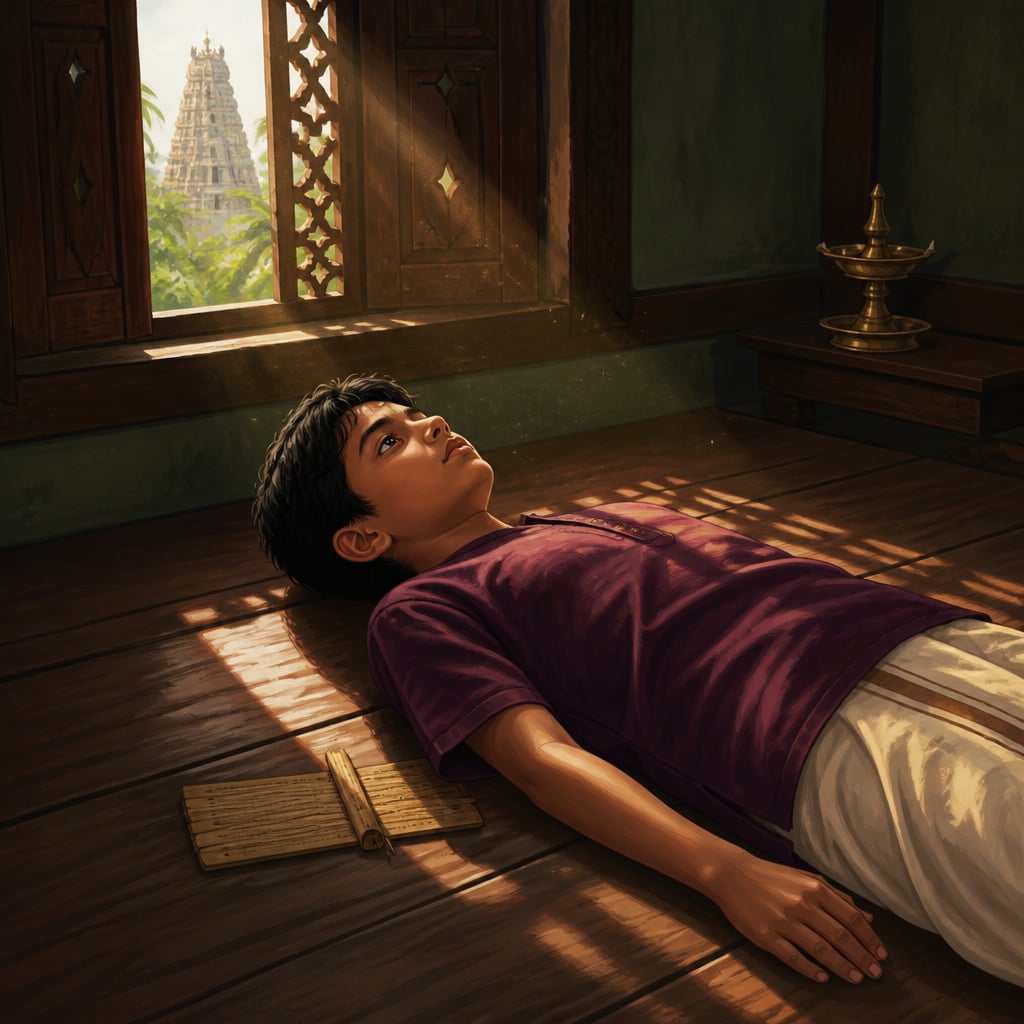
Forty-five minutes later he gets up. He walks downstairs and eats. He never tells his uncle what happened. He goes to school the next morning. But something inside him has shifted in a way that will not undo. Within six weeks the boy will leave home, travel south, and arrive at the foot of the mountain Arunachala in Tiruvannamalai. He will sit there in silence for the next fifty-four years. The world will come to know him as Ramana Maharshi.
What the boy did that afternoon, the Shaiva tradition has a precise name for. It is called aham nirasa, the rejection of the 'I'. It is the central inner work of this course's final chapter, and it is the work the next six lessons are about. This first lesson is about how it is actually done.
The Shaiva Method Is the Third Way
Most cultures hand the practitioner two options for handling the ego.
The first is suppression. Push the ego down. Be humble. Smile when you want to shout. Make a small body. The trouble with suppression is that the ego it pushes down does not vanish. It hides, gathers heat, and emerges later in twice the size. The practitioner who suppresses for a decade is not less egoic. He is more controlled, more polite, and more brittle.
The second is indulgence. Let the ego have what it wants. Win the argument, take the seat, post the photograph. The ego, the indulgence theory says, will eventually tire and quiet down. The trouble is that the ego does not tire. It feeds on what it gets and asks for more. The practitioner who indulges for a decade is not less egoic either. He is louder, hungrier, and lonelier.
The Shaiva tradition refuses both. It offers a third method, which is the method the boy on the floor at Madurai used by accident. The method has a single instruction. Do not push the ego down. Do not feed it. Sit in a place that is not the ego, and watch it. That is all.
Why Witnessing Burns
When the ego is watched, something specific happens.
The ego is, the Shaiva texts say, a thing that depends entirely on identification. Its full sentence is always 'I am angry', 'I am important', 'I am right', 'I am hurt'. It cannot exist as bare 'angry' or bare 'hurt'. The 'I am' is structural. The moment the chanter steps half a step back and notices, anger is appearing in this body right now, the ego loses the very identification it lives on. It thins. Not because it has been forced to thin. Because it had nothing else to feed on.
This is what the Shiva Purana calls the smashana function of Shiva. Shiva is the god of the cremation ground. Smashana, in Sanskrit, names the place where bodies are burned. But the texts mean it doubly. There is the literal cremation ground at Manikarnika in Kashi, where bodies have been burned without a single day's pause for at least three thousand years. And there is the inner cremation ground, the place inside the practitioner where the ego is burned the same way: by being placed inside a fire that the practitioner does not need to light. The fire is awareness itself. Awareness, when it watches the ego, is the cremation flame.
The Shaiva instruction is not to fight the ego. It is to walk it to the smashana inside, set it down, sit with it, and let awareness do its work. The boy on the floor at Madurai did this in a single forty-five-minute session. Most of us will need a small smashana visit every day for the rest of our lives. The shape of the practice is the same.

A Concrete Witness Practice
Here is the technique, in the form a 2026 householder can actually use.
- The trigger. Each evening, at the close of the day, sit for five minutes. Find one moment in the day where the ego flared. Not a small irritation. A specific moment where you felt I am being disrespected, I am better than this, I deserve more, I am being misunderstood, I should not have to deal with this. Pick the strongest one.
- The replay. Replay the moment in the mind. The room. The other person's face. The exact word that triggered the flare. Do not edit. Do not justify. Just see it again.
- The shift. Now do the boy's move. Step half a step back. Notice that the body had a reaction, that the throat tightened, that the chest filled with heat. Notice it as if you are watching a film of someone else having that reaction. Do not push the reaction away. Do not feed it by re-arguing the case in your head. Just watch.
- The release. Sit with the watching for two minutes. The ego, deprived of its identification, will start to thin. You will feel something soften. The teaching is that the softening is not yours to engineer. It is what awareness does to the ego on its own, the way fire does its work on dry wood.
The Shaiva tradition is precise that this practice is daily, not occasional. The smashana inside is to be visited every evening, the way a temple is visited every morning. The ego accumulates daily. The witness has to clear daily.

Bhairava and the Fifth Head
There is a Puranic story that compresses this teaching into a single image.
The texts say that Brahma once had five heads, and the fifth head, mounted high above the others, told a lie about its own authority. Shiva, in his fierce form Bhairava, walked up and, with a single fingernail, removed the head. The other four were left. Brahma did not die. He continued his work. But the lying head was gone.
The teaching the Shaiva tradition draws from this is exact. The ego is not the whole person. It is one head among several, and it is the one head whose authority is louder than its content. The work is not to kill the person. The work is to remove the lying head. Bhairava is the form of awareness that does this without anger, without ceremony, with the quiet precision of a fingernail.
When you sit in your evening review and watch the day's ego-flare, you are doing what Bhairava does in that scene. You are not killing yourself. You are not even fighting the ego. You are simply removing, one small flare at a time, the head that has been claiming more than it deserves.
Modern Echoes
In the twentieth century, the Swiss psychiatrist Carl Jung corresponded for years with the German Indologist Heinrich Zimmer about exactly this Shaiva method. Jung's letters, published in the Eranos Yearbook through the 1930s and 40s, repeatedly note that the Shaiva instruction to witness the shadow rather than suppress or indulge it preceded his own concept of shadow integration by at least fifteen hundred years. Jung's term for the lifelong practice of meeting and watching the unwanted parts of oneself, what he called Schattenintegration (shadow integration), is functionally a translation of the smashana practice.
In 2011, the American neuroscientist David Eagleman, in his book Incognito, made a related point in laboratory language. The brain, Eagleman showed, contains a layer that performs (the actor) and a separate layer that observes (the witness). The two are physiologically distinct. Most humans live almost entirely in the actor layer. The contemplative move, across every Indic tradition Eagleman surveyed, is to spend more of one's life in the witness layer than in the actor layer. The Shaiva method names this move and gives it its earliest extant practice protocol.
Closer to ordinary life, the psychologist Tara Brach, who has worked since the 1990s in Maryland with patients suffering from chronic anxiety, teaches a four-step inner practice she calls RAIN (Recognise, Allow, Investigate, Nurture). Her acknowledged source for the framework, in her 2019 book Radical Compassion, is the smashana method she encountered through her teacher Joseph Goldstein, who in turn studied it with the Shaiva and Buddhist masters of north India. Three thousand years after the Shiva Purana described the technique, a clinical psychologist in Bethesda is using a four-step version of it with anxious software engineers.
Back to the Boy on the Floor
The boy on the floor at Madurai did not invent the method. He stumbled into a teaching the Shaiva tradition had been preserving in its texts and at its smashanas for at least three millennia. The fear of death he met that afternoon was the same fire Bhairava uses on the lying head. What was burned was not Venkataraman the schoolboy. What was burned was the part of him that had been claiming to be Venkataraman the schoolboy.
For the next fifty-four years at Arunachala, the man the world called Ramana Maharshi gave only one piece of advice to thousands of visitors who asked him what to do about the ego. He told them, in five different languages, to ask one question. Who is angry. Who is hurt. Who is wanting. That question, repeated patiently, walks the asker into the same forty-five minutes the boy spent on the floor. It is the inner cremation ground, made portable.
The work of this entire chapter, and arguably of the entire Shaiva tradition, is the work of dissolving the 'I' that runs almost every sentence in your day. Not by silencing it. Not by pleasing it. By watching it, daily, until it loses the identification it lives on. The Shaiva tradition calls this aham nirasa, the rejection of the 'I', and it considers it the foundation on which all the other inner transformations of this chapter (detachment without coldness, stillness as power, surrender as final practice) eventually stand.
The boy got up off the floor and ate his dinner. He did not stop being a person. He stopped, in some quiet structural way, being a person who had to defend an 'I'. That is the entire lesson. Everything that follows in this chapter is just learning how to do it for forty-five minutes a day, then for an hour, then for the rest of an ordinary life.
Historical context
Vedic to Modern Bharat (roughly 4000 BCE to present)
The teaching of aham nirasa (rejection of the 'I') is one of the few continuous threads in Bharat's intellectual history, running unbroken from the Vedic period to the present. Its earliest extant source is the Shvetashvatara Upanishad's image of the two birds on a single tree (Shvetashvatara 4.6, also Mundaka 3.1.1), composed and orally transmitted during the late Vedic period when the Saraswati civilisation was still active. The Puranic narrative form arrived later. The Shiva Purana's Shatarudra Samhita, composed and edited between roughly 300 and 700 CE, gave the teaching its most narratively vivid image: Bhairava removing Brahma's lying fifth head with a single fingernail. The decisive philosophical synthesis came in the 8th century, when Adi Shankara, born at Kalady in Kerala, composed the Atma Bodha and the Brahma Sutra commentaries that placed the witness self (sakshi) at the centre of Advaita Vedanta. From Shankara's lifetime onward, the witness teaching became the standard inner work of Shaiva-Vedanta households across Bharat, taught at the Sringeri, Dwarka, Puri, and Jyotirmath peethams he founded. The modern transmission, through 20th-century sages like Ramana Maharshi at Arunachala (1896 to 1950), Nisargadatta Maharaj in Mumbai (1897 to 1981), and the Kanchi Paramacharya Chandrashekarendra Saraswati (1894 to 1994), has carried the same teaching into homes and into clinical psychology departments across the world.
Living traditions
The Shaiva witness method has had perhaps the most significant cross-cultural afterlife of any single contemplative practice from Bharat. The Swiss psychiatrist Carl Jung corresponded with the German Indologist Heinrich Zimmer for decades and acknowledged in his published Eranos lectures (1933 to 1948) that what he called 'shadow integration' was a Western recovery of the smashana method. The American clinical psychologist Tara Brach, in her 2019 book 'Radical Compassion', published a four-step framework she calls RAIN (Recognise, Allow, Investigate, Nurture) and traced it explicitly back through her teacher Joseph Goldstein to the Shaiva and Buddhist masters of north Bharat. Hospital chaplaincy programmes at the All India Institute of Medical Sciences in New Delhi and at major palliative care wards across the country use a clinical adaptation of the witness practice with patients facing terminal illness; the Shaiva insight that the witness is unaffected by the body's dying turns out to be one of the most stabilising teachings in clinical psychology. The neuroscientist David Eagleman, in 'Incognito' (2011), showed that the actor and witness layers of cognition are physiologically distinct, and named the Indic contemplative traditions as the earliest extant protocol for spending more of one's life in the witness layer than the actor layer. The boy on the floor at Madurai in 1896 was practising what laboratory neuroscience, clinical psychology, and Western depth psychology have since had to discover, language by language, over a hundred and thirty years.
- Sakshi Sadhana (The Witness Practice): The slow, daily practice of watching the ego from a place that is not the ego. The classical instruction is a five-minute evening review of one specific moment in the day where the ego flared, observed without justification or condemnation, sat with until the flare loses its identification. The practice traces directly to the Shvetashvatara Upanishad's image of the two birds on a tree, was systematised by Adi Shankara in the Atma Bodha and Brahma Sutra commentaries in the 8th century, and was distilled into a single living instruction by Ramana Maharshi at Tiruvannamalai in the 20th century: when a feeling arrives, ask 'who is angry, who is hurt'. The asking is the practice.
- Manikarnika Ghat: The principal Shaiva cremation ground in the world, continuously active for at least three thousand years with bodies burning every hour of every day without a single day's pause. The ghat is named for Shiva's earring (manikarnika), which the tradition says fell here, sanctifying the ground forever. The site contains the Manikarnika Kund (sacred pool), the temple of Tarakeshwar Mahadev (where Shiva is said to whisper the Tarak mantra into the ear of the dying for liberation), and the ground itself where the funeral pyres burn around the clock. The Shaiva tradition treats Manikarnika not as a place of fear but as the openly visible cremation flame the ego cannot survive. A single visit, sat with calmly, is one of the most concentrated ego-witnessing experiences available anywhere in the Hindu world.
- Sri Ramana Ashramam: The ashram founded around the residence of Ramana Maharshi (1879 to 1950), the modern Bharat exemplar of aham nirasa. The ashram preserves the Old Hall where Ramana sat in silence with thousands of seekers, the Samadhi shrine where he is interred, and the Skandashramam cave higher up Arunachala where he lived for many years after his ego-death experience. The Talks volumes that record his teachings, including his consistent recommendation of the witness inquiry 'who is angry, who is hurt', are available at the Ashramam Bookshop. The 14 km circumambulation path around Arunachala (Giri Pradakshina) is performed daily by thousands, often in silent witness mode, and is one of the most accessible ways to practise the lesson's teaching.
Reflection
- Pick one moment in the past week when your ego flared. Replay it in your mind. Now look at it again from the witness, the sakshi, and ask: was the 'I am' I added to the experience really necessary, or was the experience itself enough information?
- Why might the Shaiva tradition have placed Bhairava, the fierce form, in charge of ego work, rather than the gentler forms of Shiva like Dakshinamurti or Sadashiva?
- Modern self-improvement broadly treats the self as a project to be optimised, healed, or affirmed. The Shaiva method treats the self as the obstacle to be witnessed and dissolved. What does each model say about what a human being most needs?