Dakshinamurti: The Silent Teacher

How truth is transmitted without words

Four young sages climb Mount Kailasa with one question they cannot answer after reading every scripture. Shiva sits under a banyan tree and does not say a word. Their questions dissolve. The lesson reads the Dakshinamurti image and the tradition's teaching that the deepest transmission happens in silence.

The Banyan and the Four Sages

On the lower slopes of Mount Kailasa, in a clearing held by the spread of a single enormous banyan tree, four young sages sit on the bare ground. Their names are Sanaka, Sanandana, Sanatana, and Sanatkumara. They are the Kumaras, the eternal child-sages, sons of Brahma, born before time and never aged. They are perhaps five years old in appearance. They are older than the worlds.

They have come with one question. They have read every scripture. They have argued with the greatest teachers of their age. They have followed every argument to its end. The question has not settled.

In front of them, on a low stone platform under the banyan, sits Shiva. He is young. His face is calm. He is dressed in tiger-skin and ash. He is facing south, the direction of Yama, the lord of death. His right hand is lifted, the index finger curled back to touch the thumb in a small circle. The other three fingers extend outward. This is the chinmudra, the gesture of consciousness. His left hand rests on his knee, holding a palm-leaf manuscript and a string of rudraksha beads.

The Kumaras sit. They wait. Shiva does not speak.
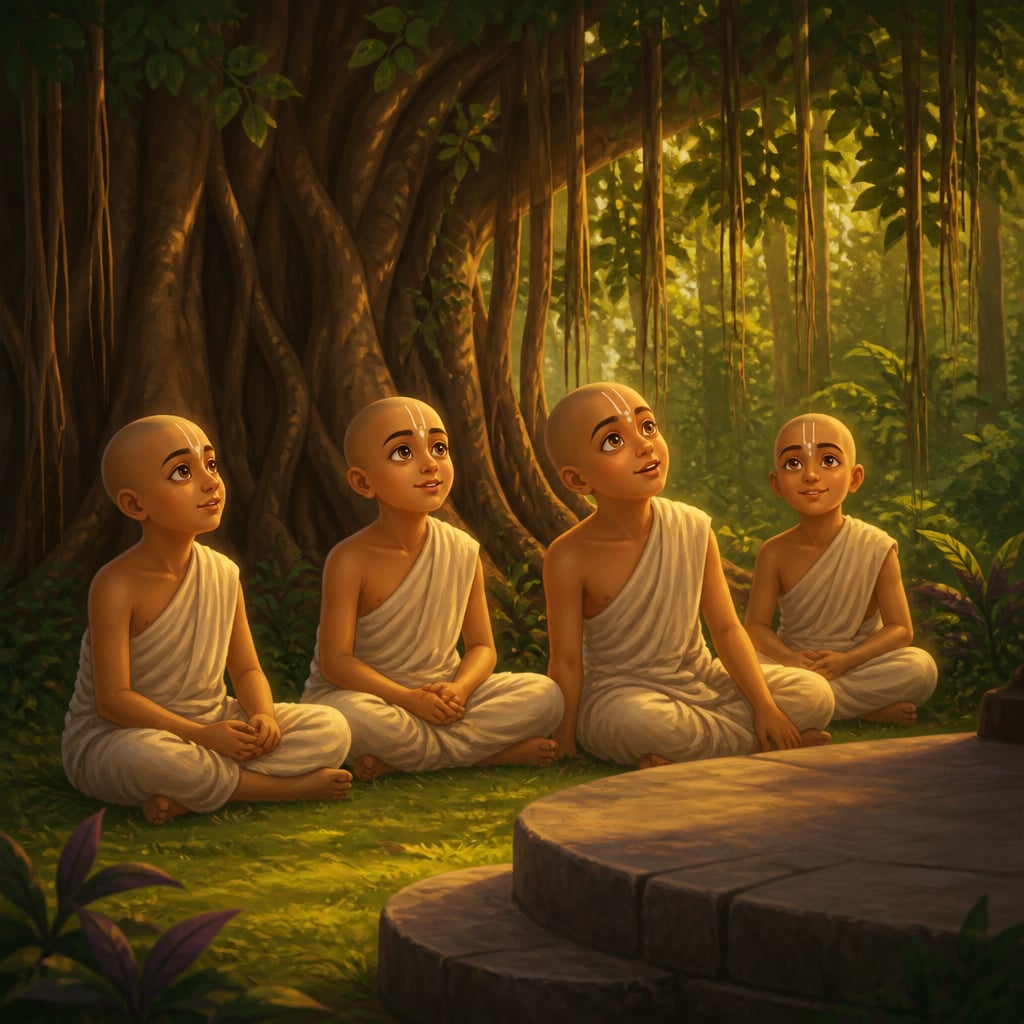
Young south-facing Shiva seated under a banyan in chinmudra before the four child-sage Kumaras, teaching them in silence.

For a long time, nothing happens. The wind moves the banyan leaves. A small fire smoulders in a clay bowl beside the platform. Under Shiva's foot, a small dark figure lies pressed against the stone, eyes half-closed. This is Apasmara, the demon of forgetfulness. Shiva's foot is on him, gently, holding him still.

Still no one speaks. The Kumaras keep watching.

At some point, the question dissolves. Not because someone has answered it. Because the four sages, watching the still young face under the banyan, watching the small circle of finger touching thumb, watching the steady foot on the still demon, recognise something they could not have read in any book. The Adi Shankaracharya, eight centuries before us, summarised this moment in a single famous half-verse.

मौनव्याख्या प्रकटितपरब्रह्मतत्त्वं युवानम्।

mauna-vyākhyā prakaṭita-parabrahma-tattvaṃ yuvānam

The young one whose silent exposition reveals the truth of the supreme Brahman.

Adi Shankaracharya, Dakshinamurti Stotram, Dhyana Shloka

The phrase is mauna-vyakhya, silent exposition. The teaching the four oldest students of any age finally received was given without a word.

What the Iconography Says

This form has a name. It is Dakshinamurti, the south-facing form. Every detail of the icon is a teaching, and the Shiva Purana is unusually patient in explaining them. The iconography is the lesson, compressed into a body.

Every South Indian Shiva temple, from the eighth century onwards, places a Dakshinamurti shrine on the south wall of the main sanctum. The placement is canonical. The bhakta who walks the inner path around the temple meets Dakshinamurti on the south side, the side of death and of teaching, and stands before the gesture for a long moment before continuing.

Why Silence

The four Kumaras had a problem that words could not solve. The problem was not that they did not know enough. The problem was that everything they knew was held inside the question that did not settle. More words would have added more material to the same question. Silence dropped the question.

The Shaiva tradition has held this insight for two thousand years. There are truths the mind can hold and there are truths the mind has to let go of in order to hold. The first kind can be transmitted by language. The second kind cannot. Adi Shankaracharya, in the Dakshinamurti Stotram he composed in the eighth century, gave the form a complete Advaita Vedanta primer in ten verses. Every verse begins from the same premise. The truth pointed to is not a thing that the words can carry. The words can only walk you to the foot of the banyan. The recognition has to happen in your own seeing.

This is also why Dakshinamurti is shown as young. Most teachers gain authority through age. Dakshinamurti is shown as a youth surrounded by old sages. The form is making a precise claim. Authority in this teaching does not come from age, accumulation, or experience. It comes from clarity. A young person whose attention is settled can transmit what the oldest scholar with a divided mind cannot.

The Practice the Form Asks For

Householder facing south in daily practice

The form is not only an icon to look at. It is a posture for the bhakta to take. The traditional Dakshinamurti sadhana, preserved at the Sringeri Sharada Peetham in Karnataka and at every Advaita matha that follows the Shankaracharya lineage, has a simple shape.

Sit facing south. Light one small lamp. Hold the right hand in chinmudra, thumb-tip touching index-tip. Let the breath settle. Do not chase questions. Do not chase answers. Sit. Let the silence be the teacher.

A practitioner who does this for ten minutes a day, for a few months, will notice something the Shiva Purana has been describing for centuries. The questions that seemed urgent at the start of the sit are usually not the same questions by the end. Some have dissolved. Some have answered themselves. A few remain, but they sit differently in the chest. The mind that was making the questions has slightly loosened its grip on the question-making.

This is the Dakshinamurti effect. Not solutions. Loosening.

The Living Dakshinamurti

Mature Ramana Maharshi in silence at Arunachala

In the twentieth century, on a small mountain in Tamil Nadu called Arunachala, a man named Ramana Maharshi sat for fifty-three years and taught primarily through silence. He answered questions when asked. Most of the time, he sat. Visitors came. Scholars came. Soldiers came. Carl Jung wrote about him. Somerset Maugham, after meeting him, wrote a novel based on the encounter, The Razor's Edge, published in 1944.

Those who knew Ramana said the same thing, with small variations, for half a century. The deepest things they took away from him were taken away in silence. He was, in the tradition's reading, a living Dakshinamurti. The form had walked off the south wall and into a body.

This is one of the recurring patterns of Indian spiritual history. The Dakshinamurti form is not a museum piece. Every two or three generations, in some small village or some unremarkable mountain, the form takes a body again and sits down to teach. The four Kumaras are still arriving. The banyan is still spreading. The young face is still calm.

Modern Echoes

Contemporary research keeps arriving at the edge of the same teaching. The neuroscientist Andrew Newberg, working at the Marcus Institute of Integrative Health, has shown that sustained silent attention measurably reduces activity in the brain's default mode network, the network most associated with self-referential thinking and unsettled rumination. The therapist Marsha Linehan, founder of Dialectical Behaviour Therapy, has built her work around the observation that some emotional states cannot be reasoned out of, only sat with until they pass. The management researcher Susan Cain, in her 2012 book Quiet, made the case that the best leaders in many domains are the ones who speak last, listen most, and create the silence in which others can think.

None of these are the Shaiva teaching. The Shaiva teaching is older, deeper, and more daring. It is the claim that the highest truth itself cannot cross language, that some recognitions are only possible in silence, and that the proper posture for receiving them is to sit, face south, hold the chinmudra, and let the question dissolve.

The Kumaras returned to their tasks. The question had not been answered. It had been outgrown. They went home and taught the next generation in the same way they had been taught.

The banyan is still there. The seat is empty. The next generation of students is already walking up the slope.

The next lesson stays on the same mountain but moves the seat. From the banyan to the cremation ground. From the south-facing teacher to the ash-smeared lord who befriends the one thing every person flees, and shows what it is to sit in front of fear and death without flinching.

Living traditions

The Dakshinamurti form has had an unusually rich modern afterlife. Adi Shankaracharya's Dakshinamurti Stotram remains a set text in Advaita Vedanta study at every traditional matha and is now part of the Sanskrit honours syllabus at universities including Banaras Hindu University, Sri Sankaracharya University in Kalady, and the Sringeri Vidya Bharati program. Ramana Maharshi's silent teaching at Arunachala from 1896 to 1950 produced a global following that continues to grow, with Ramanashramam recording over four lakh visitors annually in 2024 from more than fifty countries. Carl Jung's 1944 essay on Ramana, Paul Brunton's A Search in Secret India (1934, over a million copies sold), and Somerset Maugham's The Razor's Edge (1944, over three million copies sold and adapted into films in 1946 and 1984) brought the silent-teacher tradition into Western consciousness. In contemporary India, the Sringeri Sharada Peetham's daily Dakshinamurti Stotram recitation has been livestreamed since 2018 and now reaches over fifty thousand viewers daily. The yoga teacher Sadhguru's Isha Foundation has built a modern Dhyanalinga consecrated in 1999 explicitly along the Dakshinamurti axis, with the inner shrine designed for silent meditation rather than ritual worship. Across all of these surfaces, the same teaching keeps surfacing in new clothes. The deepest recognition is given without words. The student who has read every scripture finally understands when the teacher sits still. The form on the south wall is older than any of us and shows every sign of outlasting the languages we are using to describe it.

Reflection

More in The Inner Transformation Model

All lessons in The Inner Transformation Model · Shiva Purana course