Sharanagati: Dadhichi's Bones and the Final Surrender

The gift that was never asked for

The gods arrive in single file at the door of the sage Dadhichi and ask him to give his bones. The asura Vritra cannot be killed by any ordinary weapon. Only a weapon made from the bones of a sage who has dissolved his ego completely will work. Dadhichi agrees. This lesson reads that agreement as the Shiva Purana's final teaching on surrender.

The Gods at the Door

On the banks of the Saraswati river, near a thatched hermitage hidden in a grove of palasha trees, sometime in the early Puranic period, an old sage in bark cloth heard footsteps at his door. The sage was Dadhichi, son of the rishi Atharvan, husband of Suvarcha, and one of the few remaining Vedic seers who had renounced even the use of fire for cooking. His diet was forest fruit, his bath was the river, and his daily practice was the silent recitation of the Atharva mantras his father had taught him.
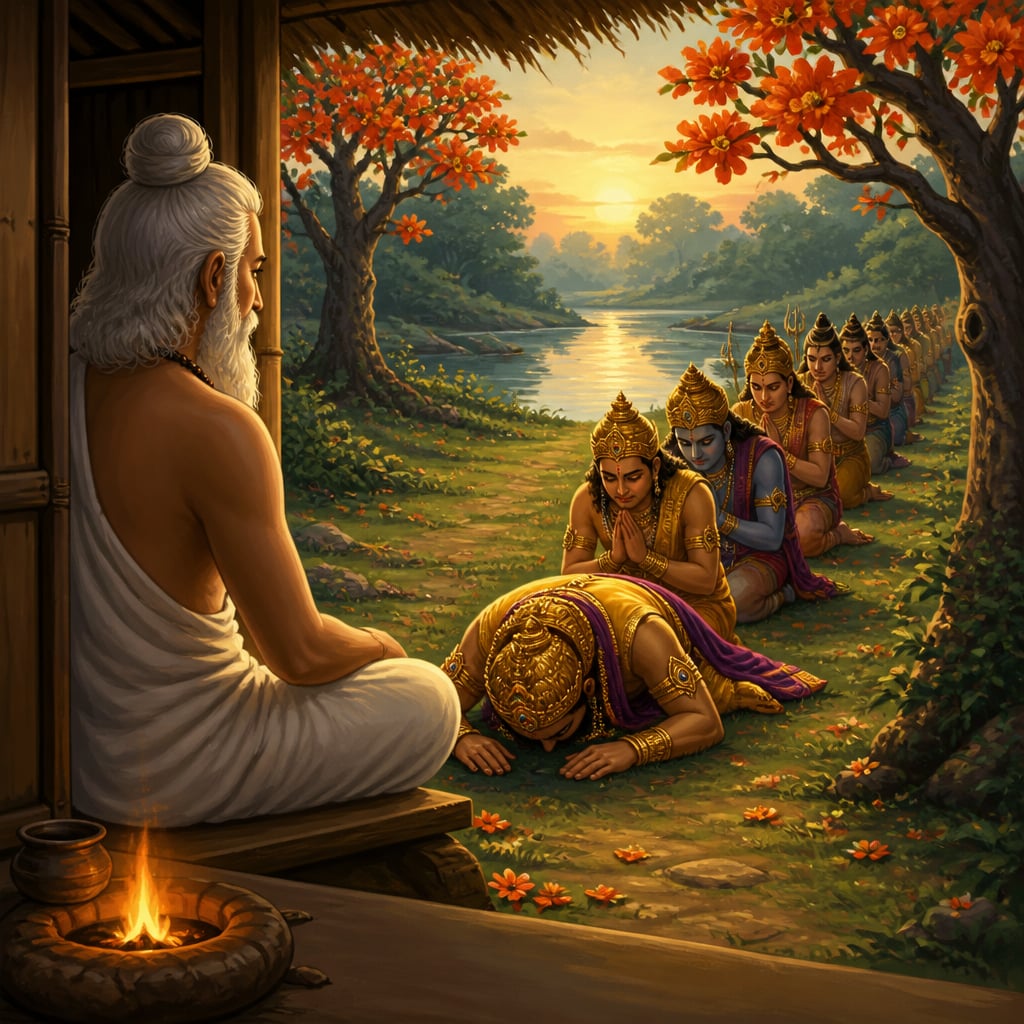
The sage Dadhichi in bark cloth at the door of his Saraswati-bank hermitage, hearing the footsteps of the gods approaching.

The footsteps were not those of a single visitor. The Shiva Purana, in the Rudra Samhita, records that the entire pantheon of devas had walked single file to his door. Indra was at the front, his face hollow. Behind him stood Agni, Vayu, Varuna, the Adityas, the Maruts, the Vasus. They had all lost their kingdom. The asura Vritra, who had grown so powerful on the strength of a boon that he had swallowed the cosmic waters and dried up the rivers, could not be killed. Brahma, consulted in despair, had given the gods one and only one prescription. The weapon that could end Vritra would have to be forged from the bones of a sage who had given his body away while still alive, voluntarily, without coercion, without negotiation.

The gods had walked the length of the subcontinent. Every hermitage in Bharata. Every sage refused. Some refused with elaborate justifications, some with anger, some by simply not answering the door. By the time they arrived at Dadhichi's hut on the Saraswati, they had been walking for years. Indra knelt at the threshold. He could not bring himself to ask.

Dadhichi looked at them. The Shiva Purana describes the next moment with the kind of precision the tradition reserves for its most uncompromising teachings. The sage did not flinch. He did not argue. He did not negotiate. He did not ask whether the cause was worthy enough, whether the gods had earned the gift, whether the asura was as terrible as they claimed. He understood, in a single breath, what was being asked, and he understood that the asking had taken Indra everything he had. He spoke a single sentence.

Take what you need. The body is already not mine.

The gods stood frozen. They had walked for years and never expected the answer to actually come. Dadhichi sat down in padmasana. He drew his breath inward. He withdrew his consciousness from the physical body in the manner the Vedic tradition calls utkrānti, the deliberate departure of the life-force through the crown of the head. The body remained, perfectly preserved, the bones now available without any violence having been done. The smiths of Indra carried the bones away. From the spine, Tvashtri the divine architect forged the Vajra, the thunderbolt that could not be deflected. With it Indra slew Vritra. The cosmic waters returned. The rivers flowed. The cosmos was returned to its order.

This lesson is the closing lesson of the course. It is the chapter's final teaching and the course's final teaching. The Shiva Purana places Dadhichi here, deliberately, because every other inner-transformation move in the chapter rests on this one. The destruction of the ego, the detachment without coldness, the stillness as power, the silent teacher, the facing of fear and death: all of them lead to this single act. The act is sharanagati, the absolute surrender. The Shaiva tradition's argument across the entire course closes here.

What Surrender Is Not

Most modern uses of the word surrender carry a meaning that is the opposite of what the Shaiva tradition means by sharanagati. The word in modern English usage signals defeat. The army surrenders. The defendant surrenders. The patient surrenders to the disease. The English word names the moment one party concedes that another party has won.

Sharanagati is none of these.

The Shaiva tradition is precise that sharanagati is not:

What sharanagati IS, in the Shaiva tradition's careful definition, is the collapse that is not defeat but the emptying that fills. It is the moment a being gives up what it had been holding because, in the giving, the holding is finally seen for what it always was: a fiction. The body had never been Dadhichi's. The bones had never been his. The years he had thought of them as his were the misunderstanding, not the gift of the bones.

This is the inversion the Shaiva tradition has been preparing the practitioner for across all five preceding lessons. The destruction of the ego is the preparation. The detachment without coldness is the preparation. The stillness, the silence, the facing of fear and death are all the preparation. Sharanagati is what they were preparing for. The course closes here because the course was always closing here.

The Three Things Dadhichi Did Not Do

The Shiva Purana's literary precision in the Dadhichi episode is in what the sage did not do. Three absences carry the entire teaching.

He did not ask whether the cause was worthy. The gods had not yet stated the cause when Dadhichi spoke. He understood the asking was real and the need was absolute, and the question of whether Indra deserved the gift never entered the moment. The Shaiva tradition's reading is that sharanagati does not run a worthiness check on the receiver. The gift is given because the giving itself completes the giver. The receiver's worthiness is the receiver's problem.

He did not negotiate the form of the giving. He did not propose that he give a finger, a tooth, a single bone. He did not suggest the gods come back in a few months once he had finished a vow he was midway through. He understood that partial giving is not giving. The gift was either the body or it was not the gift the gods were here for.

He did not perform the giving. There was no speech. No formal vow recited at length. No call to the household to gather and witness. He sat. He breathed in. The body was released. The Shaiva tradition holds the silence here as essential. The act that announces itself is, by that very announcement, partly retained. The act that does not announce itself is the act fully given.

These three absences are the working definition of sharanagati for the practitioner. Do not run a worthiness check on the receiver. Do not negotiate the form. Do not perform the giving.

The Vajra and the Cosmos

Tvashtri forges the Vajra from Dadhichi's bones

The outer half of the story is what the bones became. Tvashtri, the divine architect, forged the spine into the Vajra. The Shiva Purana is careful with the metallurgical language. The Vajra was forged not from the bones alone but from the bones consenting. The consent was the metallurgical input that made the weapon undeflectable.

Indra wields the Vajra against Vritra

Indra carried the Vajra into battle against Vritra. The asura, who had swallowed the cosmic waters and dried the rivers, could not deflect the weapon. The Vajra struck. Vritra fell. The waters poured out of his belly and returned to their channels. The Saraswati flowed again. The Ganga flowed again. The cosmos's drought ended in a single afternoon.

The Shaiva tradition is interested in a structural feature of this outer story. The cosmos was saved by the act of one being who had finished considering the body his own. No army. No alliance. No counter-boon. One sage, in padmasana, on the bank of the Saraswati, had done the inner work to the point that, when the cosmos asked, the cosmos was answered.

This is the Shaiva tradition's most uncompromising claim about the relation between the inner and the outer. The outer is held by the inner. The cosmos is held by the few who have done the inner work to the point that they have nothing left to defend. When the cosmos cracks, those few are who the cosmos turns to. Dadhichi is the canonical example. The cracks the cosmos has shown across history have been mended, in the tradition's reading, by Dadhichis whose names are usually not recorded.

The Inverted Reading: What Sharanagati Returns

The story's hardest teaching is what sharanagati returned to Dadhichi.

In the literal frame, the sage died. The body was given. The narrative pauses there. Many readers stop at this point and conclude that sharanagati is, finally, a beautiful but tragic act. The sage gave his life. The cosmos was saved. The cost was the sage.

The Shaiva tradition's reading does not stop there. The Rudra Samhita closes the episode with a verse the lesson has chosen as one of its anchor shlokas. Dadhichi, the verse says, did not lose the body. He preceded it. The body was not the substance the bones embodied. The substance was the consciousness that had, while alive, already finished considering the body its own. The bones were the trace of that consciousness, and the trace was what Tvashtri forged.

The sage's consciousness, in the Shaiva reading, did not die. It was already not bound to the body it had given. The departure was the formality. The Vajra is, in this reading, the literal object that Dadhichi's lifelong sadhana congealed into. The cosmos was saved by Dadhichi's sadhana. The bones were the form the sadhana took.

This is the inversion the chapter has been pointing at across five lessons. Surrender does not subtract. It returns. What it returns is not what was given. It is the underlying ground that what-was-given was always merely a form of. Dadhichi did not get his body back. He had never lost what the body was a form of. The bones became the Vajra; the consciousness became the cosmos's protection. The gift completed the giver in a way no holding could have.

This reading is also the reading the Shiva Purana gives of every other surrender story in the canon. Markandeya's surrender to Yama at the cremation ground. Sati's surrender at Daksha's yajna. Bhasmasura's surrender, ironic and unintended, when his palm landed on his own head. In every case, the surrender was the moment the surrendering being met what it had always been the form of. The Shaiva tradition's relation to surrender is, finally, this. Surrender is the moment the form meets the formless that it had been the form of. The form does not lose the formless. It finds it.

The Course Closes Here

The Shiva Purana places Dadhichi as the closing teaching for a careful reason. The whole course has been walking the practitioner from the cosmic stories of Chapter 1 through the householder practices of Chapter 10 to the inner-transformation moves of Chapter 11. Each chapter has been answering a different question. Who is Shiva. How does he act. What does the householder do. What is the inner work the practice is preparing.

The Dadhichi lesson is the answer to the final question.

The inner work is preparing the practitioner to give. Not necessarily the bones. The bones are the canonical extreme. For most householders the giving will look smaller. The giving of the certainty that one's career is one's identity. The giving of the certainty that one's family arrangement is permanent. The giving of the certainty that the body in its current form will continue. The giving of the certainty that one's spiritual progress is one's own achievement. Each of these is a small Dadhichi moment, and most lives have a few each year.

The Shaiva tradition's promise across the course is that the practitioner who has done the daily and weekly work of the prior chapters will, when the small Dadhichi moments arrive, have the inner spaciousness to meet them with sharanagati rather than resistance. The promise is not that the moments will be pleasant. It is that they will return what no holding could have returned.

Modern Echoes

The Dadhichi story has been engaged by modern thinkers across multiple traditions, often without their knowing the canonical source. Viktor Frankl, the Austrian psychiatrist who survived Auschwitz, wrote in Man's Search for Meaning (1946) of the moment in the camp when, having lost his manuscript, his family, his profession, and the certainty that he would survive, he discovered what he called the last of the human freedoms: the freedom to choose one's response to even the most absolute deprivation. Frankl's freedom is, in dharmic vocabulary, sharanagati. The discovery that what has been taken was never what one was, and that what one is cannot be taken.

The Indian armed forces explicitly invoke Dadhichi. The Param Vir Chakra, India's highest military gallantry award, established in 1950, is described in the official citation as forged in the spirit of Maharshi Dadhichi's bones. The PVC has, as of 2026, been awarded twenty-one times, twenty of them posthumously. Each citation, when read in the context of the Dadhichi story, becomes a modern instance of the Shaiva canon's most ancient teaching. The body was given. The cosmos was held. The form returned to the formless that had been its source.

The Saraswati no longer flows above ground in the stretch where Dadhichi sat. The river went underground sometime in the third millennium BCE, and modern hydrological studies have traced its paleo-channel from the Himalayas to the Arabian Sea. The hermitage is gone. The bones are gone. What remains is the act, recited in the Rudra Samhita, taught by every Shaiva acharya, embedded in the citations of the country's highest gallantry award, and quietly enacted, in small Dadhichi moments, by every practitioner who has done the inner work of the eleven preceding chapters and arrives at this closing lesson with the inner spaciousness to receive it.

The course closes here. What follows in Chapter 12 is the application of everything the course has built. The teaching is complete. What remains is the living of it.

Historical context

The Dadhichi episode reaches its canonical Puranic form in the Rudra Samhita of the Shiva Purana (5th to 10th century CE), with deeper roots in the Atharva Veda's Atharvan lineage hymns and the Brihadaranyaka Upanishad's references to the Atharvan sage's son. The story is systematised by the Saiva Siddhanta tradition between the 11th and 13th centuries.

The Dadhichi episode sits at the intersection of three major Indian textual traditions: the Vedic, in which Dadhichi is the son of the Atharvan rishi and a transmitter of the Atharva mantras; the Puranic, in which the Rudra Samhita of the Shiva Purana places his sharanagati at the closing of the Vritra-Indra cycle; and the philosophical, in which the Saiva Siddhanta acharyas (12th to 14th century) developed the canonical reading of sharanagati as the central inner act of Shaiva sadhana. The episode has been continuously preserved in the canonical Sanskrit recensions, in the Tamil Saiva Siddhanta commentaries, in the Marathi Bhakti tradition (especially through Eknath's Eknathi Bhagavata commentary in the 16th century), and in the modern Hindi Puranic katha tradition that runs continuously at Naimisharanya, Mishrikh, and Pushkar. The Indian Republic's institutionalisation of the Dadhichi reference in the Param Vir Chakra in 1950 is the modern state's acknowledgement that the country's highest honour for sacrifice draws its spiritual authority from the sage's act on the Saraswati. The continuing pilgrimage practice at Naimisharanya, Mishrikh, and Pushkar, combined with the daily recitation of the Tvameva Mata verse in millions of households, makes the Dadhichi teaching one of the most widely-kept inner observances in the modern Hindu world.

Living traditions

Dadhichi's legacy in 2026 is held in three institutional forms across India. The first is the Param Vir Chakra, India's highest military gallantry award, instituted on 26 January 1950 with explicit reference to the sage's bones in its citation and design. The PVC has, as of 2026, been awarded twenty-one times, and each citation is a modern instance of the Shaiva canon's closing teaching. The second is the continuing pilgrimage to Naimisharanya and Mishrikh, which has, since 2014, seen substantial infrastructure investment from the Uttar Pradesh government's heritage tourism programme, with annual pilgrim footfall increasing from roughly 200,000 in 2010 to over 1.2 million in 2024. The third is the embedding of the Tvameva Mata refuge verse in the daily puja closures of millions of households across India and the diaspora, which makes Dadhichi's teaching, in plain practice, one of the most widely-kept inner observances in the modern Hindu world. The Saiva Siddhanta Maha Samajam runs an annual Sharanagati Sadhana Camp at the Tiruvavaduthurai Adheenam every Bhadra (August or September) that draws roughly two thousand young Tamil Shaivas each year for a three-day immersion in the chapter's closing teaching. The 12th-century Saiva Siddhanta acharyas who first systematised the Dadhichi reading would, the Saivacharya tradition holds, be quietly satisfied to know that the teaching they preserved is, in our time, walked, recited, and embodied by more devotees than at any prior moment.

Reflection

More in The Inner Transformation Model

All lessons in The Inner Transformation Model · Shiva Purana course