Shakti: The Power That Moves Consciousness
Awareness without energy is a corpse
Adi Shankaracharya opens the Soundarya Lahari with a single line: if Shiva is joined with Shakti, he is able to act. Without her, he cannot even stir. Awareness alone is not enough. Energy alone is not enough. This lesson walks that verse through the household, the body, and the meditation seat.
The Line on the Verandah
There is a small house in Kaladi, on the sloping bank of the Periyar river in central Kerala. The verandah is open to the courtyard. Coconut palms throw long shadows across the floor in the late afternoon. The year is around 800 CE. A boy of perhaps twelve, sitting cross-legged on the polished red oxide floor with a slate on his knees, is writing in Sanskrit. His left hand steadies a small lamp. His right hand holds a stub of chalk. He has been writing for hours. The first line of his hymn is finished.
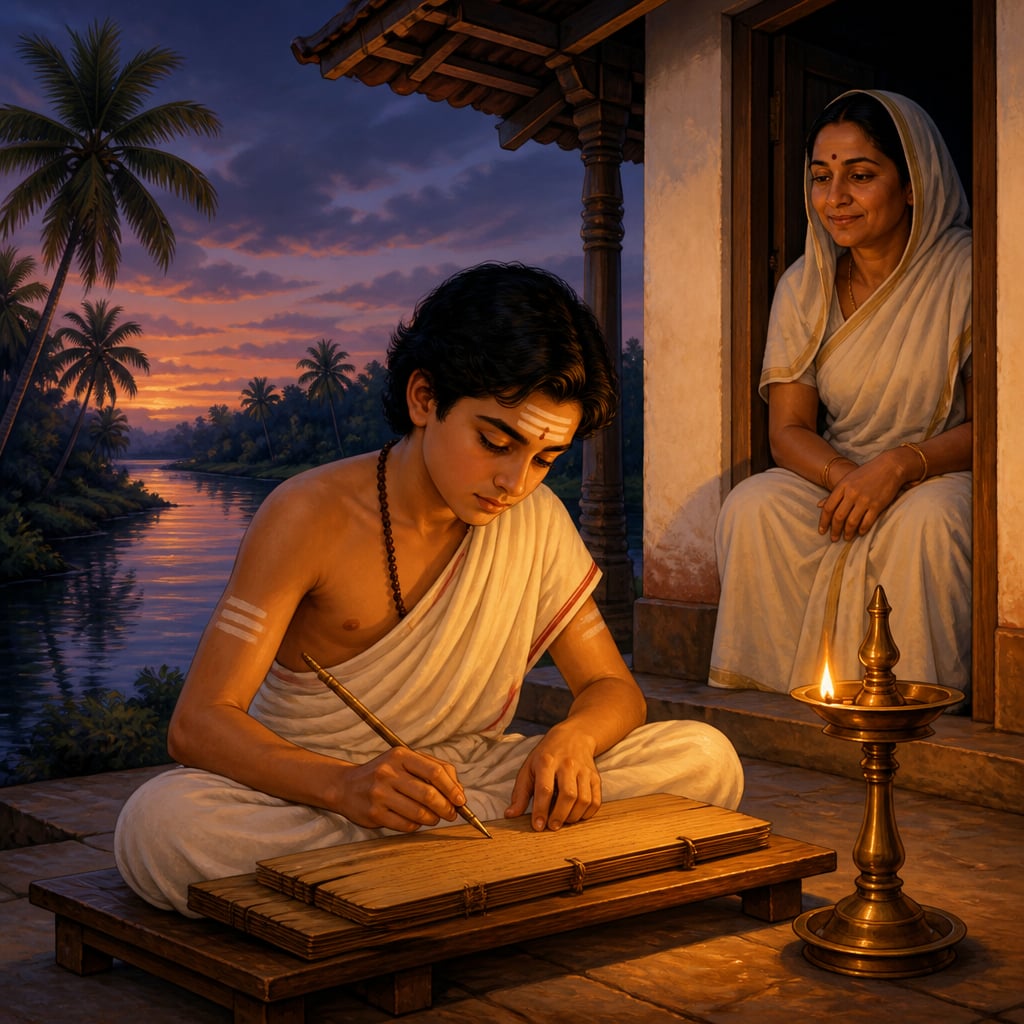
His name is Adi Shankaracharya. The hymn he is beginning will be called the Soundarya Lahari, the wave of beauty, and tradition will hold that its first hundred verses, called the Ananda Lahari or wave of bliss, were dictated to him by Shiva himself on Mount Kailasa and brought back down to the world. The first line of the first verse is a single Sanskrit sentence. It is also one of the most quoted sentences in the entire Shaiva and Shakta tradition. The reason it is quoted so often is that it solves, in eighteen syllables, the problem the rest of this chapter has been circling.
The line reads:
शिवः शक्त्या युक्तो यदि भवति शक्तः प्रभवितुम्
śivaḥ śaktyā yukto yadi bhavati śaktaḥ prabhavitum
If Shiva is joined with Shakti, he is able to act.
The boy writes the second line under it.
न चेदेवं देवो न खलु कुशलः स्पन्दितुमपि
na ced evaṃ devo na khalu kuśalaḥ spanditum api
If not, the god is not even able to stir.
The lamp flickers once. The chalk stops. The verse is the door of the chapter. The reader who walks through it will not be able to read the rest of the Shiva Tattva the same way again.
What The Verse Is Saying
The last lesson placed Shiva as chit, pure awareness. The silent witness. The one in whom every thought, sound, and image arises and passes. That lesson made one teaching very clear. It also left one question wide open. If awareness is the still witness of everything, then who or what is doing the moving? Who walks the body to the well in the morning? Who picks up the child? Who writes the verse? Who runs the cosmos?
The Shaiva tradition has a one-word answer. Shakti.

Shakti is not a separate goddess standing next to Shiva, the way a wife stands next to a husband in a wedding photograph. The image is older and more intimate than that. Shiva is the still axis. Shakti is the turning of every wheel that hangs from it. The two are one being, named in two ways for the sake of clear thought, the way the same person can be named as the parent and as the worker without becoming two people.
Shankara's verse makes the relationship sharp. Shiva alone is not yet able to act. A god of pure awareness, with no power, would be a watcher, perfect and useless. Shakti alone is not yet directed. Power without awareness would be a flood, raw and dangerous. The cosmos as we live in it, the body as we walk in it, the breath as it enters and leaves, the thought as it forms and dissolves, all of this is the marriage of the two. Awareness and energy. Witness and movement. The still and the turning.
The Sanskrit gives the second half of the verse a small, devastating turn. Spanditum api. To even stir. Without Shakti, Shiva cannot so much as twitch. The line is not metaphor. It is the cleanest possible statement of the Shaiva theology of action. Awareness without energy does not move the smallest finger.
Shava: The Word Inside The Word
The Shakta tradition takes Shankara's line one step further. It points out a small piece of Sanskrit wordplay that hides inside the word shiva itself.
Shiva with the long i is the auspicious one, the god. Shava with the short a is a corpse. The two words are written almost identically. The only difference is one vowel. The teaching the tradition built on this near-identity is short.
Shiva without Shakti is shava.
Without her, the lord is not the lord. He is a body without breath. A throne without a king. A lamp without a flame. The Shakta saint Ramprasad Sen of eighteenth-century Bengal wrote in one of his Bengali songs that he had heard Shiva himself confess this, that without his Mother he was nothing but a body in the burning ground. The image is severe. It is meant to be. The tradition is forcing a question. What in your own life is awareness without energy? A vow you keep meaning to begin. A skill you have understood for ten years and never practised. A relationship you know is important and have not called this month. The Shaiva tradition does not call any of this small. It calls it shava. A body waiting for the breath that is Shakti.
This is where the chapter on Shiva turns. A philosophy that ends at pure awareness has not yet finished. It has only set the stage. Shakti is what walks onto the stage and begins the play.
How The Pair Shows Up In The Body
The tradition does not leave the teaching at the level of cosmology. It walks it down into the body, where every reader can check it. The classical Shaiva and Tantric texts describe two channels in the subtle body. Ida, on the left, is the cool, lunar, receptive current, associated with awareness. Pingala, on the right, is the warm, solar, active current, associated with energy. They cross each other along the spine, weaving around the central channel called Sushumna. When the two are in balance, breath and attention move together. When they are out of balance, the body either dries out (too much active current) or stalls (too much receptive current).
| Side | Sanskrit Name | Quality | Domain |
|---|---|---|---|
| Left channel | Ida | Cool, receptive, lunar | Awareness, witnessing, rest |
| Right channel | Pingala | Warm, active, solar | Energy, action, output |
| Central channel | Sushumna | Awakened, integrated | The marriage of the two |

This is why the most basic pranayama practice in the Shaiva-Tantric tradition is nadi shodhana, alternate-nostril breathing. The seeker closes the right nostril, breathes in through the left. Closes the left, breathes out through the right. Reverses. The whole cycle is a small, quiet rehearsal of the marriage Shankara named in his first verse. Awareness in. Energy out. Energy in. Awareness out. The breath itself is the pair.
The modern reader does not need the Sanskrit map to test the claim. Notice your own state on a heavy workday. By six in the evening, attention is still on, but the energy has gone somewhere. You can see what needs doing. You cannot make yourself do it. The Shaiva diagnosis is simple. The witness is at the seat. Shakti has stepped out of the room. The cure is not more thinking. The cure is to walk, to eat, to splash water on the face, to call someone you love, to do anything that brings the energy back. Then the witness has something to ride.
The Three Faces of Shakti
The Shiva Purana and the Shakta texts together name three classical aspects of Shakti, each of which is also a goddess in the household tradition. Together, they cover the full range of what energy does in a life.
- Iccha Shakti, the power of will. The pull that says this, not that. The inner movement that gets you out of bed, that picks the project, that closes the browser tab. Her household form is Parvati as the mountain's daughter, the one who chose Shiva and kept choosing him through years of tapas.
- Jnana Shakti, the power of knowledge. The clarity that lets the will find its target. The lamp that shows what the room contains. Her household form is Saraswati, the river-goddess of speech, learning, and music.
- Kriya Shakti, the power of action. The hand that picks up the tool. The body that walks to the well. The cosmos that turns. Her household form is Lakshmi, the goddess of wealth, fortune, and the visible result of work.
| Aspect | Sanskrit | What She Powers | Household Form |
|---|---|---|---|
| Will | Iccha Shakti | The choice, the pull, the this not that | Parvati |
| Knowledge | Jnana Shakti | The clear seeing of the target | Saraswati |
| Action | Kriya Shakti | The hand on the tool, the visible result | Lakshmi |
A life that has only one of the three is incomplete. Will without knowledge is a sprint in the wrong direction. Knowledge without will is a library no one visits. Action without will or knowledge is busywork. The Shakta claim is that the goddess in her full form is the marriage of the three, and that what we call a flourishing human life is the same marriage at the smaller scale.
Why The Tradition Worships Her First
In most South Indian Shiva temples, the smaller shrine of the goddess sits inside the same compound as the main Shiva sanctum. The order of darshan is fixed. The devotee visits the goddess first. Only then is she or he allowed into the inner sanctum where Shiva sits. Pilgrims at Madurai's Meenakshi-Sundareshwarar temple know this rule. So do pilgrims at the Akilandeshwari-Jambukeshwarar temple at Thiruvanaikaval, where the goddess is so central that the temple is named for her first.
The Shaiva reading of the rule is not that the goddess is more important than the god. The rule is enacting Shankara's verse. Shakti is the door. Awareness is the seat behind the door. You cannot walk into the seat without first being received by the door. The pilgrim who tries to skip the goddess and run straight to Shiva is the seeker who is trying to wake up without using the body. The body is the door. The breath is the door. The energy in the room right now is the door. The Shaiva tradition simply made the rule literal in stone.
This is also why Shri Vidya, the Tantric tradition that worships the goddess as Lalita Tripurasundari through the Sri Yantra and the fifteen-syllable Panchadasi mantra, sits at the heart of the Smarta and Shankara lineages today. The peethams at Sringeri, Kanchi, and elsewhere preserve Shri Vidya as the central goddess upasana of the very tradition Adi Shankara founded. The boy who wrote the verse on the verandah at Kaladi did not put Shakti in a chapter at the end of his teaching. He put her in the first sentence.
The Householder's Version
Shakti is not only for monks and tantric initiates. The household version of the teaching is built into the structure of every working home, and most readers have already seen it without naming it.
In most traditional households, one partner is associated with the still axis and the other with the active turning. One holds the visible authority. The other knows where the salt is, keeps the calendar of births and deaths and festivals, decides which child needs the warm shawl tonight. Without her, the house does not stir. The roles can swap. The point is the structure. A life needs a still axis and a turning energy. A household, a workplace, a startup, a temple, an army. When the still axis is gone, the energy whirls without aim. When the turning is gone, the axis stands alone in an empty room.
The most useful inner question this lesson can leave you with is, which side of the pair am I currently leaning into, and which side has gone quiet. The Shaiva move is not to push harder on the strong side. It is to call the quiet side back into the room.
Modern Echoes
The psychologist Mihaly Csikszentmihalyi, in his 1990 book Flow, named a state in which a person's capacity and the demands of the task are perfectly matched. In flow, the witness is awake, the energy is fully engaged, and the two move as one. Csikszentmihalyi did not name Shankara, but his description of the flow state is the closest twentieth-century approximation of the Shiva-Shakti marriage in lay psychological language. Awareness without energy is boredom. Energy without awareness is anxiety. The marriage of the two is flow.
The physician and researcher Andrew Huberman, in his Stanford-based work on autonomic balance, has popularised the same teaching in nervous-system terms. The parasympathetic branch is the receptive, restoring current. The sympathetic branch is the active, mobilising one. A healthy life cycles between the two. Burnout is what happens when the sympathetic branch runs alone for too long. Depression is what happens when the parasympathetic branch runs alone. The remedy, in both cases, is to restore the marriage. Modern neuroscience and the Soundarya Lahari are looking at the same body from opposite ends.
The management writer Jim Collins, in his 2001 book Good to Great, identified the Level 5 leader, who combines fierce professional will with deep personal humility. Will and humility are the corporate version of Shakti and Shiva. The will alone produces a tyrant. The humility alone produces a saint who cannot ship the next quarter. The marriage produces a leader who builds something that outlasts her tenure.
Back at the Verandah
The boy at Kaladi finished the second line. He set down the chalk. The lamp had almost burned through. The verse would travel for twelve centuries and still be the first thing recited in Sri Vidya temples on a Tuesday morning.
This week, you will have at least one moment when the witness is awake but the energy has stepped out of the room. You will sit in front of an open document, or on the edge of a phone call, or at a kitchen counter with the right ingredients lined up, and the small movement that turns awareness into action will not happen. The Shaiva tradition has been waiting for that moment. It does not ask you to think harder. It asks you to invite Shakti back. Move the body. Splash water. Light a small lamp. Touch the floor with both hands. Say a single name of the Mother under your breath. Anything that returns the breath to the room. Then the witness inside, the one who has not moved at all, will have something to ride.
Living traditions
The Shakti tradition is alive across modern India in a form Shankara himself would recognise. The Sringeri Sharada Peetham, founded in the eighth century, continues to teach Sri Vidya and recite the Lalita Sahasranama daily under the present Jagadguru. The Kanchi Kamakoti Peetham preserves the Kamakshi worship at Kanchipuram and conducts annual Brahmotsavams that draw lakhs of pilgrims. Public Navaratri celebrations in Kolkata, Mysuru, Vijayawada, Ahmedabad, and Vadodara each draw multi-million-strong crowds for the nine nights of the goddess each autumn. The Vaishno Devi shrine in Jammu receives more than ten million pilgrims annually, making it one of the most visited Shakti shrines in the world. Sadhguru's Linga Bhairavi consecration at the Isha Yoga Center near Coimbatore (2010) is a modern public installation of the goddess in her fierce, energising form, with a daily aarti that draws thousands of women and men. Mata Amritanandamayi (Amma) and Sri Sri Ravi Shankar both teach forms of Devi upasana to international audiences, and the Lalita Sahasranama is now available in classical recordings by M. S. Subbulakshmi (1958) that have travelled into homes and meditation rooms from Chennai to California. The eighteen-syllable verse Adi Shankaracharya wrote on a sloping verandah in eighth-century Kaladi is, twelve hundred years later, the working theology of every household where the Mother is invoked first.
- Sri Vidya Upasana: The classical Tantric worship of the Mother as Lalita Tripurasundari, transmitted through the Shri Yantra (a geometric diagram of nine interlocking triangles), the fifteen-syllable Panchadasi mantra, and the sixteen-syllable Shodashi mantra. Sri Vidya is the central upasana of the Smarta tradition organised by Adi Shankaracharya and is preserved at the Sringeri, Kanchi, and Pejawar mathas, as well as in many household lineages across India. A Sri Vidya practitioner performs daily puja to the Sri Yantra, recites the Panchadasi or Shodashi, and reads from the Lalita Sahasranama, the thousand names of the goddess.
- Lalita Sahasranama Daily Recitation: The thousand names of Lalita Tripurasundari, contained in the Brahmanda Purana, are recited daily in homes and temples across India, especially on Fridays and during the nine nights of Navaratri. The recitation takes about thirty-five to forty minutes. Devotees offer kumkum (red turmeric powder) at each name in the abbreviated puja called kumkumarchana. The Sahasranama is regarded as the most accessible Shri Vidya practice for householders, requiring no formal initiation while preserving the full vocabulary of the tradition.
- Navaratri: Nine Nights Of The Goddess: The most important annual celebration of Shakti across India, observed twice a year (Sharad Navaratri in autumn and Vasant Navaratri in spring), with Sharad Navaratri being the larger public festival. Households install a small altar (golu in Tamil Nadu, kalasha in Karnataka, ghatasthapana in Maharashtra), invite the goddess as a guest for nine nights, and read or recite the Devi Mahatmyam daily. The first three nights are dedicated to Durga (the warrior aspect), the next three to Lakshmi (the abundance aspect), and the final three to Saraswati (the wisdom aspect). The tenth day, Vijayadashami, marks the goddess's victory.
- Devi Kamakshi Temple, Kanchipuram: One of the three primary Shakti Peethas of South India (the other two being Madurai's Meenakshi and Varanasi's Vishalakshi). The presiding deity, Kamakshi, sits in the rare Padmasana posture on a golden throne in the inner sanctum, holding a sugarcane bow, a parrot, a noose, and a goad. The temple traditionally enforces the rule that Shiva worship in Kanchipuram passes through the goddess first. The Kamakoti Peetham, founded by Adi Shankaracharya, has its seat at this temple, and the Lalita Sahasranama kumkumarchana is performed daily before the goddess. The Soundarya Lahari is recited on every Friday.
- Sringeri Sharada Peetham: The southernmost of the four mathas founded by Adi Shankaracharya in the eighth century, on the banks of the Tunga river. The presiding deity is Sharadamba, the goddess of learning, enshrined in a granite sanctum with a daily Lalita Sahasranama parayana. The Sringeri Acharya is the thirty-sixth pontiff in an unbroken line from Shankara, and the matha continues to teach Sri Vidya, Vedanta, and the Soundarya Lahari to qualified students. The mathadhipati gives darshan in the morning and evening to all visitors.
- Mookambika Temple, Kollur: One of the Sapta Mukti Sthalas (seven liberation sites) of Karnataka and a major Shakti shrine on the foothills of the Kodachadri hills. The presiding deity, Mookambika, is enshrined as a swayambhu (self-manifest) Jyotirlinga combined with a metal panchaloha murti of the goddess in front, in a unique form that integrates Shiva and Shakti in a single sanctum. The temple is closely associated with Adi Shankaracharya, who is said to have meditated at Kollur and installed the goddess image himself. The atmosphere of the small town, ringed by hills and the Souparnika river, is regarded by Sri Vidya practitioners as one of the most charged Shakti spaces in South India.
Reflection
- Where in your own life are you currently being Shiva without Shakti, awareness without the energy that would let you act?
- Why do you think the South Indian temple tradition makes the rule of visiting the goddess first inviolable, even for the most learned Shaiva pilgrim?
- If awareness alone is not yet able to act, and energy alone is not yet directed, what is the nature of a being in whom the two have never been separate?