Chit: Shiva as Consciousness Itself

The silent witness behind every thought

Shiva is not fundamentally a god in a story. Shiva is the awareness in which the story is being read. The Vidyeshvara Samhita names him Chit, pure consciousness, the silent witness behind every thought. Notice the breath. Now notice the one who is noticing. That is what the Shiva Purana means by Shiva.

The Pause After the Stories

For four chapters, the Shiva Purana has been telling stories. Sati walked into her father's yajna. Parvati climbed the mountain and won the wedding. Ganesha was made from turmeric paste at his mother's door. Kartikeya was born of fire and the six Krittikas nursed him. The text has filled the reader with image, name, place, and event.

This chapter is the pause. Suta, the storyteller speaking to the sages at Naimisharanya, sets down the narrative and turns to the question that has been waiting all along.

"Sages," he says, "you have heard who Shiva married, who Shiva fathered, who Shiva fought, where Shiva walks. Now hear what Shiva is."

The sages settle. The fire in the centre of the assembly is low. The forest of Naimisharanya is quiet at this hour. Suta continues with the line that opens the philosophical core of the entire Purana.
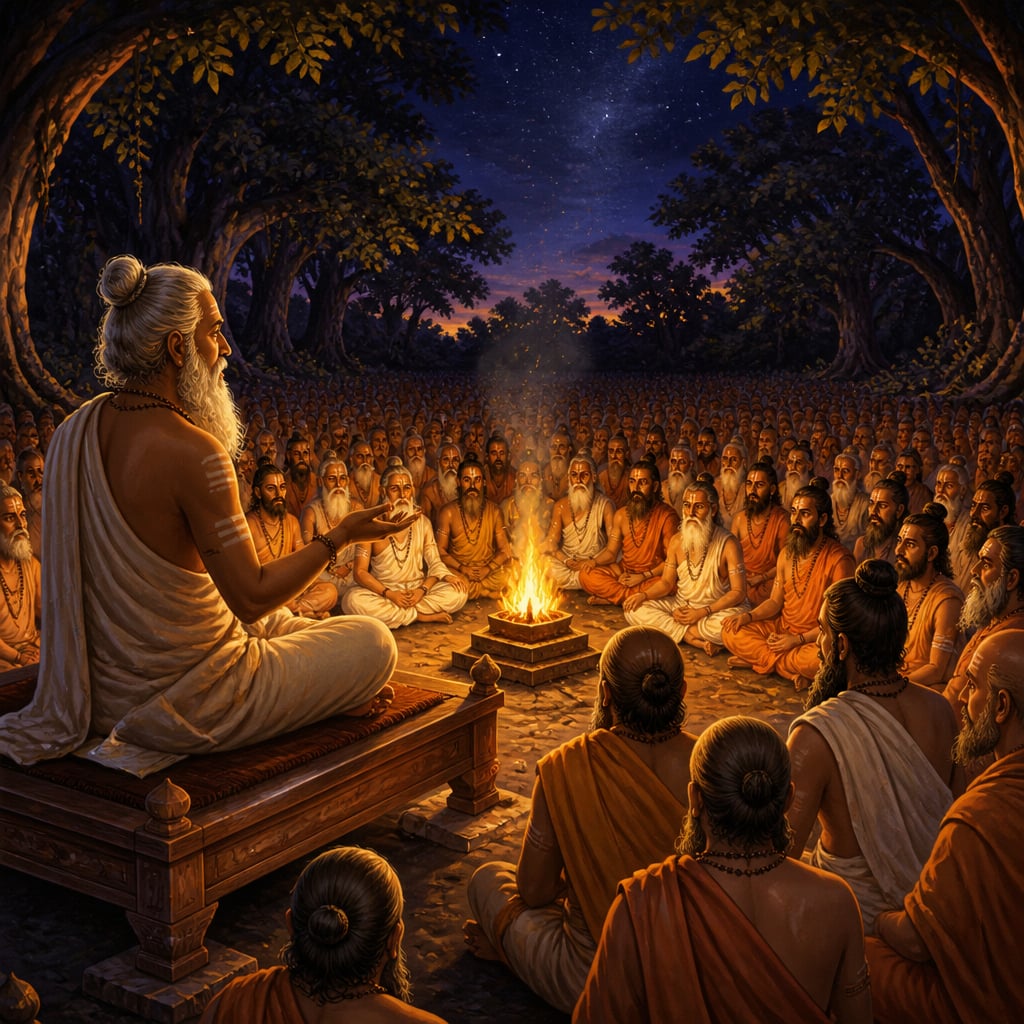
Suta seated at Naimisharanya speaking to assembled sages by firelight

"Shivah chit-svarupah. Shiva is consciousness in its own form. Not a being who has consciousness. Consciousness itself, taking the form of a being only so that we may speak of it."

What the Word Chit Means

The Sanskrit word chit is one of the three words used by the dharmic tradition to name the absolute. The full triple is sat-chit-ananda: existence, consciousness, bliss. Of the three, chit is the most direct entry for a reader who is not yet sure what existence and bliss might mean.

Chit is the simple fact that there is awareness. Right now, as you read this sentence, something is aware that the words are being read. That something is not the eyes. The eyes are seen by it. It is not the mind that is forming opinions about the sentence. The mind is seen by it as well. It is not the body that is sitting on the chair. The body is also seen by it.

What sees all of these is what the Shiva Purana calls Shiva.

This is not a metaphor. The Vidyeshvara Samhita is explicit. The reader is not being asked to imagine Shiva as the witness. The reader is being asked to notice the witness that is already present, and then to recognise that this witness is what every Shaiva temple, every linga, every mantra, has been pointing at all along.

A Small Experiment

The Shiva Purana, more often than people remember, includes practical instruction. The Vidyeshvara Samhita gives a small experiment here, paraphrased and expanded by the Shaiva commentators across the centuries.

A modern seeker noticing the noticer in a balcony meditation

Sit upright. Close the eyes. Bring attention to the breath. Notice it for ten breaths. Do not change it.

Now ask, silently: who is noticing the breath?

Do not answer with a name. Do not answer with a story about yourself. Just notice that there is a noticer. The breath is being noticed. There is, by definition, someone or something that is noticing. That noticing is happening right now.

The Shiva Purana's claim, which is also the claim of the entire Advaita Shaiva tradition that grew from it, is that this noticing is not a part of you. It is the part of you that is real. Everything else, the body, the breath, the thoughts, the moods, the memories, the plans, the worries, the name, the role, the history, is something that the noticing is aware of. The noticing itself is never the object of awareness. It is awareness.

This is Shiva.

Why It Is Called the Witness

The Sanskrit word the tradition uses is sakshi, which translates as witness. The metaphor is precise. A witness in a courtroom is not a participant in the events being described. The witness is the one who saw. The witness is, in fact, defined by the fact of having seen, not by having acted.

The Mandukya Upanishad, one of the shortest and most concentrated of the Upanishads, names the four states of human experience: waking, dreaming, deep sleep, and the fourth state called turiya. Turiya is not another state alongside the first three. It is the awareness in which all three appear. The awareness that knows you are awake. The awareness that knows you were dreaming. The awareness that knows you slept and remembers, on waking, that the sleep was deep.

The Shiva Purana takes the Upanishadic teaching and gives it a name and a face. The fourth state, turiya, the witness, the chit, is what tradition has been calling Shiva all along. The matted hair, the trishula, the Nataraja in the ring of fire are all images. The thing they image is the silent awareness reading this sentence right now.

What changes What does not change
The body, from infancy to old age The awareness that has known every age of the body
The thoughts, from minute to minute The awareness in which the thoughts arise
The moods, from joy to sorrow The awareness that knows both
The roles you play, across decades The awareness that has played them all
Waking, dreaming, deep sleep The awareness present in all three

The column on the right is what Shiva names. The lesson is asking the reader to see that this column has been there the whole time.

What I Am Really Means

Most people, when they say the words I am, mean something like I am Vamsee, a son of these parents, who lives in this city, and works at this job, and has these worries. The Shiva Purana asks the reader to perform a small subtraction.

Take the sentence I am Vamsee, a son of these parents, who lives in this city, and works at this job, and has these worries. Remove the name. Remove the parents. Remove the city. Remove the job. Remove the worries. What is left is the simplest sentence the Sanskrit tradition holds: aham asmi, I am.

The Shiva Purana's claim is that this remaining I am, with no attributes, is not a smaller version of the original sentence. It is the original. Everything else was something added on top. The added attributes change. The bare I am does not. It was there at five years old. It will be there at eighty-five. It is there in a room of strangers and there in a room alone. It is there in joy and there in grief.

This bare I am is what the Mahavakya Aham Brahmasmi of the Brihadaranyaka Upanishad points at. It is what the Mahavakya Tat Tvam Asi of the Chandogya Upanishad points at. It is what the Shaiva mantra Shivoham, I am Shiva, names directly. The chapter you are now beginning is the Purana saying, in its own voice, that this is the same teaching it has been telling stories around for the previous four chapters.

Why the Stories First

The Shiva Purana could have begun with this chapter. It chose not to. The reason, the Shaiva commentary tradition is clear about, is that the bare I am is too thin to hold the attention of an unprepared mind. The mind needs images, names, dramas, the wedding on Kailasa, the haldi at the door, the trishula in the cremation ground, before it is ready to set them all down and look at the awareness in which they were happening.

The stories were the doorway. The chit is the room the doorway leads into.

This is not a small structural choice. It is the dharmic tradition's deepest pedagogical move. The stories are not lower than the philosophy. They are the path the philosophy walks on. A reader who skips the stories and tries to begin with the chit will find the chit slippery, abstract, hard to hold. A reader who has lived through Sati's fire, Parvati's tapas, Ganesha's door, Kartikeya's six faces, has an inner field rich enough to host the simple teaching that the awareness in which all those scenes appeared is what Shiva has always meant.

A Modern Frame

Bernardo Kastrup, a Dutch philosopher writing at the start of the twenty-first century from his work at the European Organisation for Nuclear Research and later at Radboud University, has spent the last fifteen years arguing for what he calls analytic idealism, the position that consciousness is the fundamental substance of reality and that matter is what consciousness looks like from a particular perspective. His 2019 book The Idea of the World lays out the argument carefully. Kastrup is explicit that his project is, in modern philosophical vocabulary, the same one the Vedanta and Shaiva traditions worked out centuries earlier.

David Chalmers, the Australian philosopher at New York University, gave the modern world the phrase the hard problem of consciousness in his 1995 paper. The hard problem asks why there is any subjective experience at all, given that the brain can in principle be described in entirely physical terms. The Shiva Purana's chapter five answers the question by inverting it. The hard problem only seems hard because we have started from matter and tried to derive consciousness. Start from consciousness, the Purana says, and matter is what consciousness becomes when it forgets itself for a while.

The physicist Erwin Schrodinger, writing in his 1944 book What Is Life? and his 1958 book Mind and Matter, came to the same conclusion from the other direction. After decades inside quantum mechanics, he wrote that consciousness must be singular, not plural, that "there is only one consciousness" and that the appearance of many minds is a function of how the one consciousness reflects in many bodies. He cited the Upanishadic line Tat Tvam Asi directly. The Shiva Purana's claim that Shiva is chit, and that this chit is the awareness reading this sentence right now, is the Hindu form of the same recognition.

The rest of the chapter, beginning with the next lesson on Shakti, will give the chit its movement, its play, its world-making power. But the door has already been opened in this lesson. The awareness that has been reading these words from the first sentence is what the Shiva Purana means by Shiva. The whole chapter, and arguably the whole text, has been, in the Purana's own claim, an elaborate hand pointing at this simple fact.

Living traditions

The chit-recognition that this chapter opens has had one of the longest continuous lineages of any teaching in the dharmic tradition. Adi Shankara, in the eighth century CE, gave it its sharpest classical form in the Vivekachudamani and the Nirvana Shatkam. Abhinavagupta, in the eleventh-century Trika Shaivism of Kashmir, developed it into the Pratyabhijna philosophy of self-recognition. Sri Ramana Maharshi, in the twentieth century at Tiruvannamalai, gave it its most accessible modern form as the practice of self-enquiry, atma-vichara, with the question who am I. Nisargadatta Maharaj in 1970s Bombay took it into the urban household with his book I Am That. In contemporary Western philosophy, the Dutch philosopher Bernardo Kastrup at Radboud University has argued for analytic idealism, the position that consciousness is the fundamental substance of reality, in books including The Idea of the World. The physicist Erwin Schrodinger cited the Upanishadic mahavakya Tat Tvam Asi directly in his 1958 Mind and Matter. Arunachala in Tamil Nadu remains a living centre of the practice, and Naimisharanya in Uttar Pradesh holds the geographic memory of where the Shiva Purana was first told.

Reflection

More in Shiva Tattva: Core Philosophy

All lessons in Shiva Tattva: Core Philosophy ยท Shiva Purana course