Pancha Bhuta Lingas: The Five Element Temples
Walking the elements in South India
Five of Shiva's eight bodies are the elements: space, air, fire, water, earth. The South Indian Shaiva tradition built a temple for each one. This lesson visits all five Pancha Bhuta Lingas, from Chidambaram in the south to Kalahasti in the north, and reads what the geography is teaching.
A Map You Can Walk
In the previous lesson you met Ashtamurti, the eight-bodied Shiva. Eight forms: the five elements, the sun, the moon, the soul. The lesson ended with the line that the Shaiva tradition refused to leave Ashtamurti as a list. It built temples for it. This lesson is the walk.
The Pancha Bhuta Lingas are five Shiva temples in South India. Each one is dedicated to a single element. Chidambaram for space. Sri Kalahasti for air. Arunachala for fire. Thiruvanaikaval for water. Ekambareshwar for earth. They are not metaphors. They are functioning temples that have been continuously worshipped for a thousand years or more, each one with its own story, its own form of the linga, and its own daily ritual that honours the specific element the temple is keeping.
A pilgrim who walks all five, in any order, is reading the Ashtamurti doctrine with the soles of his feet.
Why Build the Elements
The rest of the Indian philosophical tradition is content to discuss the elements. The Sankhya schools list them. The Yoga schools meditate on them. The Vedanta schools dissolve them into Brahman. The Shaiva tradition of the Tamil south did something none of these schools quite did. It said: if Shiva is in the elements, then a person who has never read a philosophy book should be able to walk to where Shiva is in space, in air, in fire, in water, in earth, and bow.
This is the deeper logic of the Pancha Bhuta Lingas. Philosophy that depends on literacy is philosophy that excludes most of humanity. Architecture that holds the same teaching is open to anyone with feet. The five temples are the Tamil Shaiva contribution to the question of how a high doctrine can stay public.
Each temple has, at its sanctum, a form of the linga that physically embodies the element it serves. Not a symbol of the element. The element itself, made into the linga, daily.
Chidambaram: The Linga of Space
The first temple is in Chidambaram in central Tamil Nadu. The element is akasha, space. The temple is the seat of the Akasha Linga and the home of Nataraja, Shiva as the cosmic dancer.
Walk into the inner sanctum at Chidambaram and you will find something unusual. Behind the curtain, where every other temple shows a stone linga, Chidambaram shows nothing. There is empty space. The priests draw the curtain back to reveal it, and the revelation itself is the darshan. This is called the Chidambara Rahasya, the secret of Chidambaram. The space inside the sanctum is the linga. There is nothing more to show because space is exactly what is shown.
The theological point is exact. Space is the first element, the most subtle, the one inside which all the other four arise. It cannot be seen because seeing happens inside it. The temple's refusal to show a stone is the most precise possible Shaiva pedagogy: Shiva as space is what you have been looking through, not what you have been looking at.
Nataraja, in his iconic dance, is also enshrined here, in the same temple, in the same complex. The cosmos arises and dissolves inside the space the dance opens. The five acts of Nataraja, as you saw in the previous lesson, are creation, sustenance, dissolution, concealment, and grace. Chidambaram holds them all in the empty sanctum.
Sri Kalahasti: The Linga of Air
The second temple is at Sri Kalahasti, just north of Tirupati in Andhra Pradesh. The element is vayu, air. The temple is the seat of the Vayu Linga.
Walk into the inner sanctum here and you will see, on the linga itself, a small lamp burning. The flame, in still air, will visibly flicker. There are no fans. There are no open windows. The flame moves anyway. The priests will tell you, and the geological surveys confirm, that there is a continuous, gentle current of air inside the sanctum, moving across the linga, that no one can fully account for. The flame's flicker is the Vayu Linga's daily darshan.

The story of the temple is also the story of three unlikely devotees: a spider (Sri in Telugu), a snake (Kala), and an elephant (Hasti). Each worshipped the linga in his own way: the spider wove a canopy of webs over it, the snake placed jewels at its base, the elephant bathed it daily with water from the Swarnamukhi river. They sometimes destroyed each other's worship without knowing. Shiva, moved by all three, granted them moksha together. The temple's name, Sri-Kala-Hasti, holds all three names in one breath.
The air element teaches what the spider, snake, and elephant teach. Air is invisible. Devotion is also often invisible to the next devotee. Three different kinds of beings worshipped the same linga in three different ways, and each thought the others were enemies. The linga, like the air, accepts all three.
Arunachala: The Linga of Fire
The third temple is at Tiruvannamalai in northern Tamil Nadu. The element is agni, fire. The temple is the seat of the Agni Linga, also called Arunachaleshwara, lord of the red mountain.
The Arunachala story is the same Lingodbhava story you met in Chapter 1. Brahma and Vishnu argued about who was greater. A pillar of fire, infinite in both directions, appeared between them. Vishnu became a boar and dug down. Brahma became a swan and flew up. Neither found the end. The pillar revealed itself as Shiva. The mountain at Tiruvannamalai is said to be that very pillar, cooled into rock so that human devotees could approach it without being burned.
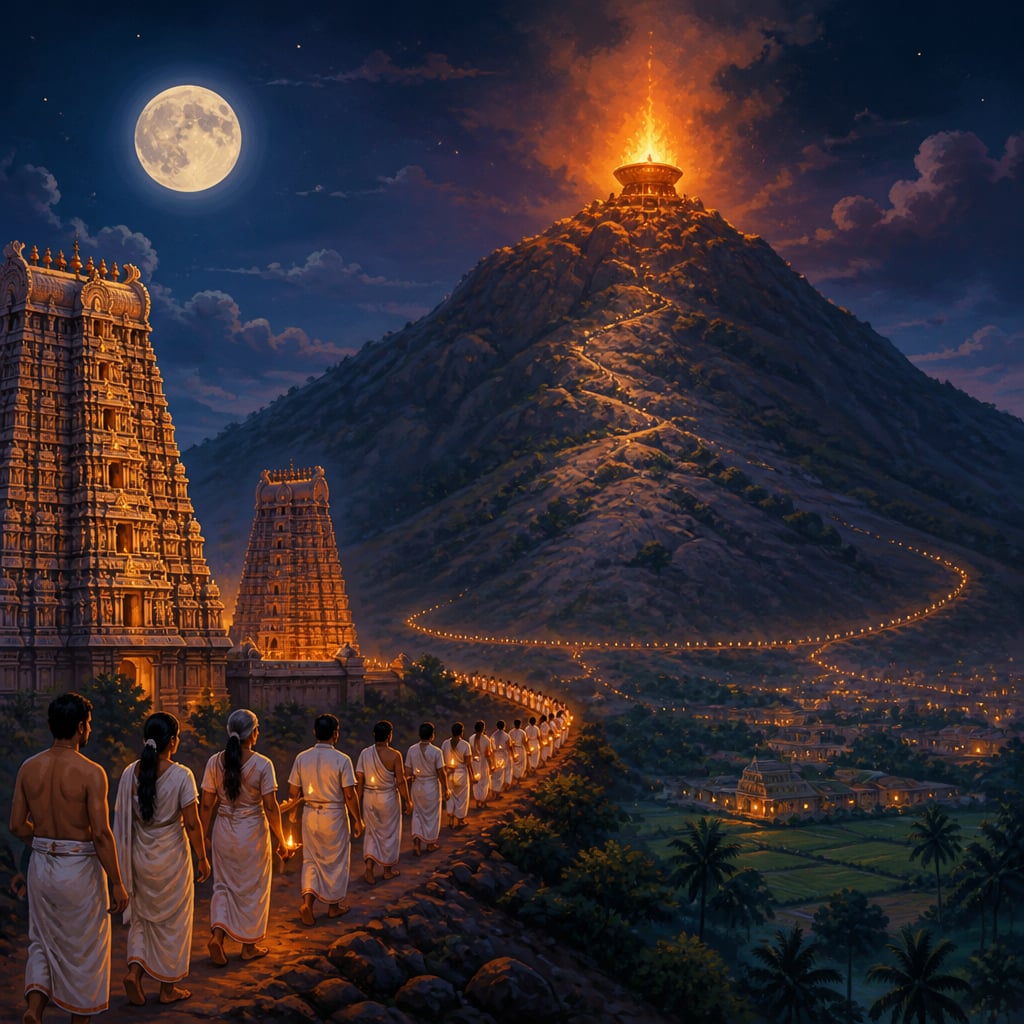
The mountain itself is the linga. There is a smaller stone linga in the temple sanctum at the foot of the hill, but the real linga is the eight-kilometre, 800-metre-high red granite mountain you can see from the temple's gopuram.
The walk around the mountain, called the Girivalam, is the temple's central practice. Pilgrims walk the 14-kilometre circumambulation barefoot, especially on every full moon, when the path fills with hundreds of thousands of walkers. This is one of the largest walking pilgrimages in the world that does not require a single building to be entered.
In the 20th century, the sage Ramana Maharshi lived for 54 years on the slopes of this mountain. He left home as a sixteen-year-old, arrived at Tiruvannamalai, and never left. Ramana taught that Arunachala is not just a place. It is a fire that burns the ego of anyone who thinks of it. Just thinking of Arunachala, he said, is enough. The Agni Linga, in his teaching, is the fire that burns the false self while leaving the true self untouched.
The Krittika Deepam festival, held each November or December on the full-moon night closest to the Krittika star, lights an enormous lamp at the summit of Arunachala. The lamp is visible for thirty kilometres around. The mountain becomes, for one night, the cosmic pillar of fire it always was.
Thiruvanaikaval: The Linga of Water
The fourth temple is at Thiruvanaikaval on an island in the Kaveri river near Tiruchirappalli in Tamil Nadu. The element is apas, water. The temple is the seat of the Appu Linga, also called Jambukeshwara.
The linga at Thiruvanaikaval is a small stone linga set in a recess in the floor of the sanctum. Water continuously seeps into the recess from an underground spring. The linga is, every day of the year, partially submerged in the water that the earth itself sends up. There are no taps. There is no abhisheka pot. The water arrives by itself.
When the Kaveri floods, as it does several times a year, the spring rises and the entire sanctum is filled. The priests perform their puja standing in water up to the waist. When the river retreats, the spring follows. The linga is never dry.
The temple's story is again the story of unlikely devotees. A spider and an elephant once worshipped the linga at this site. The spider wove a web to keep the sun from falling on the linga. The elephant came each morning to bathe the linga with water and brushed the web off. The spider, frustrated, eventually crawled into the elephant's trunk and bit it. The elephant died. The spider, in his next life, was born as Kochengannan, the red-eyed Chola king who built the present temple structure. The story is the temple's reminder that even rage can become devotion, given enough time.
The water element teaches what no other element teaches as directly: that the source you are looking for is below you, not in front of you. The spring at Thiruvanaikaval rises through the floor. The Tamil tradition takes this seriously. Where you stand is where the source is closest. The water has been waiting under the floor all along.
Ekambareshwar: The Linga of Earth
The fifth temple is at Kanchipuram, the sacred city in northern Tamil Nadu. The element is prithvi, earth. The temple is the seat of the Prithvi Linga, also called Ekambareshwara, lord of the single mango tree.
The linga at Ekambareshwar is made of earth. Not stone. Not metal. Sand, packed and consecrated. To this day, the temple does not perform abhisheka with water on this linga, because water would dissolve it. Instead, the abhisheka is performed on a metal kavacham, a protective shell, that is placed over the earthen linga. The element the linga is made of is too fragile for water. The element itself is what is being worshipped.

The story behind the temple is the marriage of Shiva and Parvati. Parvati once playfully covered Shiva's eyes with her hands. The cosmos went dark. Shiva sent her to do tapas to repair what had been done. She came to Kanchipuram, made a linga of sand under a single mango tree, and worshipped it. The Vegavati river, in spate, threatened to wash the sand linga away. Parvati embraced the linga with her own body to protect it. Shiva, watching, was moved. He came to her. They were married at Kanchipuram, under the same mango tree, where the temple stands today.
The mango tree is still in the temple complex, in the open air at the centre, said to be the same tree under which the marriage happened. The tree has four branches, each said to bear a different variety of mango representing the four Vedas. Devotees circumambulate the tree as part of the temple visit.
The earth element teaches that the most fragile material can hold the most divine. A linga of sand should not last a season. The Ekambareshwar Prithvi Linga has lasted, in unbroken worship, for at least a thousand years. The lesson the temple is making with its very building material is the lesson Parvati made with her body: the most divine work in your life will look, from outside, like the most fragile thing you have. Hold it the way she held it. The river will pass.
What the Five Together Teach
Visit the five in any order, and the picture they paint is the same. Space at Chidambaram is the field inside which everything else arises. Air at Sri Kalahasti is the unseen movement that the flame reveals. Fire at Arunachala is the burning that ends the false self. Water at Thiruvanaikaval is the source that rises from below. Earth at Ekambareshwar is the fragile material that holds the divine.
A seeker who has walked all five no longer needs to ask whether Shiva is in the world. He has bowed at five separate sites, each of which made the answer concrete. The Shaiva tradition's quiet confidence comes from this. Doctrine alone wears down. Architecture that has been worshipped for a thousand years, with the element itself as the linga, does not.
The five temples are also a working diagnostic. Each pilgrim notices that one of the five sites speaks louder to him than the others. The temple that speaks loudest is usually the element his life is currently working on. A man whose life is full of fire, anger or ambition or burning purpose, often finds Arunachala speaks to him. A man whose life is full of unspoken grief often finds Thiruvanaikaval, the water that rises from below, undoes him without warning. The five temples are a quiet teaching about which element is currently most alive in your own life. The temple chooses you as much as you choose it.
Why This Matters in 2026
Most modern lives have lost contact with the elements. The body wakes inside a climate-controlled room, washes in piped water, eats cooked food, breathes filtered air, walks on tiles. The earth, water, fire, air, and space that the body is made of have receded from daily experience. The result is the strange feeling that many people in 2026 describe: that the body is somehow not at home in the world it lives in.
The Pancha Bhuta Lingas are the Shaiva tradition's answer to that drift. They are five concrete places where you can put your feet on each element, in turn, and remember that the body is the elements. You do not need to fly to all five. You can begin with the element nearest you. A walk barefoot on earth. A swim in a river. A morning sit before fire. An hour with the eyes closed, listening to the air. A few minutes of doing nothing in a quiet room, noticing the space.
The five temples scale down to a five-day practice that any householder can do, anywhere. The architecture of the doctrine is portable. That is what the South Indian Shaivas understood when they built it.
This lesson lands on the inner-transformation anchor of stillness. The five elements, each in turn, are not asking you to do anything. They are asking you to stand still long enough that the element can be felt. Space cannot be felt by anyone in a hurry. Air cannot be felt by anyone with a fan on. Fire cannot be felt by anyone who keeps the AC running. Water cannot be felt by anyone who only takes piped showers. Earth cannot be felt by anyone who never takes the shoes off. The five element temples are not, finally, a pilgrimage to five places. They are a pilgrimage to the stillness in which the world can re-enter the body.
Historical context
Pallava and Chola periods (c. 6th to 13th century CE), with major Pancha Bhuta Linga temple constructions and Tamil Saiva theology flowering through the medieval era.
The Pancha Bhuta Linga doctrine appears in fragments across the Sanskrit Puranas, especially the Shiva Purana (Vidyeshvara and Kailasa Samhitas) and the Skanda Purana, but it received its fullest theological development in the Tamil Saiva tradition between the 6th and 12th centuries CE. The Tamil Tirumurai canon, in 12 books, systematically integrated the five sites into a single pilgrimage geography. The Chola dynasty (9th to 13th century) financed major reconstructions of all five temples and embedded their worship into the royal calendar. The Vijayanagara empire (14th to 17th century) extended the same patronage. The continuity is the key point: the Pancha Bhuta Linga circuit has had royal, priestly, and popular patronage continuously for over a thousand years, which is why the temples and their daily rituals survive intact today.
Living traditions
The Pancha Bhuta Linga circuit remains one of the most followed pilgrimage routes in South India, with active travel agencies in Chennai, Bengaluru, and Hyderabad offering structured ten-day tours that visit all five sites. Sri Ramanasramam at Tiruvannamalai, founded around the presence of Ramana Maharshi (1879-1950), now hosts thousands of seekers from India and abroad each year and has been one of the most influential modern Indian spiritual centres. The Chidambaram Natyanjali dance festival, founded in 1981, has become a primary venue for Bharatanatyam dancers worldwide. The geological and acoustic studies of Sri Kalahasti's airflow and Thiruvanaikaval's water source are now part of the Archaeological Survey of India's heritage documentation. Most importantly, the Pancha Bhuta Linga doctrine continues to inform a wide ecological and elemental awareness in modern Indian environmentalism: the 2018 anti-pollution campaign on the Vegavati river at Kanchipuram, the Kaveri water-protection movement around Thiruvanaikaval, and the Arunachala Reforestation Project have each drawn explicit theological energy from the temples they surround. The lesson the temples taught a thousand years ago, that the elements are sacred and worth bowing to, has become, in 2026, part of the language of how India argues for its own ecology.
- Arunachala Girivalam: The 14-kilometre barefoot circumambulation of the Arunachala mountain at Tiruvannamalai. Pilgrims walk the route either at dawn or through the full-moon night. The full-moon Girivalam, called Pournami Girivalam, draws several hundred thousand walkers each month, with the largest gatherings on Chitra Pournami (April or May) and Karthigai Deepam (November or December). The walk passes eight smaller lingas around the mountain, each marking a direction, and ends back at the temple at the foot of the hill. Ramana Maharshi walked the route many times, and his recommendation that beginners walk it slowly is still the standard pilgrim instruction.
- Krittika Deepam: The annual lighting of an enormous lamp at the summit of Arunachala on the full-moon night closest to the Krittika star, in November or December. The lamp uses several tonnes of ghee and burns for several days. The light is visible for thirty kilometres around the mountain. Devotees carry smaller lamps in procession around the temple at the foot of the hill, and many begin the Girivalam at the moment the summit lamp is lit. The festival re-enacts the original Lingodbhava: the cosmic pillar of fire becoming visible again.
- Nataraja Temple, Chidambaram (Akasha Linga): The space-element temple, with the Chidambara Rahasya at its core: behind the curtain in the inner sanctum, there is empty space, which is the linga. The temple complex covers 40 acres and includes the famous gold-roofed Chit Sabha (the hall of consciousness) and the Kanaka Sabha (the golden hall) where Nataraja's bronze image is housed. The temple's daily rituals include six pujas, with the Ardhajama puja at 9 PM being the most attended. The temple hosts the annual Chidambaram Natyanjali dance festival at Maha Shivaratri.
- Arunachaleshwara Temple and Mountain (Agni Linga): The fire-element temple at the foot of the Arunachala mountain. The temple complex is one of the largest in India by area, covering 25 acres, with a 217-foot-high eastern gopuram that is among the tallest temple towers in the world. The mountain itself, however, is the real linga, and the Girivalam circumambulation is the temple's central practice. The Sri Ramanasramam, the ashram of Ramana Maharshi, is on the south-western slope of the mountain and remains a major pilgrimage site in its own right. The summit lamp at Krittika Deepam is the year's most dramatic moment.
- Sri Kalahasti Temple (Vayu Linga): The air-element temple just 36 kilometres east of Tirupati. The temple sits between the Kailasagiri and Durgi hills, on the bank of the Swarnamukhi river. The Vayu Linga in the inner sanctum has a small lamp burning continuously beside it; the flame visibly flickers despite the absence of any obvious air source. The temple is also a major Rahu-Ketu parihara site, drawing devotees seeking remedies for astrological afflictions. The 36-pillar mandapam at the entrance is one of the finest pieces of Vijayanagara temple architecture.
- Jambukeshwara Temple, Thiruvanaikaval (Appu Linga) and Ekambareshwara Temple, Kanchipuram (Prithvi Linga): The water-element temple at Thiruvanaikaval sits on Srirangam island in the Kaveri river. The Appu Linga is partially submerged in water that rises from an underground spring; even in summer, the linga is wet. The temple is part of the larger Srirangam complex and is best visited in conjunction with the Ranganathaswamy temple of Vishnu, which sits on the same island, making the visit a Hari-Hara pilgrimage in miniature. The earth-element temple at Kanchipuram is in the heart of the city, with the famous mango tree at the centre of the courtyard. The Prithvi Linga is made of sand and is never bathed with water; the marriage of Shiva and Parvati is celebrated here annually as the Panguni Uthiram festival in March or April.
Reflection
- Of the five elements, which one is your life currently working on, and which temple, even from photographs alone, is the one that pulls at you?
- Why does Chidambaram show empty space behind the curtain instead of a stone linga, and what would change in your own life if you stopped expecting the truth to look like a stone?
- What does it mean about the dharmic worldview that its highest teaching about the elements was preserved in five buildings rather than in five chapters of a treatise?