Linga: The Formless Given Form

Cosmic axis, pillar of presence

Walk into any Shiva temple and the central image is not a face. It is a smooth vertical stone, often dark, often wet. Children ask what it is and adults change the subject. The Shiva Purana gives the real answer: the Linga is the formless given form, the place where the infinite agrees to be touched.

Walking Into A Shiva Temple
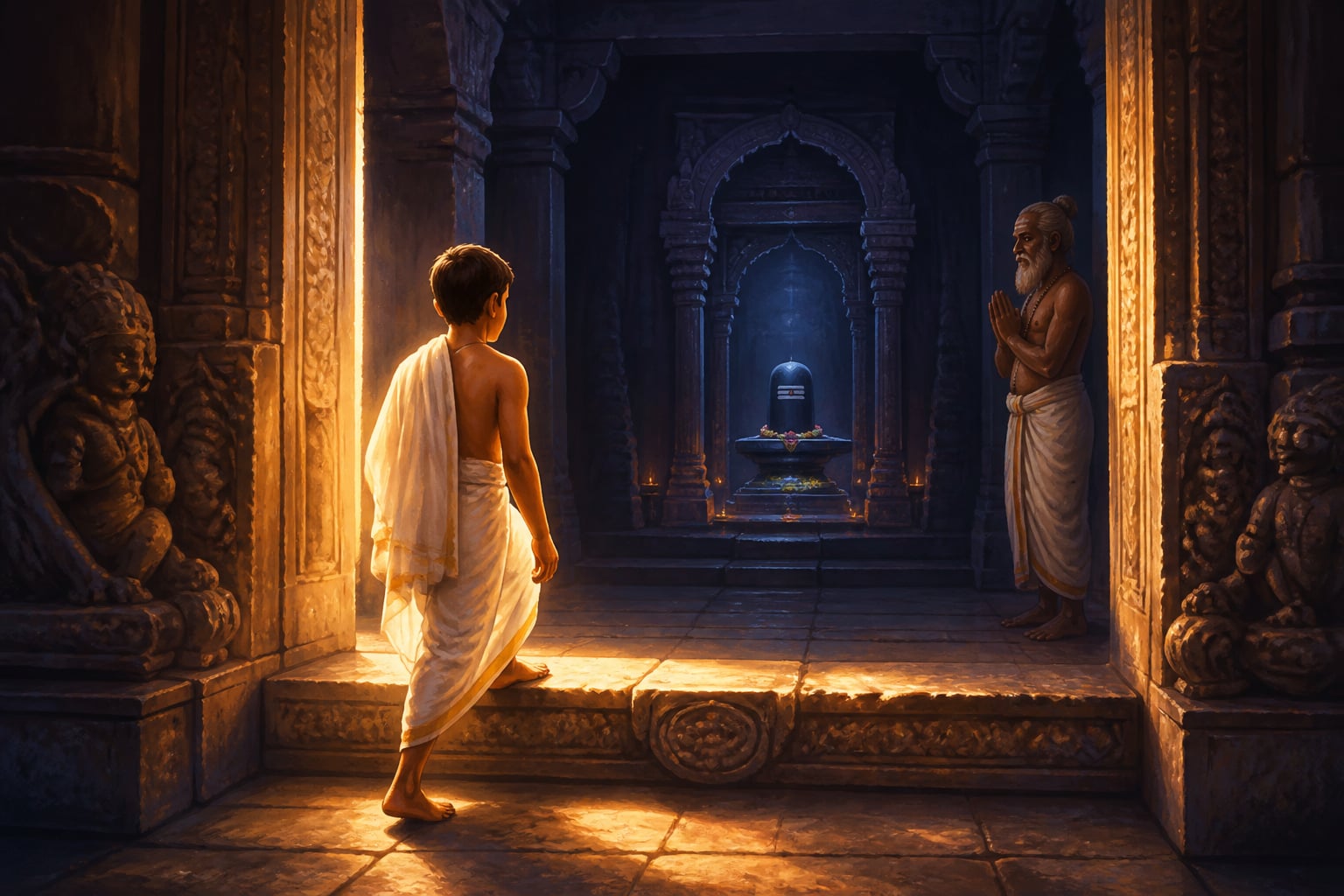
A devotee crossing the threshold of a Shiva temple sanctum

The doorway is low. You bend to enter. The air gets cooler. The lamps are smaller. The chanting, if there is any, is a low murmur, not a song. Your eyes adjust. At the far end of the sanctum, on a raised platform, sits the central image of the temple.

It is not a statue. It is not a face. It is a smooth stone, often dark, sometimes black, sometimes the deep grey of basalt or the dark green of a polished rare granite. It rises vertically from a circular or three-sided base. Water drips on it slowly from a copper vessel suspended above. A garland of bilva leaves lies across its top. A pujari pours milk down its surface, then water, then a thin stream of honey, then water again. The stone glistens. Steam rises faintly in the lamp light.

This is the Shiva Linga. It is the central image of more major temples in India than any other single form. The twelve Jyotirlingas, the five Pancha Bhuta Lingas, the Banalingas of Omkareshwar's river, the household lingas in millions of puja rooms, every Shiva shrine in every village in India is built around this same shape.

And yet many modern Hindus, especially those who grew up in cities and were taught the religion in fragments, do not have a clear answer when a child asks what the Linga is. The answers they have heard range from the apologetic to the embarrassed to the wildly off. The Shiva Purana itself has a clear answer. The Linga, it says, is Shivasya pratimaa, the visible sign of Shiva. It is the formless given form so that the human mind has a place to rest its attention.

This lesson reads the Linga with the dignity the symbol deserves.

Lingodbhava cosmic pillar of fire rising endlessly through the cosmos

The Word Itself

The Sanskrit word linga means mark, sign, or distinguishing characteristic. Patanjali's grammar uses linga for the sign that distinguishes one thing from another. Logic uses it for the mark by which an inference is drawn (when you see smoke, smoke is the linga of fire). The word does not primarily mean an organ. It means that by which something is known.

When the tradition calls the central image of Shiva a Linga, it is making a precise philosophical statement. The image is not Shiva. The image is the mark of Shiva, the sign by which the formless presence becomes available to the senses. Just as smoke is not fire but signals fire, the Linga is not Shiva but signals Shiva. The mind that touches the Linga is being asked to think past the stone toward what the stone marks.

The Shiva Purana's Vidyeshvara Samhita is direct about this:

लिङ्गयते गम्यते यत्र तत् लिङ्गमिति कीर्तितम्।

liṅgyate gamyate yatra tat liṅgam-iti kīrtitam |

That through which one approaches and reaches what is to be known is called the Linga.

Shiva Purana, Vidyeshvara Samhita

The word is functional. The Linga is whatever lets the mind reach Shiva. The stone is the most enduring of those whatevers. Any genuine Shaiva acharya will say the same. The Linga is not the goal. The Linga is the door.

The Lingodbhava Story

The Shiva Purana gives a famous origin story for why the Linga is the central image. The Vidyeshvara Samhita opens with it.

Long before this universe, Brahma the creator and Vishnu the sustainer fall into an argument about which of them is supreme. The argument grows. The two gods, both vast, both eternal, both proud of their roles, are about to come to blows.

At that moment, between them, a column of fire rises from the depths of the cosmos and stretches upward beyond sight. The pillar has no top and no bottom. It glows white. It hums. It contains all sounds and no sound. The two arguing gods stop and stare.

From inside the pillar, a voice says, The one of you who can find my end first is the supreme one.

Vishnu takes the form of a great boar (his Varaha avatar) and dives downward to find the bottom. He digs through layer after layer of the cosmos, through worlds and underworlds, through eras and aeons. The pillar continues. He never finds the bottom. Exhausted and humbled, he returns.

Brahma takes the form of a great swan (his Hamsa form) and flies upward to find the top. He flies through the sky, through the heavens, through realms beyond realms. The pillar continues. He never finds the top. Unwilling to admit failure, he conspires with a falling ketaki flower to lie on his behalf, claiming he has touched the top. Vishnu admits he could not find the bottom. Brahma claims he found the top.

The pillar opens. From inside it steps Shiva, smiling, ash on his body, the third eye open. He commends Vishnu for his honesty. He curses Brahma for his lie (which is why Brahma has almost no temples in India today). He blesses the ketaki flower partially (which is why the ketaki is offered to Shiva only sparingly). And then he says the line that names the central image of his worship.

This pillar that has no top and no bottom is my Linga. Worship me in this form, and I will be present. Worship me in any other form first, and you will not yet have understood me.

The Lingodbhava murti that you see in the niche of the southern wall of every traditional Tamil and Telugu Shiva temple is this scene. The pillar with Shiva inside it. Vishnu as the boar at the bottom. Brahma as the swan at the top. The two gods whose pride was humbled by what neither could measure.

The Two Parts

A temple Linga has two visible parts. The standing stone (the Linga proper) and the platform it sits on (the yoni-pitha or avudaiyar in Tamil). The platform usually has a channel that leads water out of the temple.

The Shiva Purana is clear about what the two parts mean. They are not embarrassing. They are not, in the original sense, anatomical at all in the way modern English readers have sometimes been taught. They are cosmological.

Part Sanskrit name What it represents
The vertical stone Linga Shiva, pure consciousness, the unmoving witness, the cosmic axis
The base Yoni-pitha (literally, the seat of origin) Shakti, the universal womb, the field from which all manifestation arises
The two together Linga-yoni Shiva-Shakti union, consciousness embedded in its own creative power

The linga-yoni image is the same teaching as Ardhanarishvara (the half-woman half-man form of Shiva taught in an earlier lesson) and Shiva-Shakti (taught in the lesson before this one). The same metaphysics, given three different visual forms. The Linga is the most abstract of the three, which is why it is also the most universal. It does not fix the deity in any particular face or body. It points past form to what form arises within.

The water that drips on the Linga and exits through the channel in the yoni-pitha is the visible image of anugraha, the grace that flows from Shiva through Shakti into the world. When you see the milk poured at the top run out at the side and into the courtyard, you are watching the cosmic teaching enacted in twenty seconds.

Why Not A Face

Indian art is among the most face-loving traditions on earth. The bronzes of the Cholas, the murals of Ajanta, the sculpture of Khajuraho and Belur and Halebidu are all extravagantly figured. Hindu deities have faces in vast iconographic detail. Vishnu has his ten avatars, each with their own form. Devi has her thousand forms. Ganesha is unmistakeable. Hanuman has his open-chested gesture, Krishna his flute, Rama his bow.

Why then does Shiva, the most loved of the great gods, refuse a face in his central image?

The Shiva Purana's answer is theological. Shiva is chit, pure consciousness. Consciousness has no face. The moment you give it a face, you have stopped pointing at consciousness and started pointing at a being who has consciousness. Every other deity is consciousness wearing a story. Shiva, the tradition holds, is the consciousness inside which the stories happen. The Linga refuses the face because the face would be a category mistake.

This is also why Shiva, alone among the great gods, has a parallel tradition of representation with face (Nataraja, Dakshinamurti, Bhairava, Ardhanarishvara, the family scenes with Parvati and the boys) and without face (the Linga). The two traditions are not in conflict. They are two registers. The narrative deity walks through the stories. The Linga sits in the inner sanctum, behind the stories, before them, after them. When you go deepest into the temple, you do not find a more ornate Shiva. You find the Linga. The architecture is making a metaphysical point.

The Linga Is Not A Phallus

This needs to be said clearly. The reading of the Linga as primarily a phallic symbol is a colonial reading that the Shiva Purana itself does not give and that no traditional Shaiva acharya teaches. It became dominant in English-language scholarship through the work of nineteenth-century Indologists who, working from a Christian missionary background, read Hindu sacred symbols through their own anxieties about the body.

The word linga, as shown above, means mark or sign. Sanskrit has separate words for the male and female anatomy. The linga-yoni cosmology is about consciousness and its creative power, not about anatomy. Yes, the form has a vertical stone in a base, and yes, generative cosmology and human generation rhyme symbolically (they do in every culture on earth, including the Christian one with its ancient phallic obelisks reused as church spires). But the primary meaning in the Shiva Purana is the cosmological one, not the anatomical.

The traditional pujari at any major Shiva temple in India will give the Shiva Purana's meaning if asked seriously. The household grandmother teaching her grandchildren to do bilva offering will give the Shiva Purana's meaning. The acharyas of Kashi, Sringeri, Madurai, and Pashupatinath will give the Shiva Purana's meaning. The colonial reading is now, two centuries on, beginning to be quietly shed even in academic Indology, as readers return to the primary sources and find that the tradition was always speaking about something larger and more interesting than what nineteenth-century anxiety projected onto it.

A Hindu child asking what the Linga is deserves the actual answer. It is the sign of Shiva, the formless given form so the mind has a place to rest. The pillar in the Lingodbhava story. The cosmic axis. The mark by which the unmarked is known. That answer is true, traditional, and dignified. Use it.

What The Worshipper Does

A priest performing abhisheka with milk on a Shiva linga

The daily worship of a Linga, anywhere from the Kashi Vishwanath to a small village shrine, has a remarkably consistent shape. It is one of the few rituals in Hinduism that has not changed much in two thousand years.

  1. Abhisheka. The Linga is bathed. Water first. Then milk. Then curd. Then ghee. Then honey. Then sugar. Each substance is poured slowly down the surface and runs out through the yoni-pitha channel. The five-substance bath is called panchamrita abhisheka, the bath of five nectars. Each substance is a layer of the cosmos being offered.
  2. Bilva. A leaf of the bilva tree, with three leaflets representing the three gunas or the three aspects of Shiva, is placed on top.
  3. Vibhuti. Sacred ash, the residue of fire and the reminder of impermanence, is placed in three horizontal lines on the Linga and on the worshipper's forehead.
  4. Mantra. Om Namah Shivaya, the five-syllable mantra, is chanted. In some traditions, the Sri Rudram is recited.
  5. Naivedya. Food is offered, usually fruit, sometimes a small portion of cooked rice or a sweet.
  6. Arati. The lamp is circled before the Linga.
  7. Pradakshina. The worshipper circumambulates the shrine, but in Shiva temples only halfway around (the channel from the yoni-pitha is not crossed, out of respect for the flow of grace).

The whole sequence takes ten minutes for a household worship, ninety minutes for a temple abhisheka, and a full day for a major festival. The shape, however, is the same at every scale. Bathe the Linga. Offer the leaf. Mark with ash. Chant the name. Offer food. Wave the lamp. Walk halfway around. A child of seven can be taught the full sequence in an afternoon. The ritual is simple precisely because the symbol is profound.

The Lesson Underneath

The Linga is the Shiva Purana's gift to a tradition that knew everything about the body and chose, at the centre of its most loved temple, to put a sign that points past the body. The choice is deliberate. The choice is mature.

It says, in stone, what the Upanishads say in syllables. That which cannot be measured by the boar going down or the swan going up is what is real. That which has no top and no bottom is the truth. The face you can see is the story. The pillar you cannot measure is the source.

The child who grows up bathing a Linga in the morning is being trained, without a word being said, in the difference between what can be touched and what can be reached. The hand touches the stone. The mind reaches past it. That training, repeated for a lifetime, is what produces the slightly distant smile of the elderly Hindu pilgrim at Kashi who has been doing this for sixty years. They are not worshipping the stone. They are using the stone to remember what the stone is the mark of.

In the next lesson, that same metaphysics walks out of the sanctum and into the world, as Ashtamurti, the eight forms of Shiva visible in the ordinary elements of the cosmos. Earth, water, fire, air, ether, sun, moon, and the soul of every being. The pillar in the temple is the same pillar in the river, the field, the lamp, and the breath.

Key figures

Shiva

The formless absolute who appears as the beginningless and endless pillar of light at the heart of the Lingodbhava story

Brahma

The creator god who flew upward in the form of a swan and could not find the top of the pillar

Vishnu

The sustainer god who took the form of the boar Varaha and dived to find the bottom of the pillar

Historical context

The Linga as a worship object has roots in the Indus Valley period (c. 2500 BCE) and is consolidated in the Puranic age (c. 300-1400 CE) through texts like the Shiva Purana, Linga Purana, and Skanda Purana

The Linga is the longest continuously worshipped religious image in any living tradition on earth. From the small smoothed stones found at Indus Valley sites to the daily abhisheka in 2026 at Kashi, the line is unbroken across more than four thousand years. The Shiva Purana sits roughly in the middle of this arc, codifying the theological meaning of the image at a moment when the worship had already been ancient for two millennia. The text's claim that the Linga is the formless given form is therefore not an innovation but a clarification, a putting into Sanskrit of what the practice had always been doing. The pan-Indian geography of the twelve Jyotirlingas and the five Pancha Bhuta Lingas knits the subcontinent together through this single symbol more comprehensively than any political unifier ever did. The Linga is, in a real sense, the most pan-Indian sacred image in the country.

Living traditions

The Linga remains the most active sacred image in Hindu India in 2026. The Kashi Vishwanath corridor expansion, the Mahakaleshwar Mahalok project at Ujjain, the Somnath restoration after independence, and the ongoing care of the Pancha Bhuta Lingas across Tamil Nadu show that the symbol is continually being maintained, restored, and made accessible to new generations. Hindu households in cities and villages alike still install small Lingas in puja rooms, still offer water and bilva leaves daily, still observe Mahashivaratri and Pradosham. The colonial misreading of the Linga as primarily phallic is being quietly corrected, including in increasingly nuanced academic Indology, as scholars return to the Sanskrit primary sources and find the cosmological meaning the tradition itself has always taught. In wellness and yoga circles globally, the practice of meditating before a Linga is being adopted by non-Hindu practitioners drawn to its spareness and depth. The grandmother teaching her grandchild to pour one cup of water on the household Linga at dawn is the symbol's deepest preservation. As long as that gesture continues, the formless given form continues to do its work.

Reflection

More in Shiva Tattva: Core Philosophy

All lessons in Shiva Tattva: Core Philosophy · Shiva Purana course