Panchakshara: Om Namah Shivaya Decoded

Five syllables that hold the cosmos

Five syllables. Na, ma, shi, va, ya. The simplest mantra in the Shaiva world, and quietly the most precise. The Shiva Purana opens it like a map. Each syllable is one of the five elements, one of the five acts of Shiva. This lesson decodes every syllable and shows where each one lives in the body.

A Boy In A Cave

In the year 1896, in a small cave on the side of Arunachala hill at Tiruvannamalai, a sixteen-year-old boy sat in silence. He had run away from his uncle's house in Madurai a few weeks earlier, after a death-experience he could not explain. He had taken a third-class train ticket to Tiruvannamalai with a few rupees in his pocket. He had eaten almost nothing for days. His skin was peeling from the heat. Insects had bitten his thighs raw because he would not move when they came.
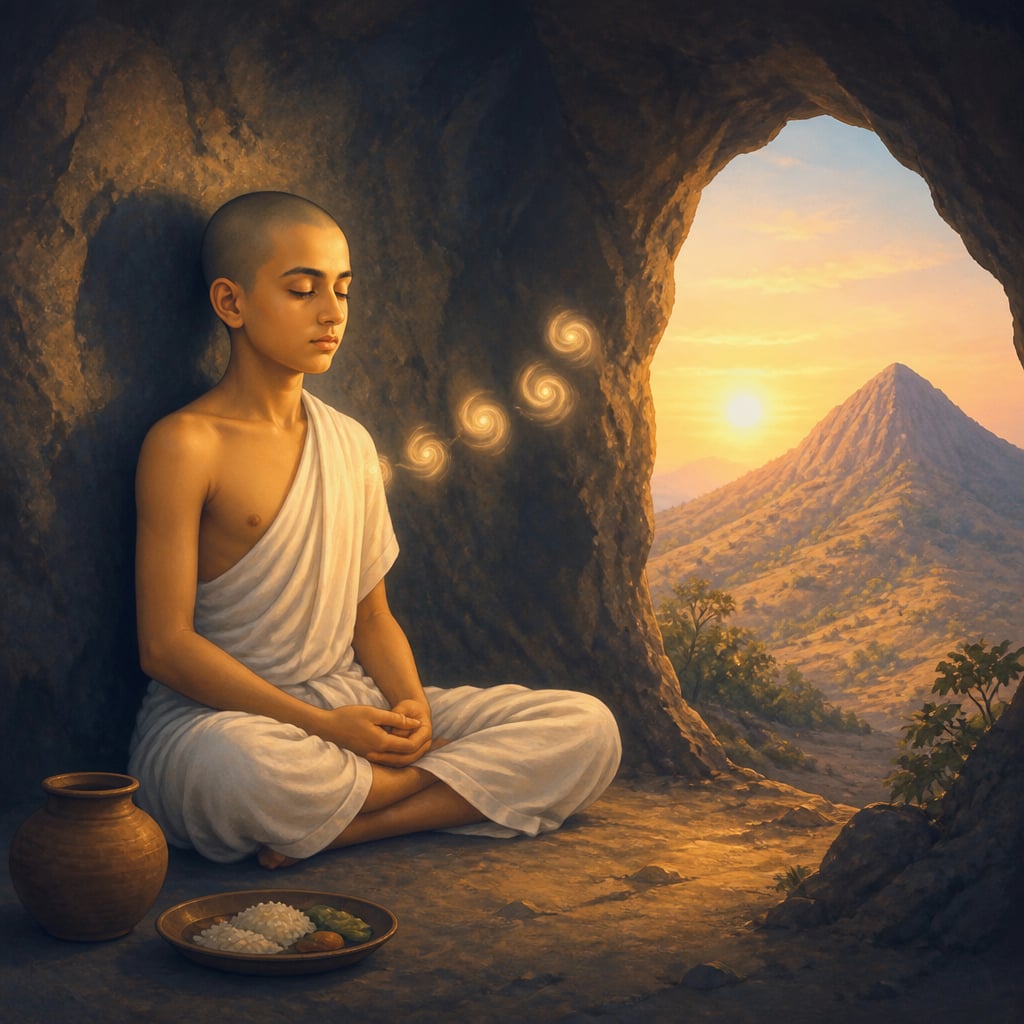
Young Ramana Maharshi meditating in a dim cave on Arunachala in 1896

A local devotee, Palaniswami, found him in the cave and tried to give him food. The boy did not speak. Palaniswami asked his name. The boy did not answer.

The boy in the cave was Venkataraman Iyer, who would in a few years be called Ramana Maharshi, and who would for the next fifty-four years sit on the slopes of Arunachala without leaving. The mantra he was repeating in those weeks of silence, the only sound he allowed past his lips, was five syllables long.

Na. Ma. Shi. Va. Ya.

Om Namah Shivaya.

For the rest of his life, Ramana would teach that this five-syllable mantra was the most direct sound in the Shaiva world. He would also say it was the most misunderstood. This lesson is about why a mantra of five small syllables is held by the Shiva Purana to hold the entire cosmos, and why a teenage boy in a cave on a hill could afford to repeat nothing else.

Five Syllables, Five Elements

The Shiva Purana teaches that Om Namah Shivaya is not just a prayer of submission. It is a map. The five syllables, Na, Ma, Shi, Va, Ya, correspond, in order, to the five elements of the dharmic cosmos.

Syllable Element Quality
Na Earth (pṛthvī) Solidity, support, the ground beneath
Ma Water (āpas) Flow, cohesion, the body's wetness
Shi Fire (tejas) Heat, transformation, the inner light
Va Air (vāyu) Motion, breath, the carrier of life
Ya Ether (ākāśa) Space, openness, the field that holds all four

The Shiva Purana does not present this as decoration. It presents it as instruction. To say the mantra correctly, the Shaiva tradition holds, is to walk in sound through the same five elements that build the visible world. The earth syllable settles at the base of the body. The water syllable rises through the belly. The fire syllable lights the heart and throat. The air syllable opens the breath. The ether syllable opens the space at the crown.

This is why the chapter on the Pancha Bhuta Lingas, the five-element temples we walked through in the previous lesson, is the natural ground for this mantra. Every syllable corresponds to a real temple. Na is Ekambareshwar at Kanchipuram. Ma is Thiruvanaikaval at Tiruchirappalli. Shi is Arunachala at Tiruvannamalai. Va is Sri Kalahasti. Ya is Chidambaram. The mantra is the South Indian pilgrimage compressed into five sounds.

Why Om Comes First

Readers of the mantra often ask why the chant begins with Om when the famous five syllables are Na, Ma, Shi, Va, Ya. The Shiva Purana is precise about this. Om is not part of the panchakshara, the five-syllable core. Om is the adhikara, the qualification, the seal that licenses the five.

Om is the pranava, the primordial sound that the Vedas treat as the source of all mantras. Adi Shankaracharya in his commentary on the Mandukya Upanishad treats Om as the sound that names consciousness itself, with its three matras (a, u, m) corresponding to waking, dream, and deep sleep, and the silence at its end corresponding to turiya, pure awareness. To prefix Om to the five syllables is to plant the mantra in pure awareness before walking it through the elements.

The full chant, Om Namah Shivaya, is therefore six syllables in two registers. The first is consciousness itself, undifferentiated. The next five are the differentiated cosmos walked back to consciousness. The mantra is the round trip.

What Namah Means, And What It Does Not

The Shaiva tradition is careful about the word namah. The popular translation is I bow, or salutation to. The Shiva Purana adds a precise grammatical note. Namah in Sanskrit takes the dative case. It means not mine. It is closer to not for me than to I bow to you. To say Namah Shivaya is, literally, not mine, for Shiva.

This is the reason the Shaiva tradition reads the mantra as a renunciation of ownership before it is a salutation. The five syllables that follow describe the cosmos. The word that precedes them surrenders the cosmos. The structure is not I praise the five elements. The structure is the five elements are not mine, they belong to Shiva.

Adi Shankaracharya, in his short hymn called the Nirvana Shatakam, took this same logic and wrote six verses each ending in Chidananda rupah Shivoham Shivoham, I am Shiva, I am Shiva. The Nirvana Shatakam is the secondary move that the panchakshara prepares the ground for. First not mine, for Shiva. Then, when the not-mine has done its work, I am Shiva. The Shaiva mantra-marga walks the first before it dares the second.

The Five Faces, The Five Seats

The Shiva Purana adds a third map onto the same five syllables. Each syllable corresponds to one of the five faces of Shiva, the Pancha Brahma, the five aspects through which Shiva creates, sustains, and reabsorbs the cosmos.

A Pancha Mukha Linga with five carved faces of Shiva

These five faces are the iconographic basis of every Lingodbhava column and every Pancha Mukha Linga found from the Pashupatinath temple in Kathmandu to the Shore Temple at Mahabalipuram. When a sthapati carves a five-faced linga, he is carving the panchakshara mantra in stone.

The Shaiva Siddhanta tradition takes this further into the human body. Each syllable, with its element and its face, also has a seat in the spine: Na at the muladhara at the base, Ma at the svadhishthana below the navel, Shi at the manipura at the solar plexus, Va at the anahata at the heart, Ya at the vishuddhi at the throat. The mantra walks the lower five chakras of classical yoga from earth to ether. The sixth and seventh chakras are the silence after the mantra ends.

How To Repeat It

The Shiva Purana describes the practice in three concentric circles. The outermost is vaikhari, audible repetition: the mantra spoken aloud, at normal speaking volume, with the ears hearing what the mouth says. The middle is madhyama, whispered repetition: the mantra moved by the lips and tongue but barely sounded, audible only to the practitioner. The innermost is manasika, mental repetition: the mantra repeated in thought alone, no movement of the lips, no breath, only the inner sound.

The tradition is precise that the practitioner walks from outer to inner over years, not minutes. Vaikhari for the first months of practice. Madhyama as the mantra begins to hold itself. Manasika when the mantra has become the inner climate, repeating itself without the practitioner's effort. The Shiva Purana calls this last stage ajapa, that which repeats without being repeated. The mantra has become the mind's natural breath.

A woman doing silent japa with a rudraksha mala at dawn

The count traditional to the panchakshara is one hundred and eight, ashtottara, on a rudraksha mala. One hundred and eight is the classical Shaiva number, the count of beads on the mala, the count of names in the Shiva Sahasranama divided into rounds, the count of Nataraja's poses. The Shaiva grihastha repeats the mantra one hundred and eight times each morning before work and one hundred and eight times each evening before sleep. The Shaiva sannyasi repeats it without count.

Modern Echoes

The Harvard cardiologist Herbert Benson, in his 1975 book The Relaxation Response, documented the measurable effects of repetitive mantra recitation on blood pressure, heart rate, and oxygen consumption. His protocol asked subjects to silently repeat any single short phrase of their own choosing for ten to twenty minutes a day. He found the same physiological signature he later traced through Catholic rosary prayer, Sufi dhikr, and Tibetan Buddhist mani recitation. The Shaiva panchakshara, repeated as the Shiva Purana describes, is one of the canonical practices in this family. Benson's data did not prove the dharmic claim that the mantra reorganises the elements. It did show that something measurable in the body changes when five syllables are repeated faithfully for several months.

The linguist Frits Staal at Berkeley spent his career arguing that Vedic and Shaiva mantras are best understood not as sentences with meaning but as sound-actions whose effect is structural, not semantic. His 1989 book Rules Without Meaning treats the panchakshara as a precise example. The mantra works, in Staal's reading, because the five syllables are an articulatory map of the mouth, moving from the dental Na to the labial Ma to the palatal Shi to the labial Va to the palatal Ya. To say the mantra correctly is to exercise the entire mouth. Staal argued that the Shaiva tradition had recognised this two thousand years before linguistic phonetics was a discipline.

In 2018, a research group at the National Institute of Mental Health and Neurosciences in Bengaluru published a paper in the journal Frontiers in Psychology showing that participants who repeated Om Namah Shivaya for twenty minutes a day across eight weeks showed measurable reductions in cortical thickness in regions associated with rumination and increases in regions associated with sustained attention. The study did not validate the metaphysics of the Shiva Purana. It did show, in scanner data, that a teenage boy in a cave on Arunachala had not been wasting his time.

Back To The Cave

Return to the cave on Arunachala. The boy is still there. Palaniswami has set down a small leaf-bowl of buttermilk near his feet. The boy will not look at it for hours. His lips, when they move, move on five syllables. The mantra has been walking through earth at the base of his spine, water at his belly, fire at his heart, air at his breath, and ether at his crown for so long that the elements no longer belong to him. They belong to Shiva. Eventually he will speak again. He will spend the rest of his life teaching what those five syllables, repeated in silence, finally cleared away.

The next lesson keeps the count of five but changes the form. The five syllables become five acts of a dance. We move from the cave on Arunachala to the Tillai forest in the south, where Shiva is still dancing the dance that holds the worlds together. The sound becomes movement. The mantra becomes Nataraja.

Historical context

Puranic compilation period (c. 8th to 12th century CE), with the panchakshara doctrine attested in earlier Vedic and Tamil Shaiva sources stretching back at least to the Rudradhyaya of the Yajur Veda (c. 1000 BCE) and the Tevaram hymns of the Nayanar saints (c. 6th to 9th century CE).

The first and second millennia CE were a period in which the Shaiva tradition developed one of the most sophisticated mantra-margas in any religious culture. Three streams converged: the Vedic Rudra-cult, with the Shri Rudram and the Rudradhyaya; the Tamil bhakti movement of the Nayanars, with the Tevaram and Tiruvachakam hymns making the panchakshara singable; and the Tantric Shaiva sampradayas of Kashmir and the south, with their dense decoding of mantra into yantra and chakra. The Shiva Purana stands at the meeting point of these three. The Vidyeshvara Samhita carries the Vedic register. The Kotirudra Samhita carries the bhakti register. The Vayaviya Samhita carries the Tantric register. By the 12th century, the panchakshara had become the single most-recited Shaiva mantra in the subcontinent, a status it has not lost. The Lingayat reformer Basavanna in 12th century Karnataka rebuilt his entire community discipline around the mantra. The Pashupata sadhus at Kathmandu took it as their initiatory seed-mantra. The dasanami sannyasis of Adi Shankara's mathas carry it as one of the maha-vakyas of their order.

Every Shaiva household, sannyasi, temple, and pilgrimage in the Indian subcontinent rests on these five syllables. Without the panchakshara, the Shaiva mantra-marga would not exist. The Pancha Bhuta Linga circuit, the rudraksha mala, the abhisheka liturgy, the Tevaram hymns, the Lingayat ishta-linga discipline, and the modern teachings of Ramana Maharshi and Sadhguru Jaggi Vasudev all assume the five syllables and their decoding.

Living traditions

The panchakshara is, by some recent counts, among the three most-recited mantras in the world, alongside Om Mani Padme Hum and the Christian Lord's Prayer. Ramana Maharshi's teaching of the mantra, transmitted through Arthur Osborne's Be As You Are (1971) and David Godman's edited talks, has reached an estimated forty million readers in over twenty languages. Eckhart Tolle in The Power of Now (1997) cited Ramana's panchakshara japa as the closest practical example of the inner stillness he was describing for a Western audience. The Beatles' George Harrison spent time at Sri Ramanasramam in 1967 and recorded his Shiva-influenced song 'Awaiting on You All' on the All Things Must Pass album in 1970. The Indian classical singer M S Subbulakshmi's 1969 recording of the Bhaja Govindam, with the panchakshara woven into its closing stanzas, has been streamed over a billion times across platforms. In contemporary practice, the Isha Foundation under Sadhguru Jaggi Vasudev runs a yearly Maha Shivaratri broadcast from Coimbatore that draws an estimated 800 million viewers across television and digital platforms, with Om Namah Shivaya as the central chant. The Sankat Mochan tradition continues to teach the mantra in daily kathas in Varanasi. The 2018 NIMHANS study and a follow-up 2022 study at AIIMS Delhi have added the only neurological evidence base any mantra in any tradition currently has. The five syllables, whose decoding the Shiva Purana fixed in the early second millennium, have not slowed down.

Reflection

More in Shiva Tattva: Core Philosophy

All lessons in Shiva Tattva: Core Philosophy · Shiva Purana course